Police and Crime Commissioners: From Bureaucratic to Democratic - - PDF document

police and crime commissioners from bureaucratic to
SMART_READER_LITE
LIVE PREVIEW

Police and Crime Commissioners: From Bureaucratic to Democratic - - PDF document

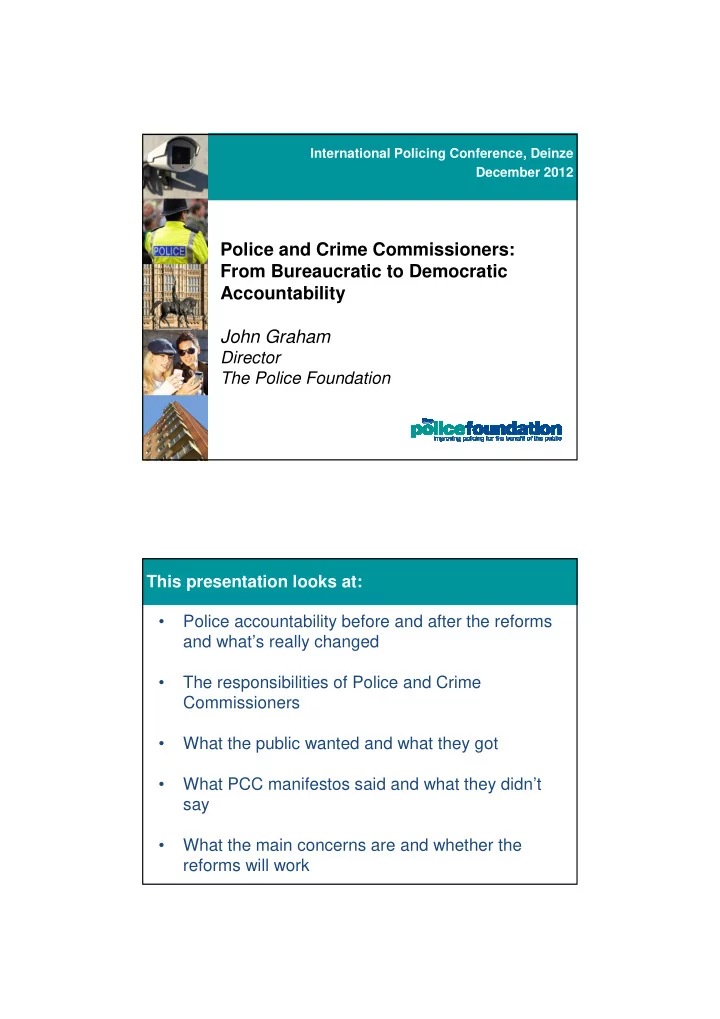
International Policing Conference, Deinze December 2012 Police and Crime Commissioners: From Bureaucratic to Democratic Accountability John Graham Director The Police Foundation This presentation looks at: Police accountability before


slide-1
SLIDE 1

International Policing Conference, Deinze December 2012

Police and Crime Commissioners: From Bureaucratic to Democratic Accountability John Graham

Director The Police Foundation This presentation looks at:

  • Police accountability before and after the reforms

and what’s really changed

  • The responsibilities of Police and Crime

Commissioners

  • What the public wanted and what they got
  • What PCC manifestos said and what they didn’t

say

  • What the main concerns are and whether the

reforms will work

slide-2
SLIDE 2

Situation prior to the reforms

  • Tripartite since Police Act 1964: HS, CC, LPA (17

members: 9 local councillors, 3 magistrates and 5 local appointees)

  • Early attempts to reform police accountability thwarted by

conservative politicians and the police

  • Inefficient police service, unaccountable to invisible LPAs

and resistant to reform, led to micro-management of policing from the centre

  • Failure of mergers and targets to address performance as

public expectations rise and public confidence falls

  • Identification of democratic deficit as the problem

Current system: from tripartite to quadripartite

  • Model of directly elected individual first suggested by two left
  • f centre sociologists in 1984
  • Picked up 20 years later by right of centre think tank and

appeared in Conservative manifesto in 2010

  • Heavily influenced by New York (Bratton/Guiliani)
  • Police and Social Responsibility Act 2011: Police and Crime

Commissioners; enacted November 2012

  • “The most significant democratic reform of policing in our

lifetime” (Home Secretary, 2012)

  • Quadripartite system: HS, CC, PCC and PCP
slide-3
SLIDE 3

So what’s really changed?

  • Shift of power from the centre to the local: HS no longer

has power to hire and fire CCs and has abolished national crime targets

  • Narrowing of police function (combat locally visible crime

more effectively)

  • Less “red tape”, fewer resources (20% cuts by 2015)
  • Greater transparency and information provision to the

public so they can hold police to account (crime maps)

  • London: responsibility for policing devolved to Mayor

What are PCCs meant to do?

  • “Cutting crime, no more no less” (Home Secretary, 2012)
  • Statutory responsibilities:
  • Deliver effective and efficient police service
  • Consult public and victims
  • Prepare Police and Crime Plan
  • Set the police budget and precept
  • Appoint/remove CC and hold him/her to account
  • Collaborate with other PCCs, forces and partners
  • Monitor complaints
  • Operational policing still the preserve of the CC
slide-4
SLIDE 4

What the public wanted…and what they got

  • 59% wanted a former police officer, but only 20%

(8) are former police officers

  • 26% wanted someone with military experience, but
  • nly 17% (7) are ex-military
  • 7% wanted a local politician, but 54% are either

current or former local politicians

  • 6% wanted a national politician, but 15% (6) are

former MPs

  • 12 Independents, 13 Labour, 16 Conservative

What PCC manifestos said…

  • Public engagement
  • Address needs of victims
  • Protecting the front line and visible policing

(including keeping police ‘on the beat’).

  • Improve efficiency, cut bureaucracy
  • Support neighbourhood policing, volunteering
  • Address ASB
slide-5
SLIDE 5

And what they didn’t say…

  • Draw on evidence not just public opinion
  • Allocate resources on basis of need not votes
  • Set targets based on outcomes (reduced

fear/victimisation) not inputs (more bobbies-on- the-beat)

  • Build strong, sustainable relationships with CCs,

local partners and ALL sectors of community

  • Promote police legitimacy

Some early signs… On their first day in office:

  • 1 CC resigned
  • 1 PCC scrapped business partnering
  • 1 PCC made a play for proceeds of crime
  • 1 PCC announced closure of PHQ
  • 1 PCC promised a “Special Constable” for every

town and city

  • 1 PCC set up Sentencing Unit (to campaign for

tougher sentences)

slide-6
SLIDE 6

Will it work?

  • Long overdue attempt to address democratic deficit and give

public greater ownership of police performance

  • Should focus on issues of most concern to some

communities (but not all)

  • Operational independence of CCs left intact, but could cause

problems in practice

  • Tensions with CC, partners and other PCCs
  • Will they be able to cut crime? matching services to needs

will be difficult politically

What are the main areas of concern?

  • No statutory duty to prevent crime or maintain order
  • Big experiment (never piloted) that could lead to populism (41 mini arms

races)

  • Less visible local crime will be under-resourced (e.g. OC, DV)
  • Remoteness across large geographic areas (GMP: 2.5m; Thames Valley:

18 local authorities; West Midlands: 28 MPs)

  • Management and outcome of election discredited whole exercise
  • No national postal mail-out (many people didn’t know about election
  • r who candidates were)
  • Poor timing (US election, “weather”)
  • 15% turnout (undermines democratic mandate and principle of

policing by consent)

slide-7
SLIDE 7

What the public thought of the election …

  • “As I can no longer trust even the most glowing paragraphs about any

candidate – quite apart from not having the faintest idea what qualities a PCC will really need – I will be taking the advice (from Sir Ian Blair, ex Commissioner of the MPS) not to vote. Believe me, this is not because I do not care.”

  • “I thought we were voting for an independent person who would do his or

her best to use their specialist knowledge to reduce crime in our area. However, it seems we are actually being asked to vote for a politician attached to a party. What has this to do with preventing crime?”

  • “The candidates have been announced. One runs her own marketing

company the other a community-based transport organisation. Why should I vote for either of them? And what chance will I get to meet either

  • f them at a public meeting before the election? This isn’t democracy, it’s

a shambles.”

Democracy in Britain

  • Long term decline as power of global corporations grows
  • Politicians less representative, citizens increasingly

disillusioned (not helped by MPs expenses’ scandal)

  • Democracy in Britain report: “when does low turnout

undermine notion of representative democracy?”

  • PCC elections: rejection of party politics, not really local, not

really representative

  • VERDICT: Brave attempt that may falter on waves of narrow

conceptualisation, professional resistance, political apathy and inept implementation...but maybe better in 4 years time?