Pointer Variables Chapter 4: (Pointers and) Linked Lists Declaring - - PowerPoint PPT Presentation

pointer variables
SMART_READER_LITE
LIVE PREVIEW

Pointer Variables Chapter 4: (Pointers and) Linked Lists Declaring - - PowerPoint PPT Presentation

Pointer Variables Chapter 4: (Pointers and) Linked Lists Declaring a variable creates space for it Pointer variables in a region of process memory called stack Operations on pointer variables each memory cell has an address


slide-1
SLIDE 1

Chapter 4: (Pointers and) Linked Lists

Pointer variables Operations on pointer variables Linked lists Operations on linked lists Variations on simple linked lists

doubly linked lists circular linked lists

EECS 268 Programming II 1

Pointer Variables

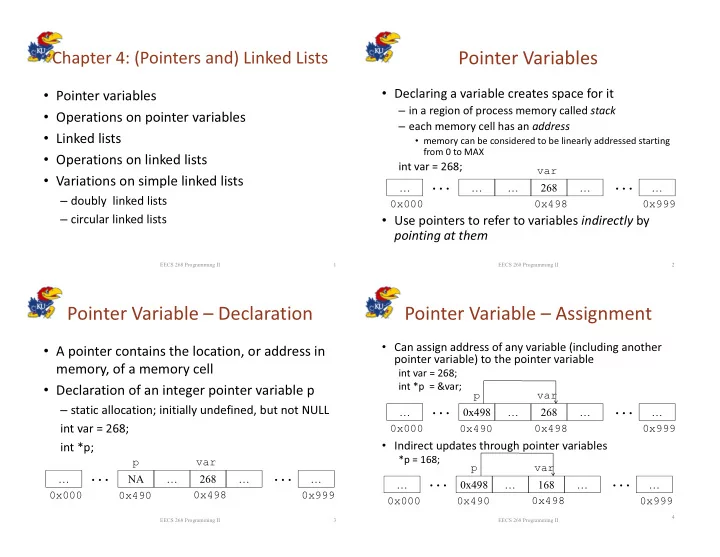
Declaring a variable creates space for it

in a region of process memory called stack each memory cell has an address

memory can be considered to be linearly addressed starting from 0 to MAX

int var = 268;

Use pointers to refer to variables indirectly by pointing at them

2

var 0x498 268

  • 0x000

0x999

EECS 268 Programming II

Pointer Variable Declaration

A pointer contains the location, or address in memory, of a memory cell Declaration of an integer pointer variable p

static allocation; initially undefined, but not NULL int var = 268; int *p;

3

0x498 268

  • NA
  • 0x000

0x999 var p 0x490

EECS 268 Programming II

Pointer Variable Assignment

Can assign address of any variable (including another pointer variable) to the pointer variable

int var = 268; int *p = &var;

Indirect updates through pointer variables

*p = 168;

4

0x498 268

  • 0x498
  • 0x000

0x999 var p 0x490 0x498 168

  • 0x498
  • 0x000

0x999 var p 0x490

EECS 268 Programming II

slide-2
SLIDE 2

Pointer Variable Assignment

& : address-of operator

expression *p represents the memory cell to which p points

Pointer variables are also variables!

need space in memory can have pointer variables pointing to other pointer variables int a, *p, **pp; p = &a; pp = &p;

5 EECS 268 Programming II

Pointer Variable Types

All pointer variables hold integer addresses, but have types

very important during pointer arithmetic int a, *ip = &a, **pp; char c, *cp = &c; ip ip cp cp pp = &a; // Is this valid ?

Multiple/divide with pointer variables generally is not meaningful

6

see C4-pointers.cpp

EECS 268 Programming II

New Operator

All declared variables, arrays are statically assigned space (on the stack) by the compiler Can also allocate space dynamically at runtime

use the new operator int *p = new int; double *dp = new double(4.5); my_class *instance = new my_class(); if the operator new cannot allocate memory, it throws the exception std::bad_alloc (in the <new> header)

very uncommon

7 EECS 268 Programming II

Delete Operator

Memory available to a program is limited

return dynamically allocated memory to the system if no longer needed use the delete operator int *p = new int(268); cout delete p;

8

see C4-funcarg.cpp

EECS 268 Programming II

slide-3
SLIDE 3

De-allocating Memory

delete leaves the variable contents undefined

a pointer to a deallocated memory (*p) cell is possible and dangerous deallocated memory can be reassigned after another call to new refers to undefined memory called the dangling pointer error p = NULL; // safeguard

9

see C4-dangling.cpp

EECS 268 Programming II

Memory Leak

A memory leak is another common problem when using pointers and dynamic memory

happens when allocated memory can no longer be reached so, cannot be de-allocated! wastes memory resources, eventually system will run

  • ut of memory

int i, *ip; ip = new int(268); ip = &i; // memory leak!

10 EECS 268 Programming II

Pointer Examples

11 EECS 268 Programming II

Pointers

12 EECS 268 Programming II

slide-4
SLIDE 4

Best Practices

Memory allocated using new should be deallocated using delete

destructor is a good place to deallocate memory implicitly called once object goes out of scope can also be called explicitly when object no longer needed

Do not call delete again to de-allocate same memory

usually happened unintentionally!

Do not call delete on a pointer

that is not initialized or is NULL, that is pointing to a variable not allocated using new

13 EECS 268 Programming II

Dynamic Allocation of Arrays

int arraySize = 50; double *anArray = new double[arraySize ]; delete[] to release array memory

delete[] anArray;

The size of a dynamically allocated array can be increased

double *oldArray = anArray; anArray = new double[2*arraySize];

14 EECS 268 Programming II

Arrays and Pointers

Pointer variable assigned to an array name can be used just like an array

int arr[100], *ip; ip = arr; for(i=0 ; i<100 ; i++) ip[i] = arr[i]+1; // ip and arr are aliased

ip[i], arr[i], *(ip+i) all point to the same location.

15 EECS 268 Programming II

Linked List?

Options for implementing an ADT List

Array has a fixed size

Data must be shifted during insertions and deletions

Linked list is able to grow in size as needed

Does not require the shifting of items during insertions and deletions

16 EECS 268 Programming II

slide-5
SLIDE 5

Linked List ?

17

Figure 4-1 (a) A linked list of integers; (b) insertion; (c) deletion

EECS 268 Programming II

Pointer-Based Linked Lists

A node in a linked list is usually a struct

struct Node { int item Node *next; }; // end Node

The head pointer points to the first node in a linked list

18

Figure 4-7 A head pointer to a list

EECS 268 Programming II

Pointer-Based Linked Lists

If head is NULL, the linked list is empty A node is dynamically allocated

Node *p; // pointer to node p = new Node; // allocate node

19 EECS 268 Programming II

Displaying the Contents of a Linked List

Reference a node member with the ->

  • perator

p->item

Visits each node in the linked list

pointer variable cur keeps track of current node

for (Node *cur = head; cur != NULL; cur = cur->next) cout << cur->item << endl;

20 EECS 268 Programming II

slide-6
SLIDE 6

Displaying the Contents of a Linked List

21

Figure 4-9 The effect of the assignment cur = cur->next

EECS 268 Programming II

Deleting a Specified Node from a Linked List

Deleting an interior node

prev->next = cur->next;

22

Figure 4-10 Deleting a node from a linked list

EECS 268 Programming II

Deleting the First Node from a Linked List

23

Figure 4-11 Deleting the first node

Deleting the first node

head = head->next;

EECS 268 Programming II

Inserting a Node into a Specified Position of a Linked List

  • To insert a node between two nodes

newPtr->next = cur; prev->next = newPtr;

24

Figure 4-12 Inserting a new node into a linked list

EECS 268 Programming II

slide-7
SLIDE 7

Inserting a Node at the Beginning of a Linked List

To insert a node at the beginning of a linked list

newPtr->next = head; head = newPtr;

25

Figure 4-13 Inserting at the beginning of a linked list

EECS 268 Programming II

Inserting a Node into a Specified Position of a Linked List

Finding the point of insertion or deletion for a sorted linked list of objects Node *prev, *cur; for (prev = NULL, cur = head;

(cur != NULL)&&(newValue > cur->item); prev = cur, cur = cur->next);

26 EECS 268 Programming II

A Pointer-Based Implementation of the ADT List

Public methods

isEmpty getLength insert remove retrieve

Private method

find

27

Private data members

head size

Local variables to methods

cur prev

see C4-ListP.cpp

EECS 268 Programming II

Constructors and Destructors

Default constructor initializes size and head A destructor is required for de-allocating dynamically allocated memory

else, we will have a memory leak!

List::~List() { while (!isEmpty()) remove(1); } // end destructor

28 EECS 268 Programming II

slide-8
SLIDE 8

Constructors and Destructors

Copy constructor creates a deep copy

copies size, head, and the linked list the copy of head points to the copied linked list

In contrast, a shallow copy

copies size and head the copy of head points to the original linked list

If you omit a copy constructor, the compiler generates one

but it is only sufficient for implementations that use statically allocated arrays

29 EECS 268 Programming II

Shallow Copy vs. Deep Copy

30

Figure 4-18 Copies of the linked list in Figure 4-17; (a) a shallow copy; (b) a deep copy

EECS 268 Programming II

Comparing Array-Based and Pointer- Based Implementations

Size

increasing the size of a resizable array can waste storage and time linked list grows and shrinks as necessary

Storage requirements

array-based implementation requires less memory than a pointer-based one for each item in the ADT

31 EECS 268 Programming II

Comparing Array-Based and Pointer- Based Implementations

Retrieval

the time to access the ith item

Array-based: Constant (independent of i) Pointer-based: Depends on i

Insertion and deletion

Array-based: Requires shifting of data Pointer-based: Requires a traversal

32 EECS 268 Programming II

slide-9
SLIDE 9

Passing a Linked List to a Method

pointer has access to the entire list Pass the head pointer to a method as a reference argument

Enables method to change value of the head pointer itself (value argument would not)

33

Figure 4-22 A head pointer as a value argument

EECS 268 Programming II

Processing Linked Lists Recursively

Recursive strategy to display a list

write the first item in the list write the rest of the list (a smaller problem)

Recursive strategies to display a list backward

write the list minus its first item backward write the first item in the list

Recursive view of a sorted linked list

The linked list to which head points is a sorted list if

head is NULL or head->next is NULL or head->item < head->next->item, and head->next points to a sorted linked list

34

see C4-ListP.cpp

EECS 268 Programming II

Objects as Linked List Data

Data in a node of a linked list can be an instance of a class

typedef ClassName ItemType; struct Node { ItemType item; Node *next; }; //end struct Node *head;

35 EECS 268 Programming II

Consts and References

Const

const int val = 100; const int *ptr = &val; const int * const ptr = &val; void List::method() const;

Reference variables

used for passing arguments to methods by reference changes made within the method reflected in caller

36

see C4-RefVar.cpp

EECS 268 Programming II

slide-10
SLIDE 10

Variations: Circular Linked Lists

Last node points to the first node Every node has a successor No node in a circular linked list contains NULL

37

Figure 4-25 A circular linked list

EECS 268 Programming II

Variations: Circular Linked Lists

Access to last node requires a traversal Make external pointer point to last instead of first node

to access both first and last nodes without a traversal

38

Figure 4-26 A circular linked list with an external pointer to the last node

EECS 268 Programming II

Variations: Dummy Head Nodes

Dummy head node

always present, even when the linked list is empty insertion and deletion algorithms initialize prev to point to the dummy head node, rather than to NULL

eliminates special case for head node

39

Figure 4-27 A dummy head node

EECS 268 Programming II

Variations: Doubly Linked Lists

Each node points to both its predecessor and its successor Circular doubly linked list with dummy head node

precede pointer of the dummy head node points to the last node next pointer of the last node points to the dummy head node

40 EECS 268 Programming II

slide-11
SLIDE 11

Variations: Doubly Linked Lists

To delete the node to which cur points

(cur->precede)->next = cur->next; (cur->next)->precede = cur->precede;

To insert a new node pointed to by newPtr before the node pointed to by cur

newPtr->next = cur; newPtr->precede = cur->precede; cur->precede = newPtr; newPtr->precede->next = newPtr;

41 EECS 268 Programming II

Variations: Doubly Linked Lists

42

Figure 4-29 (a) A circular doubly linked list with a dummy head node (b) An empty list with a dummy head node

EECS 268 Programming II

The C++ Standard Template Library

The STL contains class templates for some common ADTs, including the list class The STL provides support for predefined ADTs through three basic items

Containers

Objects that hold other objects

Algorithms

That act on containers

Iterators

Provide a way to cycle through the contents of a container

43 EECS 268 Programming II

Summary

The C++ new and delete operators enable memory to be dynamically allocated and recycled Vs A class that allocates memory dynamically needs an explicit copy constructor and destructor

compiler provides shallow copy constructor by default

In a doubly linked list, each node points to both its successor and predecessor

44 EECS 268 Programming II