Point o t of Care T T esti ting ng From om Su Sumer to Sta - - PowerPoint PPT Presentation

point o t of care t t esti ting ng from om su sumer to
SMART_READER_LITE
LIVE PREVIEW

Point o t of Care T T esti ting ng From om Su Sumer to Sta - - PowerPoint PPT Presentation

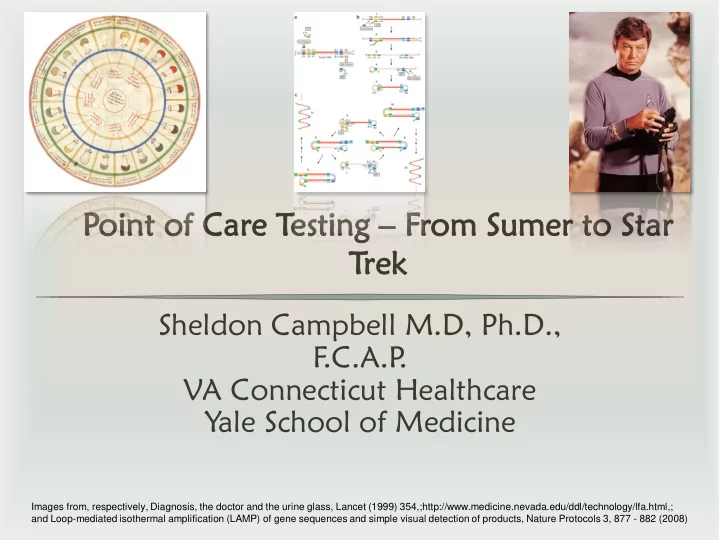
Point o t of Care T T esti ting ng From om Su Sumer to Sta to Star Tr Trek Sheldon Campbell M.D, Ph.D., F .C.A.P . VA Connecticut Healthcare Yale School of Medicine Images from, respectively, Diagnosis, the doctor and the urine


slide-1
SLIDE 1

Point o t of Care T T esti ting ng – From

  • m Su

Sumer to Sta to Star Tr Trek

Sheldon Campbell M.D, Ph.D., F .C.A.P . VA Connecticut Healthcare Yale School of Medicine

Images from, respectively, Diagnosis, the doctor and the urine glass, Lancet (1999) 354,;http://www.medicine.nevada.edu/ddl/technology/lfa.html,; and Loop-mediated isothermal amplification (LAMP) of gene sequences and simple visual detection of products, Nature Protocols 3, 877 - 882 (2008)

slide-2
SLIDE 2

A Diagnosis from Urine

From: The evolution of urine analysis; an historical sketch of the clinical examination of urine. Wellcome, Henry S. Sir, 1853-1936. London, Burroughs Wellcome [1911]

slide-3
SLIDE 3

Learning Objectives

  • Participants will be able to:

– Recognize the evolution of modern Good Laboratory Practices in the history of uroscopy. – Demonstrate the evolution of infectious- disease POCT from the first rapid Strep to current molecular flu tests. – Explain the characteristics of the ideal point-of- care infectious-disease test. – Explain how Campbell’s Laws will impact the implementation of emerging point-of-care platforms.

slide-4
SLIDE 4

Petru trus, hi his stu tuden ents a and an n attend ndant wit with a a flask

  • f u
  • f urine, c. 1

1500

From Fasciculus Medicinae, Venice,

  • C. Arrivabenus, 1522

Harvard Art Museums/Fogg Museum, Gray Collection of Engravings Fund, G5121.2

slide-5
SLIDE 5

Ancient POCT : Urine Examination (Uroscopy)

From: The evolution of urine analysis; an historical sketch of the clinical examination of urine. Wellcome, Henry S. Sir, 1853-1936. London, Burroughs Wellcome [1911]

slide-6
SLIDE 6

Uroscopy in the Ancient World

  • A Sumerian

Syllibarium (dictionary) c. 4000 BC lists body parts, and alludes to changes in color and constitution of urine

  • bserved by

physicians.

slide-7
SLIDE 7

Some Sanskrit diagnoses:

– Iksumeha, cane-sugar juice urine. – Ksuermeha, potash urine. – Sonitameha, urine containing blood. – Pistameha, floury-white urine.

  • When the patient passes this type of urine the hair on

the body becomes erect, and the urine looks as though mixed with flour. Urination is painful.

– Hastimeha, elephant urine.

  • “The patient continuously passes turbid urine like a mad

elephant.”

– Madhumeha, honey urine.

  • T

rains of long black ants are attracted by the urine.

slide-8
SLIDE 8

Hip ippocrates o

  • n Ur

n Urine ine Analys ysis is

Emphasized the importance of examining the urine with all five senses. Thank goodness for technology.

slide-9
SLIDE 9

Advances in Urine Analysis

  • Theophilus (610-641 AD)

employed heat to further the analysis of urine; arguably the first analytic technique in medicine.

  • Alsahavarius (c. 1085) noted the

effect of certain foods on the color of the urine, and cautioned physicians against being fooled by intentional ingestions.

  • Actuarius (d. 1283)

recommended the use of a graduated glass for measuring sediments.

slide-10
SLIDE 10

Spec Specimen en G Guidelines

Ismail of Jurjani (c. end of 11th century), a Persian physician Includes container specifications, time of collection, storage conditions, and patient instructions. Goes on to provide detailed recommendations for examination of urine.

slide-11
SLIDE 11

Comprehe prehensive Q QA for Uro roscopy

Gilles de Corbeil, early 12th Century Poem written in dactylic hexameter, which I dare anyone here to write a scientific publication in today.

slide-12
SLIDE 12

Fletcher, 1541

  • Advocated the use of the

mixed urine passed during the entire day rather than a single sample.

– “T ake the whole urine and not the part such as is made at one time, but mingle not the urines made at severall times, but keep them severall both for quantity, color, and contents”

  • Not quite a modern

timed collection, but trending that way.

slide-13
SLIDE 13

Robert ert Rec ecord rde, 1 1548 548 Provided another detailed set of procedures for urine examination, including: When to examine each aspect of the urine; color and consistency while still warm, sediments and contents after cooling. The exact nature of the viewing container (the urine-glass), and graduation of the container into segments, each used for a separate observation, e.g. the segment above the ring being used for the bubbles.

slide-14
SLIDE 14

Historical Attempts to Comply with CLIA

  • The urine-glass disc

was used as a colorimetric standard (the first

  • nes known date

from 1400 or before) in urine diagnosis.

published in 1506 by Ullrich Pinder, in his book Epiphanie Medicorum, from http://blogs.scientificamerican.com/oscillator/2012/10/18/the-urine-wheel/

slide-15
SLIDE 15

From http://www.theaquavitaproject.com /project.php#

A Modern T n Trans nslatio ion

slide-16
SLIDE 16

Paracels lsus ( (1493 493-1541 541) and A Analyt ytic ical Uro roscopy

slide-17
SLIDE 17

Va Van Hel elmo mont (1578 578- 1644 644): Measureme rement

Measured the comparative weight – what we’d identify as the specific gravity – of urine in various conditions.

slide-18
SLIDE 18

Further Advances

  • In 1620, De Peiresc described rhomboidal crystals

in urine; later shown to be uric acid.

  • Thomas Willis (1674) distilled urine and described

the components derived; also described the sweetness of urine in diabetes mellitus.

  • Lorenzo Bellini (1643-1704) evaporated urine and

concluded that urine was composed of ‘water, salt, and tasteless earth’.

  • Boerhave (1668-1738) directly measured specific

gravity; also discovered urea.

  • Urea more completely described in 1771 by Rouelle

the Younger.

slide-19
SLIDE 19

Matthew Dobson (1772) and Diabetes

  • Evaporated diabetic

urine to dryness; discovered that the residue was indistinguishable from common sugar by taste, smell, or chemical treatments.

slide-20
SLIDE 20

Further Analysis of Urine

  • T

ests for sugar, bile, and albumen were developed during the 1800s, and their use in diagnosis

  • f disease

developed.

  • Use of the

microscope in examination of urine sediment also developed in 1800s.

slide-21
SLIDE 21

Creatures in the Urine

slide-22
SLIDE 22

History of Uroscopy – Lessons

  • Like us, the ancient

uroscopists:

– Paid attention to pre- analytical, analytical, and post-analytical components of testing. – Attempted to standardize procedures and practices – Attempted to train, and assess and ensure competency – Attempted to improve the practice of their craft

What has been will be again, what has been done will be done again; there is nothing new under the sun. Ecclesiastes 1:9

slide-23
SLIDE 23

An Image of

  • f Uro

roscopy

17th Century print by Isaac Sarabat, from the NLM History of Medicine collection.

slide-24
SLIDE 24

The Mo he Modern rn Era ra o

  • f

POCT : T : Rapi pid Anti tigen T T es ests ts

  • In the infectious disease world, the

first antigen tests for POC use were rapid strep latex tests.

  • A major advance over existing

methods.

  • Required a simple extraction

followed by latex agglutination on a glass slide. Gerber, M. A., L. J. Spadaccini, L. L. Wright, and L. Deutsch. 1984. Latex agglutination tests for rapid identification of group A streptococci directly from throat

  • swabs. J. Pediatr. 105:702-705.
slide-25
SLIDE 25

Evolution of Rapid T ests

  • Methodology

– Flow-through cartridge EIA succeeded latex. – And was succeeded by lateral-flow tests.

  • Regulation: CLIA
  • Analytes (waived)

– Antibody T ests: Helicobacter pylori, Hepatitis C, HIV 1&2, EBV, Lyme, RSV – Antigen T ests: Adenovirus, Influenza A&B, RSV , group A Strep, Trichomonas.

slide-26
SLIDE 26

Limits of Antigen T esting

Convenience sample of recent literature; selected by Medline search + fit to single page

slide-27
SLIDE 27

1826 Image

  • Cred

redit: Wellcome Library, London

  • A physician

examining a urine specimen in which a faint figure of a baby is visible, a female patient is crying and being shouted at by her angry mother, indicating that she is pregnant.

  • Watercolour by

I.T ., 1826.

slide-28
SLIDE 28

Molecular T esting for Influenza

  • Real-time methods can provide result in ~1h or so.
  • Molecular methods as a class exceed culture in sensitivity

(probably due to viral loss in transport)

  • Detection properties do vary from system to system – do your

homework!

  • Moderately to very expensive equipment
  • Moderate to high complexity (no CLIA-waived tests yet).
  • Now clearly the ‘gold standard’
  • Information sources:
  • http://www.cdc.gov/flu/pdf/professionals/diagnosis/table1-

molecular-assays.pdf

  • CAP Website for some price information
  • Manufacturer’s web sites and PubMed for pictures, workflow and
  • ther information.
slide-29
SLIDE 29

FDA-approved Molecular Influenza T ests

  • Cepheid Xpert Flu Assay
  • eSensor Respiratory Viral Panel
  • FilmArray Respiratory Panel
  • Ibis PLEX-ID Flu (seems to be off the market)
  • Prodesse PROFLU and PROFAST
  • Quidel Molecular Influenza A+B Assay
  • Qiagen Artus Influenza A/B Rotor-gene RT
  • PCR kit
  • Simplexa Flu A/B & RSV and Flu A/B & RSV Direct and

Influenza A H1N1 (2009)

  • Verigene Respiratory Virus Nucleic Acid T

est and RV+ T est

  • X-

TAG Respiratory Viral Panel and RVP-FAST

  • Iquum LIAT Influenza A/B Assay
  • Alere i Influenza A/B

More on the way!!

slide-30
SLIDE 30

Cepheid Xpert Flu Assay

  • From Cepheid
  • Detects Flu A and B;

discriminates 2009 H1N1.

  • Approved for

nasopharyngeal swabs, nasal aspirates, and nasal washes.

  • Moderately complex
  • List price ~$50/cartridge,

instruments $24,900– $174,400 depending on capacity

  • Sample to answer ~1h
slide-31
SLIDE 31

Xpert Flu Workflow

slide-32
SLIDE 32

FilmArray Respiratory Panel

  • From: Biofire, in the process of being

acquired by BioMerieux

  • Detects: Influenza A and B

(discriminates H1, H3, 2009 H1) Respiratory Syncytial Virus, Parainfluenza 1, 2, 3 and 4 virus, Human Metapneumovirus, Rhinovirus/Enterovirus, Adenovirus, 4 Coronavirus variants, Bordetella pertussis, Mycoplasma pneumoniae, and Chlamydophila pneumoniae

  • Approved for NP swabs
  • Moderately complex
  • List price: $129/sample; instruments

$39,500 each

  • Sample to answer ~1h
slide-33
SLIDE 33

Filmarray Workflow

slide-34
SLIDE 34

Simplexa Flu A/B & RSV and Flu A/B & RSV Direct and Influenza A H1N1 (2009)

  • From Focus Diagnostics /

3M

  • Detects Influenza A&B

and RSV; a separate test discriminates 2009 H1N1

  • Approved for NP Swabs
  • Highly complex (Direct

version is Moderately complex)

  • List price: $49 reagents,

requires Focus/3M Cycler

  • Sample to answer ~4h,

~2h for Direct

slide-35
SLIDE 35

Verigene Respiratory Virus Nucleic Acid T est and RV+ T est

  • From Nanosphere
  • Detects Influenza A & B,

RSV A&B, Plus version discriminates H1, H3, and 2009 H1N1

  • Approved for NP

swabs

  • Moderately complex
  • List price $70 reagents,

instruments N/A

  • Sample to answer 3.5h
slide-36
SLIDE 36

Verigene RV / RV+ Workflow

slide-37
SLIDE 37

Alere I Influenza A and B

  • CLIA Waived; 15 min to result
slide-38
SLIDE 38

Alere I Workflow

  • Bring supplies to room temperature.
  • Put test base and sample receiver on

instrument; allow to warm.

  • Place swab in sample receiver, mix.
  • Apply transfer cartridge to sample receiver.
  • Move transfer cartridge to test base.
  • Close lid; test runs 10 minutes.
slide-39
SLIDE 39

Iquum LIAT Influenza A/B Assay

  • From Iquum (recently

acquired by Roche); LIAT stands for Lab-In-A- T ube

  • Detects Influenza A&B
  • Approved for NP swabs
  • Moderately complex;

platform is CLIA-waived for group A strep

  • List price N/A
  • Sample to answer .5h
slide-40
SLIDE 40

LIAT Workflow

slide-41
SLIDE 41

Not All Molecular T ests Are The Same

  • Numerous, rather

confusing studies; I picked one simple example.

  • Don’t take this as a

comprehensive assessment of both assays; neither performed as well as the authors’ homebrew RT

  • PCR.

Comparative Evaluation of the Nanosphere Verigene RV+ Assay and the Simplexa Flu A/B & RSV Kit for Detection of Influenza and Respiratory Syncytial Viruses; Kevin Alby, Elena B. Popowitch and Melissa B. Miller,

  • J. Clin. Microbiol. January 2013 vol. 51 no. 1 352-353
slide-42
SLIDE 42

Speed and Multiplexing and Complexity

1 2 3 4 5 6 7 8 9 10 2 4 6 8 # of targets Time to result (hr)

FilmArray eSensor RVP Prodesse Proflu Iquum LIAT Quidel Flu Simplexa Qiagen Artus XTAG RVP Xpert Flu Simplexa Direct Verigene XTAG RVP FAST Highly Complex Moderately Complex Alere i Waived

slide-43
SLIDE 43

Parsing Cost

  • Cost per test depends on reagent +

instrumentation + labor.

– How many single-test modules do you need?

  • Make sure to count in instrumentation for

extraction, if needed.

  • Reimbursement is a moving target; ask an

expert.

  • Potential for savings elsewhere in the

system, if your bean-counters are sophisticated.

slide-44
SLIDE 44

Cost of Waivers

  • 1,200 hours per waiver application
  • FDA expects each manufacturer will spend

2,800 hours creating and maintaining the record of the application

  • $350,000 = total operating and

maintenance cost associated with a waiver application (specimen collection, lab supplies, reference testing, shipping, instructional materials, study oversight)

Federal Register, vol. 78, April 19, 2013.

slide-45
SLIDE 45

Future Developments

  • T

echnological advances

  • performance
  • speed
  • footprint
  • Expanded test menus
  • quantitative assays
  • Resource limited settings
slide-46
SLIDE 46

What to think about as POCC

  • All the usual QC and QA, plus:
  • Interferences

– Extraction efficiency – Inhib hibitio ion by:

  • Blood
  • DNA

– Internal amplification / extraction controls

  • Contamination

– Extraordinarily sensitive methods – Speci cimen en cross-contamination

  • Native material transferred from a positive to a negative specimen
  • Collection devices
  • Ports, racks, hands

– Amplicon contamination

  • From amplified material
  • How well is the product contained?
  • Waste disposal

– Carry-over studies

slide-47
SLIDE 47

T enier’s Quack Doctor

slide-48
SLIDE 48

Where are we going?

  • I’ve thought about this a lot.
  • Derived Campbell’s Laws of POCT
  • T

wo Laws, with inpatient and outpatient corollaries

– Feedback encouraged.

slide-49
SLIDE 49

Campbell’s First Law of POCT

  • Nobody ever went into Nursing because

they wanted to do lab tests.

– I can’t document this with a literature citation, but it has high face-validity. – Anecdotally, our nurses/docs have hated glucose monitoring (still done but loathed), ER troponins (tried, failed), and rapid HIV (tried, failed).

slide-50
SLIDE 50

Campbell’s Second Law of POCT

  • No POC test is easier than checking one

more box on the laboratory order form.

– Waived tests are easy, but much, much harder than checking one more box on a form you already filled out. – A lot of simple, rapid tests end up being done in the lab.

slide-51
SLIDE 51

Campbell’s Laws Example: Primary Care HIV T esting

  • June 8

e 8, 2 2010: Provider A er A: “Sheldon, has rapid testing been considered to prevent this problem? Would this be feasible? Might allow us to expand testing to highest yield sites (i.e. the ER)…”

  • July

ly-Oc Octobe ber 2010: 10: Set up program, created templated progress notes,

  • rdered kits, trained 20+ Primary Care providers to do rapid HIV tests.
  • Octobe

ber 2 2010 10-Jan anuar ary 2011: 11: Number of rapid HIV tests performed: 1

  • Jan

anuary 2 2011 011: Provider B: B: “Even though I am one of the biggest proponents, I have only done one, and that was for another provider who didn’t know how to do it. I don’t see people clamoring to do the

  • test. I’m interested in Provider A’s thoughts.”
  • Res

espo ponse, Provi vide der A A: “We have had very little use in <our clinic>. I think that it’s so easy to send the pt for bloodwork that there is not much demand.”

  • Januar

ary 7, 2011 011, P POC OCC: “Next week I will be coming around to the Primary Care areas to collect the HIV kits. Please have them easily

  • accessible. Tha

hank y you a and ha have a a pl plea easant w week eeken end.”
slide-52
SLIDE 52

Campbell’s Laws: Inpatient Corollaries

  • An inpatient POC test is useful only if:

– The time for transport to the lab for THAT SINGLE ANALYTE significantly and negatively impacts care, OR – The test is performed on an easily-obtained sample (e.g. fingerstick blood) more frequently than routine blood draws are obtained.

slide-53
SLIDE 53

Campbell’s Laws: Outpatient Corollaries

  • An outpatient POC test is useful only if:

– The test result is available during the patient visit AND a decision can be made or action taken on the basis of it without waiting for

  • ther lab results, OR

– If you can make money doing it.

slide-54
SLIDE 54

Campbell’s Outreach / Developing- World Corollaries

  • Sometime’s there’s no lab-order form.
  • Sometimes there’s no nurse.
  • Sometimes there’s no refrigeration, power,
  • r lights.
  • Campbell’s Laws should not be applied
  • utside of a healthcare environment where

the basic terms apply.

slide-55
SLIDE 55

Recommendation

  • “Point-of-care testing, especially those analyses that are

conducted at the patient’s bedside, in a physician’s office,

  • r in a clinic, is a growing trend in health care, and clinical

microbiology professionals should prepare for this future

  • reality. Clinical microbiologists must ensure that the

individuals who perform point-of-care testing understand how to interpret the results. Clinical microbiologists should be called upon to help select the assay targets, advise on test formats, and participate in clinical trials.”

  • From “Clinical Microbiology in the 21st Century: Keeping

the Pace”. American Academy of Microbiology, 2008. Available on-line at: http://www.asm.org/academy/index.asp?bid=58445

slide-56
SLIDE 56

A Doctor Examining Urine, T rophime Bigot, 1679-1750

slide-57
SLIDE 57

The Future, Perhaps

slide-58
SLIDE 58
slide-59
SLIDE 59

$17.1 million Longitude prize for POCT for bacterial infections

slide-60
SLIDE 60

Acknowledgements

  • For information on uroscopy:

– Melissa Grafe, Ph.D. John R. Bumstead Librarian for Medical History Cushing/Whitney Medical Library, Yale University – The evolution of urine analysis; an historical sketch of the clinical examination of urine. Wellcome, Henry S. Sir, 1853-1936. London, Burroughs Wellcome [1911].

  • Of this 305-page monograph, only the first 92 pages

pertain to uroscopy; the rest consists of advertisements for Wellcome products.

  • FDA waiver requirements from a slide

provided by Dr. Barbara Robinson-Dunn.

slide-61
SLIDE 61