point for mild cognitive impairment and dementia Navas Nadukkandiyil - - PowerPoint PPT Presentation

point for mild cognitive impairment and dementia
SMART_READER_LITE
LIVE PREVIEW

point for mild cognitive impairment and dementia Navas Nadukkandiyil - - PowerPoint PPT Presentation

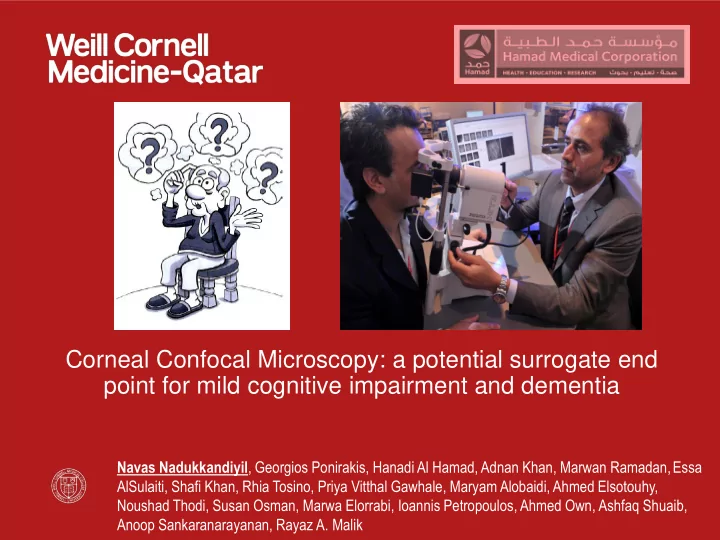
Corneal Confocal Microscopy: a potential surrogate end point for mild cognitive impairment and dementia Navas Nadukkandiyil , Georgios Ponirakis, Hanadi Al Hamad, Adnan Khan, Marwan Ramadan, Essa AlSulaiti, Shafi Khan, Rhia Tosino, Priya Vitthal


slide-1
SLIDE 1

Main Presentation Title Edit In Slide Master

Navas Nadukkandiyil, Georgios Ponirakis, Hanadi Al Hamad, Adnan Khan, Marwan Ramadan, Essa AlSulaiti, Shafi Khan, Rhia Tosino, Priya Vitthal Gawhale, Maryam Alobaidi, Ahmed Elsotouhy, Noushad Thodi, Susan Osman, Marwa Elorrabi, Ioannis Petropoulos, Ahmed Own, Ashfaq Shuaib, Anoop Sankaranarayanan, Rayaz A. Malik

Corneal Confocal Microscopy: a potential surrogate end point for mild cognitive impairment and dementia

slide-2
SLIDE 2

Main Presentation Title Edit In Slide Master

DISCLOSURE

  • ur elders our treasure

2

All individuals in a position to control content (Nurse Planer, content expert, presenters, faculty, authors, and content reviewers) disclosed no relevant relationships with any commercial organization to influence the content of this activity

slide-3
SLIDE 3

Main Presentation Title Edit In Slide Master

3

Background

  • 5-8 in 100 people aged ≥ 60 have dementia
  • Dementia is characterised by neuronal dysfunction/damage.
  • Current diagnostic tests performed by physicians are invasive,

expensive and largely based on memory.

  • Corneal confocal microscopy (CCM), a non-invasive ophthalmic

device can detect neuronal damage in peripheral (neuropathy) & central (PD, MS, ALS) neurodegenerative conditions.

Objectives

  • Evaluate the diagnostic ability of CCM for MCI and dementia
  • Determine the association between corneal axonal loss and

cognitive and physical impairment.

Design

  • Individuals with MCI and dementia recruited from the Memory clinic

and cognitively healthy controls recruited from the Geriatric clinic in Qatar between October 2016 and May 2017

Question

Is there a link between dementia and neurodegeneration in the cornea?

slide-4
SLIDE 4

Main Presentation Title Edit In Slide Master

4

Methods

79 patients with MCI (n=32), dementia (n=26) and age matched cognitively healthy controls (n=21) underwent clinical examination, neuropsychological testing, neuroimaging and CCM. MoCA assessment: visuospatial/executive, naming, attention, language, abstraction, delayed recall, and

  • rientation. Normal: ≥ 26-30.

Corneal confocal microscopy (CCM), a non- invasive ophthalmic imaging technique,

  • Validated for the diagnosis of neuropathy using

the Heidelberg HRT III (Heidelberg Engineering GmbH, Heidelberg, Germany).

  • Measure structural nerve loss and reinnervation

in vivo.

  • 5 images/subject within the central subbasal

nerve plexus of the cornea

  • Underwent quantification of corneal nerve fiber

density (CNFD), branch density (CNBD) and length (CNFL)

slide-5
SLIDE 5

Main Presentation Title Edit In Slide Master

5

Demographic and clinical characteristics

Controls (n= 21) MCI (n= 32) Dementia (n= 26) P value1 P value2 P value3 Demographics Age, mean (SD), years 68.57 (7.72) 69.47 (7.29) 72.96 (7.77) NS NS NS Gender (F, M) 13 8 16 16 15 11 NS NS NS Diabetes, % 71.43 59.38 48.00 NS NS NS Diabetes duration, mean (SD), years 11.53 (6.13) 13.47 (7.81) 14.42 (8.84) NS NS NS HbA1c, mean (SD), % 7.11 (1.30) 6.99 (1.70) 6.41 (1.15) NS NS NS

  • Chol. mean (SD), mmol/l

4.64 (1.09) 4.40 (0.95) 4.16 (1.01) NS NS NS

  • Trig. mean (SD), mmol/l

1.65 (0.91) 1.82 (1.38) 1.42 (0.69) NS NS NS* Hgb, mean (SD), gm/dL 13.69 (1.86) 12.68 (1.94) 12.98 (1.59) NS NS NS MCV, mean (SD), fL 84.71 (5.38) 83.69 (10.60) 86.74 (5.50) NS* NS NS* BP sys, mean (SD), mmHg 144.76 (11.75) 141.78 (15.62) 145.67 (25.03) NS NS* NS* BP dias, mean (SD), mmHg 76.10 (9.38) 74.88 (7.76) 66.35 (22.25) NS NS* .02* CNFL, mean (SD), mm/mm 25.67 (5.85) 19.61 (7.22) 15.65 (7.19) <.01 <.0001 .04

1 Controls vs MCI 2 Controls vs dementia 3 MCI vs dementia
slide-6
SLIDE 6

Main Presentation Title Edit In Slide Master

6

Corneal confocal microscopy (CCM)

Corneal sub-basal nerve plexus in: (A) A 70 year-old cognitively healthy control showing normal corneal axons; (B) A 69 year old patient with mild cognitive impairment (MCI) (C) A 69 year old patient with dementia showing a progressive reduction in corneal nerve fiber density, branch density and length.

slide-7
SLIDE 7

Main Presentation Title Edit In Slide Master

7

Fibre density Branch density Fibre length

slide-8
SLIDE 8

Main Presentation Title Edit In Slide Master

8

Demographic and clinical characteristics

Controls (n= 21) MCI (n= 32) Dementia (n= 26) P value1 P value2 P value3 Cognitive impairment MoCA, mean (SD) 26.19 (4.99) 21.03 (4.51) 13.71 (5.92) <.001 <.0001 <.0001 MoCA-memory, mean (SD) 10.29 (5.58) 7.78 (4.43) 6.00 (4.85) NS <.01 NS MoCA-executive function, mean (SD) 4.38 (1.16) 2.28 (1.46) 1.17 (1.90) <.0001 <.0001* .02 MoCA-attention, mean (SD) 5.48 (0.98) 4.56 (1.76) 2.08 (1.53) .05 <.0001* <.0001 MoCA-orientation, mean (SD) 5.86 (0.48) 5.34 (1.12) 3.04 (1.37) NS <.0001* <.0001 Severity of disability FIM, mean (SD) 120.08 (11.75) 116.71 (10.99) 94.27 (28.96) NS <.001* <.01* Corneal axonal morphology CNFD, mean (SD), No./mm2 32.59 (7.98) 24.61 (9.46) 19.34 (8.15) <.01 <.0001 .03 CNBD, mean (SD), No./mm2 114.87 (48.43) 78.91 (45.92) 53.92 (39.89) <.01 <.0001 .03 CNFL, mean (SD), mm/mm2 25.67 (5.85) 19.61 (7.22) 15.65 (7.19) <.01 <.0001 .04

1 Controls vs MCI 2 Controls vs dementia 3 MCI vs dementia

slide-9
SLIDE 9

Main Presentation Title Edit In Slide Master

9

Diagnostic ability of CCM

AUC 95% CI Threshold value Sensitivity (%) Specificity (%) Positive likelihood ratio Negative likelihood ratio Dementia CNFD 0.86 0.75 – 0.96 28 84.62 71.43 0.79 0.79 CNBD 0.85 0.70 – 0.95 64 73.08 90.48 0.90 0.73 CNFL 0.85 0.70 – 0.95 21 80.77 80.95 0.84 0.77 MCI CNFD 0.73 0.64 – 0.89 28 65.63 71.43 0.78 0.58 CNBD 0.72 0.61 – 0.88 100 81.25 57.14 0.74 0.67 CNFL 0.75 0.66 – 0.90 22 71.88 71.43 0.79 0.63

slide-10
SLIDE 10

Main Presentation Title Edit In Slide Master

10

Diagnostic ability of CCM

AUC 95% CI Threshold value Sensitivity (%) Specificity (%) Positive likelihood ratio Negative likelihood ratio Dementia CNFD 0.86 0.75 – 0.96 28 84.62 71.43 0.79 0.79 CNBD 0.85 0.70 – 0.95 64 73.08 90.48 0.90 0.73 CNFL 0.85 0.70 – 0.95 21 80.77 80.95 0.84 0.77 MCI CNFD 0.73 0.64 – 0.89 28 65.63 71.43 0.78 0.58 CNBD 0.72 0.61 – 0.88 100 81.25 57.14 0.74 0.67 CNFL 0.75 0.66 – 0.90 22 71.88 71.43 0.79 0.63

slide-11
SLIDE 11

Main Presentation Title Edit In Slide Master

11

Multiple linear regression analysis of corneal nerve morphology with cognitive and physical function

Coefficient 95% Confidence Interval P value R-square MoCA CNFD 0.26 0.10 - 0.42 <.01 24% CNBD 0.05 0.03 - 0.08 <.001 27% CNFL 0.37 0.18 - 0.57 <.001 28% MoCA-memory CNFD 0.03

  • 0.10 - 0.17

NS 1% CNBD 0.02

  • 0.01 - 0.04

NS 3% CNFL 0.07

  • 0.09 - 0.24

NS 2% MoCA-executive function CNFD 0.08 0.04 - 0.12 .0001 36% CNBD 0.02 0.01 - 0.02 <.0001 38% CNFL 0.12 0.07 - 0.17 <.0001 41% MoCA-attention CNFD 0.09 0.04 - 0.13 <.001 22% CNBD 0.01 0.01 - 0.02 <.01 19% CNFL 0.11 0.05 - 0.17 <.001 22% MoCA-orientation CNFD 0.05 0.02 - 0.09 <.01 28% CNBD 0.01 0.01 - 0.02 <.01 26% CNFL 0.07 0.03 - 0.11 <.01 28% FIM CNFD 0.89 0.34 - 1.45 <.01 36% CNBD 0.11 0.01 - 0.22 .03 29% CNFL 0.95 0.25 - 1.65 <.01 32%

slide-12
SLIDE 12

Main Presentation Title Edit In Slide Master

Conclusions

12

Findings: Corneal confocal microscopy (CCM) identifies nerve damage in the cornea and demonstrates good diagnostic accuracy for both mild cognitive impairment (MCI) and

  • dementia. Corneal nerve damage relates to cognitive decline and physical disability

Meaning: CCM may act as an objective, non-invasive imaging end point for neurodegeneration in patients with MCI and dementia.

slide-13
SLIDE 13

Main Presentation Title Edit In Slide Master

Thanks