
3/30/2018 1
Poetry
The Pumping Lemma
Any regular language L has a magic number p And any long-enough word in L has the following property: Amongst its first p symbols is a segment you can find Whose repetition or omission leaves x amongst its kind. So if you find a language L which fails this acid test, And some long word you pump becomes distinct from all the rest, By contradiction you have shown that language L is not A regular guy, resiliant to the damage you have wrought. But if, upon the other hand, x stays within its L, Then either L is regular, or else you chose not well. For w is xyz, and y cannot be null, And y must come before p symbols have been read in full. As mathematical postscript, an addendum to the wise: The basic proof we outlined here does certainly generalize. So there is a pumping lemma for all languages context-free, Although we do not have the same for those that are r.e.
- - Martin Cohn
Your questions?
L = {an: n is prime}
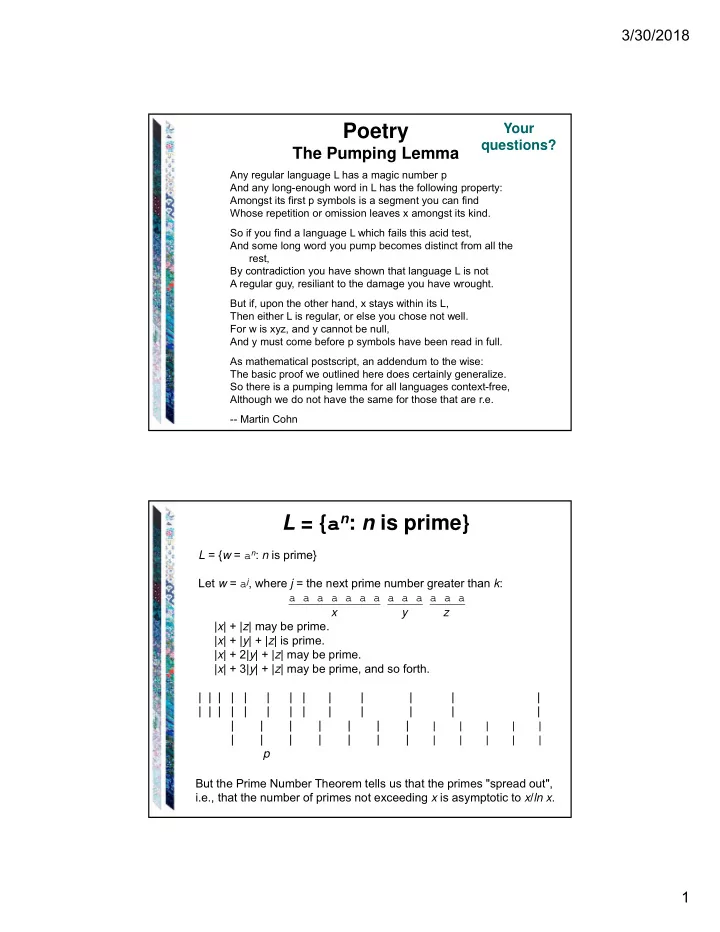
L = {w = an: n is prime} Let w = aj, where j = the next prime number greater than k: a a a a a a a a a a a a a x y z |x| + |z| may be prime. |x| + |y| + |z| is prime. |x| + 2|y| + |z| may be prime. |x| + 3|y| + |z| may be prime, and so forth. | | | | | | | | | | | | | | | | | | | | | | | | | | | | | | | | |
| | | | |
| | | | | | |
| | | | |
p But the Prime Number Theorem tells us that the primes "spread out", i.e., that the number of primes not exceeding x is asymptotic to x/ln x.