Compatible rewriting systems and completion for proving operator - - PowerPoint PPT Presentation

compatible rewriting systems and completion for proving
SMART_READER_LITE
LIVE PREVIEW

Compatible rewriting systems and completion for proving operator - - PowerPoint PPT Presentation

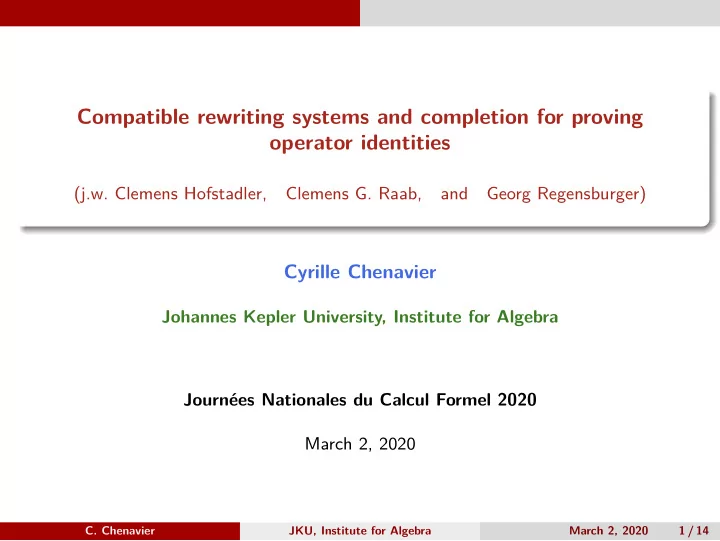
Compatible rewriting systems and completion for proving operator identities (j.w. Clemens Hofstadler, Clemens G. Raab, and Georg Regensburger) Cyrille Chenavier Johannes Kepler University, Institute for Algebra Journes Nationales du Calcul


slide-1
SLIDE 1

Compatible rewriting systems and completion for proving

  • perator identities

(j.w. Clemens Hofstadler, Clemens G. Raab, and Georg Regensburger)

Cyrille Chenavier

Johannes Kepler University, Institute for Algebra Journées Nationales du Calcul Formel 2020 March 2, 2020

  • C. Chenavier

JKU, Institute for Algebra March 2, 2020 1 / 14

slide-2
SLIDE 2

Formal proofs of operator identities Motivations

Operator identities and membership problems

Objective: formally prove operator identities (e.g., for computing solutions/integrability conditions of a functional system of equations, proving analytic formulas, . . .)

  • perators are terms constructed from basic symbols

"forgetting" the analytic meaning of operators Prove new identities check membership in suitable algebraic structures, e.g.,

  • linear P.D.E.’s with constant/polynomial coeff. polynomial/Weyl algebras
  • integro-diff. systems with smooth unknown functions tensor algebras
  • other systems with mixed operations Ore algbras/extensions, tensor rings

Check membership use rewriting theory

  • e.g., (adaptations of) Gröbner/Janet bases, tensor reduction systems, . . .
  • simplify a syntactic expression into an equivalent one, e.g.,

∂ ◦ = Id : A ◦ ∂ ◦

  • B

A ◦ B

  • C. Chenavier

JKU, Institute for Algebra March 2, 2020 2 / 14

slide-3
SLIDE 3

Formal proofs of operator identities Motivations

Operator identities and membership problems

Objective: formally prove operator identities (e.g., for computing solutions/integrability conditions of a functional system of equations, proving analytic formulas, . . .)

  • perators are terms constructed from basic symbols

"forgetting" the analytic meaning of operators Prove new identities check membership in suitable algebraic structures, e.g.,

  • linear P.D.E.’s with constant/polynomial coeff. polynomial/Weyl algebras
  • integro-diff. systems with smooth unknown functions tensor algebras
  • other systems with mixed operations Ore algbras/extensions, tensor rings

Check membership use rewriting theory

  • e.g., (adaptations of) Gröbner/Janet bases, tensor reduction systems, . . .
  • simplify a syntactic expression into an equivalent one, e.g.,

∂ ◦ = Id : A ◦ ∂ ◦

  • B

A ◦ B

  • C. Chenavier

JKU, Institute for Algebra March 2, 2020 2 / 14

slide-4
SLIDE 4

Formal proofs of operator identities Motivations

Operator identities and membership problems

Objective: formally prove operator identities (e.g., for computing solutions/integrability conditions of a functional system of equations, proving analytic formulas, . . .)

  • perators are terms constructed from basic symbols

"forgetting" the analytic meaning of operators Prove new identities check membership in suitable algebraic structures, e.g.,

  • linear P.D.E.

’s with constant/polynomial coeff. polynomial/Weyl algebras

  • integro-diff. systems with smooth unknown functions tensor algebras
  • other systems with mixed operations Ore algbras/extensions, tensor rings

Check membership use rewriting theory

  • e.g., (adaptations of) Gröbner/Janet bases, tensor reduction systems, . . .
  • simplify a syntactic expression into an equivalent one, e.g.,

∂ ◦ = Id : A ◦ ∂ ◦

  • B

A ◦ B

  • C. Chenavier

JKU, Institute for Algebra March 2, 2020 2 / 14

slide-5
SLIDE 5

Formal proofs of operator identities Motivations

Operator identities and membership problems

Objective: formally prove operator identities (e.g., for computing solutions/integrability conditions of a functional system of equations, proving analytic formulas, . . .)

  • perators are terms constructed from basic symbols

"forgetting" the analytic meaning of operators Prove new identities check membership in suitable algebraic structures, e.g.,

  • linear P.D.E.’s with constant/polynomial coeff. polynomial/Weyl algebras
  • integro-diff. systems with smooth unknown functions tensor algebras
  • other systems with mixed operations Ore algbras/extensions, tensor rings

Check membership use rewriting theory

  • e.g., (adaptations of) Gröbner/Janet bases, tensor reduction systems, . . .
  • simplify a syntactic expression into an equivalent one, e.g.,

∂ ◦ = Id : A ◦ ∂ ◦

  • B

A ◦ B

  • C. Chenavier

JKU, Institute for Algebra March 2, 2020 2 / 14

slide-6
SLIDE 6

Formal proofs of operator identities Motivations

Operator identities and membership problems

Objective: formally prove operator identities (e.g., for computing solutions/integrability conditions of a functional system of equations, proving analytic formulas, . . .)

  • perators are terms constructed from basic symbols

"forgetting" the analytic meaning of operators Prove new identities check membership in suitable algebraic structures, e.g.,

  • linear P.D.E.’s with constant/polynomial coeff. polynomial/Weyl algebras
  • integro-diff. systems with smooth unknown functions tensor algebras
  • other systems with mixed operations Ore algbras/extensions, tensor rings

Check membership use rewriting theory

  • e.g., (adaptations of) Gröbner/Janet bases, tensor reduction systems, . . .
  • simplify a syntactic expression into an equivalent one, e.g.,

∂ ◦ = Id : A ◦ ∂ ◦

  • B

A ◦ B

  • C. Chenavier

JKU, Institute for Algebra March 2, 2020 2 / 14

slide-7
SLIDE 7

Formal proofs of operator identities Motivations

Additionnal task

Symbolic computations may not take into account compatibility conditions ⊲ multiplication of coefficients is not defined everywhere, e.g., matrices ⊲ operators may have domains and codomains composition is not defined everywhere e.g., ∂ : Ck+1(I) → Ck(I),

  • : Ck(I) → Ck+1(I)

Solutions

In this talk, we present two solutions to take compatibility conditions into account 1st solution: compute and then check compatibility

  • check membership using rew.
  • check "validity" at the end of the calculus

2nd solution: restrict to compatible rew. steps

  • check membership using only "valid" rew. steps
  • C. Chenavier

JKU, Institute for Algebra March 2, 2020 3 / 14

slide-8
SLIDE 8

Formal proofs of operator identities Motivations

Additionnal task

Symbolic computations may not take into account compatibility conditions ⊲ multiplication of coefficients is not defined everywhere, e.g., matrices ⊲ operators may have domains and codomains composition is not defined everywhere e.g., ∂ : Ck+1(I) → Ck(I),

  • : Ck(I) → Ck+1(I)

Solutions

In this talk, we present two solutions to take compatibility conditions into account 1st solution: compute and then check compatibility

  • check membership using rew.
  • check "validity" at the end of the calculus

2nd solution: restrict to compatible rew. steps

  • check membership using only "valid" rew. steps
  • C. Chenavier

JKU, Institute for Algebra March 2, 2020 3 / 14

slide-9
SLIDE 9

Formal proofs of operator identities Motivations

Additionnal task

Symbolic computations may not take into account compatibility conditions ⊲ multiplication of coefficients is not defined everywhere, e.g., matrices ⊲ operators may have domains and codomains composition is not defined everywhere e.g., ∂ : Ck+1(I) → Ck(I),

  • : Ck(I) → Ck+1(I)

Solutions

In this talk, we present two solutions to take compatibility conditions into account 1st solution: compute and then check compatibility

  • check membership using rew.
  • check "validity" at the end of the calculus

2nd solution: restrict to compatible rew. steps

  • check membership using only "valid" rew. steps
  • C. Chenavier

JKU, Institute for Algebra March 2, 2020 3 / 14

slide-10
SLIDE 10

Formal proofs of operator identities Motivations

Additionnal task

Symbolic computations may not take into account compatibility conditions ⊲ multiplication of coefficients is not defined everywhere, e.g., matrices ⊲ operators may have domains and codomains composition is not defined everywhere e.g., ∂ : Ck+1(I) → Ck(I),

  • : Ck(I) → Ck+1(I)

Solutions

In this talk, we present two solutions to take compatibility conditions into account 1st solution: compute and then check compatibility

  • check membership using rew.
  • check "validity" at the end of the calculus

2nd solution: restrict to compatible rew. steps

  • check membership using only "valid" rew. steps
  • C. Chenavier

JKU, Institute for Algebra March 2, 2020 3 / 14

slide-11
SLIDE 11

Formal proofs of operator identities Motivations

Additionnal task

Symbolic computations may not take into account compatibility conditions ⊲ multiplication of coefficients is not defined everywhere, e.g., matrices ⊲ operators may have domains and codomains composition is not defined everywhere e.g., ∂ : Ck+1(I) → Ck(I),

  • : Ck(I) → Ck+1(I)

Solutions

In this talk, we present two solutions to take compatibility conditions into account 1st solution: compute and then check compatibility

  • check membership using rew.
  • check "validity" at the end of the calculus

2nd solution: restrict to compatible rew. steps

  • check membership using only "valid" rew. steps
  • C. Chenavier

JKU, Institute for Algebra March 2, 2020 3 / 14

slide-12
SLIDE 12

Compatible rew. systems for operator identities Formally prove operator identities

Formal proofs of operator identities in more details

Given: basic operators satisfying identities, e.g., ∂(f ) := f ′,

  • (f ) :=

x

x0

f (t)dt, Eval(f ) := f (x0) are s.t.

  • ∂ = Id − Eval,

∂ ◦ = Id i.e., ∀f :

x

x0 f ′(t)dt = f (x) − f (x0),

x

x0 f (t)dt

= f (x) Objective: prove new identities using symbolic methods, e.g., Eval ◦ = 0, i.e., ∀f :

x0

x0 f (t)dt = 0,

follows from

  • − Eval ◦

=

  • ∂ ◦

=

  • C. Chenavier

JKU, Institute for Algebra March 2, 2020 4 / 14

slide-13
SLIDE 13

Compatible rew. systems for operator identities Formally prove operator identities

Formal proofs of operator identities in more details

Given: basic operators satisfying identities, e.g., ∂(f ) := f ′,

  • (f ) :=

x

x0

f (t)dt, Eval(f ) := f (x0) are s.t.

  • ∂ = Id − Eval,

∂ ◦ = Id i.e., ∀f :

x

x0 f ′(t)dt = f (x) − f (x0),

x

x0 f (t)dt

= f (x) Objective: prove new identities using symbolic methods, e.g., Eval ◦ = 0, i.e., ∀f :

x0

x0 f (t)dt = 0,

follows from

  • − Eval ◦

=

  • ∂ ◦

=

  • C. Chenavier

JKU, Institute for Algebra March 2, 2020 4 / 14

slide-14
SLIDE 14

Compatible rew. systems for operator identities Formally prove operator identities

Formal proofs of operator identities in more details

Given: basic operators satisfying identities, e.g., ∂(f ) := f ′,

  • (f ) :=

x

x0

f (t)dt, Eval(f ) := f (x0) are s.t.

  • ∂ = Id − Eval,

∂ ◦ = Id i.e., ∀f :

x

x0 f ′(t)dt = f (x) − f (x0),

x

x0 f (t)dt

= f (x) Objective: prove new identities using symbolic methods, e.g., Eval ◦ = 0, i.e., ∀f :

x0

x0 f (t)dt = 0,

follows from

  • − Eval ◦

=

  • ∂ ◦

=

  • C. Chenavier

JKU, Institute for Algebra March 2, 2020 4 / 14

slide-15
SLIDE 15

Compatible rew. systems for operator identities Noncommutative polynomials and operators

Polynomial description of operators (constant coefficients)

Noncommutative polynomials: polynomial multiplication operator composition, e.g., id − 1 + e, di − 1 ∈ Rd, i, e Indeterminates and generators of the ideal: t

  • ∂ − Id + Eval = 0,

∂ ◦ − Id = 0 and ∂,

  • ,

Eval New identities: belong to the ideal spanned by assumptions, e.g., ei = (id − 1 + e)i − i(di − 1) Remark: membership is not enough if operators have distinct domains and codomains

  • abb−a− − 1 = a(bb− − 1)a− + (aa− − 1): no meaning when

A : U → U, B : V → V are invertible operators

  • for integro-differential operators:

∂ : Ck+1(I) → Ck(I),

  • : Ck(I) → Ck+1(I),

Eval : Ck+1(I) → Ck+1(I)

  • C. Chenavier

JKU, Institute for Algebra March 2, 2020 5 / 14

slide-16
SLIDE 16

Compatible rew. systems for operator identities Noncommutative polynomials and operators

Polynomial description of operators (constant coefficients)

Noncommutative polynomials: polynomial multiplication operator composition, e.g., id − 1 + e, di − 1 ∈ Rd, i, e Indeterminates and generators of the ideal: t

  • ∂ − Id + Eval = 0,

∂ ◦ − Id = 0 and ∂,

  • ,

Eval New identities: belong to the ideal spanned by assumptions, e.g., ei = (id − 1 + e)i − i(di − 1) Remark: membership is not enough if operators have distinct domains and codomains

  • abb−a− − 1 = a(bb− − 1)a− + (aa− − 1): no meaning when

A : U → U, B : V → V are invertible operators

  • for integro-differential operators:

∂ : Ck+1(I) → Ck(I),

  • : Ck(I) → Ck+1(I),

Eval : Ck+1(I) → Ck+1(I)

  • C. Chenavier

JKU, Institute for Algebra March 2, 2020 5 / 14

slide-17
SLIDE 17

Compatible rew. systems for operator identities Noncommutative polynomials and operators

Polynomial description of operators (constant coefficients)

Noncommutative polynomials: polynomial multiplication operator composition, e.g., id − 1 + e, di − 1 ∈ Rd, i, e Indeterminates and generators of the ideal: t

  • ∂ − Id + Eval = 0,

∂ ◦ − Id = 0 and ∂,

  • ,

Eval New identities: belong to the ideal spanned by assumptions, e.g., ei = (id − 1 + e)i − i(di − 1) Remark: membership is not enough if operators have distinct domains and codomains

  • abb−a− − 1 = a(bb− − 1)a− + (aa− − 1): no meaning when

A : U → U, B : V → V are invertible operators

  • for integro-differential operators:

∂ : Ck+1(I) → Ck(I),

  • : Ck(I) → Ck+1(I),

Eval : Ck+1(I) → Ck+1(I)

  • C. Chenavier

JKU, Institute for Algebra March 2, 2020 5 / 14

slide-18
SLIDE 18

Compatible rew. systems for operator identities Noncommutative polynomials and operators

Polynomial description of operators (constant coefficients)

Noncommutative polynomials: polynomial multiplication operator composition, e.g., id − 1 + e, di − 1 ∈ Rd, i, e Indeterminates and generators of the ideal: t

  • ∂ − Id + Eval = 0,

∂ ◦ − Id = 0 and ∂,

  • ,

Eval New identities: belong to the ideal spanned by assumptions, e.g., ei = (id − 1 + e)i − i(di − 1) Remark: membership is not enough if operators have distinct domains and codomains

  • abb−a− − 1 = a(bb− − 1)a− + (aa− − 1): no meaning when

A : U → U, B : V → V are invertible operators

  • for integro-differential operators:

∂ : Ck+1(I) → Ck(I),

  • : Ck(I) → Ck+1(I),

Eval : Ck+1(I) → Ck+1(I)

  • C. Chenavier

JKU, Institute for Algebra March 2, 2020 5 / 14

slide-19
SLIDE 19

Compatible rew. systems for operator identities Noncommutative polynomials and operators

Polynomial description of operators (constant coefficients)

Noncommutative polynomials: polynomial multiplication operator composition, e.g., id − 1 + e, di − 1 ∈ Rd, i, e Indeterminates and generators of the ideal: t

  • ∂ − Id + Eval = 0,

∂ ◦ − Id = 0 and ∂,

  • ,

Eval New identities: belong to the ideal spanned by assumptions, e.g., ei = (id − 1 + e)i − i(di − 1) Remark: membership is not enough if operators have distinct domains and codomains

  • abb−a− − 1 = a(bb− − 1)a− + (aa− − 1): no meaning when

A : U → U, B : V → V are invertible operators

  • for integro-differential operators:

∂ : Ck+1(I) → Ck(I),

  • : Ck(I) → Ck+1(I),

Eval : Ck+1(I) → Ck+1(I)

  • C. Chenavier

JKU, Institute for Algebra March 2, 2020 5 / 14

slide-20
SLIDE 20

Compatible rew. systems for operator identities Quiver representations

Quivers represented by operators

  • d

e i C k+1(I) C k(I)

∂ Eval

  • Labelled quivers directed graphs with edges labelled in an alphabet
  • formal link with operators through quiver representations (no injectivity requirement)
  • one letter may be used to label multiple edges (used to represent many identities)

Prove identities ideal membership with a compatible decomposition, e.g., ⊲ ei = (id − 1 + e)i − i(di − 1) = idi − i + ei − idi + i ⊲ ∃ parallel paths •

→ • labelled by each monomial Membership may be proved using rewriting 1st method for proving operator identities

Rewrite to zero and then check compatibility

  • C. Chenavier

JKU, Institute for Algebra March 2, 2020 6 / 14

slide-21
SLIDE 21

Compatible rew. systems for operator identities Quiver representations

Quivers represented by operators

  • d

e i Ck+1(I) Ck(I)

∂ Eval

  • Labelled quivers directed graphs with edges labelled in an alphabet
  • formal link with operators through quiver representations (no injectivity requirement)
  • one letter may be used to label multiple edges (used to represent many identities)

Prove identities ideal membership with a compatible decomposition, e.g., ⊲ ei = (id − 1 + e)i − i(di − 1) = idi − i + ei − idi + i ⊲ ∃ parallel paths •

→ • labelled by each monomial Membership may be proved using rewriting 1st method for proving operator identities

Rewrite to zero and then check compatibility

  • C. Chenavier

JKU, Institute for Algebra March 2, 2020 6 / 14

slide-22
SLIDE 22

Compatible rew. systems for operator identities Quiver representations

Quivers represented by operators

  • d

e i C∞(I) C∞(I)

∂ Eval

  • Labelled quivers directed graphs with edges labelled in an alphabet
  • formal link with operators through quiver representations (no injectivity requirement)
  • one letter may be used to label multiple edges (used to represent many identities)

Prove identities ideal membership with a compatible decomposition, e.g., ⊲ ei = (id − 1 + e)i − i(di − 1) = idi − i + ei − idi + i ⊲ ∃ parallel paths •

→ • labelled by each monomial Membership may be proved using rewriting 1st method for proving operator identities

Rewrite to zero and then check compatibility

  • C. Chenavier

JKU, Institute for Algebra March 2, 2020 6 / 14

slide-23
SLIDE 23

Compatible rew. systems for operator identities Quiver representations

Quivers represented by operators

  • d

e i Ck+1(I) Ck(I)

∂ Eval

  • Labelled quivers directed graphs with edges labelled in an alphabet
  • formal link with operators through quiver representations (no injectivity requirement)
  • one letter may be used to label multiple edges (used to represent many identities)

Prove identities ideal membership with a compatible decomposition, e.g., ⊲ ei = (id − 1 + e)i − i(di − 1) = idi − i + ei − idi + i ⊲ ∃ parallel paths •

→ • labelled by each monomial Membership may be proved using rewriting 1st method for proving operator identities

Rewrite to zero and then check compatibility

  • C. Chenavier

JKU, Institute for Algebra March 2, 2020 6 / 14

slide-24
SLIDE 24

Compatible rew. systems for operator identities Quiver representations

Quivers represented by operators

  • d

e i e i d Ck+1(I) Ck(I)

∂ Eval

  • Labelled quivers directed graphs with edges labelled in an alphabet
  • formal link with operators through quiver representations (no injectivity requirement)
  • one letter may be used to label multiple edges (used to represent many identities)

Prove identities ideal membership with a compatible decomposition, e.g., ⊲ ei = (id − 1 + e)i − i(di − 1) = idi − i + ei − idi + i ⊲ ∃ parallel paths •

→ • labelled by each monomial Membership may be proved using rewriting 1st method for proving operator identities

Rewrite to zero and then check compatibility

  • C. Chenavier

JKU, Institute for Algebra March 2, 2020 6 / 14

slide-25
SLIDE 25

Compatible rew. systems for operator identities Quiver representations

Quivers represented by operators

  • d

e i Ck+1(I) Ck(I)

∂ Eval

  • Labelled quivers directed graphs with edges labelled in an alphabet
  • formal link with operators through quiver representations (no injectivity requirement)
  • one letter may be used to label multiple edges (used to represent many identities)

Prove identities ideal membership with a compatible decomposition, e.g., ⊲ ei = (id − 1 + e)i − i(di − 1) = idi − i + ei − idi + i ⊲ ∃ parallel paths •

→ • labelled by each monomial Membership may be proved using rewriting 1st method for proving operator identities

Rewrite to zero and then check compatibility

  • C. Chenavier

JKU, Institute for Algebra March 2, 2020 6 / 14

slide-26
SLIDE 26

Compatible rew. systems for operator identities Quiver representations

Quivers represented by operators

  • d

e i Ck+1(I) Ck(I)

∂ Eval

  • Labelled quivers directed graphs with edges labelled in an alphabet
  • formal link with operators through quiver representations (no injectivity requirement)
  • one letter may be used to label multiple edges (used to represent many identities)

Prove identities ideal membership with a compatible decomposition, e.g., ⊲ ei = (id − 1 + e)i − i(di − 1) = idi − i + ei − idi + i ⊲ ∃ parallel paths •

→ • labelled by each monomial Membership may be proved using rewriting 1st method for proving operator identities

Rewrite to zero and then check compatibility

  • C. Chenavier

JKU, Institute for Algebra March 2, 2020 6 / 14

slide-27
SLIDE 27

Compatible rew. systems for operator identities Provide compatible decompositions

Illustrating example

Consider the inhomogeneous linear O.D.E. y′′(x) + A1(x)y′(x) + A0(x)y(x) = r(x) (1) Assumption: (1) can be factored into the 1st order equations y′(x) − B2(x)y(x) = z(x) and z′(x) − B1(x)z(x) = r(x) General solution given by y(x) = H2(x)

x

x2

H2(t)−1H1(t)

t

x1

H1(u)−1r(u) du dt (2) where Hi(x) is s.t. H′

i (x) − Bi(x)Hi(x) = 0 and Hi(x)−1 exists

Illustration of the rewriting/quiver approach: formally prove that (2) is a solution of (1)

  • C. Chenavier

JKU, Institute for Algebra March 2, 2020 7 / 14

slide-28
SLIDE 28

Compatible rew. systems for operator identities Provide compatible decompositions

Illustrating example

Consider the inhomogeneous linear O.D.E. y′′(x) + A1(x)y′(x) + A0(x)y(x) = r(x) (1) Assumption: (1) can be factored into the 1st order equations y′(x) − B2(x)y(x) = z(x) and z′(x) − B1(x)z(x) = r(x) General solution given by y(x) = H2(x)

x

x2

H2(t)−1H1(t)

t

x1

H1(u)−1r(u) du dt (2) where Hi(x) is s.t. H′

i (x) − Bi(x)Hi(x) = 0 and Hi(x)−1 exists

Illustration of the rewriting/quiver approach: formally prove that (2) is a solution of (1)

  • C. Chenavier

JKU, Institute for Algebra March 2, 2020 7 / 14

slide-29
SLIDE 29

Compatible rew. systems for operator identities Provide compatible decompositions

Illustrating example

Assumptions: prove that y(x) = H2(x)

x

x2

H2(t)−1H1(t)

t

x1

H1(u)−1r(u) du dt is solution of

  • (∂ − B1) ◦ (∂ − B2)

(y(x)) = r(x) where Hi is s.t. H′

i (x) − Bi(x)Hi(x) = 0 and Hi(x)−1 exists

Algebraic part: X := {h1, h2, b1, b2, ˜ h1, ˜ h2, i, d}, I := I(f1, . . . f5) ⊂ RX, where f1 := dh1 − h1d − b1h1, f2 := dh2 − h2d − b2h2, f3 := h1˜ h1 − 1, f4 := h2˜ h2 − 1, f5 := di − 1 Claim: f admits a compatible decomposition, where f := (d − b1)(d − b2)h2i˜ h2h1i˜ h1 − 1

  • C. Chenavier

JKU, Institute for Algebra March 2, 2020 8 / 14

slide-30
SLIDE 30

Compatible rew. systems for operator identities Provide compatible decompositions

First method

Represented quiver: we need 2nd order derivative/integration and regularity assumptions

  • Fact: F := {f1, . . . , f5}

⇒ f

→F 0 using an orientation of fi’s dh1 h1d + b1h1, dh2 h2d + b2h2, h1˜ h1 1, h2˜ h2 1, di 1 and keeping track of cofactors, we get f = f1i˜ h1 + (d − b1)f2i˜ h2h1i˜ h1 + f3 + (d − b1)f4h1i˜ h1 +(d − b1)h2f5˜ h2h1i˜ h1 + h1f5˜ h1 (3) By a case analysis: (3) is a compatible decomposition of f the claim is proven

  • C. Chenavier

JKU, Institute for Algebra March 2, 2020 9 / 14

slide-31
SLIDE 31

Compatible rew. systems for operator identities Provide compatible decompositions

First method

Represented quiver: we need 2nd order derivative/integration and regularity assumptions

  • d

d i i Fact: F := {f1, . . . , f5} ⇒ f

→F 0 using an orientation of fi’s dh1 h1d + b1h1, dh2 h2d + b2h2, h1˜ h1 1, h2˜ h2 1, di 1 and keeping track of cofactors, we get f = f1i˜ h1 + (d − b1)f2i˜ h2h1i˜ h1 + f3 + (d − b1)f4h1i˜ h1 +(d − b1)h2f5˜ h2h1i˜ h1 + h1f5˜ h1 (3) By a case analysis: (3) is a compatible decomposition of f the claim is proven

  • C. Chenavier

JKU, Institute for Algebra March 2, 2020 9 / 14

slide-32
SLIDE 32

Compatible rew. systems for operator identities Provide compatible decompositions

First method

Represented quiver: we need 2nd order derivative/integration and regularity assumptions

  • d

d i i b1 b2 h2 h1 ˜ h1 h2 ˜ h2 h1 Fact: F := {f1, . . . , f5} ⇒ f

→F 0 using an orientation of fi’s dh1 h1d + b1h1, dh2 h2d + b2h2, h1˜ h1 1, h2˜ h2 1, di 1 and keeping track of cofactors, we get f = f1i˜ h1 + (d − b1)f2i˜ h2h1i˜ h1 + f3 + (d − b1)f4h1i˜ h1 +(d − b1)h2f5˜ h2h1i˜ h1 + h1f5˜ h1 (3) By a case analysis: (3) is a compatible decomposition of f the claim is proven

  • C. Chenavier

JKU, Institute for Algebra March 2, 2020 9 / 14

slide-33
SLIDE 33

Compatible rew. systems for operator identities Provide compatible decompositions

First method

Represented quiver: we need 2nd order derivative/integration and regularity assumptions

  • d

d i i b1 b2 h2 h1 ˜ h1 h2 ˜ h2 h1 Fact: F := {f1, . . . , f5} ⇒ f

→F 0 using an orientation of fi’s dh1 h1d + b1h1, dh2 h2d + b2h2, h1˜ h1 1, h2˜ h2 1, di 1 and keeping track of cofactors, we get f = f1i˜ h1 + (d − b1)f2i˜ h2h1i˜ h1 + f3 + (d − b1)f4h1i˜ h1 +(d − b1)h2f5˜ h2h1i˜ h1 + h1f5˜ h1 (3) By a case analysis: (3) is a compatible decomposition of f the claim is proven

  • C. Chenavier

JKU, Institute for Algebra March 2, 2020 9 / 14

slide-34
SLIDE 34

Compatible rew. systems for operator identities Provide compatible decompositions

First method

Represented quiver: we need 2nd order derivative/integration and regularity assumptions

  • d

d i i b1 b2 h2 h1 ˜ h1 h2 ˜ h2 h1 Fact: F := {f1, . . . , f5} ⇒ f

→F 0 using an orientation of fi’s dh1 h1d + b1h1, dh2 h2d + b2h2, h1˜ h1 1, h2˜ h2 1, di 1 and keeping track of cofactors, we get f = f1i˜ h1 + (d − b1)f2i˜ h2h1i˜ h1 + f3 + (d − b1)f4h1i˜ h1 +(d − b1)h2f5˜ h2h1i˜ h1 + h1f5˜ h1 (3) By a case analysis: (3) is a compatible decomposition of f the claim is proven

  • C. Chenavier

JKU, Institute for Algebra March 2, 2020 9 / 14

slide-35
SLIDE 35

Compatible rew. systems for operator identities Provide compatible decompositions

First method

Represented quiver: we need 2nd order derivative/integration and regularity assumptions

  • d

d i i b1 b2 h2 h1 ˜ h1 h2 ˜ h2 h1 Fact: F := {f1, . . . , f5} ⇒ f

→F 0 using an orientation of fi’s dh1 h1d + b1h1, dh2 h2d + b2h2, h1˜ h1 1, h2˜ h2 1, di 1 and keeping track of cofactors, we get f = f1i˜ h1 + (d − b1)f2i˜ h2h1i˜ h1 + f3 + (d − b1)f4h1i˜ h1 +(d − b1)h2f5˜ h2h1i˜ h1 + h1f5˜ h1 (3) By a case analysis: (3) is a compatible decomposition of f the claim is proven

  • C. Chenavier

JKU, Institute for Algebra March 2, 2020 9 / 14

slide-36
SLIDE 36

Compatible rew. systems for operator identities Provide compatible decompositions: second method

Second method

Objective: restrict to rew. steps s.t.

We only use "valid" computations

Signatures: σ(dh2) = {•

→ •,

→ •}, σ(h2d) = {•

→ •}, σ(b2h2) = {•

→ •}

  • d

d b1 b2 i i h1 h1 h2 h2 ˜ h1 ˜ h2 Definition: a rew. rule m → g is Q-compatible if σ(m) ⊆ σ(g), e.g., ⊲ dh2 → h2d + b2h2 is not compatible the first method involved invalid computations ⊲ h2d → dh2 − b2h2 is compatible

  • C. Chenavier

JKU, Institute for Algebra March 2, 2020 10 / 14

slide-37
SLIDE 37

Compatible rew. systems for operator identities Provide compatible decompositions: second method

Second method

Objective: restrict to rew. steps s.t.

We only use "valid" computations

Signatures: σ(dh2) = {•

→ •,

→ •}, σ(h2d) = {•

→ •}, σ(b2h2) = {•

→ •}

  • d

d b1 b2 i i h1 h1 h2 h2 ˜ h1 ˜ h2 Definition: a rew. rule m → g is Q-compatible if σ(m) ⊆ σ(g), e.g., ⊲ dh2 → h2d + b2h2 is not compatible the first method involved invalid computations ⊲ h2d → dh2 − b2h2 is compatible

  • C. Chenavier

JKU, Institute for Algebra March 2, 2020 10 / 14

slide-38
SLIDE 38

Compatible rew. systems for operator identities Provide compatible decompositions: second method

Second method

Objective: restrict to rew. steps s.t.

We only use "valid" computations

Signatures: σ(dh2) = {•

→ •,

→ •}, σ(h2d) = {•

→ •}, σ(b2h2) = {•

→ •}

  • d

d b1 b2 i i h1 h1 h2 h2 ˜ h1 ˜ h2 Definition: a rew. rule m → g is Q-compatible if σ(m) ⊆ σ(g), e.g., ⊲ dh2 → h2d + b2h2 is not compatible the first method involved invalid computations ⊲ h2d → dh2 − b2h2 is compatible

  • C. Chenavier

JKU, Institute for Algebra March 2, 2020 10 / 14

slide-39
SLIDE 39

Compatible rew. systems for operator identities Provide compatible decompositions: second method

Second method

Objective: restrict to rew. steps s.t.

We only use "valid" computations

Signatures: σ(dh2) = {•

→ •,

→ •}, σ(h2d) = {•

→ •}, σ(b2h2) = {•

→ •}

  • d

d b1 b2 i i h1 h1 h2 h2 ˜ h1 ˜ h2 Definition: a rew. rule m → g is Q-compatible if σ(m) ⊆ σ(g), e.g., ⊲ dh2 → h2d + b2h2 is not compatible the first method involved invalid computations ⊲ h2d → dh2 − b2h2 is compatible

  • C. Chenavier

JKU, Institute for Algebra March 2, 2020 10 / 14

slide-40
SLIDE 40

Compatible rew. systems for operator identities Provide compatible decompositions: second method

Second method

Objective: restrict to rew. steps s.t.

We only use "valid" computations

Signatures: σ(dh2) = {•

→ •,

→ •}, σ(h2d) = {•

→ •}, σ(b2h2) = {•

→ •}

  • d

d b1 b2 i i h1 h1 h2 h2 ˜ h1 ˜ h2 Definition: a rew. rule m → g is Q-compatible if σ(m) ⊆ σ(g), e.g., ⊲ dh2 → h2d + b2h2 is not compatible the first method involved invalid computations ⊲ h2d → dh2 − b2h2 is compatible

  • C. Chenavier

JKU, Institute for Algebra March 2, 2020 10 / 14

slide-41
SLIDE 41

Compatible rew. systems for operator identities Provide compatible decompositions: second method

Second method

Objective: restrict to rew. steps s.t.

We only use "valid" computations

Signatures: σ(dh2) = {•

→ •,

→ •}, σ(h2d) = {•

→ •}, σ(b2h2) = {•

→ •}

  • d

d b1 b2 i i h1 h1 h2 h2 ˜ h1 ˜ h2 Definition: a rew. rule m → g is Q-compatible if σ(m) ⊆ σ(g), e.g., ⊲ dh2 → h2d + b2h2 is not compatible the first method involved invalid computations ⊲ h2d → dh2 − b2h2 is compatible

  • C. Chenavier

JKU, Institute for Algebra March 2, 2020 10 / 14

slide-42
SLIDE 42

Compatible rew. systems for operator identities Provide compatible decompositions: second method

Second method

Objective: restrict to rew. steps s.t.

We only use "valid" computations

Signatures: σ(dh2) = {•

→ •,

→ •}, σ(h2d) = {•

→ •}, σ(b2h2) = {•

→ •}

  • d

d b1 b2 i i h1 h1 h2 h2 ˜ h1 ˜ h2 Definition: a rew. rule m → g is Q-compatible if σ(m) ⊆ σ(g), e.g., ⊲ dh2 → h2d + b2h2 is not compatible the first method involved invalid computations ⊲ h2d → dh2 − b2h2 is compatible

  • C. Chenavier

JKU, Institute for Algebra March 2, 2020 10 / 14

slide-43
SLIDE 43

Compatible rew. systems for operator identities Provide compatible decompositions: second method

Theorem Let Q be a quiver labelled by X, let F ⊂ RX and let g ∈ RX. Assume that each rew. rule is Q-compatible and g

→F 0.

  • The obtained decomposition of g is compatible
  • For all representations of Q s.t. all elements of F are mapped to 0, g is also mapped

to 0 Remark

Using the Theorem:

  • representation(s) of the quiver map any polynomial to the operator(s) it represents
  • elements of F polynomial expressions of known operator identities
  • g polynomial expression of the identity we wish to prove
  • g

→F 0 with compatible rew. rules only the identity is proven

  • C. Chenavier

JKU, Institute for Algebra March 2, 2020 11 / 14

slide-44
SLIDE 44

Compatible rew. systems for operator identities Provide compatible decompositions: second method

Completion

Motivating example: consider as previously F := {f1, . . . , f5} and f

  • for the deglex order s.t. b1, h1 < d < b2 < h2, we get the compatible rew. rules

dh1 h1d + b1h1, h2d dh2 − b2h2, h1˜ h1 1, h2˜ h2 1, di 1

  • problem: f does not rewrite into 0
  • we need a compatible completion procedure

Adaptation of the Buchberger’s proc.: the compatible monomial h2di induces SP = dh2i − b2h2i − h2, LM(SP) = b2h2i ⊲ σ(b2h2i) = {•

→ •} ⊆ σ(dh2i) ∩ σ(h2)

  • we keep f6 := dh2i − b2h2i − h2
  • d

d b1 b2 i i h1 h1 h2 h2 ˜ h1 ˜ h2

  • C. Chenavier

JKU, Institute for Algebra March 2, 2020 12 / 14

slide-45
SLIDE 45

Compatible rew. systems for operator identities Provide compatible decompositions: second method

Completion

Motivating example: consider as previously F := {f1, . . . , f5} and f

  • for the deglex order s.t. b1, h1 < d < b2 < h2, we get the compatible rew. rules

dh1 h1d + b1h1, h2d dh2 − b2h2, h1˜ h1 1, h2˜ h2 1, di 1

  • problem: f does not rewrite into 0
  • we need a compatible completion procedure

Adaptation of the Buchberger’s proc.: the compatible monomial h2di induces SP = dh2i − b2h2i − h2, LM(SP) = b2h2i ⊲ σ(b2h2i) = {•

→ •} ⊆ σ(dh2i) ∩ σ(h2)

  • we keep f6 := dh2i − b2h2i − h2
  • d

d b1 b2 i i h1 h1 h2 h2 ˜ h1 ˜ h2

  • C. Chenavier

JKU, Institute for Algebra March 2, 2020 12 / 14

slide-46
SLIDE 46

Compatible rew. systems for operator identities Provide compatible decompositions: second method

Completion

Motivating example: consider as previously F := {f1, . . . , f5} and f

  • for the deglex order s.t. b1, h1 < d < b2 < h2, we get the compatible rew. rules

dh1 h1d + b1h1, h2d dh2 − b2h2, h1˜ h1 1, h2˜ h2 1, di 1

  • problem: f does not rewrite into 0
  • we need a compatible completion procedure

Adaptation of the Buchberger’s proc.: the compatible monomial h2di induces SP = dh2i − b2h2i − h2, LM(SP) = b2h2i ⊲ σ(b2h2i) = {•

→ •} ⊆ σ(dh2i) ∩ σ(h2)

  • we keep f6 := dh2i − b2h2i − h2
  • d

d b1 b2 i i h1 h1 h2 h2 ˜ h1 ˜ h2

  • C. Chenavier

JKU, Institute for Algebra March 2, 2020 12 / 14

slide-47
SLIDE 47

Compatible rew. systems for operator identities Provide compatible decompositions: second method

Completion

Motivating example: consider as previously F := {f1, . . . , f5} and f

  • for the deglex order s.t. b1, h1 < d < b2 < h2, we get the compatible rew. rules

dh1 h1d + b1h1, h2d dh2 − b2h2, h1˜ h1 1, h2˜ h2 1, di 1

  • problem: f does not rewrite into 0
  • we need a compatible completion procedure

Adaptation of the Buchberger’s proc.: the compatible monomial h2di induces SP = dh2i − b2h2i − h2, LM(SP) = b2h2i ⊲ σ(b2h2i) = {•

→ •} ⊆ σ(dh2i) ∩ σ(h2)

  • we keep f6 := dh2i − b2h2i − h2
  • d

d b1 b2 i i h1 h1 h2 h2 ˜ h1 ˜ h2

  • C. Chenavier

JKU, Institute for Algebra March 2, 2020 12 / 14

slide-48
SLIDE 48

Compatible rew. systems for operator identities Provide compatible decompositions: second method

Completion

Motivating example: consider as previously F := {f1, . . . , f5} and f

  • for the deglex order s.t. b1, h1 < d < b2 < h2, we get the compatible rew. rules

dh1 h1d + b1h1, h2d dh2 − b2h2, h1˜ h1 1, h2˜ h2 1, di 1

  • problem: f does not rewrite into 0
  • we need a compatible completion procedure

Adaptation of the Buchberger’s proc.: the compatible monomial h2di induces SP = dh2i − b2h2i − h2, LM(SP) = b2h2i ⊲ σ(b2h2i) = {•

→ •} ⊆ σ(dh2i) ∩ σ(h2)

  • we keep f6 := dh2i − b2h2i − h2
  • d

d b1 b2 i i h1 h1 h2 h2 ˜ h1 ˜ h2

  • C. Chenavier

JKU, Institute for Algebra March 2, 2020 12 / 14

slide-49
SLIDE 49

Compatible rew. systems for operator identities Provide compatible decompositions: second method

Completion

Motivating example: consider as previously F := {f1, . . . , f5} and f

  • for the deglex order s.t. b1, h1 < d < b2 < h2, we get the compatible rew. rules

dh1 h1d + b1h1, h2d dh2 − b2h2, h1˜ h1 1, h2˜ h2 1, di 1

  • problem: f does not rewrite into 0
  • we need a compatible completion procedure

Adaptation of the Buchberger’s proc.: the compatible monomial h2di induces SP = dh2i − b2h2i − h2, LM(SP) = b2h2i ⊲ σ(b2h2i) = {•

→ •} ⊆ σ(dh2i) ∩ σ(h2)

  • we keep f6 := dh2i − b2h2i − h2
  • d

d b1 b2 i i h1 h1 h2 h2 ˜ h1 ˜ h2

  • C. Chenavier

JKU, Institute for Algebra March 2, 2020 12 / 14

slide-50
SLIDE 50

Compatible rew. systems for operator identities Provide compatible decompositions: second method

Completion

Motivating example: consider as previously F := {f1, . . . , f5} and f

  • for the deglex order s.t. b1, h1 < d < b2 < h2, we get the compatible rew. rules

dh1 h1d + b1h1, h2d dh2 − b2h2, h1˜ h1 1, h2˜ h2 1, di 1

  • problem: f does not rewrite into 0
  • we need a compatible completion procedure

Adaptation of the Buchberger’s proc.: the compatible monomial h2di induces SP = dh2i − b2h2i − h2, LM(SP) = b2h2i ⊲ σ(b2h2i) = {•

→ •} ⊆ σ(dh2i) ∩ σ(h2)

  • we keep f6 := dh2i − b2h2i − h2
  • d

d b1 b2 i i h1 h1 h2 h2 ˜ h1 ˜ h2

  • C. Chenavier

JKU, Institute for Algebra March 2, 2020 12 / 14

slide-51
SLIDE 51

Compatible rew. systems for operator identities Provide compatible decompositions: second method

Completion

Motivating example: consider as previously F := {f1, . . . , f5} and f

  • for the deglex order s.t. b1, h1 < d < b2 < h2, we get the compatible rew. rules

dh1 h1d + b1h1, h2d dh2 − b2h2, h1˜ h1 1, h2˜ h2 1, di 1

  • problem: f does not rewrite into 0
  • we need a compatible completion procedure

Adaptation of the Buchberger’s proc.: the compatible monomial h2di induces SP = dh2i − b2h2i − h2, LM(SP) = b2h2i ⊲ σ(b2h2i) = {•

→ •} ⊆ σ(dh2i) ∩ σ(h2)

  • we keep f6 := dh2i − b2h2i − h2
  • d

d b1 b2 i i h1 h1 h2 h2 ˜ h1 ˜ h2

  • C. Chenavier

JKU, Institute for Algebra March 2, 2020 12 / 14

slide-52
SLIDE 52

Compatible rew. systems for operator identities Provide compatible decompositions: second method

Many proofs at once

Using completion: letting G := F ∪ {f6}, we have f

→G 0 From the compatibility theorem: for all representations ϕ of Q ∀g ∈ G : ϕ(g) = 0 ⇒ ϕ(f ) = 0 Consequences: let us consider the linear O.D.E. y′′(x) + A1(x)y′(x) + A0(x)y(x) = r(x) (4) where

  • A0, A1 are functions of class Ck
  • r is a function of class Ck

If (4) may be factored into 1st order O.D.E.’s with homogeneous invertible sol. Hi, y(x) = H2(x)

x

x2

H2(t)−1H1(t)

t

x1

H1(u)−1r(u) du dt is a function of classe Ck+2 solution of (4)

  • C. Chenavier

JKU, Institute for Algebra March 2, 2020 13 / 14

slide-53
SLIDE 53

Compatible rew. systems for operator identities Provide compatible decompositions: second method

Many proofs at once

Using completion: letting G := F ∪ {f6}, we have f

→G 0 From the compatibility theorem: for all representations ϕ of Q ∀g ∈ G : ϕ(g) = 0 ⇒ ϕ(f ) = 0 Consequences: let us consider the linear O.D.E. y′′(x) + A1(x)y′(x) + A0(x)y(x) = r(x) (4) where

  • A0, A1 are functions of class Ck
  • r is a function of class Ck

If (4) may be factored into 1st order O.D.E.’s with homogeneous invertible sol. Hi, y(x) = H2(x)

x

x2

H2(t)−1H1(t)

t

x1

H1(u)−1r(u) du dt is a function of classe Ck+2 solution of (4)

  • C. Chenavier

JKU, Institute for Algebra March 2, 2020 13 / 14

slide-54
SLIDE 54

Compatible rew. systems for operator identities Provide compatible decompositions: second method

Many proofs at once

Using completion: letting G := F ∪ {f6}, we have f

→G 0 From the compatibility theorem: for all representations ϕ of Q ∀g ∈ G : ϕ(g) = 0 ⇒ ϕ(f ) = 0 Consequences: let us consider the linear O.D.E. y′′(x) + A1(x)y′(x) + A0(x)y(x) = r(x) (4) where

  • A0, A1 are analytic functions
  • r is an analytic function

If (4) may be factored into 1st order O.D.E.’s with homogeneous invertible sol. Hi, y(x) = H2(x)

x

x2

H2(t)−1H1(t)

t

x1

H1(u)−1r(u) du dt is an analytic function solution of (4)

  • C. Chenavier

JKU, Institute for Algebra March 2, 2020 13 / 14

slide-55
SLIDE 55

Compatible rew. systems for operator identities Provide compatible decompositions: second method

Many proofs at once

Using completion: letting G := F ∪ {f6}, we have f

→G 0 From the compatibility theorem: for all representations ϕ of Q ∀g ∈ G : ϕ(g) = 0 ⇒ ϕ(f ) = 0 Consequences: let us consider the linear O.D.E. y′′(x) + A1(x)y′(x) + A0(x)y(x) = r(x) (4) where

  • A0, A1 are n × n matrices of functions of class Ck
  • r is a vector of n functions of class Ck

If (4) may be factored into 1st order O.D.E.’s with homogeneous invertible sol. Hi, y(x) = H2(x)

x

x2

H2(t)−1H1(t)

t

x1

H1(u)−1r(u) du dt is a vector of n functions of class Ck+2 solution of (4)

  • C. Chenavier

JKU, Institute for Algebra March 2, 2020 13 / 14

slide-56
SLIDE 56

Compatible rew. systems for operator identities Provide compatible decompositions: second method

Many proofs at once

Using completion: letting G := F ∪ {f6}, we have f

→G 0 From the compatibility theorem: for all representations ϕ of Q ∀g ∈ G : ϕ(g) = 0 ⇒ ϕ(f ) = 0 Consequences: let us consider the linear O.D.E. y′′(x) + A1(x)y′(x) + A0(x)y(x) = r(x) (4) where

  • A0, A1 are · · ·
  • r is a · · ·

If (4) may be factored into 1st order O.D.E.’s with homogeneous invertible sol. Hi, y(x) = H2(x)

x

x2

H2(t)−1H1(t)

t

x1

H1(u)−1r(u) du dt is a · · · solution of (4)

  • C. Chenavier

JKU, Institute for Algebra March 2, 2020 13 / 14

slide-57
SLIDE 57

Compatible rew. systems for operator identities Conclusion

Summary

Compatible rewriting rew. rules respects parallel paths of a labelled quiver

  • used to prove operator identities without checking each computational step
  • existence of a (partial) completion procedure
  • implementation Mathematica package OperatorGB

References: t

  • arXiv ref: arXiv:2002.03626
  • package link: http://gregensburger.com/softw/OperatorGB/

THANK YOU FOR YOUR ATTENTION!

  • C. Chenavier

JKU, Institute for Algebra March 2, 2020 14 / 14

slide-58
SLIDE 58

Compatible rew. systems for operator identities Conclusion

Summary

Compatible rewriting rew. rules respects parallel paths of a labelled quiver

  • used to prove operator identities without checking each computational step
  • existence of a (partial) completion procedure
  • implementation Mathematica package OperatorGB

References: t

  • arXiv ref: arXiv:2002.03626
  • package link: http://gregensburger.com/softw/OperatorGB/

THANK YOU FOR YOUR ATTENTION!

  • C. Chenavier

JKU, Institute for Algebra March 2, 2020 14 / 14