Planning practice and the purpose of the enforcement system - - PDF document

planning practice and the purpose of the enforcement
SMART_READER_LITE
LIVE PREVIEW

Planning practice and the purpose of the enforcement system - - PDF document

30/06/2016 Progress in planning: regression in enforcement? Stephen Mc Kay Director of Planning Education School of Planning, Architecture and Civil Engineering Queen's University, Belfast Planning practice and the purpose of the


slide-1
SLIDE 1

30/06/2016 1 Progress in planning: regression in enforcement?

Stephen Mc Kay Director of Planning Education School of Planning, Architecture and Civil Engineering Queen's University, Belfast

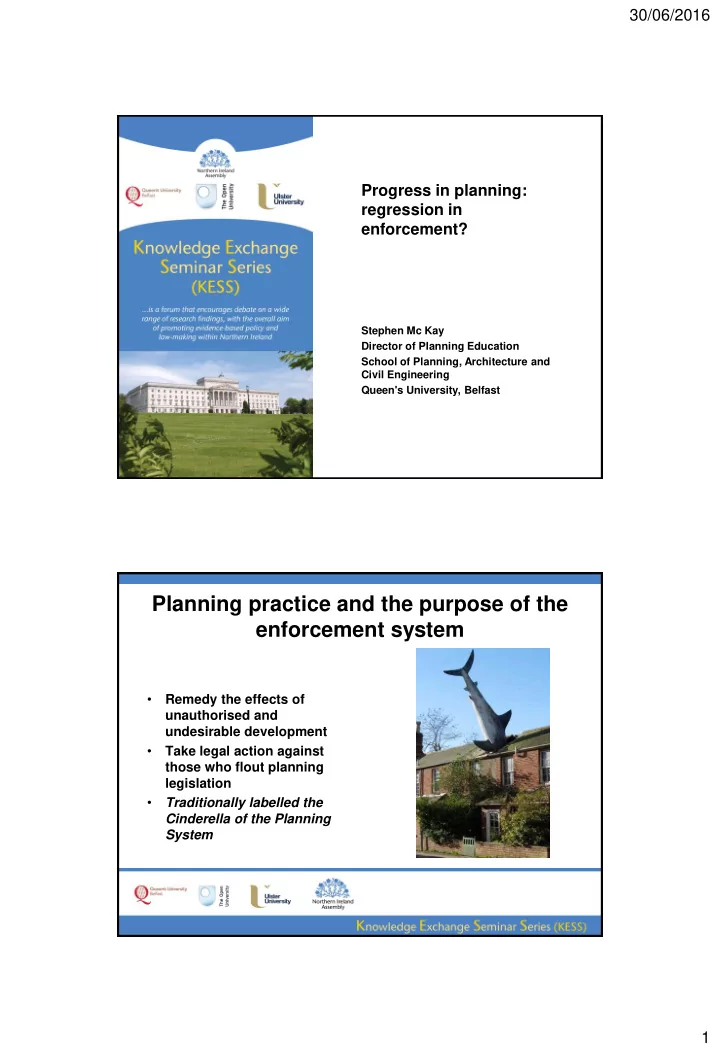
Planning practice and the purpose of the enforcement system

  • Remedy the effects of

unauthorised and undesirable development

  • Take legal action against

those who flout planning legislation

  • Traditionally labelled the

Cinderella of the Planning System

slide-2
SLIDE 2

30/06/2016 2

Definition of development

Two strands:

  • perational development

material change of use

Key Contextual Matters

  • The Town and Country Planning Act 1947:
  • Discretion
  • The 4 year rule...one exception
  • The enforcement notice
  • The Magistrates Court
  • 1947-90...recognition of the need to differentiate in

the definition of development

slide-3
SLIDE 3

30/06/2016 3

Issue 1: the Magistrates Court

Case 1

2010 – Demolition of B1 listed building at Piney Ridge on Belfast’s Malone Road

slide-4
SLIDE 4

30/06/2016 4

Piney Ridge The outcome

  • Following a successful prosecution, the

Magistrates’ Court fined the offender £150 whilst the company of which he is director was fined £200.

  • The Department did not include a condition to

reinstate the building in the listed building enforcement notice.

slide-5
SLIDE 5

30/06/2016 5

Case 2

  • Harrymount House, Waringstown - listed dwelling was

unlawfully demolished following the start of approved works to renovate the building.

  • Successfully prosecuted and the overall total fine

imposed by the court was £50000.

The outcome

  • ...the highest ever issued in the jurisdiction and seen as

a major breakthrough in terms of the planning prosecution being supported by the courts.

  • On appeal, however, the £15000 fine imposed on

each of the two owners was reduced to £500 and the contractor's £20000 fine was reduced to £100.

slide-6
SLIDE 6

30/06/2016 6

Does the problem prevail elsewhere?

  • The literature suggests that it is perceived as a problem

throughout GB, particularly in the context of built heritage.

What about in the south?

  • A snapshot suggests that similar issues prevail...Dublin,

Cork and Limerick

  • whilst in Leitrim the quote was....
  • “we’ve almost given up on prosecuting as the courts

either let those who flagrantly flout the law off the hook

  • r fail to impose a significant deterrent”
slide-7
SLIDE 7

30/06/2016 7

A paradigm shift since mid -2012? Case 3

  • March 2012
  • £30,000 at Armagh Magistrates' Court for non-

compliance with two Enforcement Notices.

  • Unauthorised operational development (shop, diner,

storage buildings) and unauthorised change of use of lands to vehicle sales.

slide-8
SLIDE 8

30/06/2016 8

Case 4

  • 6th June 2012
  • A £20,000 fine imposed at Enniskillen Magistrates'

Court for non compliance with a Planning Enforcement Notice which sought the demolition of an unauthorised dwelling in Lisbellaw.

The rationale for change

  • ...new sentencing guidance issued to the Magistrates

Court

  • However…
slide-9
SLIDE 9

30/06/2016 9

Continuation of perceived leniency?

  • May 21st 2012
  • Listed building demolition

Before

slide-10
SLIDE 10

30/06/2016 10

After Outcome

The offender pleaded guilty to the demolition of a Listed Building and was fined £5,000

slide-11
SLIDE 11

30/06/2016 11

  • Fines issued to major offenders still perceived to be

a problem

  • Early evidence suggests that generally the “Super

Councils” are “putting enforcement on the back burner”

February 2014

  • England – major development
  • a specialised planning court has been

created within the High Court and appeals may in certain circumstances be able to proceed directly to the Supreme Court

slide-12
SLIDE 12

30/06/2016 12

Issue 2 Time limitation

  • From 4 and 10 to 5 and 5
  • The sequence of events:
  • Response to Consultation for Reform (2009)
  • The Planning Bill (November 2010)
  • The Planning Act 2011
  • Commencement of Section 132 (almost immediate)
slide-13
SLIDE 13

30/06/2016 13

Section 132

  • “....(1) where there has been a breach of control

consisting in the carrying out without permission of building, engineering, mining or other operations...no enforcement action may be taken after the end of 5 years.....(3)in the case of any other breach of planning control, no enforcement action may be taken after the end of the period of 5 years beginning with the date of the breach ..”

  • So what?

Recent developments

  • The then DCLG 2002/2006 – 15 years
  • Richard Humphreys QC in the JPL
  • “20 years of the 10 year rule – time for reform”
  • .......not a reduction to a 5 year immunity period but a

doubling to 20!

  • ...associated issues
slide-14
SLIDE 14

30/06/2016 14

Concealment and time limitation

  • Concealment of development has been a high profile

issue in England

The Fidler Case

slide-15
SLIDE 15

30/06/2016 15

An enforcement notice…may be issued…

  • within the period of four years from the date of the

breach.

  • Forbes stated…”in my view the inspector’s findings of

fact make it abundantly clear that the erection of the straw bales was an integral – indeed essential part of the operation designed to deceive the LPA”

Important

  • It was accepted at that time that concealment does not

in itself provide a legitimate basis for the council to succeed, as hiding something does not take away the lawful rights that accrue due to the passage of time...BUT subsequently!

slide-16
SLIDE 16

30/06/2016 16

The Beesley Case

Change of use from a barn to a dwelling

  • SoS CLG and another v Welwyn Hatfield Council
  • Beesley’s applied for a LDC
  • refused
  • allowed on appeal
  • reversed at High Court
  • High Court decision reversed on appeal
  • Supreme Court set aside the LDC
slide-17
SLIDE 17

30/06/2016 17

Positive deception!

  • The court ‘s opinion was that dismissing the case would

damage confidence in the law

  • “Parliament had not intended such an
  • utcome...dishonesty must not be crowned with

success”…The Connor Principle

  • …hence Mr Fidler’s conduct was also subsequently

deemed to be a case of deception

April 6th 2012

  • The Localism Act 2011
  • Local authorities are provided with a 6 month window in

which to take action against “concealed breaches of planning control”

slide-18
SLIDE 18

30/06/2016 18

The provision

  • The period commences from the date on which a breach

is discovered “regardless of whether that discovery was made after the usual immunity period”…applied to mining back in 1947!

Going Forward

  • We are moving into a new era of planning where policy

making and decision taking must be seen to be beyond reproach.

  • Questions still exist around the development and

commencement of immunity legislation.

  • If the legitimacy of the planning system is to be

maintained perhaps issues like these need to be revisited and, where appropriate, remedies developed.

slide-19
SLIDE 19

30/06/2016 19

...and as for Mr Fidler Thank you

slide-20
SLIDE 20

30/06/2016 20