
SLIDE 1
Planning for the Future(s)
Guidance on ACES Considerations into Long Range Transportation Plans
2018 FAV Summit November 27, 2018
SEPTEMBER 2018
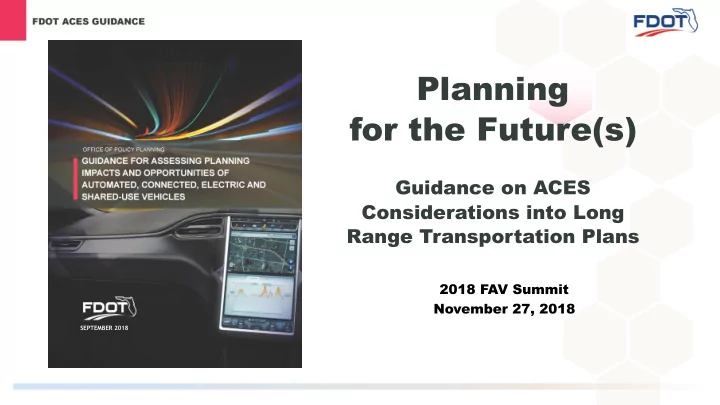
Planning for the Future(s) Guidance on ACES Considerations into - - PowerPoint PPT Presentation
Planning for the Future(s) Guidance on ACES Considerations into Long Range Transportation Plans 2018 FAV Summit November 27, 2018 SEPTEMBER 2018 Agenda Definitions Purpose & Approach Guide Overview Key Findings
2018 FAV Summit November 27, 2018
SEPTEMBER 2018
Source: www.tmcnet.com
NVIDIA to introduce level-4 enabling system by 2018 Audi to introduce a self-driving car by 2020 NuTonomy to provide self driving taxi service in Singapore by 2018 Delphi and MobilEye to provide off the shelf driving system by 2019 Ford CEO announces fully autonomous vehicles for mobility service by 2021 Volkswagen expects first self driving cars on the market by 2019 GM states autonomous cars could be deployed by 2020 or sooner BMW to launch autonomous iNext in 2021 First autonomous Toyota to be available in 2020 Uber fleet to be driverless by 2030.
Source: http://www.driverless-future.com/?page_id=384
This graphic image is from www.bing.com and licensed under CC BY
Technology Received Benefit
Forward collision warning ▼27% Front-to-rear crashes ▼20% Front-to-rear crashes with injuries ▼7% Claim rates for damage to other vehicles ▼14% Claim rates for injuries to people in other vehicles Forward collision warning plus autobrake ▼50% Front-to-rear crashes ▼56% Front-to-rear crashes with injuries ▼13% Claim rates for damage to other vehicles ▼21% Claim rates for injuries to people in other vehicles Lane departure warning ▼11% Single-vehicle, sideswipe and head-on crashes ▼21% Injury crashes of same types Blind spot detection ▼14% Lane-change crashes ▼23% Lane-change crashes with injuries ▼9% Claim rates for damage to other vehicles ▼12% Claim rates for injuries to people in other vehicles Rear automatic braking ▼62% Backing crashes ▼13% Claim rates for damage to the insured vehicle ▼26% Claim rates for damage to other vehicles Rearview cameras ▼17% Backing crashes Rear cross-traffic alert ▼22% Backing crashes Source: IIHS
1 Coordinate with other organizations regarding ACES communication roles and responsibilities. 2 Report ACES impact on transportation system performance and other community vision, goals, objectives and assets. 3 Collaborate with the private sector to deploy ACES technologies in more uniform, predictable ways. 4 Identify and develop staff skills and knowledge on advances in ACES to help them better inform and serve the public, local decision-makers and other participants in the planning process. 5 Help the public understand ACES technology so that community decisions about related investments and impacts are made in a timely, factual and sustainable fashion. 6 Develop a roadmap of appropriate interactions between MPOs and industry, legislatures, federal government and others to facilitate ACES deployment and accelerate the accompanying societal benefits. 7 Consider developing an ACES committee to inform other policy committees on the trade-offs of ACES. 8 Develop an industry council to identify opportunities for private-sector ACES interactions and collaboration.
4 Identify and develop staff skills and knowledge on advances in ACES to help them better inform and serve the public, local decision-makers and
1 Determine potential effects of ACES on infrastructure funding, revenue sources and stakeholder support. 2 Explore funding scenarios to evaluate effects of revenue shortfalls and alternative revenue sources on capital programs. 3 Investigate road pricing and other non-traditional funding sources that better support desired community outcomes. 4 Coordinate with ACES committee and the public to weigh the benefits and drawbacks of non-traditional funding sources to determine whether there is the political will to adopt and sustain those sources in support of a community vision. 5 Coordinate with federal and state agencies to ensure that new funding mechanisms create opportunities to replace local revenue sources disrupted by ACES. 6 Capitalize on the funding opportunities at federal, state and/or local funds.
1 Determine potential effects of ACES on infrastructure funding, revenue sources and stakeholder support.
1 Refine or revise MPO goals in light of ACES opportunities, impacts and uncertainties. 2 Link local ACES-related long-term goals with state and federal goals to take advantage of benefits and future opportunities. 3 Use regular planning processes such as development of unified work program and scenario planning to capture new data and trends that can be used to achieve regional vision and goals. 4 Transit Planning a. Reconsider current transit development plan in light of ACES-related opportunities and threats.
transit features and land use.
5 Performance Measures a. Develop and continually refine a flexible approach to determining ACES-driven system performance needs and measures.
meeting community needs, preferences and expectations. 6 Smart Cities a. Work with municipalities and the private sector to define, collect and share “smart cities” data relevant to long-range planning
generation, supporting power systems and other features of the EV ecosystem.
most effective in an ACES future and plan for supporting transit features and land use.
federal and state regulatory requirements while better meeting community needs, preferences and expectations.
1 Terminal Times, Friction Factors, modifying the Trip Table are three areas to account for ACES technologies in travel demand models 2 Socioeconomic data may be a factor in market penetration rates of ACES technologies in certain zones 3 Travel Characteristic surveys may also be used to refine inputs within the Value of Time parameter for additional demand model refinements 4 ACES impacts on the relationships between VHT , VMT and network speeds within the model vary between FHWA scenarios and may influence goals and objectives 5 Freeway lanes may realize higher capacity improvements due to fewer friction factors and the lack of pedestrian crossings 6 The complexity of models impact the results of capacity, speeds, and VMT depending on scenario used. Therefore, no two model results may be alike.
Terminal Times, Friction Factors, modifying the Trip Table are three areas to account for ACES technologies in travel demand models Freeway lanes may realize higher capacity improvements due to fewer friction factors and the lack of pedestrian crossings
Source: citilabs
1 Identify ACES solutions to mitigate potentially increased VMT and vehicle emissions. 2 Coordinate with local governments on land-use and parking policies to achieve local and regional goals. 3 Work with the local transit agency to develop policies that integrate ride hailing and TNCs with traditional transit, including integrated payment. 4 Develop a comprehensive freight strategy that addresses private sector and military freight needs and trends.
2 Coordinate with local governments on land-use and parking policies to achieve local and regional goals.
Source: www.planetizen.com
1 Build consensus with MPO members regarding how to account for ACES in project development and prioritization. 2 Explore how best to implement new ACES-related infrastructure needs and standards into project planning, including such considerations as the need for: a. Increased road marking implementation and maintenance for machine vision (e.g. electronic lane markings that allow use of V2I to provide more accurate lane markings and to provide changing road lanes for work zones.)
pick up zones for transportation network companies, etc.
3 Incorporate ACES-related investments into already programed TIP/STIP and fiscally constrained LRTP infrastructure plans and individual projects.
a. Increased road marking implementation and maintenance for machine vision (e.g. electronic lane markings that allow use of V2I to provide more accurate lane markings and to provide changing road lanes for work zones.) 1 Build consensus with MPO members regarding how to account for ACES in project development and prioritization.
Source: www.wonderfulengineering.com
Source: Mercedes Benz
(mbusa.com/mercedes/future/model/model-All_New_F015_Luxury)
Administrator for Metropolitan Planning FDOT Project Manager Mark.reichert@dot.state.fl.us
Florida Director of Multi-Modal Planning HNTB Project Manager bgwalker@hntb.com