Plan LOCALISATION DES ENTREPRISES ET POLITIQUES DE POLES DE - - PDF document

plan
SMART_READER_LITE
LIVE PREVIEW

Plan LOCALISATION DES ENTREPRISES ET POLITIQUES DE POLES DE - - PDF document

Plan LOCALISATION DES ENTREPRISES ET POLITIQUES DE POLES DE


slide-1
SLIDE 1

1

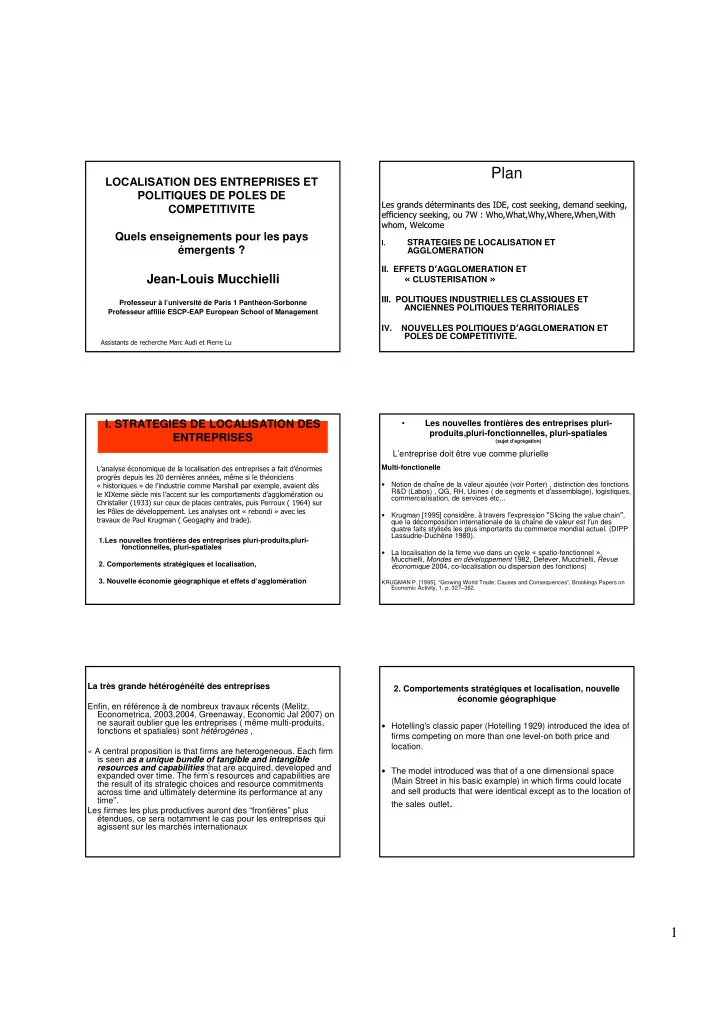
LOCALISATION DES ENTREPRISES ET POLITIQUES DE POLES DE COMPETITIVITE Quels enseignements pour les pays émergents ?

Jean-Louis Mucchielli

Professeur à l’université de Paris 1 Panthéon-Sorbonne Professeur affilié ESCP-EAP European School of Management

  • Plan

I.

STRATEGIES DE LOCALISATION ET AGGLOMERATION

  • II. EFFETS DAGGLOMERATION ET

CLUSTERISATION

  • III. POLITIQUES INDUSTRIELLES CLASSIQUES ET

ANCIENNES POLITIQUES TERRITORIALES

  • IV. NOUVELLES POLITIQUES DAGGLOMERATION ET

POLES DE COMPETITIVITE.

  • I. STRATEGIES DE LOCALISATION DES

ENTREPRISES

1.Les nouvelles frontières des entreprises pluri-produits,pluri- fonctionnelles, pluri-spatiales

  • 2. Comportements stratégiques et localisation,
  • 3. Nouvelle économie géographique et effets d’agglomération

! " #! #$# %&$' ( " ) ! #*# +$ ,, $ ! #!

  • ./0112*# #*./0342

5 + ##6 (7)+ +* 8 .9# 26

  • Les nouvelles frontières des entreprises pluri-

produits,pluri-fonctionnelles, pluri-spatiales

(sujet d’agrégation)

Multi-fonctionelle : Notion de cha;ne de la valeur ajoute (voir Porter) , distinction des fonctions R&D (Labos) , QG, RH, Usines ( de segments et d!assemblage), logistiques, commercialisation, de services etc< : Krugman [1995] consid$re, = travers l!expression >Slicing the value chain?, que la dcomposition internationale de la cha;ne de valeur est l!un des quatre faits styliss les plus importants du commerce mondial actuel. (DIPP Lassudrie-Duchêne 1980). : La localisation de la firme vue dans un cycle ( spatio-fonctionnel ), Mucchielli, Mondes en dveloppement 1982, Defever, Mucchielli, Revue conomique 2004, co-localisation ou dispersion des fonctions)

KRUGMAN P. [1995], “Growing World Trade: Causes and Consequences”, Brookings Papers on Economic Activity, 1, p. 327–362.

L’entreprise doit être vue comme plurielle Enfin, en référence à de nombreux travaux récents (Melitz, Econometrica, 2003,2004, Greenaway, Economic Jal 2007) on ne saurait oublier que les entreprises ( même multi-produits, fonctions et spatiales) sont hétérogènes , « A central proposition is that firms are heterogeneous. Each firm is seen as a unique bundle of tangible and intangible resources and capabilities that are acquired, developed and expanded over time. The firm’s resources and capabilities are the result of its strategic choices and resource commitments across time and ultimately determine its performance at any time”. Les firmes les plus productives auront des “frontières” plus étendues, ce sera notamment le cas pour les entreprises qui agissent sur les marchés internationaux La très grande hétérogénéité des entreprises

  • 2. Comportements stratégiques et localisation, nouvelle

économie géographique : Hotelling's classic paper (Hotelling 1929) introduced the idea of firms competing on more than one level-on both price and location. : The model introduced was that of a one dimensional space (Main Street in his basic example) in which firms could locate and sell products that were identical except as to the location of the sales outlet.

slide-2
SLIDE 2

2

  • L’entreprise comme acteur stratégique
  • Strategic seeking Fighting with competitors

Insider – outsider Firstmover_ follower Market pre-emption

  • First-mover Advantages (FMAs)
  • Definition

An advantage gained by the first significant company to move into a new market

Wal Wal-

  • Mart

Mart Shenzhen Metro Metro Carrefour Carrefour

  • !"

# #$%

  • Carrefour 1995

the 1st hyper-store in Beijing 2006 70 hypermarkets and 225 discounts

  • Wal-Mart 1996

the 1st super-center in Shenzhen 2006 56 stores in China

  • Metro 1996

the 1st store in Shanghai 2006 30 discount, cash-only stores

MNE

Export FDI NE Entry Entry NE Duopoly with FDI Monopoly with FDI Monopoly with Export Monopoly with Export Local F Local F.

  • 3. Les comportements d’agglomération
slide-3
SLIDE 3

3

Activities’agglomeration focus on endogeneous determinants explaining the spatial concentration of activities; that’s the new geography economic. Endogeneous means here that we are not interested by traditional location determinant like comparative advantage, but by determinants created themselves by the global behavior of the firms “Economic activities are unevenly distributed across space. The determinants of spatial differences in the patterns of production have traditionally been presented in terms of differences in endowments, technologies, or policy regimes. Such explanations, while relevant, fail to explain why even a priori similar regions can develop very different production structures.” Ottaviano et Puga (1998) .

  • A strong agglomeration effect :

Globalization, agglomeration and FDI location: The case of French firms in Europe.More than 38% of French affiliates are located in European countries. UK, Germany,Spain, Belgium and Italie attract more than 75% of those European locations. Among these countries capital cities and industrial clusters attract the majority.

@

How should the returns to spatial concentration be modeled? More than a century ago Alfred Marshall suggested a threefold

  • classification. he argued that industrial districts arise because of :

1/ knowledge spillovers ("the mysteries of the trade become no mysteries, but are as it were in the air"), 2/ the advantages of thick markets for specialized skills, 3/ the backward and forward linkages associated with large local markets. Variable to explain : Industrial Japanese firms location in Europe Source :JETRO can obtain the date of first activity for the subsidiaries and the host country and then the host county or region.. Example : Japanese Firms in Europe Revue Economie et Statistiques Mucchielli/Mayer 1999 Statistics for the Determinants : Industrial statistics coming from Eurostat for national and regional data. 446 observations, 48 sectors possible choices = 49 regions belonging to 8 European country Four main déterminants : π π π π = β β β β1 Demand + β β β β2 Costs + β β β β3 Number of firms + β β β β4 Incentives

+

  • + / -

+ (/ - ?)

AGGLOMERATION EFFECTS A/ Negative impact for wages An increase of 10% for the costs in a given region reduce the probability of 13% to attract a Japanese investment comparing to the other region of the same country. Main results B/. Positif impact of agglomération : Inside each country . Japanese enterprise are located in the region where the other Japanese firms are already, and also the other firms belonging to the same sector. C/ Positif impact of the demand : GDP is important in the location : Japanese subsidiary are concentrated in the economic center of each host country . D/ Weak impact for policy. In term of tax profit, this variable doesn’t seem to be important on the choice of location.

slide-4
SLIDE 4

4

  • II. AGGLOMERATION ET EFFETS DE «

CLUSTERISATION »

  • 1. Clustérisation, réseaux et croissance
  • 2. Théories de la croissance et

« clustérisation » Definition : cluster. define it as

  • a geographically bounded concentration
  • f similar, related or complementary businesses,
  • with active channels for business transactions,

communications and dialogue

  • that share specialized infrastructure, labor markets

and services,

  • and that are faced with common opportunities and
  • threats. (Rosenfeld 2002).
  • A

A

  • 1. Clusterisation et réseaux

An industry clusters may be defined very generally as a group of business enterprises and non-business organizations for whom membership within the group is an important element

  • f each member firm’s individual competitiveness.

Binding the cluster together are

  • "buyer-supplier relationships,
  • or common technologies,
  • common buyers or distribution channels,
  • or common labor pools (Enright 1996, p. 191)."

A potential live cycle for a cluster

Un cluster est une agglomération mais une agglomération n’est pas forcement un cluster

  • B ! # ##
  • ! "

Le cluster comme un ensemble de liens entre entreprises de la même agglomération Le cluster comme un ensemble d’acteurs variés et de marchés de facteurs et de produits

slide-5
SLIDE 5

5

# *!' "

.# #+C#7 !2

Source : Competitiveness and Economic Development: Where Does Texas Stand? M. Porter 2006 2) Explications de calculer LQ : E1 = Regional Employment in Industry X; E2 = Total Regional Employment N1 = National Employment in Industry X; N2 = Total National Employment If LQ < 1, region is less specialized in industry X, and needs to import goods to satisfy local demand If LQ = 1, region produces just enough in industry X to satisfy local demand If LQ > 1, region is more specialized in industry X and exports the industry’s output to other regions Source: The role of regional cluster M.E. Porter 2004

Figue 2.14 1) Taille et performance

Source : Competitiveness and Economic Development: Where Does Texas Stand? M. Porter 2006

  • #D

#

  • 6
  • 2. Explaining the clusters : bgrowth theories

Economic growth theories and technology policy

In the neo-classical growth theory (the Solow-Swan model) output is determined by the stock of capital and labour.

  • The key determinant of economic growth is capital

accumulation as productivity growth results from increases in the amount of capital per worker.

  • However, as capital per worker increases the marginal

productivity of capital declines.

  • In the long-run equilibrium growth is left unexplained as it is

fully determined by an exogenous term, labelled ‘technological progress’.

  • Technology is treated as a public good determined

exogenously to the model. New growth theory (NGT) developed in the second half of the 1980s attempt to overcome the problems and explain long- term economic growth endogenously. Romer and Lucas (1988) put forward the idea that technological change is linked to new accumulation of capital (physical and human).

  • In their models, the beneficial external effects of capital

accumulation, technological progress through learning-by- doing, outweigh the reduction in marginal returns of capital per worker and long-run productivity growth may occur.

  • Following Romer (1990), in these models innovation is no

longer conceptualised as a pure externality but is the product

  • f a deliberate effort of firms.
slide-6
SLIDE 6

6

.

Knowledge

  • A main contribution has been the differentiation between

codified and tacit knowledge. Codified knowledge is formalised and can be stored, copied and transmitted easily. New technologies allow the rapid transmission of codified knowledge across large distances and at low cost.

  • On the contrary, tacit knowledge is accumulated through

experience and learning-by-doing, is embodied in individuals and can only be transferred through social interaction.

  • Unlike codified knowledge, tacit knowledge is non-formalised. A

central idea of evolutionary economics is that large parts of the knowledge needed in innovation processes are tacit. Nelson and Sampat (2001) The distinction between tacit and codified knowledge has strong geographical implications for the structure of industry.

  • Tacit knowledge can only be transferred through face-to-face

contact between individuals, so that they learn from each

  • ther’s experience. Innovative firms which are located close to

competitors, suppliers and customers have further opportunities for interaction and hence higher access to knowhow.

  • This explains one of the paradoxes of globalisation:

location is crucial

  • III. ANCIENNES POLITIQUES INDUSTRIELLES

ET POLITIQUES TERRITORIALES

  • 1. Politiques industrielles classiques
  • 2. Anciennes politiques territoriales
  • 1. Politiques industrielles classiques

Des politiques de champions nationaux à celles de champions européens

L’écartèlement entre patriotisme économique et attractivité

Industrial policy is stricto sensu a sectoral policy with as objective to promote specific sectors for especially

  • national independance,
  • autonomy of the technology ,
  • failures of private initiatives,
  • declining industries,
  • or geographical territories, and any other

interventionism.

Definition

France use to have a strong industrial policy

  • in order to try and reduce their decline,
  • or to try and push national champions even if for that it has had

to fight with the european commission autorities who try itself to improve fair competition between members.

slide-7
SLIDE 7

7

In France, we can discern three types of industrial policies :

  • Structural policies : concentration, rationalization, specialization
  • Great projects in innovative industries ( public markets,

infrastructures, policy for technology)

  • les politiques d’aide aux entreprises en difficulté.

Usually it is during mergers ansd acquisitions that States want to play a role as an “industrial meccano “ (Elie Cohen)

  • Big military project has also facilitated the emergence of

national champions (Alsthom-Alcatel, Elf, Aérospatiale), associated with a big program of infrastructure (railways, phone, nuclear...) with strong state’s enterprises (l’État-EDF, l’État-Télecom, le complexe militaro-industriel...) there the key role is not play by the ministry of industry. Example : BULL

  • In 2003, French government court over a €450 million loan

made to French hardware vendor Bull.

  • The European competition commission ask for the loan was

paid back within a year. Although Bull does not have the resources to return the money.

  • The French government takes the view that EU regulations are

at fault, suggesting that rules restricting state subsidies need to be re-examined as they are not "adapted to the current context".

  • Bull had received subsidies totaling over $2 billion in the

decade 1982-1992.

  • In 2004, the French government offered 600 million euros aid to

rescue Alstom, the French company which manufactures high- speed trains and employs 110,000 workers. The amount may be exceptionally high, but the practice of granting subsidies is not exceptional.

  • The GuardianWednesday April 26, 2006

In 2004

  • After the terrorist attacks in Madrid ;French Prime Minister

Raffarin finally speak out on the battle for Aventis between French/German Sanofi and the Switzerland based Novartis.

  • Raffarin said that in this age of terrorism France must make

sure that it always has access to vaccines against bio-terrorism and that therefore he could not support a bid for Aventis from a Swiss company.

  • Finally Aventis management and Novartis gave in to the

political pressures and Sanofi could acquire Aventis.

Tim Rogmans 16/06/2004

  • The government believes that an Aventis based in France is

more likely to keep its research base and employment in France.

  • The reality is that the management of Aventis is not responsible

to the government but to its shareholders, of who only 20% are French.

  • The management will locate its Research and Development

activities in the place where it will get the best results for its shareholders, which means, of course, the location

where it has the best chances of developing useful medicines quickly and cheaply.

  • In April 26, 2006

The French president, Jacques Chirac, announced that he would provide €2bn in funding for a series of innovative grands projets, including a Franco-German search engine to compete with Google and Yahoo!.

  • In 2006, Prime Minister Dominique de Villepin spoke of

"economic patriotism",

  • The government publish a decree on New Year's Eve, listing 11

French sectors that it can protect from foreign takeovers on grounds of national security.

  • France tones down cries of 'economic patriotism' By Katrin Bennhold

International Herald Tribune FRIDAY, JANUARY 6, 2006

slide-8
SLIDE 8

8

In France, the list of protected industries is more specific than in some other industrialised countries and therefore less prone to discretionary application by the government. It includes companies providing

  • private security in sensitive installations; information technology

security

  • research and production of chemical and biological agents that

can be used in terrorist attacks and their vaccines

  • dual-use technologies for military and civilian purposes
  • and casinos, which the government fears could be used to

launder money. For non-EU investors it adds encryption technology, secret defense contracts and weapons development research.

  • the French government has recently played the patriotism card

in response to concerns regarding developments in the country’s energy sector.

  • In order to prevent a takeover by the Italian company Enel, it
  • rdered the merger of the private energy supplier Suez with the

state-run Gaz de France.

  • 2. Les « anciennes » politiques

territoriales

l’Aménagement du territoire, c’est la recherche, dans le cadre géographique de la France, d’une meilleure répartition des hommes en fonction des ressources naturelles et des activités économiques. [...] » Eugène Claudius-Petit

La grande politique d’aménagement du territoire des années 60 Claudius Petit qui utilise l’expression pour la première fois officiellement. La reconstruction préfigure cette politique car elle se fait avec une vision d’aménagement du territoire. L’ouvrage de J.F. GRAVIER Paris et le désert français dénonce la trop grande importance du rôle de Paris mais aussi la dissymétrie NE/SO qui doivent être corrigées par une politique. Cette analyse débouche au début des années 60 avec la création de la DATAR ( O. GUICHARD, J. MONOD) . Leur discours : " on va rééquilibrer la France. " La grande idée de la période est de faire participer le territoire au développement économique et à la modernisation de la France, permettant une politique structurante de l’espace français pilotée par l’Etat, donc jacobine dans sa gestion avec des mesures lourdes :

  • schémas d’aménagement régionaux,
  • métropoles d’équilibre
  • grands équilibres structurels d’industries lourdes,
  • délocalisation des industries de main d’œuvre vers l’ouest,
  • aménagement de l’Ile de France (avec la mission et le schéma Delouvrier),

avec les villes nouvelles et l’aménagement touristique.

Les années 70 représentent un changement, avec le début de la crise économique la politique d’aménagement du territoire représente une contrainte souvent inutile ; on veut cependant limiter le " béton " avec une politique plus douce en matière environnementale.

  • On ne parle plus de métropoles d’équilibre mais de villes

moyennes et de contrats de petites villes.

  • Avec la crise de 74-75, il ne s’agit plus de construire ou

d’équiper, mais de venir au secours des régions qui se désindustrialisent. La DATAR est transformée en " pompier " et doit trouver, dans l’urgence, des solutions à la perte de milliers d’emplois ici ou là.

  • Le changement politique de 1981 n’apporte que peu de

réorientations. L’acuité de la crise limite, de fait, le rôle de la DATAR à la reconversion industrielle. A la fin des années 80, il n’y a plus de ligne directrice pour l’aménagement du territoire ; pourtant la création des régions et la décentralisation n’ont pas donné dans ce domaine les résultats escomptés.

slide-9
SLIDE 9

9

LE TOURNANT DE LA FIN DES ANNEES 1980 – 1990

  • Ce tournant aboutit à la vision actuelle de l’aménagement du
  • territoire. l’aménagement du territoire équivaut aux tentatives

de reconversion industrielle,

  • la Lorraine qui a subi la crise la plus sévère a un taux de

chômage à peine plus élevé que la moyenne française grâce à un mélange de mesures sociales, d’implantation de firmes étrangères, d’équipements universitaires…

  • C’est ensuite l’inflexion de M. C. Pasqua qui réclame

l’aménagement du territoire avec le ministère de l’Intérieur. Il lance une grande consultation sur l’aménagement du territoire, relance l’idée de " pays " avec, en arrière-plan, l’idée de développement endogène aidé par l’Etat ou l’Europe.

  • Enfin l’Union Européenne qui a eu une politique dans

l’aménagement du territoire, avec la création du FEDER en 1975 puis la politique de zonage avec des fonds européens pour aider les régions qui en ont le plus

  • besoin. La France en a largement profité puisque

presque toute la France est concernée par l’un des trois

  • bjectifs et est un gros attributaire .

Objectif 1: retard de développement: DOM TOM, Corse, Hainaut Objectif 2: déclin industriel: Lorraine, Nord Pas de Calais, Normandie etc…. Objectif 3: développement des zones rurales: Limousin, une grande partie de l’Ouest etc…

  • ESQUISSE D’UNE NOUVELLE POLITIQUE

D’AMENAGEMENT DU TERRITOIRE

  • La politique de zonage bascule avec l’élargissement de l’UE

vers l’Europe Centrale..

  • Cette inflexion donne un poids important à l’UE et oblige à une

réflexion sur le découpage administratif de la France dont l’organisation apparaît comme obsolète mais avec une symbolique importante: la commune territoire de la liberté communale, le département territoire de l’égalité - communes et départements créations de la Révolution - et l’Etat qui doit dépenser plus pour mieux redistribuer sans augmenter les impôts

  • Cette réflexion est d’autant plus nécessaire qu’émergent, dans

les intervalles, l’idée de " territoires pertinents " ( J.-L. Guigou): la Région, l’Europe, l’intercommunalité…Entre la commune et le département se dessinent les idées d’agglomération et de pays avec des principes d’intercommunalité. Dans ces conditions, quelles sont les possibilités de mise en œuvre d’une nouv”elle politique?

  • Une première voie cherche à gérer ces entités : que fait-on de

l’Ile de France capitale mondiale avec Londres, du couloir de l’Est de la France, de l’arc atlantique, des villes moyennes de l’ouest, de Lille - ville qui a le plus d’avenir -?

  • Une deuxième voie consiste à conserver tous les échelons
  • administratifs. Mais si on garde toutes ces échelles

administratives, la France aura le record du monde en matière d’organisation territoriale !

  • Une troisième voie serait un à peu près entre les deux solutions

précédentes, elle viderait de contenu les anciennes divisions et renforcerait pays et agglomérations,.

  • IV. NOUVELLES POLITIQUES

D’AGGLOMERATION ET POLES DE COMPETITIVTE

  • 1. Politiques de cluster
slide-10
SLIDE 10

10

  • " # " !"! =

!# "

The changing nature of cluster-based industrial policy making: assessing cluster- based policy principles.

  • The emergence of clusters is mostly a market-induced and

market-led process without much governmental interference. Why should governments have a role in strengthening or facilitating the emergence of innovations and strategic cluster formation?

  • Following this classical line of reasoning the primary task of

government should be to facilitate the dynamic functioning of markets and make sure that co-operation does not lead to collusive behaviour which restricts competition.

  • The literature on networking, clustering and innovation systems

clearly has portrayed an image of clustering as a bottom-up and basically market-induced and market-led process.

  • Nevertheless, it has also revealed the need to redefine the role
  • f the government as a facilitator of networking, as a catalyst of

dynamic comparative advantage and as an institution builder (Morgan, 1996), creating an efficient incentive structure to remove systemic and market inefficiencies in (national) systems

  • f innovation.

The changing role of the state in industrial policy making coincides with a shift from direct intervention to indirect inducement (Morgan, 1996).

  • From that perspective the state should not try to take the lead
  • r ownership in cluster initiatives, but primarily should work as a

catalyst and broker that brings actors together and supplies supporting structures and incentives to facilitate the clustering and innovation process.

  • In most countries this changed perspective resulted in creating

supporting structures, like initiating broker and network agencies and schemes and providing platforms for constructive dialogue and knowledge exchange.

  • In most countries subsidies and compensatory policy are no

longer the tools for modern industrial policy making (Rouvinen et al, 1997).

  • Subsidies, designed to directly support industries, distort

competition and there is clear a risk of protecting established but non competitive industries and postponing the upgrading and restructuring process towards a knowledge-based economy.

  • Next, informational complexities and the speed of market

developments make it impossible for government planning agencies to successfully and directly create clusters.

  • Due to market dynamism, governments are shooting on moving

targets and there is a clear risk of missing the target and having a lot of “ backfire” at the same time.

Pitfalls in cluster-based policy making A review of cluster-based industrial policy making experiences in OECD- countries clearly has pointed at some pitfalls in cluster-based industrial policy making. These pitfalls indicate starting points and leading policy principles when designing a comprehensive cluster-based policy (Held, 1996; Porter, 1997; Roelandt et al, 1997, Rouvinen et al, 1997, Dunning, 1997): · (1) The creation of clusters should not be a government-driven effort but should be the result of market-induced and market-led initiatives. · (2) Government policy should not have a strong orientation towards directly subsidising industries and firms or to limiting the rivalry in the market. · (3) Government policy should shift from direct intervention to indirect inducement. Public market interference only can be justified if their is a clear market or system failure. And if there are clear market and systemic imperfections, it can not necessary be concluded that government intervention will improve the situation.

slide-11
SLIDE 11

11

(4) Government should not try to take the direct lead or ownership in cluster initiatives, but basically should work as a catalyst and broker that brings actors together and supplies supporting structures and incentives to facilitate the clustering and innovation process. (5 Cluster policy should not ignore small and emerging clusters; nor should it focus only on ‘classic’ and existing clusters. (6) While cluster policy needs cluster analysis and cluster studies, An effective cluster policy means interaction between researchers, captains

  • f industry, policy-makers and scientists and creating a forum for

constructive dialogue. Cluster analysis provides a tool to analyse systems of innovation, to assess systemic imperfections and in this way provides a working method for constructive dialogue on strengths and weaknesses, competitive advantages and disadvantages, etc. (7) Clusters should not be created from “scratch” of declining markets and

  • industries. Sometimes the notion of clusters is appropriated by (industrial)

policy makers and used as an excuse to continue more or less traditional ways of defensive industrial policy making

According to several policy researchers over the past decade (Boekholt, 1997; Heath, 1998; Porter, 1997; Rouvinen et al, 1997, Ormala, 1997; Roelandt et all, 1997; Lagendijk & Charles, 1997; Held, 1996; Heath, 1998): the most appropriate government roles in cluster-based industrial policy making are

  • establishing a stable and predictable economic and political

climate.

  • creating favourable framework conditions for a smooth and

dynamic functioning of markets (infrastructure, competition policy and regulatory reform, providing strategic information),

  • creating a context that encourages innovation and upgrading by
  • rganising a challenging economic vision for the nation or

region,

  • raising awareness of the benefits of knowledge exchange and

networking,

  • providing support and appropriate incentive schemes for

collaboration and initiating network brokers and intermediaries that bring together actors,

  • acting as a facilitator and moderator of networking and

knowledge exchange,facilitating an arena for informal and formal exchange of knowledge,

  • setting up competitive programs and projects for collaborative

research and development,

  • providing strategic information (technology foresight studies,

strategic cluster studies).

  • ensure that (public) institutions (especially schools, universities,

research institutes) cultivate industry ties,

  • assure that rules and regulations maximise the flexible

adaptation to changed market conditions and stimulate innovation and upgrading processes.

In some countries at the regional level development agencies play a crucial role in the clustering process and in developing local business opportunities.

  • Cluster strategies have been adopted for instance
  • within several German Länder (Northrein-Westphalen

and Baden-Württemberg),

  • many states in the U.S.
  • many regions in Europe (Basque Country, Catalonia,

Northern Ireland, Styria-Austria).

  • In Emilia-Romagna a general shift can be observed

from a policy largely organised along sectoral lines to a more horizontal, inter-sectoral focus (Lagendijk & Charles). .

  • Good examples of creating platforms as a regional

development tool are among others: the Welsh Supplier

  • Association. the Welsh Technology Clubs (where firms,

academics and funding bodies are meeting), the Welsh Medical

  • Technology Forum and the Belgium Plato initiative bringing

together SMEs from different sectors with large international companies, managed by the Regional Development Agency in Kempen-Belgium (Boekholt, 1997).

  • A recent evaluation of the Belgium Plato initiative conducted in

1995 revealed that SMEs participating the programme were performing better (growth in turnover and employment) than those who have not participated

The systemic and market facilitating role of government is still a matter of debate.

Governments should work as institution builders creating appropriate incentive structures, as facilitators of efficient markets and as catalysts of dynamic comparative advantage.

slide-12
SLIDE 12

12

  • 2. Role of Universities
  • Cluster theory also describes how factors external to the firm

impact competitiveness and innovation. It is not just the characteristics of firms that create a truly competitive cluster; there are regional factors external to the firm that matter as well.

  • Universities are one such “regional factor” that impacts all of the

dimensions of cluster competitiveness.

  • On the one hand, universities are an asset that increases the

quality of inputs and producers, by upgrading human capital and disseminating knowledge.

  • Universities also promote economic diversity.
  • In fact, the key role of the university is not so much to grow the

economy, as it is to diversify it by generating new opportunities. University Factors There are three dimensions in which universities contribute to their local economies.

  • The first dimension is the traditional function of universities in

expanding human capital through education and training. The

  • nly problem is that when universities upgrade human capital

they make it more mobile. People with more education are more likely to move longer distances such as to new states or metropolitan areas, and they do it more for work-related reasons.

  • The second is through purchasing and procurement activities. If

regions want to maximize the human capital benefits provided by universities, then we have to consider the final aspect of how universities contribute to local economies. Related to their role in education and training, universities are creators of knowledge, sources of innovation and generators of economic development.

  • One of the formalized linkages between universities and

industry is the technology transfer process, which is the commercialization of technology created by university researchers.

  • Technology transfer became more formalized as a university

function in the late 1970s, and is becoming increasingly important at universities across the country, as a source of revenue, a stimulus to the regional economy ,

  • While technology transfer used to consist mainly of patenting, it

now includes licensing, research consortia, industrial extension (technical assistance) programs, industrial-liaison or affiliates programs, spin-off enterprises, research parks, start-up firm incubators, consultant services, and venture-capital funds.

  • Tech transfer can also include the spread of knowledge

through more informal means, such as meetings between academics and industry professionals.

  • 3. Clusters’Policy in France
  • With the world economy growing increasingly

competitive, France decided in 2004 to combine the key factors of competitiveness into its new industrial policy.

  • The aim of this policy is to encourage, then

support, projects initiated by the economic and academic players in a given local area. Goals of the French Clusters Policy

Improving and implementing compatibilities between training, upstream research and industrial innovation In a long term prospect

  • technological evolutions
  • international competition

An inquisitive decision process from September 2004 to July 2005

  • 105 proposals
  • 67 clusters
  • A new industrial policy
  • This is why it became necessary to instigate a new industrial

policy, combining local areas, innovation and industry more effectively than in the past. Bringing together the industrial, scientific and academic players in a given local area to form competitiveness clusters provides a source of:

  • innovation (proximity stimulates the circulation of information

and skills, thus facilitating the creation of more innovative projects),

  • attraction (the concentration of several players in a local area
  • ffers international visibility),
  • encouragement for companies to remain in the area (their

competitiveness is tied to their local roots, thanks to the presence of skilled individuals and profitable partnerships).

slide-13
SLIDE 13

13

French industrial policy for clusters

  • Paris, le 25 novembre 2004.

Le Premier ministre à Madame et Messieurs les préfets de région (pour attribution), Mesdames et Messieurs les préfets de département (pour information)

  • Le comité interministériel d’aménagement et de

développement du territoire (CIADT) du 14 septembre dernier a décidé de lancer un appel à projets en vue de la constitution de pôles de compétitivité à rayonnement international formés, sur un espace géographique donné, par des entreprises, des unités de recherche et des centres de formation engagés dans des projets innovants.

  • Les préfets de région sont appelés à jouer un rôle essentiel

dans ce dispositif, tant en ce qui concerne l’appui aux porteurs de projet que l’organisation de la procédure de sélection.

  • Les dossiers de candidature en réponse à l’appel à projets,

vous seront adressés par les entreprises, les unités de recherche et les centres de formation ou les représentants qu’ils auront désignés.

  • Votre capacité d’impulsion et votre rôle de conseil, que vous

exercerez en partenariat avec le conseil régional, seront déterminant pour la constitution de ces dossiers.

  • Vous prendrez contact dès que possible avec le président du

conseil régional afin de l’informer de ce dispositif et de rechercher, conjointement, les moyens de l’inscrire dans la stratégie de développement économique de la région.

  • Vous déterminerez les modalités d’accompagnement des

porteurs de projet par les services de l’Etat en veillant à y associer les collectivités territoriales, au premier rang desquelles le conseil régional et les autres principaux acteurs du développement économique régional.

  • Il convient en effet de rappeler qu’une implication forte et

concrète des acteurs publics locaux pour l’émergence et le développement des pôles de compétitivité constitue à la fois un critère d’appréciation important pour leur labellisation et une condition de leur réussite future.

  • Governance
  • Each cluster is represented and led by its own legal entity,

more often than not an association. This entity is required to give preference to industrial, scientific and academic players in its governing bodies, while ensuring that the local governments concerned with the project are also duly represented.

  • The association’s primary missions are to: design and

implement the cluster’s overall strategy, co-ordinate and select (“label”) research projects submitted for public financing reserved for competitiveness clusters, oversee the cluster’s external communications, especially its international communications, set up co-operatives with other French and foreign clusters, evaluate the projects.

  • A framework agreement governs the relationships between

the cluster, the State and the local administrations involved.

E+ #7 " 1,5 bill. Euros dedicated on 2006-2008 period

*supporting projects through FCE * involving public research centers in partnerships (French National Agency for Research - ANR) * promoting industrial R&D (Agency for Industrial Innovation – A.I.I.) * bringing a specific support to SMEs (OSEO-Anvar) For 2005-2006: 540 million euros of public funding (230 million by FCE and 310 million by agencies), 1,8 billion euros of generated R&D … and also

  • international promotion : UbiFrance
  • seeding funds : CDC
  • training : Ministry of Education
slide-14
SLIDE 14

14

  • Presentation of clusters

The CIADT meeting of 12 July 2005 attributed 67 competitiveness cluster labels out of a total of 105

  • applications. After this date, new applications were

received and certain clusters merged, bringing the current total to 67.

  • Of this total, there are 6 global competitiveness

clusters and 10 globally-oriented competitiveness clusters.

  • Example : Aerospace Valley

GLOBAL CLUSTER Sectors-: Aeronautics- Space- On-board systems

  • Main programmes-

Access to space and orbital infrastructures- Aeromechanics, materials and structures- Architecture and integration- Energy, propulsion systems, engines, environment- Maintenance, services and training- Navigation, positioning and telecommunications- Security and safety in aerial transport- On-board systems- Living earth and space Main regions- Aquitaine- Midi-Pyrénées Active members Large companies75, SMEs250, Research centres17, Training centres42, Other partners122 Governance President Jean-Marc THOMAS Managing director François J OUAILLEC Communication François JOUAILLEC International François JOUAILLEC Menaces sur des pôles de compétitivité Cyrille Lachèvre Le Figaro 19/06/2008 | Un audit pointe les faiblesses de certains pôles qui pourraient être regroupés.

selon le rapport d'évaluation des pôles de compétitivité réalisé par le BCG et le cabinet C International rendu public hier par le gouvernement 13 pôles sur 71 « pourraient tirer parti d'une reconfiguration en profondeur ». Une manière polie de dire qu'ils sont menacés. Pour les auditeurs, 19 pôles ont atteint partiellement les objectifs fixés et 39 soit une petite majorité les ont atteints totalement. Le résumé du rapport n'explique pas les raisons de l'échec des 13 pôles mis à l'index. Ni les conséquences politiques qui pourraient en découler.

slide-15
SLIDE 15

15

Les auditeurs du BCG, eux, préfèrent insister sur le fait que les

  • rganismes nationaux de recherche n'ont pas encore intégré

les pôles dans leurs choix de ressources et regrettent aussi l'absence relative des financeurs privés.

  • C. Conclusions
  • State has not abandonned the old industrial

policy.

  • Be careful to support the new one as the old one

has been supported by asymetric subsidies to the one not really competitive

  • Necessity to coordinate and facilitate not to

create

  • Necessity to create a favorable environment on

the public side in term of universities and public laboratories. Quelle politique pour un pays émergent.