Plan for Today This is an introduction to Game Theory. In - - PowerPoint PPT Presentation

plan for today
SMART_READER_LITE
LIVE PREVIEW

Plan for Today This is an introduction to Game Theory. In - - PowerPoint PPT Presentation

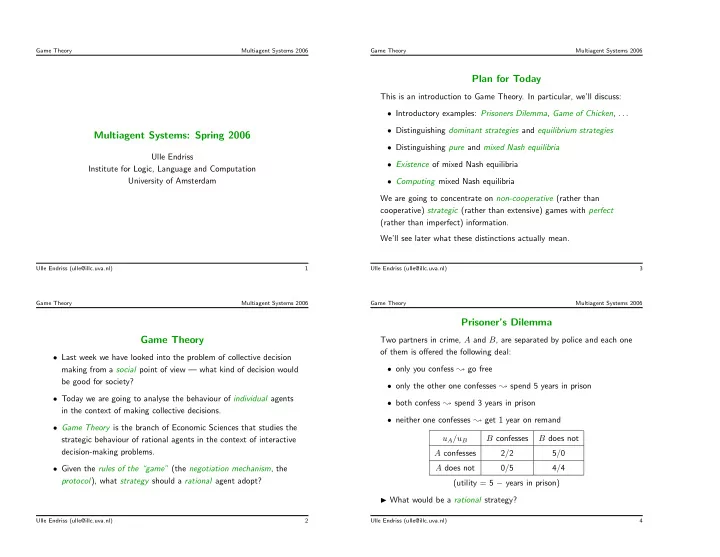
Game Theory Multiagent Systems 2006 Game Theory Multiagent Systems 2006 Plan for Today This is an introduction to Game Theory. In particular, well discuss: Introductory examples: Prisoners Dilemma , Game of Chicken , . . .


slide-1
SLIDE 1

Game Theory Multiagent Systems 2006

Multiagent Systems: Spring 2006

Ulle Endriss Institute for Logic, Language and Computation University of Amsterdam

Ulle Endriss (ulle@illc.uva.nl) 1 Game Theory Multiagent Systems 2006

Game Theory

  • Last week we have looked into the problem of collective decision

making from a social point of view — what kind of decision would be good for society?

  • Today we are going to analyse the behaviour of individual agents

in the context of making collective decisions.

  • Game Theory is the branch of Economic Sciences that studies the

strategic behaviour of rational agents in the context of interactive decision-making problems.

  • Given the rules of the “game” (the negotiation mechanism, the

protocol), what strategy should a rational agent adopt?

Ulle Endriss (ulle@illc.uva.nl) 2 Game Theory Multiagent Systems 2006

Plan for Today

This is an introduction to Game Theory. In particular, we’ll discuss:

  • Introductory examples: Prisoners Dilemma, Game of Chicken, . . .
  • Distinguishing dominant strategies and equilibrium strategies
  • Distinguishing pure and mixed Nash equilibria
  • Existence of mixed Nash equilibria
  • Computing mixed Nash equilibria

We are going to concentrate on non-cooperative (rather than cooperative) strategic (rather than extensive) games with perfect (rather than imperfect) information. We’ll see later what these distinctions actually mean.

Ulle Endriss (ulle@illc.uva.nl) 3 Game Theory Multiagent Systems 2006

Prisoner’s Dilemma

Two partners in crime, A and B, are separated by police and each one

  • f them is offered the following deal:
  • only you confess ❀ go free
  • only the other one confesses ❀ spend 5 years in prison
  • both confess ❀ spend 3 years in prison
  • neither one confesses ❀ get 1 year on remand

uA/uB B confesses B does not A confesses 2/2 5/0 A does not 0/5 4/4 (utility = 5 − years in prison) ◮ What would be a rational strategy?

Ulle Endriss (ulle@illc.uva.nl) 4

slide-2
SLIDE 2

Game Theory Multiagent Systems 2006

Dominant Strategies

  • A strategy is called (strictly) dominant iff, independently of what

any of the other players do, following that strategy will result in a larger payoff than any other strategy.

  • Prisoner’s Dilemma: both players have a dominant strategy,

namely to confess: – from A’s point of view: ∗ if B confesses, then A is better off confessing as well ∗ if B does not confess, then A is also better off confessing – similarly for B

  • Terminology: For games of this kind, we say that each player may

either cooperate with its opponent (e.g. by not confessing) or defect (e.g. by confessing).

Ulle Endriss (ulle@illc.uva.nl) 5 Game Theory Multiagent Systems 2006

Battle of the Sexes

Ann (A) and Bob (B) have different preferences as to what to do on a Saturday night . . . uA/uB Bob: theatre Bob: football Ann: theatre 2/1 0/0 Ann: football 0/0 1/2

Ulle Endriss (ulle@illc.uva.nl) 6 Game Theory Multiagent Systems 2006

Nash Equilibria

  • A Nash equilibrium is a set of strategies, one for each player, such

that no player could improve their payoff by unilaterally deviating from their assigned strategy (named so after John F. Nash, Nobel Prize in Economic Sciences in 1994; Academy Award in 2001).

  • Battle of the Sexes: two Nash equilibria

– Both Ann and Bob go to the theatre. – Both Ann and Bob go to see the football match.

  • In cases where there are no dominant strategies, a set of

equilibrium strategies is the next best thing.

  • Discussion: Games with a Nash equilibrium are of great interest to

MAS, because you do not need to keep your strategy secret and you do not need to waste resources on trying to find out about

  • ther agents’ strategies. Naturally, a unique equilibrium is better.

Ulle Endriss (ulle@illc.uva.nl) 7 Game Theory Multiagent Systems 2006

Back to the Prisoner’s Dilemma

  • Unique Nash equilibrium, namely when both players confess:

– if A changes strategy unilaterally, she will do worse – if B changes strategy unilaterally, she will also do worse

  • Discussion: Our analysis shows that it would be rational to
  • confess. However, this seems counter-intuitive, because both

players would be better off if both of them were to remain silent.

  • So there’s a conflict: the stable solution given by the equilibrium

is not efficient, because the outcome is not Pareto optimal.

  • Iterated Prisoner’s Dilemma:

– In each round, each player can either cooperate or defect. – Because the other player could retaliate in the next round, it is rational to cooperate. – But it does not work if the number of rounds is fixed . . .

Ulle Endriss (ulle@illc.uva.nl) 8

slide-3
SLIDE 3

Game Theory Multiagent Systems 2006

Game of Chicken

James and Marlon are driving their cars towards each other at top

  • speed. Whoever swerves to the right first is a “chicken”.

uJ/uM M drives on M turns J drives on 0/0 8/1 J turns 1/8 5/5

Ulle Endriss (ulle@illc.uva.nl) 9 Game Theory Multiagent Systems 2006

Analysing the Game of Chicken

  • No dominant strategy (best move depends on the other player)
  • Two Nash equilibria:

– James drives on and Marlon turns ∗ if James deviates (and turns), he will be worse off ∗ if Marlon deviates (and drives on), he will be worse off – Marlon drives on and James turns (similar argument)

  • If you have reason to believe your opponent will turn, then you

should drive on. If you have reason to believe your opponent will drive on, then you should turn.

Ulle Endriss (ulle@illc.uva.nl) 10 Game Theory Multiagent Systems 2006

How many Nash equilibria?

Keep in mind that the first player chooses the row (T/B) and the second player chooses the column (L/R) . . . L R T 2/2 2/1 B 1/3 3/2 L R T 2/2 2/2 B 2/2 2/2 L R T 1/2 2/1 B 2/1 1/2

Ulle Endriss (ulle@illc.uva.nl) 11 Game Theory Multiagent Systems 2006

Notation and Formal Definition

A strategic game consists of a set of players, a set of actions for each player, and a preference relation over action profiles for each player.

  • Players: i ∈ {1, . . . , n}
  • Actions: each player i has a set Ai of possible actions
  • Action profiles: a = (a1, a2, . . . , an) for players 1, . . . , n
  • Preferences: represented by utilities ui : A1 × · · · × An → R

Write (a−i, a′

i) for the action profile that is like a, except that player i

chooses a′

i rather than ai.

◮ Then a Nash equilibrium is an action profile a such that ui(a) ≥ ui(a−i, a′

i) for every player i and every action a′ i of player i. Ulle Endriss (ulle@illc.uva.nl) 12

slide-4
SLIDE 4

Game Theory Multiagent Systems 2006

Remarks

  • As we have seen, there are games that have no Nash equilibrium.
  • Observe that while we use utilities for ease of presentation, only
  • rdinal preferences matter (cardinal intensities are irrelevant).
  • Here we only model one-off decisions. In MAS, in particular, it is

however more likely that following a given protocol requires taking a sequence of decisions. But we can map an agent’s decision making capability to a single strategy encoding what the agent would do in any given situation. Hence, the game theoretical-models do apply here as well (see also extensive games).

Ulle Endriss (ulle@illc.uva.nl) 13 Game Theory Multiagent Systems 2006

Surprise Exam

Suppose a newspaper announces the following competition: ◮ Every reader may send in a (rational) number between 0 and 100. The winner is the player whose number is closest to 2

3 times the

arithmetic mean of all submissions (in case of a tie the prize money is split equally amongst those with the best guesses). What number would you submit (and why)?

Ulle Endriss (ulle@illc.uva.nl) 14 Game Theory Multiagent Systems 2006

A Game without Nash Equilibria

Recall that the following game does not have a Nash equilibrium: L R T 1/2 2/1 B 2/1 1/2 Whichever action the row player chooses, the column player can react in such a way that the row player would have rather chosen the other

  • way. And so on . . .

◮ Idea: Use a probability distribution over all actions as your strategy.

Ulle Endriss (ulle@illc.uva.nl) 15 Game Theory Multiagent Systems 2006

Mixed Strategies

A mixed strategy pi of a player i is a probability distribution over the actions Ai available to i. Example: Suppose player 1 has three actions: T, M and B; and suppose their order is clear from the context. Then the mixed strategy to play T with probability 1

2, M with probability 1 6, and B with

probability 1

3, is written as p1 = ( 1 2, 1 6, 1 3).

The expected payoff of a profile p of mixed strategies: Ei(p) =

  • a∈A1×···×An
  • sum over all

action profiles a ( payoff for a ui(a) ×

  • i∈{1,...,n}

pi(ai)

  • probability of

choosing a )

Ulle Endriss (ulle@illc.uva.nl) 16

slide-5
SLIDE 5

Game Theory Multiagent Systems 2006

Discussion

  • Earlier, the numbers in a game matrix represented ordinal
  • preferences. In particular, many different sets of numbers would

represent the same preference relation.

  • Ordinal preferences alone would not allow us to compare

“lotteries”: I like appeltaart more than I like bitterballen more than I like a pistoletje gezond from the cantine in Euclides . . . but this is not enough information to compare bitterballen with a 50-50 chance to win either an appeltaart or a pistoletje.

  • So in the context of mixed strategies, we take the numbers to

represent utility functions over deterministic outcomes; and we assume that the preferences of players over alternative mixed strategy profiles are representable by the expected payoffs wrt. these utilitiy functions.

Ulle Endriss (ulle@illc.uva.nl) 17 Game Theory Multiagent Systems 2006

Mixed Nash Equilibrium

Write (p−i, p′

i) for the mixed strategy profile that is like p, except that

player i chooses p′

i rather than pi.

◮ A mixed strategy profile p is a mixed Nash equilibrium iff Ei(p) ≥ Ei(p−i, p′

i) for every player i and every mixed strategy p′ i for i.

Informally: A mixed Nash equilibrium is a set of mixed strategies, one for each player, so that no player has an incentive to unilaterally deviate from their assigned strategy.

Ulle Endriss (ulle@illc.uva.nl) 18 Game Theory Multiagent Systems 2006

Example

Recall our game without a (pure) Nash equilibrium: L R T 1/2 2/1 B 2/1 1/2 In this case, guessing probabilities for a mixed Nash equilibrium is easy:

  • The row player should play T and B with probability 1

2 each.

  • The column player should play L and R with probability 1

2 each.

Given the strategy of the column player, the row player has no incentive to deviate (expected payoff is 1.5 either way), and vice versa.

Ulle Endriss (ulle@illc.uva.nl) 19 Game Theory Multiagent Systems 2006

Existence of Mixed Equlibria

We will not prove this central result here: Theorem 1 (Nash, 1950) Every finite strategic game has got at least one mixed Nash equilibrium.

J.F. Nash. Equilibrium Points in n-Person Games. Proc. National Academy of Sciences of the United States of America, 36:48–49, 1950.

Ulle Endriss (ulle@illc.uva.nl) 20

slide-6
SLIDE 6

Game Theory Multiagent Systems 2006

Computing Mixed Nash Equlibria

Recall the Game of Chicken, now in a more abstract form . . . L R T 0/0 8/1 B 1/8 5/5 We’ve already seen that this game has got two pure Nash equilibria. Does it also have a (truly) mixed equilibrium? How can we compute such an equilibrium? ◮ Note that (( 1

2, 1 2), ( 1 2, 1 2)) does not work this time (why?). Ulle Endriss (ulle@illc.uva.nl) 21 Game Theory Multiagent Systems 2006

Best Response of Player 1

Let p (q) be the probability that player 1 (player 2) plays T (L): L R T 0/0 8/1 B 1/8 5/5 L R T p · q p · (1 − q) B (1 − p) · q (1 − p) · (1 − q) Expected payoff for 1 playing T given q: E1(T, q) = q · 0 + (1 − q) · 8 Expected payoff for 1 playing B given q: E1(B, q) = q · 1 + (1 − q) · 5 Solving E1(T, q) ≥ E1(B, q) yields q ≤ 3

4.

◮ The best response p of player 1 is given by the following function: p ∈ best 1(q) =        {1} if E1(T, q) > E1(B, q), i.e. if q < 3

4

[0, 1] if E1(T, q) = E1(B, q), i.e. if q = 3

4

{0} if E1(T, q) < E1(B, q), i.e. if q > 3

4 Ulle Endriss (ulle@illc.uva.nl) 22 Game Theory Multiagent Systems 2006

Computing Mixed Nash Equlibria (cont.)

The same kind of reasoning can be used to compute the best response function of player 2 as well (payoffs happen to be symmetric here): q ∈ best 2(p) =        {1} if E2(L, p) > E2(R, p), i.e. if p < 3

4

[0, 1] if E2(L, p) = E2(R, p), i.e. if p = 3

4

{0} if E2(L, p) < E2(R, p), i.e. if p > 3

4

Each intersection of the two curves corresponds to a mixed Nash equilibrium ((p, 1 − p), (q, 1 − q)): ((1, 0),(0, 1)): player 1 plays T and player 2 plays R [pure] ((0, 1),(1, 0)): player 1 plays B and player 2 plays L [pure] (( 3

4, 1 4),( 3 4, 1 4)):

player 1 (2) plays T (L) with probability 3

4 Ulle Endriss (ulle@illc.uva.nl) 23 Game Theory Multiagent Systems 2006

Complexity of Computing Nash Equilibria

We have just seen a general method for computing all mixed Nash equilibria for a given two-player game with two possible actions each. In general, computing Nash equilibria is a very difficult problem, but it is not quite clear how difficult. According to Papadimitriou (2001), “. . . [this] is a most fundamental computational problem whose complexity is wide open.” It appears to be somewhere “between” P and NP: having guaranteed existence would be untypical for NP-hard problems, but it is not at all clear how to set up a polynomial algorithm either. STOP PRESS: Now I’ve just seen that there are some papers from late 2005 by Papdimitriou and colleagues that seem to establish some complexity results . . . definitely a possible topic for the term paper!

C.H. Papadimitriou. Algorithms, Games, and the Internet. Proc. STOC-2001.

Ulle Endriss (ulle@illc.uva.nl) 24

slide-7
SLIDE 7

Game Theory Multiagent Systems 2006

Summary

This has been an introduction to Game Theory. You should now know about dominant strategies and both pure and mixed equilibrium

  • strategies. You should also be able to compute the mixed Nash

equilibria of a simple game.

  • We have covered non-cooperative rather than cooperative games.

– Cooperative game theory studies competition amongst coalitions of players rather than amongst individuals . . .

  • We have covered strategic rather than extensive games.

– Extensive games model interactions as trees . . .

  • We have covered games with perfect information.

– Games with imperfect information are used to model situations where the players do not know each others’ preferences . . .

Ulle Endriss (ulle@illc.uva.nl) 25 Game Theory Multiagent Systems 2006

References

What we have discussed today would be covered by most textbooks on game theory, including these:

  • M.J. Osborne. An Introduction to Game Theory. Oxford

University Press, 2004.

  • M.J. Osborne and A. Rubinstein. A Course in Game Theory. MIT

Press, 1994.

  • R.B. Myerson. Game Theory: Analysis of Conflict. Harvard

University Press, 1991.

  • K. Binmore. Fun and Games. Heath, 1992.

The book by Osborne is the most introductory of these, and it has been my main reference for the preparation of this lecture.

Ulle Endriss (ulle@illc.uva.nl) 26 Game Theory Multiagent Systems 2006

What next?

We are going to apply some of the concepts we have learned about to different negotiation scenarios in multiagent systems:

  • Negotiation between two agents
  • Auctions

Ulle Endriss (ulle@illc.uva.nl) 27