Plan for this class Logistics Welcome to 4003-380 Syllabus & - - PDF document

plan for this class
SMART_READER_LITE
LIVE PREVIEW

Plan for this class Logistics Welcome to 4003-380 Syllabus & - - PDF document

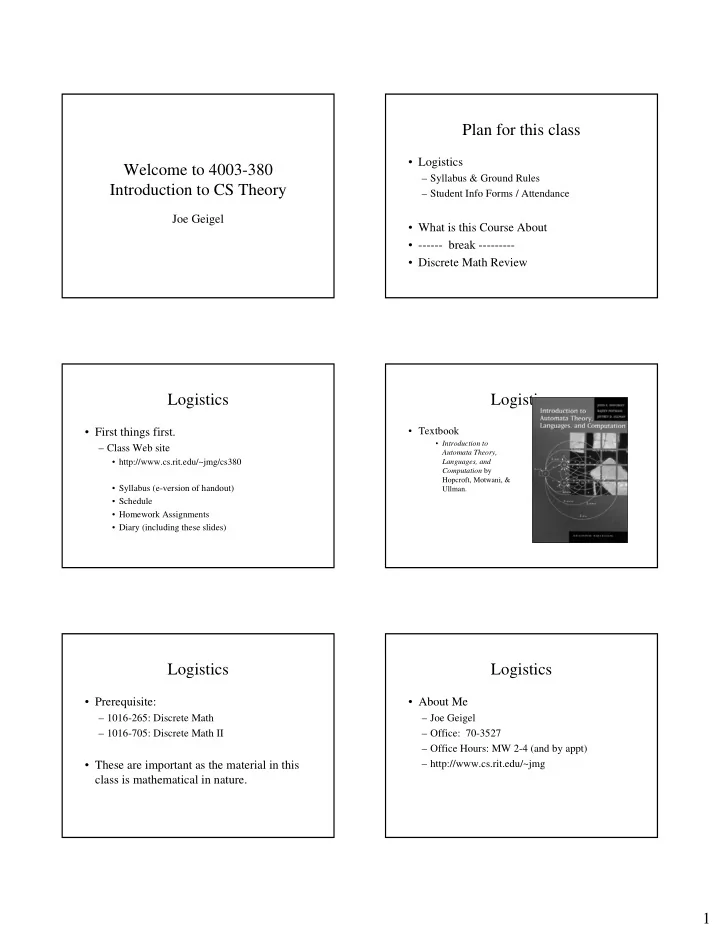
Plan for this class Logistics Welcome to 4003-380 Syllabus & Ground Rules Introduction to CS Theory Student Info Forms / Attendance Joe Geigel What is this Course About ------ break --------- Discrete Math Review


slide-1
SLIDE 1

1

Welcome to 4003-380 Introduction to CS Theory

Joe Geigel

Plan for this class

  • Logistics

– Syllabus & Ground Rules – Student Info Forms / Attendance

  • What is this Course About
  • ------ break ---------
  • Discrete Math Review

Logistics

  • First things first.

– Class Web site

  • http://www.cs.rit.edu/~jmg/cs380
  • Syllabus (e-version of handout)
  • Schedule
  • Homework Assignments
  • Diary (including these slides)

Logistics

  • Textbook
  • Introduction to

Automata Theory, Languages, and Computation by Hopcroft, Motwani, & Ullman.

Logistics

  • Prerequisite:

– 1016-265: Discrete Math – 1016-705: Discrete Math II

  • These are important as the material in this

class is mathematical in nature.

Logistics

  • About Me

– Joe Geigel – Office: 70-3527 – Office Hours: MW 2-4 (and by appt) – http://www.cs.rit.edu/~jmg

slide-2
SLIDE 2

2

Logistics

  • Grading:

– Three basic course activities:

  • Homework 40%
  • Midterm

30%

  • Final Exam 30%

Logistics

  • Homework

– Homework will be assigned weekly. – Will have 1 week to complete each assn. – Due dates are definite!

  • no late homeworks!
  • Listed in HOMEWORK section of Web site

– Group submission (max 2 people) ok – Each assignment carries equal weight – Lowest homework grade is dropped.

Logistics

  • Discrete Math Quiz

– Quick quiz on basic discrete math concepts

  • Proofs
  • Sets
  • Relations

– Will be given next class – Counts as an extra homework

Logistics

  • Homework

– Homework problem session

  • 2nd half of class on days when homework is not

assigned.

  • Questions about current homework assignment.
  • Similar problems done on the board.

Logistics

  • Midterm Exams

– Date

  • Thursday, October 14th

– Closed book…1 page study guide – No make up exams

Logistics

  • Final Exam

– Given during exam week

  • Exact date and time TBD

– Cumulative – Closed book…1 page study guide – Review Session: last class – No make up exams.

  • Any questions so far?
slide-3
SLIDE 3

3

Logistics

  • Schedule

– Posted on SCHEDULE section of Web site – Subject to change, but indicates the best guess as to what will be covered when – Includes links to these slides (in PDF) – Slides should be available 1 day before the lecture.

  • Diary

– Running list of what was actually covered when – Includes links to these slides (in PDF) – Slides should be available 1 day before the lecture.

Logistics

  • CS Dept Policy of Academic Dishonesty

– Included in hardcopy syllabus – Please read and understand.

  • Speaking of student info forms

– Any questions before I hand them out?

So what is this course all about? Think back to 1937…

There were NO programmable computers The Golden Gate Bridge was completed Jesse Owens was celebrating his Olympic gold medal Swing was king!

Meanwhile…in Princeton, NJ

  • Researchers were contemplating the following

question:

  • “Can there exist, at least in principle, a definite method by

which all mathematical problems can be decided”

  • In other words…a programmable computer.
  • They did not have the technology…yet

– But they did have mathematics

  • Mathematical models of computing machinery!

Things you will learn

  • Machines (Mathematical Models)
  • Languages
  • Computation
slide-4
SLIDE 4

4

Example: Tic Tac Toe

x x

  • x
  • x

x

This is a mathematical model for a machine that plays tic-tac- toe

Example: Turing Machine

...

  • Tape that holds

character string

  • Tape head that reads

and writes character

  • Machine that changes

state based on what is read in

Input tape (input/memory) State Machine (program) Read head

Example: Turing Machine

  • Running a Turing Machine

– Encode your input and place on the input tape – Put state machine into the “start” state – Let the machine change states as it reads/writes characters to the tape – When machine “stops”, your answer will be left

  • n the tape

Languages: String Recognition problem

  • Given a string and a definition of a

language (set of strings), is the string a member of the language?

Language recognition machine Input string YES, string is in Language NO, string is not in Language Different classes of machines can recognize different classes of languages

Languages

  • Three elements of a language

– The language itself (set of strings) – Structural Representation

  • Means for describing / generating contents of a

language

– A mathematical machine that can be used to test if a string is in the language.

Languages

  • Will actually be looking at classes of

languages:

– Each class will have its own means for structural representation. – Each class will have its own machine model for string recognition – Languages and machines get more complex as we move forward in the course.

slide-5
SLIDE 5

5

Languages

  • Strings can be used to represent problems.

Example: Tic Tac Toe

… …

a b c d e f g h i A B C D E F G H I a b c d e f g h i A B C D F G H I x e x

  • eI

x

  • x

x

  • eIbAh

Languages

  • Take home message:

– Languages and problems are the same thing – Encode problems to create strings – Add semantics to strings that represent problems. – Consider encoding with 0’s and 1’s…hmmm

Languages

  • Practical Uses of String Recognition

– Parsing / Compilers / Interpretters – grep – These mathematical models are used to parse programs written in modern computer languages

  • Questions so far?

Computation

  • Computation

– Basic questions in computer science

  • Computability: What problems can and cannot be computed?
  • Complexity: If a problem can be solved using a “computing

machine”, how long will it take ?

– Approach

  • All this theory was developed before the advent of computers!
  • Develop a mathematical model for a “computer”
  • “Run” your problem using this model to test for computability

and efficiency

So in short…

Theory of Computation Computation

Computability Complexity

Languages

Parsers / compilers / grep / programming languages, etc

slide-6
SLIDE 6

6

But all this is to come….

  • We’ll start with the basics…

– after the break

  • Any questions?