Plan for 2 nd half Ambiguous Grammars and Parse Trees Context Free - - PDF document

plan for 2 nd half
SMART_READER_LITE
LIVE PREVIEW

Plan for 2 nd half Ambiguous Grammars and Parse Trees Context Free - - PDF document

Plan for 2 nd half Ambiguous Grammars and Parse Trees Context Free Languages Questions? Parse Trees and Ambiguity Text note Parse Trees We will not be covering the conversions / Graphical means to illustrate a derivation of


slide-1
SLIDE 1

Context Free Languages

Parse Trees and Ambiguity

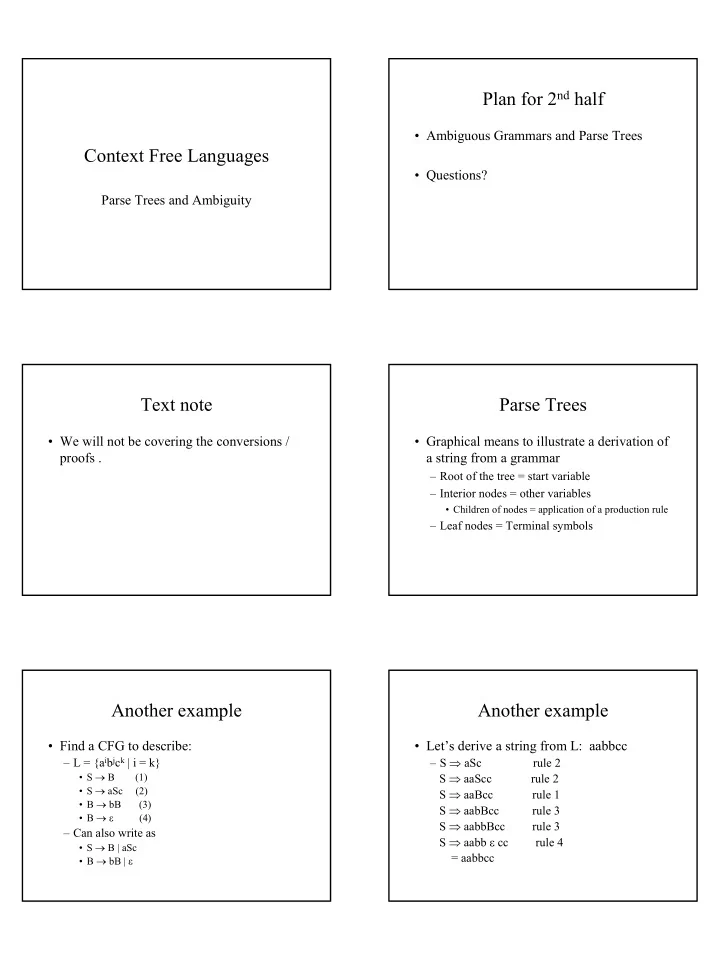
Plan for 2nd half

  • Ambiguous Grammars and Parse Trees
  • Questions?

Text note

  • We will not be covering the conversions /

proofs .

Parse Trees

  • Graphical means to illustrate a derivation of

a string from a grammar

– Root of the tree = start variable – Interior nodes = other variables

  • Children of nodes = application of a production rule

– Leaf nodes = Terminal symbols

Another example

  • Find a CFG to describe:

– L = {aibjck | i = k}

  • S → B (1)
  • S → aSc (2)
  • B → bB (3)
  • B → ε

(4)

– Can also write as

  • S → B | aSc
  • B → bB | ε

Another example

  • Let’s derive a string from L: aabbcc

– S ⇒ aSc rule 2 S ⇒ aaScc rule 2 S ⇒ aaBcc rule 1 S ⇒ aabBcc rule 3 S ⇒ aabbBcc rule 3 S ⇒ aabb ε cc rule 4 = aabbcc

slide-2
SLIDE 2

Parse Tree

  • An inorder traversal of

the tree will give the the string derived.

S a S c a S c B B b B b

ε

Rule 2 Rule 2 Rule 1 Rule 3 Rule 3 Rule 4

Recall our example from last time

  • Defining the grammar for algebraic

expressions – Production rules

– S → S + S (1) S → S – S (2) S → S * S (3) S → S / S (4) S → (S) (5) S → a (6)

One more example

  • Show derivation for a + a * a

– S ⇒ S + S rule 1 S ⇒ a + S rule 6 S ⇒ a + S * S rule 3 S ⇒ a + a * S rule 6 S ⇒ a + a * a rule 6

Parse Tree

– S ⇒ S + S rule 1 S ⇒ a + S rule 6 S ⇒ a + S * S rule 3 S ⇒ a + a * S rule 6 S ⇒ a + a * a rule 6 S S + S a S * S a a

One more example

  • Another derivation for a + a * a

– S ⇒ S * S rule 3 S ⇒ S * a rule 6 S ⇒ S + S * a rule 1 S ⇒ a + S * a rule 6 S ⇒ a + a * a rule 6

Parse Tree

– S ⇒ S * S rule 3 S ⇒ S * a rule 6 S ⇒ S + S * a rule 1 S ⇒ a + S * a rule 6 S ⇒ a + a * a rule 6 S S * S S + S a a a

slide-3
SLIDE 3

Parse trees

S S + S a S * S a a S S * S S + S a a a Same string, 2 derivations

Ambiguity

  • A CFG is said to be ambiguous if there is at

least 1 string in L(G) having two or more distinct derivations.

Famous programming language ambiguity

  • Dangling else

– <stmt> → if (<expr>) <stmt> | if (<expr>) <stmt> else <stmt> | <some_other_stmt>

if (expr1) if (expr2) f(); else g();

To which if does the else belong?

Famous programming language ambiguity

stmt if expr ) ( stmt else stmt if ( expr ) stmt expr1 g(x); f(x); expr2 In this derivation, the else belongs to the 1st if if (expr1) if (expr2) f(); else g();

Famous programming language ambiguity

stmt if expr ) ( stmt else stmt if ( expr ) stmt expr1 g(x); f(x); expr2 if (expr1) if (expr2) f(); else g();

Famous programming language ambiguity

  • A way to fix this

– <stmt> → <s1> | <s2>

<s1> → if (<expr>) <s1> else <s1> | <otherstmt> <s2> → if (<expr>) <stmt> | if (<expr>) <s1> else <s2> <s1> represents if statements with matching else <s2> represent if statements with at least 1 unmatched if The <s1> in the rule for <s2> will assure that all statements between if and else will not have a dangling else.

slide-4
SLIDE 4

Famous programming language ambiguity

if expr ) ( s1 else s1 if ( expr ) s1 expr1 g(x); f(x); expr2 s2 stmt if (expr1) if (expr2) f(); else g();

Ambiguity

  • Some languages are inherently ambiguous

– All possible grammars that generate the language are ambiguous

  • Unfortunately, there is no algorithm that can

tells us whether a grammar is ambiguous or not.

Ambiguity

  • Showing a grammar is ambiguous is easy

– Find a string x in the L(G) that has two derivations

  • Showing a particular grammar is not

ambiguous is usually difficult.

  • Showing that any grammar is not

ambiguous is not possible.

Derivations

  • Leftmost derivations

– A leftmost derivation is one where the leftmost variable in the current string is always the first to get replaced via a production rule. – A rightmost derivation is one where the rightmost variable in the current string is always the first to get replaced via a production rule.

Derivations

S S + S a S + S a a S S + S S + S a a a rightmost derivation leftmost derivation a + a + a

Ambiguity

  • As it turns out (we won’t prove this)

– In unambiguous grammars,leftmost derivations will always be unique. – In unambiguous grammars,rightmost derivations will always be unique.

slide-5
SLIDE 5

Removing ambiguities

  • Since some languages are inherently ambiguous

– This cannot always be done

  • In fact,

– We can/will show there is no “algorithm” for determining if a CFG is ambiguous

  • However,

– On a case by case basis, ambiguities can be eliminated

Example

  • Abbreviated grammar for algebraic

expressions – Production rules

– S → S + S (1) S → S * S (2) S → (S) (3) S → a (4)

Example

  • This grammar has two problems
  • 1. Precedence of operators is not respected

a * a + a should be interpreted as (a*a) + a

  • 2. Sequence of identical operators can be

grouped either from the left or the right

a + a + a can be interpreted as either (a+a)+a or a + (a + a)

Example

  • Solution

– Introduce some new variables

  • Factor – expression that cannot be broken up by either * or +

– a – (S)

  • Term – expression that cannot be broken up by +

– All Factors – T * F

  • Expression – all possible expression

– All Terms – S + T

Example

  • Our new grammar

– S → S + T | T – T → T * F | F – F → (S) | a

  • Note that

– all recursion is leftmost – * has higher precedent than + – a + a + a + a * a is interpreted as

  • ((a+a) + a) + (a*a)

Example

S S + T S + T S + T a T * F F a a F F a a

a + a + a + a * a

slide-6
SLIDE 6

Example

  • It can be shown

– That every string x, that is generated by this new grammar, has only one leftmost derivation – As such this new grammar is unambiguous – Done using induction on the |x|.

Summary

  • Ambiguity

– A grammar is ambiguous if there is a string generated by the grammar that has two distinct derivations. – Some languages are inherently ambiguous

  • All grammars that generate the language are ambiguous

– There is no algorithm to determine if any given grammar is ambiguous

  • Proving a grammar to be ambiguous is easy
  • Proving that a grammar is not is hard.

– Questions?

Summary – Today

  • Context Free Grammars
  • Parse Trees and Ambiguity

Next time

  • Exam 1
  • CFG Problem Session