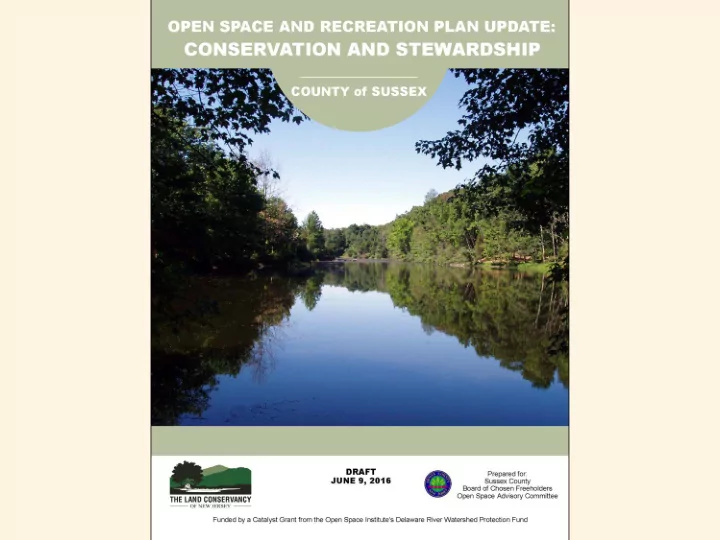
Plan Focus: Trails Stewardship Water Resources Goals of the Open - - PowerPoint PPT Presentation

plan focus trails stewardship water resources goals of
SMART_READER_LITE
LIVE PREVIEW

Plan Focus: Trails Stewardship Water Resources Goals of the Open - - PowerPoint PPT Presentation

Plan Focus: Trails Stewardship Water Resources Goals of the Open Space Program: Protect the quantity and quality of water resources Secure protection of rivers, lakes and streams Connect land for regional greenways and


slide-1
SLIDE 1
slide-2
SLIDE 2

Plan Focus:

  • Trails
  • Stewardship
  • Water Resources
slide-3
SLIDE 3

Goals of the Open Space Program:

  • Protect the quantity and quality of water resources
  • Secure protection of rivers, lakes and streams
  • Connect land for regional greenways and trail development
  • Shape growth and maintain rural character of a community
  • Safeguard threatened and endangered species habitat
  • Add to publicly owned land
  • Preserve scenic vistas
  • Offer opportunities for resource-based recreation
  • Provide opportunities for facility-based recreation
  • Engage in land stewardship activities
  • Promote tourism activities
  • Enhance land and sites with historic values
slide-4
SLIDE 4

As of May 2016, the Open Space Trust Fund has collected $36,450,305, expended $34,155,248, and has a balance of $2,926,384

For the years 2012 through 2016, the Board of Chosen Freeholders set the rate to reach a specified dollar amount targeted at $395,000 per year

slide-5
SLIDE 5

The peak for local trust fund collection rates was in 2004. The lowest amount collected was in 2015 and it is anticipated this trend will continue. In 2015, 12 of Sussex County’s 24 municipalities had active open space trust funds: Local Trust Funds Collected: $14,375,196

  • Andover Borough
  • Andover Township
  • Byram Township
  • Fredon Township
  • Green Township
  • Hamburg Borough
  • Hampton Township
  • Hopatcong Borough
  • Lafayette Township
  • Sparta Township
  • Stillwater Township
  • Wantage Township
slide-6
SLIDE 6

Andover Borough - $325,000 Andover Township - $500,000 Byram Township - $2,850,000 Frankford Township - $1,570,000 Fredon Township - $800,000 Green Township - $1,150,000 Lafayette Township - $1,125,000 Stillwater Township - $300,000 Vernon Township - $1,701,250 Wantage Township - $622,500

Sussex County has received $2,600,000 in state land acquisition grants 10 Sussex County municipalities have received Green Acres funding totaling $10,943,750 for land acquisition:

Sussex County: State Green Acres Grants

slide-7
SLIDE 7

Trails Public Lands Preserved Lands

slide-8
SLIDE 8

322 miles of blazed and maintained trails on State and Federal lands in Sussex County

  • Federal (3): Appalachian Trail National Scenic Trail, Delaware Water Gap National Recreation Area, and

Wallkill River National Wildlife Refuge

  • State (32): 6 State Parks, 1 State Forest, 12 Wildlife Management Areas (WMA), and 13 NJ Natural Land

Trust Preserves

  • Nonprofit (7) and Municipal (25) including Blair Mountain Creek Preserve in Stillwater Township

(nonprofit), and Briar Ridge in Byram Township (Municipal)

Other Trail Opportunities:

Regional Cycling:

  • Old Mine Road
  • High Point to Cape May: 238 miles-High Point State Park to Cape May through 11 Sussex County towns

Water Trails:

  • Wallkill River: 9 miles through Wallkill National Wildlife Refuge to Oil City, New York
  • Vernon Canoe Trial
  • Hopatcong State Park: Proposed system with public access points at Roland-May Eve Sanctuary and

Hopatcong State Park

slide-9
SLIDE 9

Regional Trails

Appalachian National Scenic Trail (AT) – 2,190 miles

  • New Jersey section is 72 miles long, passing through 7 Sussex County municipalities.

Liberty Water Gap Trail – 130 miles long

  • Includes Highlands Trail, Sussex Branch Trail and Paulinskill Valley Trail linking Liberty State Park to the Delaware Water Gap.

Highlands Trail - More than 150 miles when completed

  • Passes through 4 Sussex County towns (Hardyston, Sparta, Byram, Hopatcong), cooperative effort by NYNJTC.

Sussex Branch Trail – 20 miles

  • Former Sussex Branch line of the Erie Lackawanna Railroad, from Allamuchy Mountain State Park to Branchville.

Paulinskill Valley Trail – 27 miles

  • Follows an abandoned section of the New York, Susquehanna & Western Railroad from Sparta Junction to Knowlton.

Great Valley Trail – 4 miles

  • Built on the former Lehigh & New England Railroad, extends from Frankford to Hampton Township.

Ogden Mine Railroad Path - 2.7 miles long

  • Beginning at Mahlon Dickerson Reservation, it follows an abandoned railroad bed into Sparta Township.

Morris Canal Greenway

  • This is a trail system in process, portions exist in Waterloo Village, Allamuchy Mountain State Park, and Stanhope
slide-10
SLIDE 10

Preserved and Public Land

Sussex County has 144,261 acres of publicly owned and preserved land. This represents 42% of the County’s total lands (342,699 acres)

slide-11
SLIDE 11

Priority Stewardship Project Opportunities for Sussex County:

1. Riparian restoration and floodplain reforestation projects along rivers, streams, lakes, and other waterbodies. 2. Invasive species inventory and management on all open space lands. 3. Tree planting / reforestation projects in municipal recreational parks, green spaces, and steep slopes. 4. Community “watershed clean-up” programs on an open space lands and trails, most notably lands owned by the State of New Jersey. 5. Rain gardens and similar stormwater infiltration best management practices. 6. Development of conservation plans for farms which identify practices that can be funded by funding made available from Farm Bill programs.

slide-12
SLIDE 12

Sparta Township Glen Brook Park

Resource concerns and observations:

  • Erosive banks
  • Lacking an overstory canopy cover:

reduces drastic water temperate fluctuations

  • Historic flooding event compromised in-

stream habitat conditions

Stewardship opportunities, Projects, and Strategies:

  • Monitor tree survivability,

replant as necessary

  • Maintain tree protection
  • Control invasive species

(mugwort)

  • Educational/stewardship
  • pportunities for

community members Active stewardship work:

  • Restoration of damage

caused by August 2000 microburst

  • April 2016- realign the

brook with the floodplain.

  • Create pool and riffle

areas- benefit brook trout populations

  • 1,879 native trees

planted – shade the brook, stabilized erosive banks, improve water quality

slide-13
SLIDE 13

Key Strategies for Open Space Stewardship in Sussex County:

  • 1. Identify and fund a central coordinating organization and/or committee to spearhead the planning and implementation of

stewardship initiatives and programs.

  • 2. Strengthen and maintain lines of open communication between governmental and municipal officials, conservation organizations,

land managers, and community stakeholders.

  • 3. Seek and implement stewardship “projects of opportunity” that will engage community members, utilize existing financial and

technical resources, and have the ability to serve as a successful community demonstration project.

  • 4. Become aware of, and take advantage of existing conservation partnership programs and initiatives such as the United States Fish

and Wildlife Service’s Partners for Fish and Wildlife Program or United States Department of Agriculture Natural Resource Conservation Service Farm Bill Programs.

  • 5. Work with active local citizens, recreation clubs, community groups, and schools to coordinate programs that enable them to assist

with implementing stewardship work, such as “watershed clean-ups” on open space lands; ultimately identify such groups and volunteers as belonging to a Sussex County Watershed Stewards Team.

  • 6. Educate and enable municipal officials and public works employees on how to assist with open space stewardship and

maintenance activities and projects they may not typically think about.

  • 7. Install kiosks and educational signs on open space lands to raise awareness and encourage more active community stewardship.
  • 8. Seek assistance and involvement from local businesses and community sponsors to drive stewardship efforts.
  • 9. Initiate a locally driven open space monitoring and site assessment program to be conducted on a routine basis.
  • 10. Encourage and promote programs similar to the Sussex County Municipal Utilities Authority – Wallkill River Watershed Management

Group’s existing three tiered stewardship program to address stormwater management, riparian restoration, and agricultural

  • utreach and assistance throughout all of Sussex County
slide-14
SLIDE 14
slide-15
SLIDE 15
slide-16
SLIDE 16

Focus Area 1: Hydrology

slide-17
SLIDE 17

Stressed Watersheds showing the Musconetcong Watershed in Sussex County Red = Significant Recharge Areas at 70% threshold Pink – Stressed Watershed based on 25% of low flow margin Hydrology Map Showing Breakdown of Scoring Purple = Score of 3-5 Brown = Score of 1-2 White = Score of 0

slide-18
SLIDE 18

Focus Area 2 : Stream and Aquifer Quality

slide-19
SLIDE 19

Focus Area 2 : Aquatic Ecosystem Functions

slide-20
SLIDE 20
slide-21
SLIDE 21

Composite of all 3 Focus Areas

slide-22
SLIDE 22

Analysis and Parcel Recommendations

High Priority Lands: Hydrology = 22,680 acres (6.6%) Stream and Aquifer Quality = 25,569 acres (7.5%) Aquatic Ecosystem Functions = 41,183 acres (12%) Composite Mapping (Hydrology; Stream & Aquifer Quality; Aquatic Ecosystem Function): 175,310 acres = 51% of Sussex County High Priority (Excluding Preserved Lands): 16,912 acres (5%) scores 6-12 characteristics 158,399 acres (46%) scores 1-5 characteristics High Priority Properties for Water Resource Protection within 500 Feet of Public Land: 16,912 acres High Priority Lands - Of these: 14,776 acres are greater than 1 acre in size 9,959 acres are located within 500 feet of public land on 1,468 properties Total acreage of these 1,468 properties = 52,159 acres

slide-23
SLIDE 23

Partners:

Sussex County Municipal Utilities Authority Wallkill River Watershed Management Group School of Environmental & Biological Sciences Rutgers, The State University of New Jersey Funded by: A Catalyst Grant from the Open Space Institute's Delaware River Watershed Protection Fund

slide-24
SLIDE 24

THANK YOU!

Contact: Sussex County Open Space Committee The Land Conservancy of New Jersey Barbara Heskins Davis, PP, AICP bhdavis@tlc-nj.org (973) 541-1010, extension 33