Plan Do Check Act (PDCA) Plan : Identify & Analyze the problem - - PowerPoint PPT Presentation

plan do check act pdca
SMART_READER_LITE
LIVE PREVIEW

Plan Do Check Act (PDCA) Plan : Identify & Analyze the problem - - PowerPoint PPT Presentation

Plan Do Check Act (PDCA) Plan : Identify & Analyze the problem Work out what the problem is Begin to pull together any information Do (Try or Test): develop & test a possible solution Generate solutions which seem


slide-1
SLIDE 1

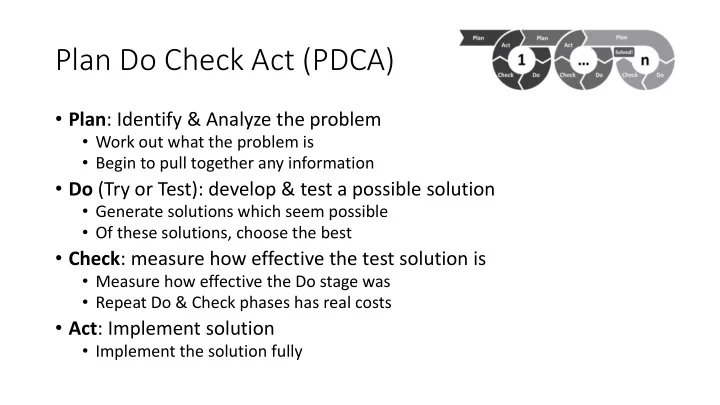
Plan Do Check Act (PDCA)

  • Plan: Identify & Analyze the problem
  • Work out what the problem is
  • Begin to pull together any information
  • Do (Try or Test): develop & test a possible solution
  • Generate solutions which seem possible
  • Of these solutions, choose the best
  • Check: measure how effective the test solution is
  • Measure how effective the Do stage was
  • Repeat Do & Check phases has real costs
  • Act: Implement solution
  • Implement the solution fully
slide-2
SLIDE 2

Presentation Main building blocks

slide-3
SLIDE 3

Pyramid Principle

Principle

  • Begin with the answer
  • Group & summarizing your supporting

arguments (x3)

  • Logically order your supporting ideas
  • Time order
  • Structural order
  • Degree order

Benefits

  • Maximize your time with your audience
  • Executives tend to think with a “top-

down” approach

  • Being direct makes you more persuasive
slide-4
SLIDE 4

Cover page

  • 1. Company name
  • 2. Company logos & color scheme
  • 3. Title & date
  • 4. Less is more
  • 5. Contact information
slide-5
SLIDE 5

Agenda page

  • 1. Executive summary
  • 2. Our approach
  • 3. Key findings
  • 4. Next steps
  • 5. Appendix
slide-6
SLIDE 6

Headlines

A good title will concisely & effectively

  • Capture the audience’s attention
  • Explain why the page is important
  • Show how the page contributes to the storyline

Notes

  • Your audience will not be trying to read a lot of text & listen to you at the

same time

  • Aim to write the headlines in a natural voice & make them informative
  • Writing what you want to say in the simplest way possible yet keeping it

compelling way

slide-7
SLIDE 7

Body

slide-8
SLIDE 8

How to choose among WORDS, TABLES, GRAPHICS

  • Use table or graphic to illustrate a reasonably simple relationship

especially when you have chance to show numerical data.

  • Use table to explain complex relationship because it provides a

concise structure to navigate

  • Use words or conceptual graphic as you have something other than

relationship

slide-9
SLIDE 9

KICKER

  • Proving to the audience the answer to “So what???” or “Why should I

care about these data/exhibits?”

slide-10
SLIDE 10

Checklist

Meeting room

  • Confirm room size
  • Check presentation equipment
slide-11
SLIDE 11

Use eye contact & body language

  • More than 30 separate muscles in our faces, when we smile, almost

half of these muscles are used.

  • Eye contact is critical for a number of reasons:
  • Sign of sincerity
  • Interest in those with whom you are speaking with
  • Practicing eye contact during regular conversations.
slide-12
SLIDE 12

Manage presentation nerves

  • 1. Know your audience
  • 2. Know your material
  • 3. Structure your presentation
  • 4. Practice
  • 5. Prepare
  • 6. Calm yourself from the inside
slide-13
SLIDE 13

Appendix

  • Put supporting data to deal with questions to the Appendix
  • Put at the end of your deck
  • Focus on the main slides & the big picture