
SLIDE 1
Continuous Improvement Toolkit . www.citoolkit.com
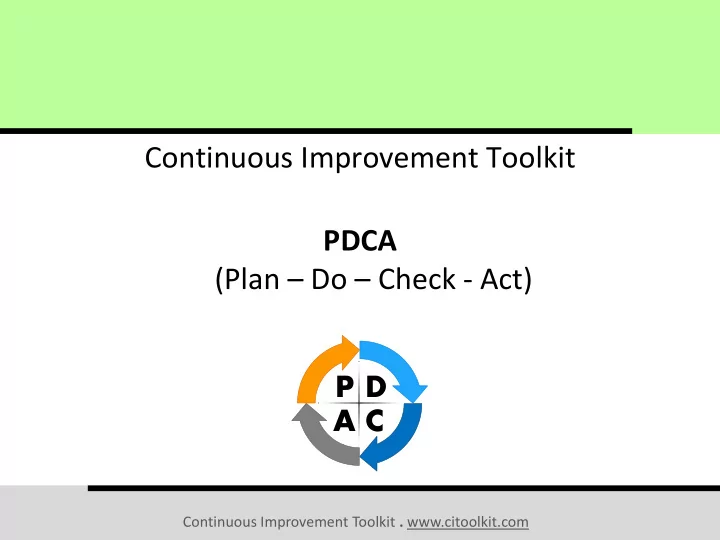
PDCA (Plan Do Check - Act) P D A C Continuous Improvement - - PowerPoint PPT Presentation
Continuous Improvement Toolkit PDCA (Plan Do Check - Act) P D A C Continuous Improvement Toolkit . www.citoolkit.com The Continuous Improvement Map Managing Deciding & Selecting Planning & Project Management* Risk PDPC
Continuous Improvement Toolkit . www.citoolkit.com
Continuous Improvement Toolkit . www.citoolkit.com
Check Sheets
Data Collection
Process Mapping Flowcharting Flow Process Charts 5S Value Stream Mapping Control Charts Mistake Proofing Tree Diagram*
Understanding Performance
Fishbone Diagram Design of Experiment
Implementing Solutions** Creating Ideas
Brainstorming Attribute Analysis
Deciding & Selecting
Decision Tree Force Field Analysis Cost Benefit Analysis Voting
Planning & Project Management*
Value Analysis Kaizen Events Quick Changeover
Managing Risk
FMEA PDPC RAID Log* Observations Focus Groups
Understanding Cause & Effect
Pareto Analysis IDEF0 5 Whys Matrix Diagram Kano Analysis KPIs Lean Measures Importance-Urgency Mapping Waste Analysis Fault Tree Analysis Relationship Mapping* Benchmarking** SCAMPER** C&E Matrix Confidence Intervals Pugh Matrix SIPOC* Prioritization Matrix Stakeholder Analysis Critical-to Tree Paired Comparison Improvement Roadmaps Interviews QFD Graphical Analysis Lateral Thinking Hypothesis Testing Visual Management Ergonomics Reliability Analysis Cross Training How-How Diagram** Flow Time Value Map ANOVA Gap Analysis* Traffic Light Assessment TPN Analysis Decision Balance Sheet Suggestion systems Risk Assessment* Automation Simulation Break-even Analysis Service Blueprints DMAIC Process Redesign Run Charts TPM Control Planning Chi-Square SWOT Analysis Capability Indices Policy Deployment Data collection planner* Affinity Diagram Questionnaires Probability Distributions Bottleneck Analysis** MSA Descriptive Statistics Cost of Quality* Process Yield Histograms & Boxplots Just in Time Pick Chart Portfolio Matrix Four Field Matrix Root Cause Analysis Data Snooping Morphological Analysis Sampling Spaghetti Diagram Pull OEE Mind Mapping* Project Charter PDCA
Designing & Analyzing Processes
Correlation Scatter Plots Regression Gantt Charts Activity Networks RACI Matrix PERT/CPM Daily Planning MOST Standard work Document control A3 Thinking
The Continuous Improvement Map
Multi vari Studies
Continuous Improvement Toolkit . www.citoolkit.com
A framework for problem solving, continuous improvement and
Widely recognized as the basis of continually improving the
An easy to remember four logical sequence steps:
Provides a simple and structured approach
Multiple iterations of the PDCA cycle may be
Continuous Improvement Toolkit . www.citoolkit.com
Used to verify the feasibility of a proposed idea whether it is an
Often used when:
Continuous Improvement Toolkit . www.citoolkit.com
Encourages the methodical way of problem solving and
Ensures that you plan, test and incorporate feedback before
Improves the critical thinking skills of your team. Helps to reach towards a more integrated system.
Continuous Improvement Toolkit . www.citoolkit.com
Repeating the PDCA cycle frequently will help implementing
The following are based around the PDCA philosophy:
Continuous Improvement Toolkit . www.citoolkit.com
The team selects the problem to be solved (or
The problem and objectives are clearly identified. The current situation is analyzed. Solution alternatives are identified, selected and
Continuous Improvement Toolkit . www.citoolkit.com
The solution is tested on a small scale basis. It involves collecting data for later analysis. It also involve measuring progress. It ensures the solution is appropriately tested
Continuous Improvement Toolkit . www.citoolkit.com
Involves analyzing the collected data and
Allows evaluating how well the solution worked. Allows discussing whether further improvements
Concerned with identifying the unexpected issues, their causes,
Continuous Improvement Toolkit . www.citoolkit.com
Involves acting on the feedback and lessons
It is also concerned with:
Continuous Improvement Toolkit . www.citoolkit.com
You may identify the next target and start again at the plan phase. The PDCA cycle can be repeatedly applied in a process of continuous
Each cycle will bring you closer to your goals and will extend your
Continuous Improvement Toolkit . www.citoolkit.com
The PDCA cycle can be used in many different situations:
Continuous Improvement Toolkit . www.citoolkit.com
A common example often used is
Plan for the new product development & production process Analyze the collected data to measure customer satisfaction Create a prototype, test it, & collect data from the customer Fully Implement the new design / act on collected feedback
Continuous Improvement Toolkit . www.citoolkit.com
The PDCA cycle is often referred to as the Shewhart Cycle or
In 1990, Deming introduced the PDSA cycle (a modified version
He believed that data analysis is an essential
Continuous Improvement Toolkit . www.citoolkit.com
OPDCA is another version of PDCA where “O” stands for
PDCA relies on trial and error, however, it keeps improving until
Maintain documentation for these projects.
Continuous Improvement Toolkit . www.citoolkit.com