Pierre Paulin Biography Born in Canada, dual citizenship (France) - - PowerPoint PPT Presentation

pierre paulin biography
SMART_READER_LITE
LIVE PREVIEW

Pierre Paulin Biography Born in Canada, dual citizenship (France) - - PowerPoint PPT Presentation

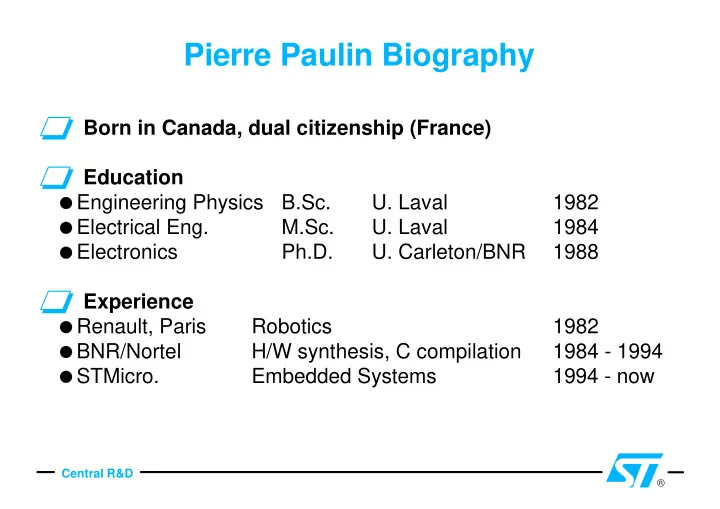
Pierre Paulin Biography Born in Canada, dual citizenship (France) Education Engineering Physics B.Sc. U. Laval 1982 Electrical Eng. M.Sc. U. Laval 1984 Electronics Ph.D. U. Carleton/BNR 1988 Experience Renault, Paris Robotics 1982


slide-1
SLIDE 1

Central R&D

Born in Canada, dual citizenship (France) Education Engineering Physics B.Sc.

  • U. Laval

1982 Electrical Eng. M.Sc.

  • U. Laval

1984 Electronics Ph.D.

  • U. Carleton/BNR

1988 Experience Renault, Paris Robotics 1982 BNR/Nortel H/W synthesis, C compilation 1984 - 1994 STMicro. Embedded Systems 1994 - now

Pierre Paulin Biography

slide-2
SLIDE 2

STMicroelectronics

Towards Application-Specific Architecture Platforms: Embedded Systems Design Automation Technologies

Pierre Paulin Director, Embedded Systems Technology Central R&D

slide-3
SLIDE 3

Central R&D

STMicroelectronics

Franco-Italian origin (formerly SGS-Thomson Microelectronics) International company now, but with strong roots in Europe

slide-4
SLIDE 4

Central R&D

NORWAY SWEDEN FINLAND DENMARK ESTONIA LATVIA LITHUANIA BELARUS UNITED KINGDOM IRELAND GERMANY POLAND UKRAINE MOLDOVA CZECH REPUBLIC AUSTRIA SLOVAKIA HUNGARY ROMANIA NETHERLANDS FRANCE LUXEMBOURG SWITZERLAND SPAIN PORTUGAL ITALY SLOVENIA CROATIA BOSNIA & HERZEGOVINA SERBIA BULGARIA MACEDONIA ALBANIA GREECE ANDORRA MALTA MONACO VATICAN CITY SAN MARINO LIECHTENSTEIN BELGIUM MONTENEGRO

STMicroelectronics POSITIVES

French cuisine Driving german cars

  • n german highways

Italian passion Swiss sense of organization English courtesy Canadian real estate U.S. stock options

slide-5
SLIDE 5

Central R&D

NORWAY SWEDEN FINLAND DENMARK ESTONIA LATVIA LITHUANIA BELARUS UNITED KINGDOM IRELAND GERMANY POLAND UKRAINE MOLDOVA CZECH REPUBLIC AUSTRIA SLOVAKIA HUNGARY ROMANIA NETHERLANDS FRANCE LUXEMBOURG SWITZERLAND SPAIN PORTUGAL ITALY SLOVENIA CROATIA BOSNIA & HERZEGOVINA SERBIA BULGARIA MACEDONIA ALBANIA GREECE ANDORRA MALTA MONACO VATICAN CITY SAN MARINO LIECHTENSTEIN BELGIUM MONTENEGRO

STMicroelectronics NEGATIVES

U.S. stock options (one week later) Canadian weather French courtesy Driving french cars

  • n London motorways

English food Swiss passion Italian sense of

  • rganization
slide-6
SLIDE 6

Central R&D

Introduction Part I: System design platforms Sample design platform: ST set-top box ASAP: Application-Specific Architecture Platform Which platform components? H/W vs FPGA vs AS-Processors vs GP-Processors Platform design automation challenges Part II: ST platform automation technologies ST system design environment ST embedded software development tools

Outline

slide-7
SLIDE 7

Central R&D

Bridging the Process / Design Gap

Design complexity (transistor count)

2000 99 98 97 96 Platforms, IP Reuse HW-SW Methodologies RTL-to-layout Flow System Level Entry Year

Source : ST

RTL design capability +20% / year Process capability +50% / year

2001 2002

slide-8
SLIDE 8

Central R&D

System Design Technology Strategy

Complement ST's rich, heterogeneous process technology

  • ffer with tools/methods supporting it at architecture and

system design levels Domain-specific tools: DSP, control/protocol, real-time Executable specifications, system validation DO THE RIGHT THING Processors, memories, logic, datapaths, analog, RF, A/D Virtual prototype, Architecture exploration, codesign Platform-based design High performance S/W compilation DO THE THING RIGHT, FAST Logic, analog, DRAM, SRAM, Flash, High-speed, Power DO IT IN ON A SINGLE CHIP!

HW-SW Methodologies RTL-to-layout Flow System Level Entry Process capabilities

Platforms, IP Reuse

slide-9
SLIDE 9

STMicroelectronics

Part I: System Design Platforms

slide-10
SLIDE 10

Central R&D

ST Platform Example: Set-top box, DVD

Development of complete IP foundation and design platform Front-end, demux Std/High-def MPEG2 video/audio, Display, 2D/3D graphics RISC, AS-DSP, smart card, I/O

STi5518 OMEGA STV0299

QPSK Rx

DBS TUNER

VCR PAL/NTSC

DACs

:

MPEG Multi-channel/ Dolby AC-3 5.1 channels

Smart Cards

Led to ST world leadership position MPEG2 audio/video decoder

  • > 30 million chips sold

Digital satellite set-top box chips-> Over 70% market share

slide-11
SLIDE 11

Central R&D

Platform Approach = Fast Derivatives

STi7000 family HD decoding, HD display,

3D graphics, High quality display

OMEGA2

2D/3D graphics, Hard-Disk Drive, Multiple demux, Java, WinCE

OMEGA1 Still image plane,

BLT engine, Enhanced display OMEGA Integrated Audio/Video, Demux Micro, On-screen Display

Basic Pay TV DISH, DIRECTV DVB Interactive BSkyB, Canal+, ONdigital, TPS MediaOne, US Cable DCT2K, Explorer 2K Web Interactive MediaWeb, DISH Player, DVB-MHP, DIRECTV++, UK Cable HD/3D Capable

OpenCable

ST Digital TV Product Families

slide-12
SLIDE 12

Central R&D

Programmable Platform Instance

Application-Specific Architecture Platform (ASAP)

Standard Processors Config DSP, MCU uProg I/O proc. MMedia processor

Executable system specification

Fixed Silicon with high programmability:

  • S/W on general purpose

and domain-specific processors

  • Microprogrammable

I/O processing

  • FPGA coprocessors

Derivative

Predefined set of standard IP

  • Std. Processors
  • Memory
  • Busses

Set of optional IP's

  • Specialized

processors

  • Hardwired IP
  • I/O

ST40 IEEE 1394

S/W

MPEG2 decoder

Mapping

Domain-specific languages System-oriented C/C++ environments

Reconfigurable Platform Template

slide-13
SLIDE 13

Central R&D

Platform Example: Set-top Box

Analysis of application requirements Derivation to specific platform instance

Platform Template

ASIC Field Prog. Proc.

Platform Instance

Audio DSP Standard I/O blocks Control MCU MPEG2 video decoder 3D Processor DRAM/SRAM ROM/Flash 2D graphics Display coprocessor

Configurable STBus

Glue Logic Standard I/O blocks D/A, A/D Audio DSP

Configured STBus

Glue Logic RS-232 Firewire iEEE 1394 audio, video D/ A Control MCU MPEG2 decoder SRAM ROM Display coprocessor

F/W

slide-14
SLIDE 14

Central R&D

Component expertise Process differentiators (BICMOS, RFCMOS, eDRAM, eFlash, OTP)

Platform IP

Wireless terminals Multimedia, Graphics Domain-specific cores: AS-MCU, AS-DSP, Network Proc.

Application IP

GSM, UMTS Set-top box, DVD, HDTV xDSL modem, Internet switch Car multimedia SmartCard Hard-Disk Drive

Platforms: Divide and Conquer

Component IP

Commodity cores: DSP, MCU, RISC, Bus A/D, D/A, I/O, Analog Flat Panels Libraries: Cells, memories, I/O

ST40 MPEG2 decoder RAM 2D graphics

week month year

System-level expertise S/W expert Platform programming Domain-specific platform expertise Fast platform derivatives Microarchitecture "Insulation" Platform "Insulation" System function Layout RTL H/W-S/W architecture

slide-15
SLIDE 15

Central R&D

Requires combination

  • f four competences

Short Time-To-Market Long Platform Lifetime Amortize increasing NRE costs e.g. mask set 250 -> 500 K$

3 year

Processors Standard IP Memory H/W coprocessor

Application

IP Components

Process Technology

Platform Architecture Definition

Platform

slide-16
SLIDE 16

Central R&D

Platform IP

Wireless terminals Multimedia, Graphics Domain-specific cores: AS-MCU, AS-DSP, Network Proc.

Application IP

GSM, UMTS Set-top box, DVD, HDTV xDSL modem, Internet switch Car multimedia SmartCard Hard-Disk Drive

Which Platform Components ?

Component IP

Commodity cores: DSP, MCU, RISC, Bus A/D, D/A, I/O, Analog Flat Panels Libraries: Cells, memories, I/O

ST40 MPEG2 decoder RAM 2D graphics

week month year

Microarchitecture "Insulation" Platform "Insulation"

slide-17
SLIDE 17

Central R&D

Design Platform Component Options

Structured Custom RTL Flow FPGA FPGA & Processor Config. Processor DSP MCU GPP (General Purpose Processor

Low design cost High flexibility High power/operation Lower speed Medium part cost High design cost Low flexibility Low power/operation High speed Lowest part cost

ASIP Analog H/W

slide-18
SLIDE 18

Central R&D

Processor Evolution Case Study

Structured Custom RTL Flow FPGA Config. Processor DSP MCU GPP (General Purpose Processor

MPEG1 ASIC MPEG2 ASIP

ASIP

Audio DSP 1992 1995 2000

slide-19
SLIDE 19

Central R&D

Component Usage Trends

Structured Custom RTL Flow FPGA FPGA & Processor Config. Processor DSP MCU GPP (General Purpose Processor

1990's 2000's

ASIP

slide-20
SLIDE 20

Central R&D

Embedded Processor Market Share

1997 13.5 B$

20% 2.7 B$ 46% 6.2 B$ 8 bit MCUs 16 bit MCUs 21% 16-24 bit DSP (int) 32 bit DSP (flt) 2.9 B$ 0.4 B$

(4.2B parts)

32 bit MPU/MCU 1.4 B$ 10%

2002 30.8 B$ (9.1B parts)

19% 31% 9.6 B$ 5.7 B$ 8 bit MCUs 16 bit MCUs 29% 1.4 B$ 32 bit DSP (flt) 4% 8.8 B$ 16-24 bit DSP (int) 32 bit MPU/MCU 5.2 B$ 17%

8-16 bit MCU + 16-24 bit DSP = 80% 2002 revenues 95% 2002 volume Average price < $3 Average price ~ $15

Source: InStat 1998 Dataquest 1998

slide-21
SLIDE 21

Central R&D

Competitive Differentiation

RTL H/W FPGA H/W ASIP, Config. Processor DSP MCU RISC, GPP (General Purpose Processor Analog H/W

% of Product Functionality Performance/Cost/Power Differentiation IP reuse Executable specification Low-power/ high-speed design Rapid prototyping System application knowledge Key Differentiators

Appplication Algorithms Tools for S/W productivity Processor Architecture

slide-22
SLIDE 22

Central R&D

Sony PlayStation2

RISC ASIP

Physical simulation VLIW Geometry calculation VLIW MPEG2 decoder ASIP Image rendering ASIP Shading ASIP I/O processor

H/W

I/O: FireWire, USB, TV RGB

Fixed design for multiple technology generations Little or no profits on hardware in short-term Significant revenue proportion from applications New product variations in S/W and F/W only

One Standard RISC (MIPS III) Audio DSP [Modem DSP]

DSP

slide-23
SLIDE 23

Central R&D

Network Processor

RISC Net Proc ASIP

Forwarding Engines (typically 6 to 8)

H/W

SRAM, SDRAM CAM Policy engines One Standard RISC

Programmability, flexibility V.S. cost/performance Application of Bermuda triangle!

System application knowledge

Application Algorithms Tools for S/W productivity Processor Architecture Bermuda

slide-24
SLIDE 24

Central R&D

ASAP Platform Components

Config. DSP

Configured bus

Glue Logic uProg peripherals Standard I/O blocks D/A, A/D RISC, VLIW Config. MCU SRAM OTP, Flash M.Media Processor

S/W F/W S/W S/W

RISC, VLIW RISC, VLIW

S/W

ASIC Configured Proc Standard Proc.

Heterogeneous multi-processor platform: Application specific processors: Video DSP, Network proc., I/O Domain-specific config. DSP: audio, low-power wireless Domain-specific config. MCU: protocol processing, bit manip. General purpose RISC, VLIW

Decreasing Risk Increasing differentiation

slide-25
SLIDE 25

Central R&D

Programmable Platform Instance

Key Platform Automation Technologies

Standard Processors Config DSP, MCU uProg I/O proc. MMedia processor

Executable system specification

ST40 IEEE 1394

S/W

MPEG2 decoder

Reconfigurable Platform Template

Platform derivative generation Application to platform mapping

Estimation

  • Arch. configuration

H/W synthesis Physical design Allocation FPGA-S/W S/W compilation FPGA synthesis Interconnect configuration

slide-26
SLIDE 26

Central R&D

Key Platform Automation Technologies

Config. DSP

Configured bus

Glue Logic uProg peripherals Standard I/O blocks D/A, A/D RISC, VLIW Config. MCU SRAM OTP, Flash M.Media Processor

S/W F/W S/W S/W

RISC, VLIW RISC, VLIW

S/W

Executable Spec

Partitioning, allocation to multi-processors Efficient use of memory & communication High-performance S/W compilation for domain-specific processors Multi-processor RTOS Domain-specific languages System-oriented C/C++ environments

slide-27
SLIDE 27

Central R&D

Platforms make commercial sense ST leadership in set-top boxes, MPEG2 chips Decrease Design NRE Time-to-market Vision for next decade Embedded Software on heterogeneous multi-processors Application specific processors Configurable, domain-specific processors General purpose RISC, VLIW Decrease: Fabrication NRE Time-to-volume

Platform Conclusions

S/W

1 12 2 3 4 5 6 7 8 9 10 11

slide-28
SLIDE 28

STMicroelectronics

Part II: ST Platform Design Automation Technologies

slide-29
SLIDE 29

Central R&D

ST System-Level Design Flow

System H/W Architecture Evaluation/Partitioning

S/W design H/W design

System integration

FlexCC CoWare SystemC h/w synthesis Aptix Fixed-point DSP H/W refinement Fixed-point DSP S/W refinement FlexSim2:

  • Arch. modelling

Logic MCU DSP DRAM ADC DAC Analog

Mentor Celaro

Interface design

CoWare

RTL signoff

SystemC (Synopsys, CoWare) FlexPerf: Performance eval. CoWare Eagle-i Unicad RTL-to-layout Tools

System function

Matlab SystemC SystemStudio FlexGdb FlexSim FlexPerf s/w analysis

H/W-S/W cosim System S/W Architecture

  • Appln. Stacks

Device Drivers GH/PGI, BSO, SH Multi, Gdb, Inquest CHESS, C

slide-30
SLIDE 30

Central R&D

FlexWare Embedded System Tools

System H/W Architecture Evaluation/Partitioning

S/W design H/W design

System integration

FlexCC Compiler FlexSim2:

  • Arch. modelling

Logic MCU DSP DRAM ADC DAC Analog

Interface design

FlexPerf: Performance eval.

System function

FlexGdb Debugger FlexSim I/S simulation FlexPerf S/W analysis

H/W-S/W cosim System S/W Architecture

Unicad RTL-to-layout Tools

slide-31
SLIDE 31

Central R&D

FlexWare1: Retargettable Embedded Software Development Tools

Application-Specific Hardware Processor Hardware Embedded Software

VHDL Functional description VHDL RTL description

Compare

VHDL RTL description

  • f processor

H/W-S/W co-simulation

FlexGdb debugger FlexSim model gen. Object code

  • Proc. model

FlexWare Processor T argetting Files C code

FlexCC compiler assembler

slide-32
SLIDE 32

Central R&D

FlexWare1 Use for ST Processors

Central R&D MSQ AS-MCU (CC, Gdb, Sim) BSP AS-MCU (CC) VIP AS-VLIW (CC) Audio Auto Periph. Industrial MMDSP+ (CC, Gdb) Sapphire AS-DSP (CC) Emerald AS-DSP (CC, Sim, Gdb) Orpheus DSP Computer Communication Network Ivory AS-DSP (CC) Ruby2 AS-MCU (CC, Sim) D950 DSP (Sim) ST100 DSP/MCU (Sim, Perf) ST10 MCU (Sim proto) ARM7 RISC Consumer ST20 MCU MMDSP (CC) D950 DSP (Sim) ST40 RISC Lx VLIW Micro ST6 MCU (CC) ST7 MCU (Sim) Super7 MCU (Sim, Asm) ST9+ MCU (Gdb)

FlexWare tool used Other tool

slide-33
SLIDE 33

Central R&D

cycle-accurate

FlexWare2: Embedded Systems Development Tools

Application-Specific Hardware Processor Hardware Embedded Software

SystemC Functional description VHDL RTL description

Compare

VHDL RTL description

  • f processor

H/W-S/W co-simulation

FlexGdb debugger Object code Functional

  • Proc. model

FlexWare Processor T argetting Files

C code

HW-SW Methodologies

FlexPerf performance analysis cycle- based C model FlexSim2 model gen. IDL2 FlexSim2 IDL2 IDL FlexSim model gen. FlexCC compiler assembler FlexCC2 Auto test Test vectors

slide-34
SLIDE 34

Central R&D

FlexWare C Compilation: FlexCC

Application-Specific Hardware Processor Hardware Embedded Software

VHDL Functional description VHDL RTL description

Compare

VHDL RTL description

  • f processor

H/W-S/W co-simulation

FlexGdb debugger FlexSim model gen. Object code

  • Proc. model

FlexWare Processor T argetting Files C code

FlexCC compiler assembler

HW-SW Methodologies

FlexPerf performance analysis

slide-35
SLIDE 35

Central R&D

Area Impact of Embedded S/W: ST set-top box audio example

SRAM 46.7% ROM 25.2% DSP core 21.0% Logic 7.1%

MPEG2 audio

SRAM 65.4% DSP core 17.1% Logic 17.6%

Karaoke

SRAM ROM DSP core Logic

0,25 micron CMOS: 64% area is memory 0,18 micron CMOS: 70% area is memory (logic scales better)

slide-36
SLIDE 36

Central R&D

FlexCC: Retargettable C Compilation

Environment for the rapid development of ANSI C compilers Covers large range of architectures Quickly retargetable Flexible enough to deal with particular features Main Usage: Application Specific Processors DSP's: MMDSP, Ivory, Sapphire, Emerald Micro-controllers: MSQ, HME, BSP, VIP But also useable for standard processors Enabling technology for embedded processors Key differentiator: development cost, time-to-market, dice area Eliminates assembler programming Strong influence on processor architects and designers

Object code Target files C code FlexCC compiler assembler

slide-37
SLIDE 37

Central R&D

Use of FlexCC1 for MMDSP

'95 '96 '97 '98 '99

MPEG2, Prologic FlexCC1 + debug info FlexCC2 MMDSP CC MMDSP+ CC MMDSP+ spec MP3 satellite radio Set-top box, DVD platform MP3 walkman MP3 + GSM Dolby AC-3

2000

slide-38
SLIDE 38

Central R&D

FlexCC1 Typical Use

010101 110110 011100

C Control FlexCC1 C DSP Low-level C for DSP C Control FlexCC1

010101 110110

High-level C code (e.g. Dolby, ETSI) Yields good results for control code Some inefficiencies for inner loops (DSP-oriented) Typical results on audio DSP:

  • Prologic:

20 MIPS

  • ETSI GSM EFR: 54 MIPS

Profiling analysis of inner loops Inner loop recoding (s/w pipelining) Array to pointer conversion Compiler guidance pragmas Sample results (ANSI C):

  • Prologic:

8 MIPS 10 man-days

  • ETSI EFR:

24 MIPS 7 man-days

  • MLP (DVD)

60 MIPS 3 man-mth

slide-39
SLIDE 39

Central R&D

FlexCC1 FlexCC2

Low-level C for DSP C Control FlexCC1

010101 110110 011100

Sapphire

C Control FlexCC2 C DSP

010101 110110

Emerald MMDSP+

Advanced Analysis Loop Optimizations Higher productivity Architecture independence Faster Smaller

MMDSP MMDSP+

slide-40
SLIDE 40

Central R&D

FlexCC2

C Control C DSP

010101 110110

Main target: DSP's

  • Exploit parallelism
  • Architecture idiosyncracies

Approach: ST added-value components on commercial ACE/CoSy compiler infrastructure Goals:

  • Maintain FlexCC1 code size
  • Improve productivity 2~4X
  • Best compilers for AS-DSP's

Emerald MMDSP+

ACE/CoSy commercial infrastructure H/W loops Softw. pipeline Array

  • ptim.

+

ST

slide-41
SLIDE 41

Central R&D

FIR LatticeP LatticeZ Cascade1 Cascade2 FSM

Benchmarks 0.5 1 1.5 2 2.5 3 3.5 Speedup FlexCC1 FlexCC2

Relative Performance

FlexCC2 Preliminary Results

1.6X faster

slide-42
SLIDE 42

Central R&D

FlexCC2 Preliminary Results

FIR LatticeP LatticeZ Cascade1 Cascade2 FSM Benchmarks 0.2 0.4 0.6 0.8 1 1.2 1.4 Words FlexCC1 FlexCC2

Relative Code Size Similar code size on average

slide-43
SLIDE 43

Central R&D

Benchmarking FlexCC2 Beta-version

10 20 30 40 50 60 FlexCC1 low C FlexCC2 high C FlexCC1 high C

GSM EFR running on single-mac DSP (MMDSP+)

MIPS needed for real-time

Optimizations ongoing: Improved register allocation, global scheduling, array to ACU mapping Target for FlexCC2 = 24 MIPS Optimal

slide-44
SLIDE 44

Central R&D

FlexWare Instruction-Set Simulation: FlexSim

Application-Specific Hardware Processor Hardware Embedded Software

VHDL Functional description VHDL RTL description

Compare

VHDL RTL description

  • f processor

H/W-S/W co-simulation

FlexGdb debugger FlexSim model gen. Object code

  • Proc. model

FlexWare Processor T argetting Files C code

FlexCC compiler assembler FlexPerf performance analysis

HW-SW Methodologies

slide-45
SLIDE 45

Central R&D

FlexSim1: Instruction-set simulation

Generation of high-performance C functional model of processor from abstract instruction-set specification Bit and instruction-accurate (Version 1) Short model development times: 2~8 man-weeks Fast: >500 K instructions/sec

FlexSim model gen.

  • Proc. C model

IDL Processor Instruction-Set Description

slide-46
SLIDE 46

Central R&D

FlexSim1 Targeting Experience

Processor Number

  • f

IDL lines Effort (person-week) Speed ST6 8-bit MCU 900 lines 1.5 p-w 1.6 MIPs ST7 8-bit MCU 1700 lines 2 p-w 675 kIPs ST9+ 8/16-bit MCU 4000 lines 4 p-w 530 kIPs Sapphire 16-bit AS-DSP 2200 lines 3 p-w 430 kIPs D950 16-bit DSP 5500 lines 6~8 p-w 800 kIPs ST10 16-bit MCU 5500 lines 6 p-w 570 kIPs

V.S. typical handwritten C++ model: 4~8 person-months effort 10X longer ~10K instr./sec. 50X slower

slide-47
SLIDE 47

Central R&D

FlexSim1 V.S. FlexSim2

D P Proc. Glue Logic Processor peripherals Processor peripherals Data mem

  • Prog. mem

Proc. Model Processor peripherals Processor peripherals D P Proc. Glue Logic Processor peripherals Processor peripherals Processor model (Core, Program + Data mem)

FlexSim1 Functional model 'Golden' reference Used for: S/W tool validation H/W design verification FlexSim2 Cycle-accurate model processor & peripherals Used for: Architecture design & verification H/W-S/W co-simulation

s/w s/w

FlexSim1 HDL FlexSim2 HDL Cosim

I/O blocks Analog Existing IP I/O blocks Analog Existing IP

slide-48
SLIDE 48

Central R&D

FlexWare Performance Analysis: FlexPerf

Application-Specific Hardware Processor Hardware Embedded Software

VHDL Functional description VHDL RTL description

Compare

VHDL RTL description

  • f processor

H/W-S/W co-simulation

FlexGdb debugger FlexSim model gen. Object code

  • Proc. model

FlexWare Processor T argetting Files C code

FlexCC compiler assembler

HW-SW Methodologies

FlexPerf performance analysis

slide-49
SLIDE 49

Central R&D

Functionalities Application S/W analysis Processor use analysis Provides generic information collection and analysis services Flexible design Open API's to allow custom analysis module development Open API's to toolsets Processor retargettable Helps designer achieve Reduced memory size & power consumption Higher real-time performance Reduced development time

FlexPerf Performance Analysis

Application S/W ( C code )

Object code Processor model FlexPerf

C compiler

slide-50
SLIDE 50

Central R&D

FlexPerf Information Generation

Application S/W code coverage Code size Results driven from C source Code and variables Instruction-set analysis Statistics on user-defined groups of instructions Resource analysis (mem,reg.) By resource name (incl.intervals for memory) Resource access frequency Instruction count

slide-51
SLIDE 51

Central R&D

FlexPerf: Instruction-Set Analysis

Percentage of executed instructions among group components Effective number of executed instructions

slide-52
SLIDE 52

Central R&D

Conclusion: FlexWare

FlexGdb debugger FlexSim model gen. Object code

  • Proc. model

Fixed point C code FlexCC compiler assembler FlexPerf performance analysis

FlexCC1 Broad range of architectures High-density control code FlexCC2 DSP-oriented High-level C: DSP & control FlexSim2 High-speed architecture sim. FlexGdb Gdb extension for DSP, MCU FlexPerf Help explore new architectures Guide processor usage

slide-53
SLIDE 53

Outlook: Central R&D Roadmap for Platform Automation

Design Oriented Tools

Verification tools

FlexSim2 micro-architecture modelling

Support for VLIW Support for multimedia, caches High-speed modelling Multi-processor platform verification Support for real time processing

FlexCC2

High-performance

S/W compiler

FlexPerf Performance Analysis

Multi-processor performance analysis Support for multi-proc

FlexGdb

S/W debug (+ DSP features) Multi-processor platform automation

I II III II III I

slide-54
SLIDE 54

Central R&D

Outlook

Acquisition of Nortel Semiconductor in May 2000 New Architecture Platform Automation R&D Activity in Ottawa Focus on Telecom Applications For more info, contact pierre.paulin@st.com

slide-55
SLIDE 55

Central R&D

Backup slides

slide-56
SLIDE 56

Central R&D

FlexGdb C source-level debugger

Link between C level description and compiled code Built on top of Gnu Gdb public domain debugger Standard Gdb features Standard RISC like architectures flat memory model FlexGdb Extensions for MCUs and DSPs Complex memory models Complex register structures and naming DSP datatype support Integrated with FlexSim, FlexCC, FlexPerf Linked to DSP in-circuit emulator Beta link to Synopsys SystemStudio

TM design tool C code FlexGdb debugger

Object code FlexSim ISS model

FlexCC compiler assembler

slide-57
SLIDE 57

Central R&D

CoDesign Activity

Participation to FlexSim2 specification and development Develop additional modules and methodologies

FlexSim2

Focus on co-simulation

Architecture Simulation tools

CoWare N2C SystemC

Logic MCU DSP DRAM ADC DAC Analog

Implementation

VHDL Verilog HW emulators

System specification tools

COSSAP SPW MatLab

HW/SW co-simulation tools

Eaglei Seamless

Logic DSP Mem MCU

s/w

Need of FlexSim2

slide-58
SLIDE 58

Central R&D

FlexSim ST100 model usage

Specification: 'Golden' functional reference Bones, CHESS model validation S/W, Tools, Applications: S/W application development S/W tool validation C compiler, debugger Operating system Processor H/W design: Test case generation Linked w. Genesys Trace comparison VHDL designers System integration (w. CoWare) H/W-S/W co-simulation Co-emulation (Metasystems) ST100 + peripherals Customer executable specification

slide-59
SLIDE 59

Central R&D

PIE: FlexSim Graphical Capture

slide-60
SLIDE 60

Central R&D

FlexSim GUI Generation: Sapphire DSP