
SLIDE 1
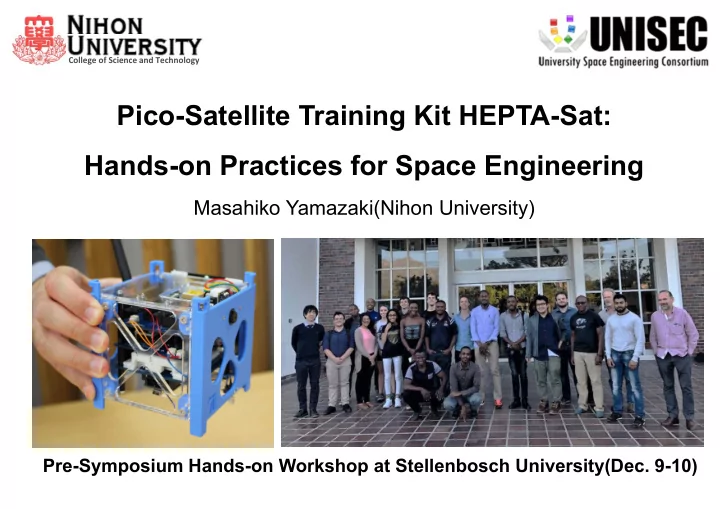
Pico-Satellite Training Kit HEPTA-Sat: Hands-on Practices for Space Engineering
Masahiko Yamazaki(Nihon University)
College of Science and Technology
Pre-Symposium Hands-on Workshop at Stellenbosch University(Dec. 9-10)
Pico-Satellite Training Kit HEPTA-Sat: Hands-on Practices for Space - - PowerPoint PPT Presentation
College of Science and Technology Pico-Satellite Training Kit HEPTA-Sat: Hands-on Practices for Space Engineering Masahiko Yamazaki(Nihon University) Pre-Symposium Hands-on Workshop at Stellenbosch University(Dec. 9-10) College of Science and
Masahiko Yamazaki(Nihon University)
College of Science and Technology
Pre-Symposium Hands-on Workshop at Stellenbosch University(Dec. 9-10)
College of Science and Technology
Pre-Symposium Hands-on Workshop at Stellenbosch University(Dec. 9-10)
Sensor Board C&DH Board EPS & Comm. Board
3
4
GPS 9-axis Flight Switch Antenna Thermal Sensor Memory MPU Release Switch
5
6
Satellite is possible to learn variety of elemental technologies Mechanical engineering, electronic engineering and communication engineering and it’s system integration. (Multi-disciplinary) To learn the space systems engineering, CubeSat development project based learning is a very effective training way. 6
1) Vibration and Shock 5) Thermal 4) High vacuum 3) Radiation 2) Mechanical, Electronic, Communication Eng.
7
Satellite is possible to learn variety of elemental technologies Mechanical engineering, electronic engineering and communication engineering and it’s system integration. (Multi-disciplinary) To learn the space systems engineering, CubeSat development project based learning is a very effective training way. It is sometimes hard to gain knowledge or experience of the whole development process because the roles are divided into team members.
8
Composed of 6 function and 6 primary sub-systems.
Function Subsystem
You can learn how each subsystem functions and how to integrate subsystems into a satellite through experiencing the process of assembly, integration including programing & system implementation and test.
9
Pin socket Electrically connected through pin- sockets. Every board has same electrical interface. Spacer Physically connected and fixed with spacer. Electrical Interface
10
Effective and low-cost tool over a short amount of time by oneself or by team. Almost all major equipment is removable and can be integrated repeatedly. The textbook allows beginners to study the software, hardware, and ultra- small satellites efficiently and systematically on their own. Users can design, manufacture and integrate their own circuit board to run an original mission. (User board)
11
Concept
Training: “Understanding basic satellite system architecture & Experiencing the pico-satellite development process” Goal of Training: “Experiencing the development process of ultra-small satellites in a short time and acquiring the basic knowledge of space engineering”
12
2MB_Flash_Memory (OBC) Micro SD (Memory) Serial (UART) I2C Camera SPI Accelerometer Gyroscope Magnetometer Transceiver GPS Transceiver Wireless communication PC USB Ground station GPS Satellites A/D converter EPS(Electrical Power Supply) Solar array Programming I/O Battery voltage check Mini- USB Pwm USER Port UART Switch Solar/DC Charger Flight Pin (F-SW-2) Battery Charge Management Controller Switch ON/OFF Flight Pin (F-SW-1) 3.3V converter 5.0V converter Release Detection Switch (R-SW) cs 5V 500mA Vout (3.3V) I/O Operational amplifier Thermal sensor Analog switch I/O 13
14
15
16
17
A hands-on class of about one day to a week was held for domestic and
18
A hands-on class of about one day to a week was held for domestic and
It held in Japan in September, Nepal in October, Bulgaria in November and South Africa in December 2017.
19
A hands-on class of about one day to a week was held for domestic and
It held in Japan in September, Nepal in October, Bulgaria in November and South Africa in December 2017.
20
Advanced satellite 1U CubeSat
Benefits of a hands-on education based on small satellite are… Experience the whole system construction. Create ideas out of nothing and integrate and accomplish the system to work correctly. Learn time and cost management, how to deal with risks, and how to work in a team. Be given feedback from the real world, not a desk study but a real experience through developing an actual spacecraft. These learning experiences can create opportunities for in-depth study of the mission plan, specialized theory, design, development and experiment, also for students who wish to learn fields other than space.