
SLIDE 1
Physicals: Scope (Extrapolate) Physicals: Scope (Extrapolate)
William Tschudi, LBNL
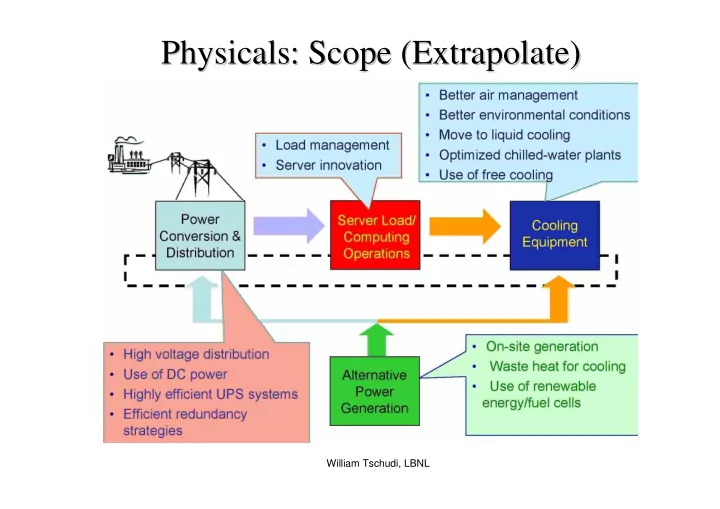
Physicals: Scope (Extrapolate) Physicals: Scope (Extrapolate) - - PowerPoint PPT Presentation
Physicals: Scope (Extrapolate) Physicals: Scope (Extrapolate) William Tschudi, LBNL Top Challenges for a Science of Physicals Models, models, models Understanding power dissipation, heat distribution, cooling, interactions
William Tschudi, LBNL
– Understanding power dissipation, heat distribution, cooling, interactions – Big “O” for energy
– Scheduling, multi-variable optimization – Formalism for multiple cooperating agents – The general power grid versus IT grid – Change the incentive structure related to electricity use
– Miniature “hobby” data centers + software toolkit
– Liquid, spray cooling – Low-loss power supplies – High-temperature materials
– Materials, packaging, architecture, enclosure, low-level software, applications – Define roles and interfaces, co-design and co-optimization, cooperating agents – “CAD for data centers”
– Extend current models to I/O, virtualization, multi-core CPUs, 3D stacking, solid-state storage, thermal cycling (relationship to performance) – More broadly: “algorithmic” energy consumption, e.g. big O for energy
– Model the relationship between power & temperature across tiers & domains – Model different types of cooling: air, liquid, free – High-temperature data centers: pushing the limits of reliability and new materials (places requirements on the software)
– Methodologies for properly designing for reliability (tradeoff between costs and UPS system and free cooling, for instance) – Models of battery discharge & efficiency according to shape of workload
– Formalisms to reason about interactions across areas, domains, and tiers
predictability, software for extrapolation, software to allow community to use
responsibilities of different domains and tier (time granularities), co- design and co-optimization of different tiers (e.g., architecture, materials, and cooling)
power supply technologies (e.g., smart power supplies, low-loss power storage), energy sources (e.g., to power PDAs)
– AC/DC conversion losses are a problem across the spectrum – Methodologies for properly designing for reliability (tradeoff between costs and UPS system and free cooling, for instance) – Co-design power generation and data center – Power storage for green energy sources – Electrical grid, supply/demand, electricity market, optimization – Models of battery discharge & efficiency according to shape of workload
– Models for power consumption and thermals: extend to I/O, virtualization, multi- core CPUs, 3D stacking, solid-state storage, thermal cycling – Models for “algorithmic” energy consumption, e.g. big O for energy – Time constants may be the key to simplifying models
– Models for relationship between power and temperature across tiers and domains: formalize current behaviors and predict future ones – Model different types of cooling: air, liquid, free – Attack heat at source: new techniques to distribute heat – High-temperature data centers (doesn’t work for other systems/devices): pushing the limits of reliability and new materials, places requirements on the software
– Formalisms to represent control agents – Theory of cooperating agents across tiers and domains
– Allow CPUs to run at higher temps (better materials or software fault tolerance) – Metrics for determining the quality of enclosure design – Cooling techniques, such as moving air flaps, floor tiles, etc – Develop cheaper rechargeable batteries and change the incentive structure – CAD for data centers
Top challenges for a “science” to consider
– Models, models, models…
– Optimization, optimization, optimization – big “O” for energy
– A methodology for repeatability and experimentation
– New technologies: “make the problem go away”
– Cross-area interactions