Physical processes affecting stratocumulus Siems et al. 1993 - - PowerPoint PPT Presentation

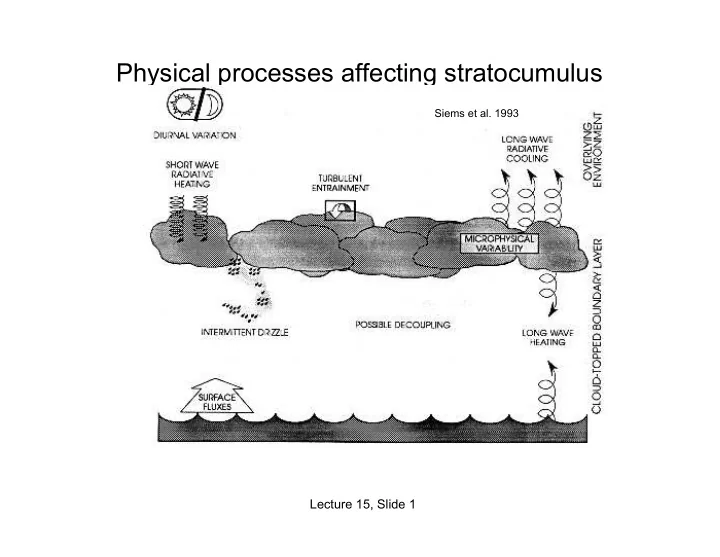
physical processes affecting stratocumulus
SMART_READER_LITE
LIVE PREVIEW

Physical processes affecting stratocumulus Siems et al. 1993 - - PowerPoint PPT Presentation

Physical processes affecting stratocumulus Siems et al. 1993 Lecture 15, Slide 1 Sc physical processes: Radiation Net upward radiative flux Strong longwave cooling at cloud top destabilizes SCBL, creating turbulence Shortwave heating in cloud


slide-1
SLIDE 1

Lecture 15, Slide 1

Physical processes affecting stratocumulus

Siems et al. 1993
slide-2
SLIDE 2

Lecture 15, Slide 2

Sc physical processes: Radiation

Strong longwave cooling at cloud top destabilizes SCBL, creating turbulence Shortwave heating in cloud cancels much of the longwave cooling during the day, weakening turbulence and favoring decoupling. Subtropical CBL radiative energy loss is usually large compared to surface heat flux.

Net upward radiative flux Diurnal cycle of net SCBL rad cooling

slide-3
SLIDE 3

Lecture 15, Slide 3

Profiles in a stratocumulus-capped mixed layer

‘Well-mixed’: Moist- conserved variables sl = cpT + gz - Lql, qt = qv + ql h = cpT + gz + Lqt are nearly uniform with height within the MBL.

ql increases linearly with z above cloud base

DYCOMS-II, July 2001 Stevens et al. 2003 QJ

slide-4
SLIDE 4

Sc diurnal cycle of liquid water path and albedo

Lecture 15, Slide 4

The diurnal cycle of cloud albedo (solid) and liquid water path (circles) averaged over 23 Jun - 15 Jul 1987 at San Nicholas Island off the California coast during the FIRE-MSC experiment.

slide-5
SLIDE 5

Lecture 15, Slide 5

Decoupled SCBL - midday, North Atlantic.

slide-6
SLIDE 6

Day vs. night profiles of turbulence in Sc-topped BL

Lecture 15, Slide 6

Mean daytime and nighttime vertical velocity variance profiles measured by a tethered balloon in June 1987 at San Nicolas Island off the CA coast during FIRE-MSC (Hignett 1991) .

slide-7
SLIDE 7

Lecture 15, Slide 7

SCBL diurnal cycle in SE Pacific sonde time series

3-hourly sondes show:

  • 1. Mixed-layer structure

with strong sharp inversion

  • 2. Regular night-time

increase in inversion height, cloud thickness.

  • 3. Decoupling measured

by cloud base - LCL increases during daytime and during periods of drizzle on 19, 21 Oct. (local noon = 18 UTC)

(Bretherton et al. 2004)

slide-8
SLIDE 8

Lecture 15, Slide 8

Sc physical processes: Precipitation

Drizzle: Drops > 100 µm radius, falling ~ 1 m s-1. Sedimentation (in cloud only): Cloud droplets less than 20 µm radius, falling a few cm s-1.

hourly cloud top hourly LCL hourly cloud base

Comstock et al. 2004

EPIC 8-mm vertically pointing ‘cloud radar’ observations of drizzling Sc z precip flux

1 mm/day

slide-9
SLIDE 9

Lecture 15, Slide 9

Sc physical processes: Turbulent entrainment

  • Driven by turbulence
  • Inhibited by a strong inversion
  • Must be measured indirectly (flux-

jump or budget residual methods)

Entrainment zone

we F+ F- flux -weF+ = flux -weF- +

′ w ′ F

e

′ w ′ F

e = −weΔF

DYCOMS-II RF01 (Stevens et al. 2003): Flight thru nocturnal Sc-capped mixed layer

slide-10
SLIDE 10

Budget residual method for estimating entrainment from ship obs

Lecture 15, Slide 10

A 6-day composite diurnal cycle of entrainment rate by SE Pacific Sc during EPIC 2001 (right) based on SCBL mass (black), moisture (blue) and heat budgets (red). All three estimates are qualitatively consistent, with strongest entrainment at night and typical magnitudes of 0-8 mm/s, but measurement uncertainties are large. Needed terms in the budget equations were deduced from radiosondes and ship-based

  • bservations of surface

precipitation, radiative and turbulent fluxes. ECMWF vertical motion was used in the mass budget and a clear- sky radiation calculation was used above the cloud layer.

Caldwell and Bretherton 2005