Photosynthesis Photosynthesis Photosynthesis Formula Game - - PDF document

photosynthesis
SMART_READER_LITE
LIVE PREVIEW

Photosynthesis Photosynthesis Photosynthesis Formula Game - - PDF document

Slide 1 / 44 Slide 2 / 44 7th Grade PSI Matter and Energy in Everyday Life www.njctl.org Slide 3 / 44 Slide 4 / 44 Table of Contents Click on the topic to go to that section Photosynthesis Photosynthesis Photosynthesis Formula Game


slide-1
SLIDE 1

Slide 1 / 44 Slide 2 / 44

7th Grade PSI Matter and Energy in Everyday Life

www.njctl.org

Slide 3 / 44 Table of Contents

· Photosynthesis · Photosynthesis Formula Game · Cellular Respiration · Matter and Energy Flow

Click on the topic to go to that section

Slide 4 / 44

Photosynthesis

Return to Table

  • f Contents

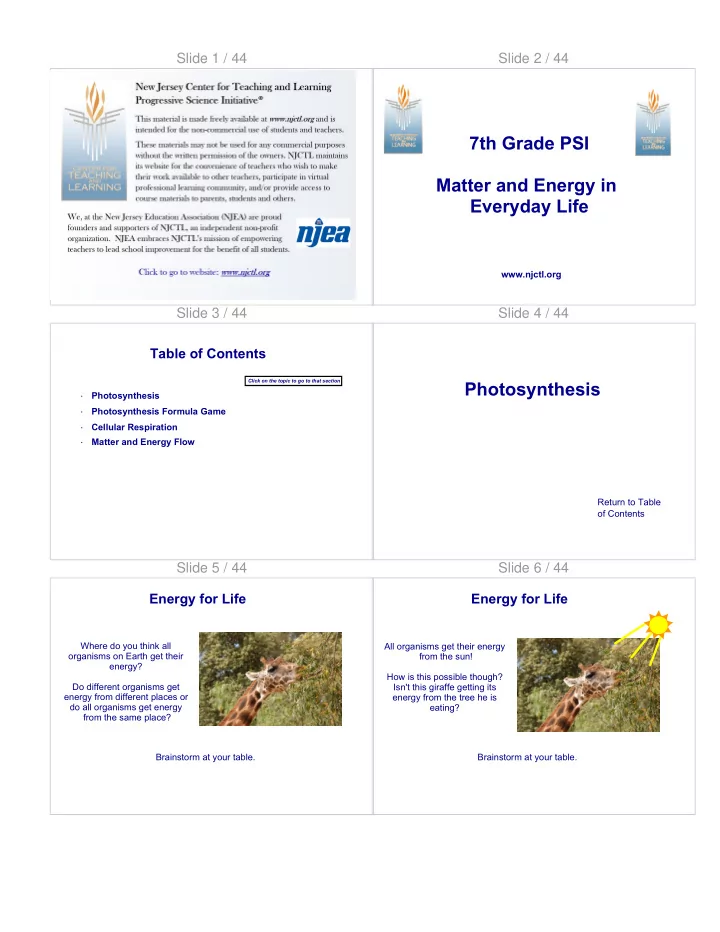
Slide 5 / 44 Energy for Life

Where do you think all

  • rganisms on Earth get their

energy? Do different organisms get energy from different places or do all organisms get energy from the same place? Brainstorm at your table.

Slide 6 / 44 Energy for Life

All organisms get their energy from the sun! How is this possible though? Isn't this giraffe getting its energy from the tree he is eating? Brainstorm at your table.

slide-2
SLIDE 2

Slide 7 / 44

The sun's energy cannot be used by cells without some help. Photosynthesis is the process that makes the energy of sunlight usable for all living things.

Photosynthesis

How do plants get the energy from the sun? Once you have come up with an idea, move the picture for the answer.

Slide 8 / 44

Are there any animals who perform photosynthesis? Plants Bacteria Algae Many living things can perform photosynthesis:

Photosynthesis Slide 9 / 44

1 Where does the energy for life come from?

A Earth B The Sun C Food D Fossil Fuels

Answer

Slide 10 / 44 Photosynthesis Discovery Lab

Complete Lab assignment according to teacher directions. Check out this video about photosynthesis. Teacher Note

Slide 11 / 44

In addition to food, what do plants provide to us which we (and the fish in this picture) need?

Chemicals involved in Photosynthesis Slide 12 / 44

Water: H2O Carbon Dioxide: CO2 Oxygen: O2 Glucose: C6H12O6

Glucose is sugar, a complex carbohydrate containing carbon. The individual molecules of Carbon, Hydrogen and Oxygen are joined together to make this molecule.

Chemicals involved in Photosynthesis

slide-3
SLIDE 3

Slide 13 / 44

2 What chemical is not part of the photosynthesis process? A carbon dioxide B water C glucose D carbon monoxide E oxygen

Answer

Slide 14 / 44 Plant Cell Review

In the last chapter, we learned about cells and organelles. At your table, think back and come up with a list of some cell characteristics and organelles which are specific to plants alone. Be ready to give an example to the class!

Slide 15 / 44

The pigment chlorophyll, which makes leaves green and is found inside the chloroplasts, collects the energy of sunlight. The roots collect water and the stomata of the leaves collect

  • CO2. These two materials are

called the reactants.

Reactants for Photosynthesis

Photosynthesis occurs mainly in the leaves of plants and in the chloroplasts.

Slide 16 / 44

3 Which of the following are used in Photosynthesis? (select all that apply)

A Sunlight B Water C Hydrogen D Carbon Dioxide Answer

Slide 17 / 44

4 Which plant parts are used in the collection of raw materials for photosynthesis? A chloroplast and endoplasmic reticulum B mitochondria and golgi body C leaves and nucleus D chloroplast and stomata

Answer

Slide 18 / 44

Step 1: Collection of raw materials (sunlight energy, water, carbon dioxide). Step 1 is called the light dependent reactions. Step 2: Processing of the raw materials to form glucose and

  • xygen. This step is called the Calvin Cycle, which is also

known as the light independent or dark reactions.

Photosynthesis is a multi-step process

slide-4
SLIDE 4

Slide 19 / 44

The Calvin Cycle occurs when the molecules of carbon dioxide and water are taken apart, rearranged and recombined using the energy in sunlight to make glucose and oxygen.

The Calvin Cycle

The Calvin Cycle is named for Melvin Calvin, who in 1937 alongside his colleagues at the University of California, discovered the process.

Slide 20 / 44

5 What is the name of the cycle that is also known as the light independent reactions? A Calvin Cycle B Photosynthesis Cycle C Hobbes Cycle D Respiration Cycle

Answer

Slide 21 / 44 Why is the Calvin Cycle also called the Dark Reaction?

It is not really dark! It can happen anytime

  • f the day, but does

not require light to work.

Slide 22 / 44 ______ + _____ _______ + ______ Equation for Photosynthesis

Drag and drop the reactants and products into the correct place in the equation. Carbon Dioxide Water Glucose Oxygen

Slide 23 / 44

The process can be simplified into the following equation:

6CO2 + 6H2O C6H12O2 + 6O2

sunlight

The equation above contains 6 carbon molecules, 12 hydrogen molecules, and 18 molecules in both the reactants and products. They have just been regrouped into different compounds.

Equation for Photosynthesis Slide 24 / 44 Photosynthesis Formula Game

Learn more about photosynthesis and formulas by playing this game. Return to Table of Contents Teacher Note

slide-5
SLIDE 5

Slide 25 / 44

6 What are the products of Photosynthesis? A Water and Carbon Dioxide B Glucose and Oxygen C Carbon Dioxide and Glucose D Water and Oxygen

Answer

Slide 26 / 44

The process of Photosynthesis has stored the energy of sunlight for later use!

Overall Idea: Photosynthesis

Glucose is used by the cell immediately or stored for growth

  • r later use. The oxygen is released as a waste product, it leaves

through the stomata. This is good news because humans and many other animals rely

  • n this oxygen!

Slide 27 / 44 Set Sail for the Island of Photosynthesis Project

Please use lab sheets to complete this assignment.

Slide 28 / 44

Cellular Respiration

Return to Table of Contents

Slide 29 / 44

Photosynthesis and respiration have a special relationship.

Photosynthesis and Cellular Respiration

In animals, breathing is also known as respiration. Our cells also need to breathe. What do you think the relationship between photosynthesis and respiration is?

Slide 30 / 44

Human and other animals do not photosynthesize. Instead, our cells perform a process called Cellular Respiration This happens in the mitochondria and the cytoplasm.

Cellular Respiration

slide-6
SLIDE 6

Slide 31 / 44

In photosynthesis, plants take in water and carbon dioxide and produce glucose and oxygen.

Photosynthesis vs. Cellular Respiration

Glucose (food) Oxygen

In order for cellular respiration to

  • ccur, cells need to take in this

glucose (sugar), which is collected through food. The cells also need this oxygen, which is collected by lungs, gills, or

  • ther similar structures.

Slide 32 / 44 Cellular Respiration

In this process, our cells also release energy. This means that cellular respiration is an exothermic reaction.

Glucose (food) Oxygen

H O H C O O

water Carbon Dioxide Energy

Our cells turn these reactants into water and carbon dioxide, which coincidentally is needed by photosynthetic organisms!

Slide 33 / 44 ____ + _____ _____ + _____+ _____ Equation for Cellular Respiration

Drag and drop the reactants and products into the correct place in the equation. Carbon Dioxide Water Glucose Oxygen Energy

Slide 34 / 44 Equation for Cellular Respiration

C6H12O6 + 6O2 6CO2 + 6H2O + ATP

This equation has 18 molecules of oxygen, 12 molecules of hydrogen and 6 molecules of carbon on both sides of the equation. ATP, or adenosine triphosphate, is the source of power in the cell.

Slide 35 / 44 Cellular Respiration Molecular Model Activity Slide 36 / 44 How does the formula for Cellular respiration relate to the formula for Photosynthesis?

Work together with your game boards from the Photosynthesis Formula game to complete the Venn Diagram in your class work section.
slide-7
SLIDE 7

Slide 37 / 44 Photosynthesis and Cellular Respiration Relationship

These two processes are opposites. The products of one are the raw materials of the other. Photosynthesis produces glucose and oxygen, which are then used by Cellular Respiration to release energy, carbon dioxide and water.

Slide 38 / 44

Photosynthesis

Cellular Respiration

Plants Use: ________ and Water Plants Produce: _______ and oxygen Carbon Dioxide and _______ Animals Produce: _________ Cell _____________ ________ Cell _____________ Animals Use glucose and ________

Fill in the blanks Slide 39 / 44

7 What is the relationship between Photosynthesis

and Cellular Respiration? A There is no relationship B They are identical C They are very similar, but not identical D They are opposite processes

Answer

Slide 40 / 44

Matter and Energy Flow

Return to Table

  • f Contents

Slide 41 / 44 Matter and Energy Flow

Now that we know how Photosynthesis and Respiration work together, let's think about how this system flows...

Photosynthesis Cellular Respiration

Slide 42 / 44 Complete the chart below _____________ ______________

Energy, Water and Carbon Dioxide RELEASED Energy STORED Glucose and Oxygen RELEASED

slide-8
SLIDE 8

Slide 43 / 44

8 How does energy flow through the cycle of Photosynthesis and Cellular Respiration? A Energy is stored and never released B Energy is stored by Photosynthesis and released by Cellular Respiration C Energy is released by Photosynthesis and stored by Cellular Respiration D Energy is released by Photosynthesis and Cellular Respiration

Answer

Slide 44 / 44 Draw your own Chart of matter and energy flow

Include: All materials and the amounts of each A plant An animal All terms Where energy is stored Where energy is released/ reused