Phases of dense matter in compact stars* David.Blaschke@gmail.com - - PowerPoint PPT Presentation

phases of dense matter in compact stars
SMART_READER_LITE
LIVE PREVIEW

Phases of dense matter in compact stars* David.Blaschke@gmail.com - - PowerPoint PPT Presentation

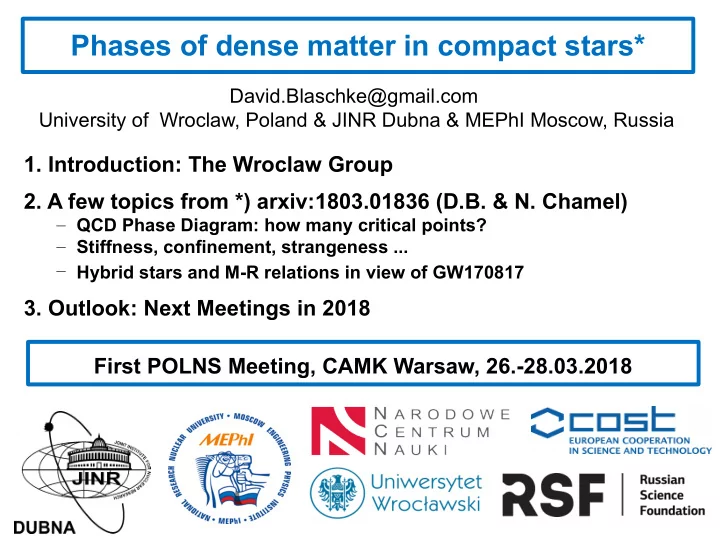
Phases of dense matter in compact stars* David.Blaschke@gmail.com University of Wroclaw, Poland & JINR Dubna & MEPhI Moscow, Russia 1. Introduction: The Wroclaw Group 2. A few topics from *) arxiv:1803.01836 (D.B. & N. Chamel)


slide-1
SLIDE 1

David.Blaschke@gmail.com University of Wroclaw, Poland & JINR Dubna & MEPhI Moscow, Russia

  • 1. Introduction: The Wroclaw Group
  • 2. A few topics from *) arxiv:1803.01836 (D.B. & N. Chamel)

– QCD Phase Diagram: how many critical points? – Stiffness, confinement, strangeness ... – Hybrid stars and M-R relations in view of GW170817

  • 3. Outlook: Next Meetings in 2018

Phases of dense matter in compact stars*

First POLNS Meeting, CAMK Warsaw, 26.-28.03.2018

slide-2
SLIDE 2

Division: Theory of Elementary Particles @ IFT UWr

Staff:

  • prof. dr hab. Krzysztof Redlich (head)
  • prof. dr hab. David Blaschke
  • prof. dr hab. Ludwik Turko

dr hab. Chihiro Sasaki, prof. Uwr dr hab. Tobias Fischer dr Pasi Huovinen dr Pok Man Lo PhD students: Dipl.-phys. Niels-Uwe Bastian mgr Łukasz Juchnowski mgr Maciej Lewicki mgr Michał Marczenko mgr Valeriya Mikhaylova mgr Michał Naskręt mgr Udita Shukla mgr Michał Szymański Master students: Ismail Soudi +many visitors from 4 continents Current NCN research projects: Maestro (1), Opus (4), Polonez (2) Main research topics:

  • Quantum field theory under extreme conditions
  • Physics of ultra-relativistic heavy-ion collisions
  • Physics of compact stars and supernovae

Publications in 2010-2015: 241 (98 with ALICE Collab.)

slide-3
SLIDE 3

Division: Theory of Elementary Particles - Collaborations

slide-4
SLIDE 4

Division: Theory of Elementary Particles - Collaborations

slide-5
SLIDE 5

Division: Theory of Elementary Particles - Collaborations

slide-6
SLIDE 6

Division: Theory of Elementary Particles - Collaborations

slide-7
SLIDE 7

Division: Theory of Elementary Particles - Collaborations

slide-8
SLIDE 8

Division: Theory of Elementary Particles - Collaborations

slide-9
SLIDE 9

Division: Theory of Elementary Particles - Collaborations

slide-10
SLIDE 10

Division: Theory of Elementary Particles

Energy and system size scan for Finding the QCD critical endpoint Collaboration with CERN Experiment NA61/SHINE since 2011 Goals of the experiment:

  • study of the properties of the onset of deconfinement and the search for the critical point of

strongly interacting matter with nucleus-nucleus, proton-proton and proton-lead collisions at six collision momenta

  • Precise hadron production measurements for calibrating neutrino beams at J-PARC, Japan

and Fermilab, US. Proton/pion-carbon and proton/pion-(replica target) interactions recorded

  • Precise hadron production measurements for reliable simulations of cosmic-ray air showers

in the Pierre Auger Observatory and KASCADE experiments

slide-11
SLIDE 11

Division: Theory of Elementary Particles

Collaboration with ALICE @ CERN

  • excellent particle identification
  • high statistics data allow new level

unprecendented accuracy

  • multihadron production near the

QCD phase boundary challenges

  • ur understanding of the process
  • f nonequilibrium QGP hadronization
  • confirmation of lattice QCD theory
slide-12
SLIDE 12

Particle Production in Strong, Time-dependent Fields

slide-13
SLIDE 13

Division: Theory of Elementary Particles

  • stiff EoS

(at flow limit)

  • low ncrit

(at NICA fixT)

  • soft EoS

(dashed line)

  • high Mmax

(J1614-2230)

  • low Monset

(all NS hybrid)

  • excluded

(J1614-2230)

Heavy-Ion Collisions Compact Stars

29 member countries

Collaboration with NICA – MPD Collaboration at JINR Dubna and COST Action MP1304 “NewCompStar”

slide-14
SLIDE 14

Division: Theory of Elementary Particles

PHAROS COST Action CA16214:

“The multi-messenger physics and astrophysics of neutron stars”

slide-15
SLIDE 15

21 member countries ! (CA15213)

!

New:

Kick-off: Brussels, October 17, 2016

THOR

“Theory of HOt Matter in Relativistic Heavy-Ion Collisions”

slide-16
SLIDE 16

International Conference “Critical Point and Onset of Deconfinement” University of Wroclaw, May 29 – June 4, 2016

slide-17
SLIDE 17

EPJA Topical Issues can be found at http://epja.epj.org/component/list/?task=topic

slide-18
SLIDE 18

Division: Theory of Elementary Particles http://www.ift.uni.wroc.pl/~ztce

slide-19
SLIDE 19

A few topics from:

Phases of dense matter in compact stars*

*) D. Blaschke & N. Chamel; arxiv:1803.01836 Invited contribution to the “CompStar White Book”, L. Rezzolla & P. Pizzochero (Eds.)

slide-20
SLIDE 20
  • A. Andronic, D. Blaschke, et al., “Hadron production ...”, Nucl. Phys. A 837 (2010) 65 - 86

CEP in the QCD phase diagram: HIC vs. Astrophysics

NuPECC Long Range Plan 2017; http://www.nupecc.org

slide-21
SLIDE 21

2nd CEP in QCD phase diagram: Quark-Hadron Continuity?

  • T. Schaefer & F. Wilczek, Phys. Rev. Lett. 82 (1999) 3956
  • C. Wetterich, Phys. Lett. B 462 (1999) 164
  • T. Hatsuda, M. Tachibana, T. Yamamoto & G. Baym, Phys. Rev. Lett. 97 (2006) 122001

Gluons ↔ Vector mesons Quarks ↔ Baryons Goldstones ↔ Pseudoscalar mesons

slide-22
SLIDE 22

Stiffness of NM / QM – where is the phase transition ?

Alford & Horowitz: INT-16-2b Kurkela, Fraga, Schaffner-Bieleich, Vuorinen (2014)

  • stiffening necessary in order to meet the 2M_sun constraint from pulsar mass measurement
  • where is the phase transition?
  • which character has the transition?
  • where is the transition to pQCD ?
  • can nuclear matter be “matched” to pQCD?
slide-23
SLIDE 23

Stiffness, confinement, strangeness ...

N.-U. Bastian & D.B., in preparation

  • T. Klaehn & T. Fischer, ApJ 810 (2015) 134
slide-24
SLIDE 24

David Blaschke, INT Seattle, 12.03. 2018

Was GW170817 not a neutron star merger?

EoS: DD2_P40 – SFM_α=0.3

  • M. Kaltenborn et al.

PRD 96 (2017) 056024 TOV / TD calculation:

  • M. Bejger et al.

Alternative: Hybrid star (HS) – HS / HS-NS merger

slide-25
SLIDE 25

Other examples: Multi-polytrope and multi-CSS model

  • V. Paschalidis et al., arxiv:1712.00451 (Phys. Rev. D)

Nonlocal NJL model (with interpolation), D. Alvarez-Castillo et al. (in preparation)

slide-26
SLIDE 26

Effect of a mixed phase: Pasta structures

do not destroy the HS-NS merger alternative Small surface tension – small structures

  • K. Maslov, N. Yasutake et al. (in prep.)

KVOR_cut2 – SFM_α=0.3,

  • A. Ayriyan et al., 1711.03926 (PRC accepted)
slide-27
SLIDE 27

Upcoming events in 2018

  • PHAROS WG2 Meeting, CAMK Warsaw, April 9-11
  • Quark matter 2018, Venice, May 14-19
  • NFQCD 2018, YITP Kyoto, May 28 – June 29
  • ICNFP 2018, OAC Kolymbari, July 3 – 13
  • HISS Dubna “Matter under Extreme Conditions ...”, August 20-31
  • CPOD 2018, Corfu, September 26-31 (?)
  • IWARA 2018, Machu Pichu, September 9-16
  • Erice School 2018, September 16-24
slide-28
SLIDE 28

Backup slides

slide-29
SLIDE 29

Alternative facts of the day: New hybrid star solutions!

arxiv:1711.06244v1, 1611.2017

slide-30
SLIDE 30

Alternative facts of the day: New hybrid star solutions!

arxiv:1711.06244v1, 1611.2017

Fake News: Nuclear matter would be unstable! Not in our part of the Multiverse !!!

slide-31
SLIDE 31

History: Third family & Nonidentical Twins

slide-32
SLIDE 32

History: Third family & Nonidentical Twins

astro-ph/9807155; A&A (2000) L9 The original Twin paper uses Glendenning construction, not Maxwell one - Surface tension zero vs. infty! Pasta phases in-between ...

slide-33
SLIDE 33

Neutron Star Interiors: Strong Phase Transition?

slide-34
SLIDE 34

Neutron Star Interiors: Strong Phase Transition?

slide-35
SLIDE 35

Neutron Star Interiors: Strong Phase Transition?

slide-36
SLIDE 36

Neutron Star Interiors: Strong Phase Transition?

slide-37
SLIDE 37

Mass-Radius Constraints: GW170817 & NICER

GW170817, announced on 16.10.2017 B.P. Abbott et al. [LIGO/Virgo Collab.], PRL 119, 161101 (2017); ApJLett 848, L12 (2017)

slide-38
SLIDE 38

GW170817: NS-NS Merger

GW170817, announced on 16.10.2017 B.P. Abbott et al. [LIGO/Virgo Collab.], PRL 119, 161101 (2017); ApJLett 848, L12 (2017) Multi-Messenger Astrophysics !! M < 2.17 M_sun (arxiv:1710.05938)

slide-39
SLIDE 39

GW170817: NS-NS Merger – Equation of State Constraints

  • M. Bejger, D.B., et al., in preparation (2017)
  • V. Paschalidis, K. Yagi, D. Alvarez-Castillo,

D.B., A. Sedrakian, arxiv:1712.00451 (2017) Suggestion: The heavier NS be a hybrid star (HS) with a quark core, evtl. member of a “third family”!

slide-40
SLIDE 40

High-mass twins (HMT) or typical-mass twins (TMT) ? For a classification see: J.-E. Christian, A. Zacchi, J. Schaffner-Bielich, arxiv:1707.07524

  • V. Paschalidis et al., arxiv:1712.00451

Neutron Star Interiors: Strong Phase Transition? M-R Relation!

slide-41
SLIDE 41

PRD88, 013083 (2013)

2.1 Constant Speed of Sound (CSS) Model

slide-42
SLIDE 42

Key fact: Mass “twins” ↔ 1st order PT

Systematic Classification [Alford, Han, Prakash: PRD88, 083013 (2013)]

EoS P(ε) <--> Compact star phenomenology M(R)

Most interesting and clear-cut cases: (D)isconnected and (B)oth – high-mass twins!

slide-43
SLIDE 43

“Holy Grail” - High-Mass Twin Stars

Alvarez & Blaschke, arxiv:1304.7758

Twins prove exitence of disconnected populations (third family) in the M-R diagram Consequence of a first order phase transition Question: Do twins prove the 1st order phase trans.?

slide-44
SLIDE 44

How likely is it that s-quarks (and no s-bar) exist and survive in neutron stars in a QGP

  • r in hyperons. How large is then the ratio s/(u+d) in neutron stars and in the Universe?

There could also be single flavor quark matter, mixed with nuclear matter (d-quark dripline) Increasing density D.B., F. Sandin, T. Klaehn, J. Berdermann, PRC 80 (2009) 065807

Neutron Star Interiors: Sequential Phase Transitions?

slide-45
SLIDE 45

How likely is it that s-quarks (and no s-bar) exist and survive in neutron stars in a QGP

  • r in hyperons. How large is then the ratio s/(u+d) in neutron stars and in the Universe?

There could also be single flavor quark matter, mixed with nuclear matter (d-quark dripline) D.B., F. Sandin, T. Klaehn, J. Berdermann, PRC 80 (2009) 065807

Neutron Star Interiors: Sequential Phase Transitions?

slide-46
SLIDE 46

Measuring Mass vs. Radius Equation of state High-mass twins:

  • D. Blaschke et al., PoS CPOD 2013
  • S. Benic et al., A&A 577 (2015) A50

High-mass triples and fourth family:

  • M. Alford and A. Sedrakian, arxiv:1706.01592

PRL 119 (2017)

Neutron Star Interiors: Sequential Phase Transitions?

slide-47
SLIDE 47

Measuring Mass vs. Radius Equation of state High-mass twins:

  • D. Blaschke et al., PoS CPOD 2013
  • S. Benic et al., A&A 577 (2015) A50

High-mass triples and fifth family:

  • A. Ayriyan, D.B., H. Grigorian, in preparation (2017)

Neutron Star Interiors: Sequential Phase Transitions?

slide-48
SLIDE 48
  • 3. Piecewise polytrope EoS

– high mass twins (HMT)?

  • J. Read et al., PRD 79, 124032 (2009)

Case E: HMT @ 2 Msun

slide-49
SLIDE 49
  • 3. Piecewise polytrope EoS – high mass twins?

Hebeler et al., ApJ 773, 11 (2013)

slide-50
SLIDE 50
  • 3. Piecewise polytrope EoS – high mass twins?

Hebeler et al., ApJ 773, 11 (2013) Here, 1st order PT in region 2: Maxwell construction: Seidov criterion for instability:

slide-51
SLIDE 51
  • 3. Piecewise polytrope EoS – high mass twins?

Third family solutions found at 2 Msol (HMT), 4-tropes favored; match with Hebeler et al.! [D. Alvarez & D.B. PRC 96 (2017) 045809] All sets with same onset of phase transition; Pcrit = 63.2 MeV/fm3, εcrit = 318.3 MeV/fm3 and same jump in energy density Δε = 253.9 MeV/fm3; varying Γ3

slide-52
SLIDE 52

Arxiv:1711.02644 [astro-ph.HE] Unfortunately, twins and third family forgotten !!! For this aim, 2- and 3-tropes not sufficient, 4-tropes!

slide-53
SLIDE 53

arxiv:1712.00451 [astro-ph.HE] CSS model (ACSX) MP model (ACBx)

slide-54
SLIDE 54

Relativistic density functional approach to quark matter - string-flip model (SFM)

M.A.R. Kaltenborn, N.-U.F. Bastian, D.B. Blaschke, PRD 96 (2017) ; arxiv:1701.04400 v3

slide-55
SLIDE 55
slide-56
SLIDE 56

Relativistic density functional approach* (I)

*This work was inspired by the textbook on “Thermodynamics and statistical mechanics” of the “red” series on Theoretical Physics by Walter Greiner and Coworkers. General nonlinear functional of quark density bilinears: scalar, vector, isovector, diquark ... Expansion around the expectation values:

slide-57
SLIDE 57

Relativistic density functional approach (II)

“no sea” approximation ... Selfconsistent densities

slide-58
SLIDE 58

Relativistic density functional approach (III)

Density functional for the SFM Quark “confinement” Quark selfenergies String tension & confinement due to dual Meissner effect (dual superconductor model) Effective screening of the string tension in dense matter by a reduction of the available volume

slide-59
SLIDE 59
  • 3. Phase transition to SFM quark matter

Hadronic matter: DD2 with excluded volume [S. Typel, EPJA 52 (3) (2016)] Varying the hadronic excluded volume parameter, p00 → v=0, … , p80 → v=8 fm^3

slide-60
SLIDE 60
  • Phys. Rev. D 96 (2017) to appear 22.09.
slide-61
SLIDE 61

KVOR_cut2 vs. string-flip model (SFM)

  • A. Ayriyan, N.-U.Bastian, D.B., H. Grigorian, K. Maslov, D. Voskresensky; arxiv:1711.03926
slide-62
SLIDE 62

Robustness of Twins against Pasta Phase Effects

arxiv:1711.03926v1, 10.11.2017

slide-63
SLIDE 63

Robustness of Twins against Pasta Phase Effects

arxiv:1711.03926v1, 10.11.2017

slide-64
SLIDE 64
  • A. Andronic, D. Blaschke, et al., “Hadron production ...”, Nucl. Phys. A 837 (2010) 65 - 86

CEP in the QCD phase diagram: HIC vs. Astrophysics

NuPECC Long Range Plan 2017; http://www.nupecc.org

slide-65
SLIDE 65

Conclusions:

High-mass twin (HMT) and Typical-mass twin (TMT) solutions obtained within different hybrid star EoS, e.g.,

  • constant speed of sound
  • higher order NJL
  • piecewise polytrope
  • density functional

Main condition: stiff hadronic & stiff quark matter EoS with strong phase transition (PT) Critical endpoint search in the QCD phase diagram with Heavy-Ion Collisions goes well together with Compact Star Astrophysics Existence of HMTs & TMTs can be verified, e.g., by precise pulsar mass and radius measurements (and good luck) → Indicator for strong PT !! Extremely interesting scenarios possible for dynamical evolution of isolated (spin-down and accretion) and binary (NS-NS merger) compact stars; GW170817 could be the inspiral of a neutron star – hybrid star binary !

slide-66
SLIDE 66

29 member countries !! (MP1304)

!

New

Kick-off: Brussels, November 25, 2013

slide-67
SLIDE 67

Backup slides

slide-68
SLIDE 68

Quark matter in 2Msun neutron stars? → only color superconducting + vector int.

  • T. Klahn et al., PRD 88 (2013) 085001; arxiv:1307.696
slide-69
SLIDE 69

Neutron Star Interiors: Strong Phase Transition?

slide-70
SLIDE 70

Neutron Star Interiors: Strong Phase Transition?

  • F. Weber:

“Neutron Stars - Cosmic Labs ...” IoP Bristol, 1999

slide-71
SLIDE 71

Goal: Hadron Dissociation in the QCD Phase Diagram

slide-72
SLIDE 72

Statistical Model of Hadron Resonance Gas Well established for Description of chemical freezeout

Goal: Hadron Dissociation in the QCD Phase Diagram

slide-73
SLIDE 73

Statistical Model of Hadron Resonance Gas Well established for Description of chemical freezeout Perturbative QCD Approximately selfconsistent HTL resummation (T > 2.5 Tc , μ > 1500 MeV)

Goal: Hadron Dissociation in the QCD Phase Diagram

slide-74
SLIDE 74

Statistical Model of Hadron Resonance Gas Well established for Description of chemical freezeout Perturbative QCD Approximately selfconsistent HTL resummation (T > 2.5 Tc , μ > 1500 MeV) QCD Phase transition(s) Mott dissociation of hadrons, Deconfinement, χSR

Goal: Hadron Dissociation in the QCD Phase Diagram

slide-75
SLIDE 75

Φ-derivable approach, 2-loop approximation

J.-P. Blaizot, E. Iancu, A. Rebhan, Phys. Rev. D 63 (2001) 065003 Skeleton expansion for thermodynamic potential and entropy

  • Inv. Temp: 1/T trace in conf. Space self-energy related to D

Dyson equation: Free propagator Do is known Essential property of Ω[D] is Stationarity under variation of D: δ Ω[D] / δ D = 0 This implies δ Φ[D] / δ D = 1/2 Π Physical propagator and selfenergy are defined self-consistently ! Self-consistent approximations are defined by the choice of Φ

Φ – derivable theories

  • G. Baym, Phys. Rev. 127 (1962) 1391; Vanderheyden & Baym; J. Stat. Phys. 93, 843 (1998)
slide-76
SLIDE 76

Approximately selfconsistent thermodynamics

Matsubara summation: Analytic properties: Thermodynamics from entropy density: for two-loop skeleton diagrams Loosely speaking: S' accounts for residual interactions of “independent quasiparticles” d/dω [ Im log D-1 + ImΠ ReD ] = 2 Im [ D ImΠ (d/dω D*) ImΠ] = 2 sin2δ dδ/dω , for D = |D|eiδ

  • D. B., G. Baym & G. Roepke, in preparation (2017)
slide-77
SLIDE 77

Φ-derivable Q-M-D PNJL model, 2-loop approximation

slide-78
SLIDE 78

Φ-derivable Q-M-D PNJL model, 2-loop approximation

slide-79
SLIDE 79

Φ-derivable Q-M-D PNJL model, 2-loop approximation

Use optical theorems ... Effect of the sin^2 term ... example: Breit-Wigner ... “Squared Breit-Wigner” ... Vanderheyden & Baym (1998) Morozov & Roepke (2009) Generalized Beth-Uhlenbeck EoS