Phase II Extension Project Downtown-Diridon Community Working Group - - PowerPoint PPT Presentation

phase ii extension project
SMART_READER_LITE
LIVE PREVIEW

Phase II Extension Project Downtown-Diridon Community Working Group - - PowerPoint PPT Presentation

VTAs BART Silicon Valley Phase II Extension Project Downtown-Diridon Community Working Group February 11, 2020 Agenda Follow-up items CWG Member Report Back Government Affairs Phase II Update & Related Planning

slide-1
SLIDE 1

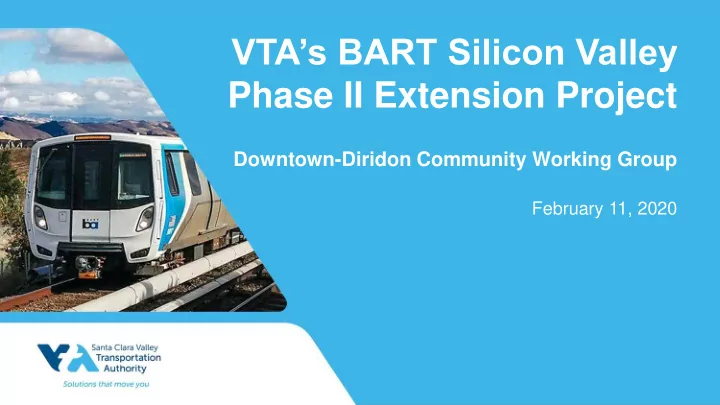
VTA’s BART Silicon Valley Phase II Extension Project

Downtown-Diridon Community Working Group

February 11, 2020

slide-2
SLIDE 2

Agenda

  • Follow-up items
  • CWG Member Report Back
  • Government Affairs
  • Phase II Update & Related Planning Efforts
  • Construction Education & Outreach Plan
  • VTA Block Design Development Framework
  • City of San José Airport Connector
  • Next Steps
slide-3
SLIDE 3

Role of the CWG

  • Be project liaisons
  • Receive briefings on technical areas
  • Receive project updates
  • Build an understanding of the project
  • Collaborate with VTA
  • Contribute to the successful delivery of the project

3

slide-4
SLIDE 4

Your Role as a CWG Member

  • Attend CWG meetings
  • Bring your own binder (BYOB)
  • Be honest
  • Provide feedback
  • Get informed
  • Disseminate accurate information
  • Act as conduits for information to community at large

4

slide-5
SLIDE 5

Role of the CWG Team

CWG Team Member Role Eileen Goodwin Facilitator Gretchen Baisa Primary Outreach Contact Jill Gibson Phase II Planning & Outreach Manager Kate Christopherson CWG Coordinator

5

slide-6
SLIDE 6

Upcoming Meetings

  • CWG Dates
  • May 12, 2020, 4:00 – 6:00 PM
  • September 15, 2020, 4:00 – 6:00 PM
  • November 17, 2020, 4:00 – 6:00 PM
  • VTA Board of Directors

(https://www.vta.org/about/board-and-committees)

  • March 5, 2020, 5:30 PM
  • April 2, 2020, 5:30 PM
  • May 7, 2020, 5:30 PM
  • Joint Policy Advisory Board (JPAB)
  • March 6, 2020, 3:00 PM

6

slide-7
SLIDE 7

Follow-Up Items

7

slide-8
SLIDE 8

Follow-Up Items

  • The Phase I fare slide in the November CWG presentation was updated

with the correct fare to SF’s Embarcadero Station.

  • Shared request with VTA planning on a Route 181 survey.
  • VTA included the February 11th Industry Forum details in the November

meeting summary. Details for VTA’s Industry Forum on February 11, 2020 can be found using the following link: https://www.eventbrite.com/e/vtas-bart-phase-ii-industry-forum-tickets- 76347775251

8

slide-9
SLIDE 9

Follow-Up Items

  • VTA shared information on MTC’s Fare Integration Study with the CWG
  • n January 20, 2020. https://www.greencaltrain.com/2019/10/fare-

integration-study-moves-forward/

  • VTA will update CWG members with funding plan updates when more

information is available.

9

slide-10
SLIDE 10

CWG Member Report Back

10

slide-11
SLIDE 11

Government Affairs

Aaron Quigley, VTA

11

slide-12
SLIDE 12

Government Affairs

12

slide-13
SLIDE 13

13

Questions?

slide-14
SLIDE 14

Phase II Update & Related Planning Efforts

Jill Gibson, VTA

14

slide-15
SLIDE 15

Phase I Update

  • VTA is currently resolving items that were identified during BART’s

acceptance testing

  • BART will then reinitiate the Phase 3 acceptance testing, then

commence pre-revenue operations

  • Once discrepancies are resolved and BART reinitiates the Phase 3

acceptance testing, the VTA/BART team will be able to provide a schedule forecast for when passenger service is scheduled to begin Board Packet: http://santaclaravta.iqm2.com/Citizens/FileOpen.aspx?Type=1&ID=2956&I nline=True

15

slide-16
SLIDE 16

Phase II Update – General Updates

VTA's BART Silicon Valley Program Delivery Chief: Takis Salpeas Experience includes: MIA Mover, BART Airport Connector, Dulles Silver Line, Utah Transit Authority Light Rail, Los Angeles Expo and Foothill Connector, plus Dubai, Riyadh, Saudi Arabia and Doha Metros

16

slide-17
SLIDE 17

Phase II Update – General Updates

  • 10% Design Received
  • VTA has received the 10% design and is reviewing and

evaluating the project scope, schedule, and budget.

  • Federal Transit Administration’s Expedited Project

Delivery Pilot Program

  • VTA and the Federal Transit Administration (FTA)

continue coordinating the federal funding process.

  • Would fund a maximum 25 percent of the total Phase II

project cost.

  • Notice of approval or disapproval of a grant request is

received within 120 days.

17

slide-18
SLIDE 18

CEOP: communication during construction between VTA, various municipalities, and the public CTMP: coordinate circulation and access within and around the construction areas for all modes ESCP: minimize impact to local emergency service routes and response times due to construction activities

Construction Outreach Management Program

18

… to be incorporated into all plans and specifications of all contracts through which Phase II will be implemented.

slide-19
SLIDE 19

Construction Transportation Management Plan

19

Guiding document to coordinate location-specific circulation and access within and around construction

  • areas. Includes:
  • Alternative access routes, detours, and supporting signage
  • Minimum requirements for pedestrians and cyclists
  • Coordination with VTA Operations and transit providers on transit

impacts

  • Early and advanced signage for transit riders
  • Parking impact maps and schedules
  • Emergency access requirements
slide-20
SLIDE 20

Construction Transportation Management Plan

  • Surveys, interviews, and observations
  • Engage a range of Stakeholders
  • e.g., Schools, churches, businesses, event centers, etc
  • Developing in partnership with the cities
  • Guides the specific Traffic Control Plans (TCP)

20

slide-21
SLIDE 21

Industry Forum – February 11th , 2020

slide-22
SLIDE 22

Industry Forum - Video

22

slide-23
SLIDE 23

24

Questions?

slide-24
SLIDE 24

Transit Oriented Communities

  • San José City Council accepted and

endorsed the Downtown San José and 28th Street / Little Portugal Playbooks on December 10, 2019.

  • Playbooks have been updated based
  • n feedback received.
  • Councilmember Peralez’s memo highlighted

the need for future commercial real estate analysis on how changes to requirements will impact small businesses

  • VTA applied for FTA’s Transit-Oriented

Development grant in November 2019.

25

slide-25
SLIDE 25

Diridon Integrated Station Concept Plan Updates

  • Presented the staff-recommended Concept Layout to the Joint

Policy Advisory Board on November 15, 2019

  • Held Diridon Station virtual town hall on November 22, 2019
  • Explored rail alignments at San José City Council Study Session
  • n January 28th, 2020
  • Partner Agency Boards and Council to consider acceptance of the

Concept Layout in February and March

26

https://www.diridonsj.org/

slide-26
SLIDE 26

27

Questions?

slide-27
SLIDE 27

Construction Education & Outreach Plan

Gretchen Baisa, VTA

28

slide-28
SLIDE 28

General Outreach Update

  • Developing New Communication Tools for

Construction:

  • SMS Construction Alert Notifications
  • Webform Capability on Project Website

(i.e., report any construction issues)

  • GIS Based Feedback Capabilities
  • Developing Part B (Pre-construction) of the

CEOP

29

Example of SMS Construction Alerts

slide-29
SLIDE 29

Public Outreach for Next Steps in EPD Process

The goal: Share new information with public on project details and construction sequencing

  • Timing: Late Spring, based on Federal Funding Milestone
  • VTA hosted meetings to be held along the alignment
  • CWG Action: Spread the word and volunteer!
  • VTA staff to join existing community, organization and neighborhood meetings
  • CWG Action: Invite us to present!
  • Event Tabling
  • Webinar and Video Presentations

30

slide-30
SLIDE 30

Small Business Program

Small Business Task Force

  • First Meeting held 11/20/2019
  • Helped develop business survey

Next Steps:

  • Assist in survey distribution
  • Review Case Studies
  • Inform construction contracts

Next meeting to be held late March

31 Business Survey

slide-31
SLIDE 31

Introducing Construction Contract Specifications

  • Contracts with engineering and construction firms usually

include requirements for impacts such as:​

  • Site set-up and management, access, notifications, and mitigations
  • These requirements can be deliberately designed to help reduce

construction impacts on neighbors

  • Small Business Task Force to inform construction contract specifications

32

slide-32
SLIDE 32

Example: Enhanced Construction Signs

33

We can specify construction contractors to place signs like these – which help you know what we require of them!

slide-33
SLIDE 33

Example: Enhanced Fencing – Business Continuity and Wayfinding

34

slide-34
SLIDE 34

35

Questions?

slide-35
SLIDE 35

VTA Block Design Development Framework

Marcy Kamerath, VTA Jeremy Nelson, VTA

36

slide-36
SLIDE 36

VTA Block Design Development Framework (DDF) Goals

VTA-led process to provide a clearly-articulated framework for future TOD on the block Goals:

  • Optimize TOD outcomes given multiple parcel owners
  • Maximize public amenities/benefits, transit ridership,

and ground-lease revenues to VTA

  • Ensure world class urban design, architecture, and

sustainable development

  • Identify potential public-private partnership (P3)
  • pportunities

VTA Block Ownership

37

slide-37
SLIDE 37

VTA Block DDF Outcomes

Outcomes:

  • Optimal building footprints to maximize TOD

yield and design quality

  • Site design, access/circulation, and

functional requirements

  • Shared amenities (loading, parking, etc.)
  • Sustainable development
  • Selection criteria for development proposals
  • RFQs/RFPs for TOD on VTA-owned parcels

Future TOD subject to environmental review and City approvals

Artist’s Rendering

38

slide-38
SLIDE 38

VTA Block DDF Schedule

39

slide-39
SLIDE 39

Preliminary Site Plan/Massing Concepts

40

slide-40
SLIDE 40

Emphasize public space and activation by freeing rooftops and the ground floor Balance connectivity of the site with constructability by having square corners Provide clear, incremental way to phase development Evaluate a greater density, that grows over time (Floor Area Ratio of 8-11)

Refining the Concepts: Engagement Input

41

slide-41
SLIDE 41

Refining the Concepts: Policies and City Guidelines

Example:

DO NOT create a long building that breaks the human scale of the street DO NOT leave the Skyline unanchored to the ground DO divide a building with over 100’ in width with breaks in massing DO extend Skyline Level tower massing ground level

slide-42
SLIDE 42

Next Steps and Discussion

slide-43
SLIDE 43

Refining the Concepts:

Example Development Performance Criteria

8 3.1 6

FAR Solar (Winter) Solar (Summer)

24% 23% 188k

Views (Park) Views (Mountains) Accessible Roof Area

slide-44
SLIDE 44

Next Steps and Discussion

slide-45
SLIDE 45

Preliminary Parking Capacity Analysis

1,688 spaces 1,688 spaces 800 - 1,000 spaces 400 - 500 spaces

Current City Code Requirement Most Cost-effective TOD Approach

slide-46
SLIDE 46

Next Steps and Discussion

slide-47
SLIDE 47

Next Steps and Discussion

slide-48
SLIDE 48

Next Steps and Discussion

slide-49
SLIDE 49

Next Steps

  • Refine preliminary site/massing concepts
  • Create implementation tools and strategy

to support the vision

  • Ongoing engagement
slide-50
SLIDE 50

51

Questions?

slide-51
SLIDE 51

February 2020 CWG

New Transit Options RFI: Airport Connector and Stevens Creek Line

slide-52
SLIDE 52

The Corridor

53

slide-53
SLIDE 53

What we want to learn

1. Are there new technologies, project delivery, or operating models that can provide grade-separated, high-capacity, high-speed transit? 2. Do these systems have lower construction, operations, and/or maintenance costs than traditional systems? 3. Can these systems be deployed faster than traditional projects? 4. Do these systems have viable financial outlooks? 5. How will these systems be constructed and deliver service on the specified corridors?

54

slide-54
SLIDE 54

Station entrance Station building Pedestrian area Bicycle path Platforms Retail / Cultural Residential / Mixed-use

Preliminary Artist Illustration

The Concept Layout

N

55

slide-55
SLIDE 55

What’s the End Goal: Connecting more people and areas to high quality transit

5 4 3 2 1

56

slide-56
SLIDE 56

The process so far

Conceptual information gathering and coalition building

RFI Period

  • Jul. - Sep. 2019

Drafted RFI

San Jose organized the the drafting of the RFI

  • Feb. - Jun. 2019

San Jose Council direction

Direction to explore new transit options

  • Feb. 2019

Stevens Creek transportation planning coordination

Resolutions of support for Complete Streets Study and transit studies

2018 - 2019

Measure A and prior studies

Measure A - Airport connecter to BART, Caltrain, and LRT 3 prior studies have been produced.

2000 - 2016

57

slide-57
SLIDE 57

Submissions

58

slide-58
SLIDE 58

Submissions

59

slide-59
SLIDE 59

Submissions

Link to Press Release with link to all submissions

https://files.constantcontact.com/7a210436601/bee9e666-c432-413d-97c6-d7f712b97f95.pdf

60

slide-60
SLIDE 60

Technology

Viability and maturity of

  • Infrastructure
  • Transit Vehicle

Value

  • System capacity
  • Rider experience
  • Scalability

Delivery & Cap Finance

  • Company readiness
  • Timeframe
  • Cost
  • Cap finance model

Operations

  • Model
  • Financial

sustainability

Evaluation Overview

61

slide-61
SLIDE 61

Questions?

Ramses Madou Division Manager of Planning, Policy, and Sustainability City of San Jose ramses.madou@sanjoseca.gov

62

slide-62
SLIDE 62

Next Steps

  • Next CWG meeting:

Tuesday, May 12, 2020, 4:00 – 6:00 PM, San José City Hall, Wing Rooms 118/119

  • Action Items

63

  • CWG Member Report Backs
  • Diridon Integrated Station

Concept Plan

  • Phase II Update
  • Construction Education &

Outreach Plan

  • Real Estate Update
  • VTA Block Design

Development Framework