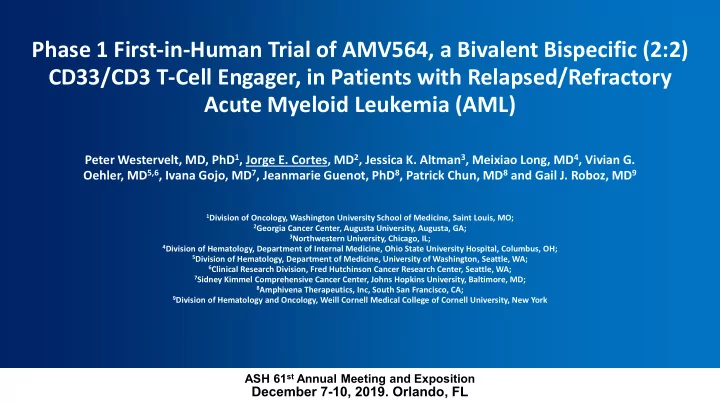
Phase 1 First-in-Human Trial of AMV564, a Bivalent Bispecific (2:2) - - PowerPoint PPT Presentation

phase 1 first in human trial of amv564 a bivalent
SMART_READER_LITE
LIVE PREVIEW

Phase 1 First-in-Human Trial of AMV564, a Bivalent Bispecific (2:2) - - PowerPoint PPT Presentation

Phase 1 First-in-Human Trial of AMV564, a Bivalent Bispecific (2:2) CD33/CD3 T-Cell Engager, in Patients with Relapsed/Refractory Acute Myeloid Leukemia (AML) Peter Westervelt, MD, PhD 1 , Jorge E. Cortes, MD 2 , Jessica K. Altman 3 , Meixiao


slide-1
SLIDE 1

Phase 1 First-in-Human Trial of AMV564, a Bivalent Bispecific (2:2) CD33/CD3 T-Cell Engager, in Patients with Relapsed/Refractory Acute Myeloid Leukemia (AML)

Peter Westervelt, MD, PhD1, Jorge E. Cortes, MD2, Jessica K. Altman3, Meixiao Long, MD4, Vivian G. Oehler, MD5,6, Ivana Gojo, MD7, Jeanmarie Guenot, PhD8, Patrick Chun, MD8 and Gail J. Roboz, MD9

1Division of Oncology, Washington University School of Medicine, Saint Louis, MO; 2Georgia Cancer Center, Augusta University, Augusta, GA; 3Northwestern University, Chicago, IL; 4Division of Hematology, Department of Internal Medicine, Ohio State University Hospital, Columbus, OH; 5Division of Hematology, Department of Medicine, University of Washington, Seattle, WA; 6Clinical Research Division, Fred Hutchinson Cancer Research Center, Seattle, WA; 7Sidney Kimmel Comprehensive Cancer Center, Johns Hopkins University, Baltimore, MD; 8Amphivena Therapeutics, Inc, South San Francisco, CA; 9Division of Hematology and Oncology, Weill Cornell Medical College of Cornell University, New York

ASH 61st Annual Meeting and Exposition

December 7-10, 2019. Orlando, FL

slide-2
SLIDE 2

AMV564: A Bivalent, Bispecific CD33/CD3 T-cell Engager

AMV564: Binding Sites & Mechanism of Action

  • CD33 Expressed on AML blasts
  • EC50 4 - 8 pM for target-dependent killing of AML cell lines

AMV564: Selectivity

2 CD33 Binding Sites 2 CD3 Binding Sites

1Amphivena Therapeutics, Inc. https://amphivena.com/amv564/ 2Chen X, et al. Induction of myelodysplasia by myeloid-derived suppressor cells. J Clin Invest. 2013;123(11):4595-611.

AMV564 Selectivity for CD33- signaling/clustered Monovalent T-cells engagers cannot distinguish cell types

slide-3
SLIDE 3

0.5 – 50 mcg 100 mcg 150 mcg 200 mcg 250 mcg

3+3 DESIGN (14 Days Continuous IV Infusion on a 28 Day cycle)

AMV564-101 Phase 1 Clinical Study Design: Relapsed/Refractory AML

450 mcg 300 mcg

Key Eligibility Criteria

  • Age ≥ 18 years
  • Relapsed or refractory

disease

  • 1-3 prior induction/salvage

regimens

  • Secondary AML
  • ECOG 0-2
  • Normal renal/hepatic

function

Status at cutoff date of 11/1/2019

  • 41 patients dosed
  • 11 dose cohorts

explored to date

  • Lead-in dosing for

450mcg cohort:

15mcg 30mcg 100mcg  150mcg 300mcg  target dose

slide-4
SLIDE 4

AMV564-101 Phase 1 Clinical Study Design: Relapsed/Refractory AML

  • Key Objectives

− To characterize the safety and tolerability, including dose-limiting toxicity (DLT), of AMV564 administered by CIV infusion − To identify the maximum tolerated dose (MTD) and recommended Phase 2 dose (RP2D) of AMV564 − To evaluate preliminary efficacy of AMV564 administered at the RP2D

  • Additional objectives

− To characterize the pharmacokinetics (PK), pharmacodynamics (PD), and immunogenicity of AMV564 when administered by CIV infusion − To evaluate predictive biomarkers of response or resistance to AMV564 − To investigate the immunoregulatory activity of AMV564, including measures of T- cell function and profiling of T-cell subpopulations

slide-5
SLIDE 5

AMV564-101: Demographics

Patient Demographics N=41 Median age, year (range), n (%) Age >65 71.3 (24.2 to 84.6) 28 (68.3) ECOG score, n (%) 1 2 7 (17.1) 29 (70.7) 5 (12.2) AML Classification, n (%) AML with Myelodysplasia Related Changes AML, Not Otherwise Specified AML with Recurrent Genetic Abnormalities Therapy Related Myeloid Neoplasm 20 (48.8) 12 (29.3) 7 (17.1) 2 (4.9) Number of prior AML regimen, n (%)a 1 2 3 >3 13 (31.7) 12 (30.0) 9 (22.5) 6 (15.0) Prior AML Therapy Anthracyline based therapy Hypomethylating agent therapy Prior high dose cytarabine (≥1000 mg/m2)a, n (%) 20 (50.0) 25 (62.5) 13 (31.7) Prior allogeneic transplant, n (%) 3 (7.3) MRC cytogenetic risk group, n (%) Unfavorable Intermediate Favorable 22 (53.7) 17 (41.5) 1 (2.4)

aN=40

slide-6
SLIDE 6

AMV564-101 Treatment-Emergent Adverse Events (> 20% Patients) and Grade 3+ AEs

Adverse Event, n (%) Total Safety Evaluable, (N=41) TEAE > 20% Grade 3+ Pyrexia 20 (48.8) 1 (2.4) Nausea 19 (46.3) Oedema peripheral 18 (43.9) 1 (2.4) Cytokine release syndrome 16 (39.0) Headache 15 (36.6) 1 (2.4) Diarrhoea 14 (34.1) 3 (7.3) Cough 14 (34.1) Febrile neutropenia 13 (31.7) 11 (26.8) Fatigue 12 (29.3) Constipation 12 (29.3) Vomiting 12 (29.3) Hypokalaemia 10 (24.4) 2 (4.9) Hypotension 10 (24.4) 3 (7.3) Rash 9 (22.0) Hypomagnesaemia 9 (22.0) Insomnia 9 (22.0)

  • No Dose-Limiting Toxicity through 450 mcg/day
  • Infusion related Adverse Events (n=2; Grade 2)
  • AEs leading to discontinuation (n=2): septic shock (n=1; 150 mcg/d) and myocarditis (n=1; 250 mcg/d)
slide-7
SLIDE 7

AMV564-101: Cytokine Release Syndrome (CRS)

  • CRS events were Grade 1 and Grade 2 in severity
  • Pre-medication: antihistamine, antipyretic, H2-antagonist, and antiemetic
  • Management includes early recognition, supportive care, tocilizumab, and

corticosteroids as per investigator discretion

CRS (N) 0.5 mcg – 30 mcg N=14 50 mcg N=4 100 mcg N=5 150 mcg N=5 200 mcg N=4 250 mcg N=4 300 mcg N=3 450 mcg N=2 Total N=41

Grade 1 1 1 3 1 1 7 Grade 2 1 2 1 2 3 9 Grade 3+

slide-8
SLIDE 8

AMV564-101: Best Response in Bone Marrow

2 37 32 1 27 33 22 28 19 13 4 5 35 6 34 29 20 25 11 23 12 9 31 3 7 8 14 16 38 30 10 15 17 36 18 26 24 21 92% 67% 60% 46% 43% 36% 35% 7% 6% 0% 0%

  • 7%
  • 10%
  • 13%
  • 13%
  • 17%
  • 17%
  • 22%
  • 23%
  • 24%
  • 33%
  • 45%
  • 46%
  • 50%
  • 57%
  • 59%
  • 63%
  • 67%
  • 75%
  • 83%
  • 84%
  • 85%
  • 88%
  • 91%
  • 92%
  • 100%
  • 80%
  • 60%
  • 40%
  • 20%

0% 20% 40% 60% 80% 100%

2 37 32 1 27 33 22 28 19 13 4 5 6 35 34 29 20 25 11 23 12 9 31 3 7 8 14 16 38 30 10 15 17 36 18 26 24 21

CRi CRp PR CR PR 0.5 mcg 1.5 mcg 5 mcg 15 mcg 50 mcg 100 mcg 150 mcg 200 mcg 250 mcg 300 mcg 450 mcg

Plot No. FLT3-ITD FLT3-TKD TP53 IDH1 IDH2 DNMT 3A ASX L1 KMT ZA EZH N-RAS TET-2

32% (n=12)

slide-9
SLIDE 9

AMV564-101: Summary of Responses

Patient Age (yrs) AML Diagnosis (WHO Criteria) AMV564 Dose Cycle and Response Prior therapy Cytogenetics (Mutation) 18 71 AML with MRC 200 mcg Cycle 1 Day 22: CR Cycle 1 Day 29: CR Cycle 2 Day 15: CR Azacitidine

  • 30

70 AML with MRC 150 mcg Cycle 2 Day 16: CRp Cycle 2 Day 29: CRi Cycle 3 Day 29: CRp Cladribine, High Dose Cytarabine Mitoxantrone

  • 3

72 AML with Recurrent Genetic Abnormalities 1.5 mcg Cycle 1 Day 29: CRi Cycle 2 Day 29: PD Cytarabine, Decitabine, Vosaroxin, Fludarabine, Lirilumab, Azacitidine KMT ZA 15 75 AML with Minimal Differentiation 100 mcg Cycle 1 Day 29: PR Cytarabine, Daunorubicin, Decitabine, Ivosidenib

  • 10

84 AML with MRC 1.5 mcg Cycle 1 Day 15 (EOI): PR Cycle 1 Day 29: PR Decitabine FLT3-ITD, DNMT3A, ASX L1, N-RAS, TET-2

MRC, Myelodysplastic Related Changes; Response criteria by European LeukemiaNet (ELN) (Dohner H et al. Diagnosis and management of AML in adults: 2017 ELN recommendations from an international expert panel. Blood. 2017;129(4):424-447)

slide-10
SLIDE 10

AMV564-101: Duration of Treatment

  • Completed Cycles

− 95.1% (n = 39) of patients in the study completed Cycle 1

  • Duration of Treatment

− Median 19.5 days (range: 15 to 204 days) − Median number of cycles = 1

  • 5 cycles: n=1
  • 6 cycles: n=1
  • Dose Adjustments:

− No dose reduction or dose delays due to AEs at dose cohorts 0.5 mcg/d to 50 mcg/d Dose Modification Category (N) 0.5 mcg – 50 mcg N=18 100 mcg N=5 150 mcg N=5 200 mcg N=4 250 mcg N=4 300 mcg N=3 450 mcg N=2 Total Dose Escalation Phase N=41 Dose Reduced Due to AEs 1 1 2 Dose Delayed Due to Aes 1 2 3

slide-11
SLIDE 11

AMV564-101: Duration of Treatment

14 15 15 15 15 15 15 15 15 15 15 15 15 15 16 16 17 18 21 22 44 44 45 49 50 50 51 53 56 56 57 57 57 70 92 196 204 14 28 42 56 70 84 98 112 126 140 154 168 182 196 210

4 7 16 2 13 23 27 28 33 19 21 32 12 5 37 22 38 25 36 31 1 24 3 17 18 6 11 9 8 10 15 20 14 35 34 26 30

CR: Complete Remission CRi: CR with Incomplete Blood Count Recovery CRp: CR with Incomplete Platelet Recovery PR: Partial Remission

0.5 mcg 1.5 mcg 5 mcg 15 mcg 50 mcg 100 mcg 150 mcg 200 mcg 250 mcg 300 mcg 450 mcg

CRp CRi CRp PR PR PR CR CR CR CR CRi

N=37 patients with complete data entered through end-of-treatment Days Patient #

slide-12
SLIDE 12

AMV564-101: Duration of Treatment: Responders (N=5)

45 50 56 57 204

14 28 42 56 70 84 98 112 126 140 154 168 182 196 210

  • No. 3
  • No. 18
  • No. 10
  • No. 15
  • No. 30

CR CR CR CR CRi CRp CRi CRp PR PR 1.5 mcg 15 mcg 100 mcg 150 mcg 200 mcg

CR: Complete Remission CRi: CR with Incomplete Blood Count Recovery CRp: CR with Incomplete Platelet Recovery PR: Partial Remission

PR

Patient 15 Patient 10 Patient 18 Patient 3 Patient 30

Days

slide-13
SLIDE 13

AMV564-101: Evidence of T Cell Activation

  • Margination/redistribution of T cells

from the periphery apparent in lead- in doses for most cycles

* Dose interruption # No sampling in cycle 4 dosing interval

10 20 30 40 50

Peripheral Blood T Cells

% of CD45+ CD3+ CD4+ CD8+

AMV564: Day: 1 8 15 22 29 36 43 50 57 63 70 77 84 91

* #

10 20 30

Bone Marrow T Cells

% of CD45+ CD3+ CD4+ CD8+

AMV564: Day: 1 8 15 22 29 36 43 50 57 63 70 77 84 91

* #

  • Evidence of T cell increases in bone

marrow in repeat-cycle patients

− No increase in Treg − Example shown: best response CRi

slide-14
SLIDE 14

AMV564-101: Conclusions and Future Directions

  • AMV564 administered as continuous IV infusion is safe and well-

tolerated at doses up to 450 mcg/day in heavily pre-treated relapsed/refractory AML patients

  • No Dose-Limiting Toxicities
  • No Grade 3+ CRS
  • Low incidence of discontinuation due adverse events
  • Early evidence of clinical activity
  • AMV564 activates T-cells and shows anti-leukemic blast activity
  • Subcutaneous and chronic dosing of AMV564 are being explored

in other clinical trials

slide-15
SLIDE 15

Acknowledgments

  • Patients and their families
  • Investigators, study teams, and site personnel