Pharmacist-Administered Immunizations Jennifer Baker, Pharm.D - - PDF document

pharmacist administered immunizations
SMART_READER_LITE
LIVE PREVIEW

Pharmacist-Administered Immunizations Jennifer Baker, Pharm.D - - PDF document

Pharmacist-Administered Immunizations Jennifer Baker, Pharm.D South Carolina Pharmacy Association November 18, 2010 Immunization Practice in SC PRESCRIBER ISSUED PRESCRIBER ISSUED PROTOCOL/STANDING INDIVIDUAL BOARD OF MEDICAL


slide-1
SLIDE 1

1

Pharmacist-Administered Immunizations

Jennifer Baker, Pharm.D South Carolina Pharmacy Association November 18, 2010

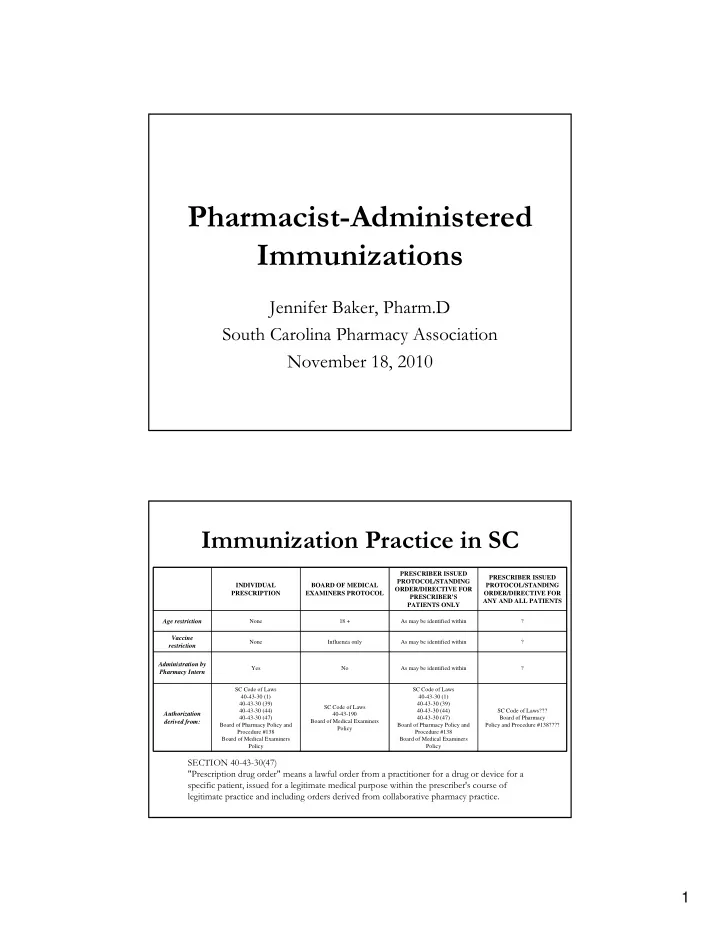
Immunization Practice in SC

SC Code of Laws??? Board of Pharmacy Policy and Procedure #138???? SC Code of Laws 40-43-30 (1) 40-43-30 (39) 40-43-30 (44) 40-43-30 (47) Board of Pharmacy Policy and Procedure #138 Board of Medical Examiners Policy SC Code of Laws 40‐43‐190 Board of Medical Examiners Policy SC Code of Laws 40-43-30 (1) 40-43-30 (39) 40-43-30 (44) 40-43-30 (47) Board of Pharmacy Policy and Procedure #138 Board of Medical Examiners Policy

Authorization derived from:

? As may be identified within No Yes

Administration by Pharmacy Intern

? As may be identified within Influenza only None

Vaccine restriction

? As may be identified within 18 + None

Age restriction PRESCRIBER ISSUED PROTOCOL/STANDING ORDER/DIRECTIVE FOR ANY AND ALL PATIENTS PRESCRIBER ISSUED PROTOCOL/STANDING ORDER/DIRECTIVE FOR PRESCRIBER’S PATIENTS ONLY BOARD OF MEDICAL EXAMINERS PROTOCOL INDIVIDUAL PRESCRIPTION

SECTION 40-43-30(47) "Prescription drug order" means a lawful order from a practitioner for a drug or device for a specific patient, issued for a legitimate medical purpose within the prescriber's course of legitimate practice and including orders derived from collaborative pharmacy practice.

slide-2
SLIDE 2

2

Board of Medical Examiners Policy

  • Acknowledges pharmacist administration
  • Vaccines other than influenza: Physician may issue

prescription or protocol for their patients or subset

  • Proper physician-patient relationship
  • Protocol components

– Procedure to determine practitioner’s patients – Pharmacist training, precautions, contraindications, management of adverse reactions – Limit number of protocols to reasonably supervise

State Influenza Protocol

Authorization

  • Determine the need for influenza vaccination
  • Administer either trivalent influenza vaccine

(TIV) by intramuscular injection or live attenuated influenza vaccine (LAIV) nasally to persons eighteen (18) years of age and older

  • Administer epinephrine and diphenhydramine

in response to acute allergic reactions

slide-3
SLIDE 3

3

Qualifications

  • Licensed in good standing in SC
  • Current BLS certification
  • APhA Pharmacy-Based Immunization Delivery

Training Program

  • Annual CE Requirement – 1 hour
  • Liability insurance

Limitations on Pharmacy-based Vaccination

  • Influenza vaccine to patients 18+ years
  • Only pharmacist can administer – no interns
slide-4
SLIDE 4

4

Protocol, Facility and Equipment

  • Current copy of protocol at each location

– Immunization clinic location

  • Appropriate area for administration
  • Supplies as listed in Appendix B

Required Supplies and Equipment Appendix B

  • Current VIS
  • Epinephrine

– Amps, vials, or EpiPen

  • Diphenhydramine

– Injectable and oral

  • Syringes/Needles
  • Alcohol Swabs
  • Bandages
  • Blood pressure monitor
  • Adult pocket mask with
  • ne-way valve
  • Flashlight/batteries
  • Wrist watch
  • Telephone
  • Ability to assist patient to

sit/lie down

slide-5
SLIDE 5

5

Eligibility Determination

  • Screening questionnaires – required language
  • Precautions & Contraindications follow CDC

recommendations

  • Pharmacist decides to:

– Immunize with either TIV or LAIV – Offer TIV instead of LAIV – Delay immunization – Refer to PCP

Informed Consent

  • Consent form – required language
  • Current VIS prior to administration

– Patient’s native language if available

slide-6
SLIDE 6

6

Pharmacy-based Vaccination Record

Maintain vaccinee record for SIX years

  • Name, address, date of birth, and telephone number of the

vaccinee

  • Vaccinee's responses to eligibility questionnaires
  • Name, dose, manufacturer, and lot number of the vaccine

administered

  • Date of the administration of the vaccine and the injection site
  • Signed and dated consent form
  • Record of any adverse events or complications that arose

following vaccination

  • Name, address, license number, and telephone number of the

administering pharmacist

  • Copy of the notification letter sent to designated primary care

practitioner

Reporting Requirements

  • Personal immunization record – wallet card
  • Medical home notification – required language
  • Immunization registry if required by DHEC
  • Adverse events - VAERS
slide-7
SLIDE 7

7

Vaccination Safety

  • Infection control/sterile technique – universal

precautions

  • Needle-stick prevention – safety needles
  • Hepatitis B Vaccine – must receive or document
  • OSHA compliance
  • Needle-Stick Management (SC Code of Laws

44-29-230)

  • Vaccination Procedure

– Language from IAC standing order (CDC) – Follow the manufacturer's recommendations regarding the storage, dosing, and administration of influenza vaccine.

  • Management of Adverse Events

– Authorizes use of epinephrine, diphenhydramine

  • Supply Considerations

– Comply with state/national guidance and directives – Physician should determine persons at higher risk

slide-8
SLIDE 8

8

Moving Forward

  • Protocol to be signed
  • Third party reimbursement?

– Medicare does not require physician – Private third-parties?

  • Other?

APPENDIX C SCREENING QUESTIONNAIRE FOR INACTIVATED INJECTABLE INFLUENZA VACCINATION

  • The following questions shall be used to determine if there is any

reason an inactivated injectable influenza vaccination should not be given: (1) Is the person to be vaccinated under the age of 18 years? (2) Is the person to be vaccinated sick today? (3) Does the person to be vaccinated have an allergy to eggs or to a component of the vaccine? (4) Has the person to be vaccinated ever had a serious reaction to influenza vaccine in the past? (5) Has the person to be vaccinated ever had Guillain-Barré syndrome?

  • If a person answers “ yes” to any of these questions, the

pharmacist must comply with Section VI of this Protocol.

slide-9
SLIDE 9

9

APPENDIX D SCREENING QUESTIONNAIRE FOR LIVE ATTENUATED INTRANASAL INFLUENZA VACCINATION

  • The following questions shall be used to determine if there is any reason a live

attenuated intranasal influenza vaccine should not be given: (1) Is the person to be vaccinated sick today? (2) Does the person to be vaccinated have an allergy to eggs or to a component

  • f the influenza vaccine?

(3) Has the person to be vaccinated ever had a serious reaction to intranasal influenza vaccine (FluMist) in the past? (4) Is the person to be vaccinated younger than age 18 years or older than age 49 years? (5) Does the person to be vaccinated have a long-term health problem with heart disease, lung disease, asthma, kidney disease, neurologic or neuromuscular disease, liver disease, metabolic disease (e.g., diabetes), or anemia or another blood disorder?

APPENDIX D SCREENING QUESTIONNAIRE FOR LIVE ATTENUATED INTRANASAL INFLUENZA VACCINATION

(7) Does the person to be vaccinated have a weakened immune system because

  • f HIV/AIDS or another disease that affects the immune system, long-term

treatment with drugs such as high-dose steroids, or cancer treatment with radiation or drugs? (8) Is the person to be vaccinated receiving antiviral medications? (9) Is the person to be vaccinated pregnant or could she become pregnant within the next month? (10) Has the person to be vaccinated ever had Guillain-Barré syndrome? (11) Does the person to be vaccinated live with or expect to have close contact with a person whose immune system is severely compromised and who must be in protective isolation (e.g., an isolation room of a bone marrow transplant unit)? (12) Has the person to be vaccinated received any other vaccinations in the past 4 weeks?

  • If a person answers “ yes” to any of these questions, the pharmacist must

comply with Section VI of this Protocol.

slide-10
SLIDE 10

10

APPENDIX E CONSENT FOR INFLUENZA VACCINE

I have read, or had explained to me, the Vaccine Information Statement for influenza vaccine. I understand the risks and benefits, and have been provided an opportunity to ask questions, and they have been answered to my satisfaction. I wish to receive the influenza vaccine and hereby give consent for [Pharmacist's Name] to administer the influenza vaccine and communicate the administration of the vaccine to my primary care practitioner, who is listed below. _______________________________________ Vaccine recipient's name _______________________________________ Vaccine recipient’s date of birth ______________________________________ Recipient's (or legal representative's) signature _________________ Date _________________ VIS Date _____________________________________________ Vaccine recipient’s designated primary care practitioner

APPENDIX F NOTIFICATION LETTER

Dear Healthcare Provider at [vaccinee's primary care clinic]: We have recently provided vaccination services to one of your patients. A personal immunization record card was filled out and given to the patient. We want to make certain that you also have this information so that you can update your patient's medical record. Please contact us if you have any questions about this information. Vaccinee's name: ____________________________________ Vaccinee's Date of Birth: ____________ The vaccine that was given on _________________ is checked below. ____ Trivalent influenza vaccine (TIV) ____ Live attenuated influenza vaccine (LAIV) Administering Pharmacist Contact Information for Administering Pharmacist

slide-11
SLIDE 11

11

APPENDIX G PROCEDURES FOR MANAGEMENT OF ADVERSE REACTIONS TO INFLUENZA VACCINATION

  • Anaphylactic Reactions
  • Signs and symptoms of anaphylactic reaction include: the

sudden or gradual onset of generalized itching, erythema (redness), or urticaria (hives); angioedema (swelling of the lips, face, or throat); bronchospasm (wheezing); shortness of breath; shock; abdominal cramping; or cardiovascular collapse. The following procedures should be used to manage anaphylactic reactions following influenza vaccination: 1. If itching and swelling are confined to the injection site where the vaccination was given, observe the vaccinee closely for at least 30 minutes, watching for the development of generalized symptoms.

APPENDIX G PROCEDURES FOR MANAGEMENT OF ADVERSE REACTIONS TO INFLUENZA VACCINATION

2. If symptoms are generalized, activate the emergency medical system (e.g., call 911) immediately. This should be done by a second person, while the pharmacist assesses the airway, breathing, circulation, and level of consciousness of the vaccinee. 3. Place vaccinee in a recumbent position and elevate legs. 4. Administer aqueous epinephrine 1:1000 dilution subcutaneously or intramuscularly (usually in the upper arm), 0.01 mL/kg/dose (adult dose ranges from 0.3 mL to 0.5 mL, with maximum single dose of 0.5 mL). The site of injection can be gently massaged to facilitate absorption. The dose may be repeated 2 or 3 times at 10 to 15 minute intervals. 5. Administer diphenhydramine either orally or by intramuscular injection; the standard dose is 1 mg/kg, up to 100 mg maximum single dose. Do not attempt to give oral medications to a vaccinee who is not fully alert and able to swallow safely.

slide-12
SLIDE 12

12

APPENDIX G PROCEDURES FOR MANAGEMENT OF ADVERSE REACTIONS TO INFLUENZA VACCINATION

6. Monitor the vaccinee closely and check vital signs (blood pressure, pulse, and respirations) every 2 to 5 minutes. 7. Stay with vaccinee until EMS arrives. 8. If necessary, maintain airway and perform cardiopulmonary resuscitation (CPR). 9. Keep vaccinee in supine position unless he or she is having breathing difficulty. If breathing is difficult, vaccinee's head may be elevated, provided blood pressure is adequate to prevent loss of consciousness. If blood pressure is low, elevate legs.

  • 10. If EMS has not arrived and symptoms are still present, repeat dose of epinephrine

every 10 to 15 minutes for up to 3 doses, depending on vaccinee's response.

  • 11. Record all vital signs, medications administered to the vaccinee (including the time,

dosage, response, and the name of the person who administered the medication), and

  • ther relevant clinical information.
  • 12. Notify the vaccinee's primary care practitioner as soon as possible. All vaccinees

experiencing anaphylactic reactions must be referred for evaluation, even if symptoms resolve completely.

APPENDIX G PROCEDURES FOR MANAGEMENT OF ADVERSE REACTIONS TO INFLUENZA VACCINATION

  • Syncope

– Syncope (fainting) and near-syncope can occur prior to and following vaccination.

1. Vaccinees who appear fearful before vaccination should be placed in a sitting or supine position when being vaccinated. 2. When a vaccinee exhibits extreme paleness, sweating, coldness of the hands and feet, nausea, lightheadedness, dizziness, weakness, or visual disturbances, the pharmacist should have the vaccinee lie flat or sit with head between knees for several minutes. Loosen any tight clothing and maintain an open airway. Apply cool, damp cloths to vaccinee's face and neck. 3. Vaccinees who fall (with or without loss of consciousness) should be examined to determine if injury is present before attempting to move the

  • vaccinee. The vaccinee should then be placed flat on back with feet
  • elevated. Call 911 if vaccinee does not recover immediately.
slide-13
SLIDE 13

13

APPENDIX G PROCEDURES FOR MANAGEMENT OF ADVERSE REACTIONS TO INFLUENZA VACCINATION

  • Local Reactions

– Local reactions are usually minor and can be managed as follows:

1. Soreness, redness, itching, or swelling at the injection site may be treated with cold compress to the injection site and a non- prescription analgesic or antipruritic medication. 2. Bleeding from the injection site should be treated with an adhesive compress over the injection site. For continued bleeding, place a thick layer of gauze pads over site and maintain direct and firm pressure with the bleeding injection site (e.g., arm) above the level of the vaccinee's heart.