
SLIDE 1
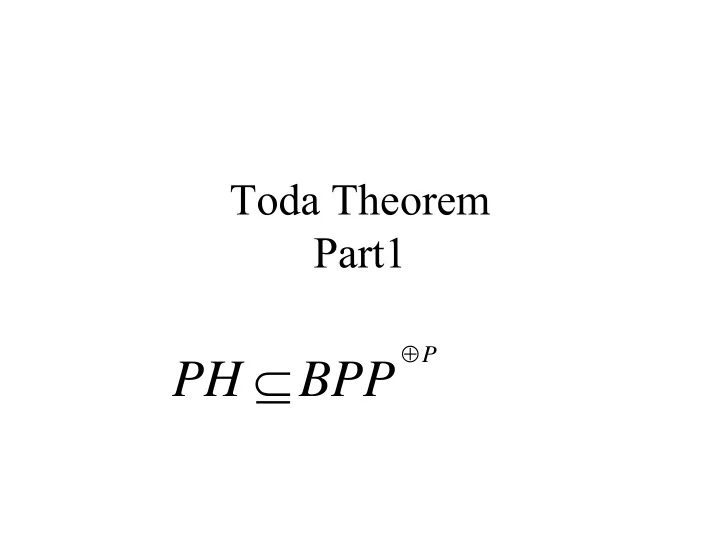
Toda Theorem Part1
BPP PH ⊆
P ⊕
PH P BPP Basic Definitions Language L belongs to class PP if - - PowerPoint PPT Presentation
Toda Theorem Part1 PH P BPP Basic Definitions Language L belongs to class PP if exists polynomial NTM such that = > { ( ) 1 } 0 . 5 x L P M x Language L belongs to class BPP if exists
P ⊕
polynomial NTM such that
5 . } 1 ) ( { > = ⇔ ∈ x M P L x
exists probabilistic polynomial algorithm such that x from L is accepted with probability more than 0.75 and x not form L is declined with the same probability.
P ⊕ (parity P) if exists polynomial-time non-deterministic Turing machine, such x lies in L is equivalent to that fact, that number of accepting computations is odd(or, exists polynomially checked relation R such that the number of y(R(x, y)= 1 ) is odd.
is complete for
SAT ⊕ P ⊕
Ρ Σ +
i
i 1
i i
≥
P
BPP NP
⊕
⊆
P
RP NP
⊕
⊆
A P A
BPP NP
⊕
⊆
P
BPP PH
⊕
⊆
N i ∈ ∀
P i
BPP P
⊕
⊆ Σ
Valiant-Vazirani Lemma
relativised
mathematical induction. It will prove, that
So, considering this Lemmas being truth we’ll receive
A P A BPP
BPP P
⊕
⊆ ⊕
P P
P
⊕ ⊆ ⊕
⊕
A A BPP
BPP BPP ⊆
P P BPP P P BPP P BPP P P BPP P k
BPP BPP BPP BPP NP NP P
k
⊕ ⊕ ⊕ ⊕ ⊕ ⊕ ⊕ Σ +
⊆ ⊆ ⊆ ⊆ ⊆ = Σ
1
and the first part of Toda’s Theorem will be proved.
where is a polynomially function of input length
are equal and the number of its accesses to L is equal to l(n) in all branches
machine N(from the definition of BPP) with the probability
to that can be made less than 0.25
A
BPP L ∈
i
p −
2
i
p
) (
2
n e −
) (
2
n e −
) ( ) ( ) (
) 2 1 ( 1 2
n l n i n e − −
− − +
) (
2
n i −
every for odd number of y. R is corresponding relationship
A BPP
P L ⊕ ∈
A A
BPP B ∈
n
x } 1 , { ∈
) (
} 1 , {
n
y
γ
∈
A A BPP A BPP A B
BPP BPP P P R ∈ ∈ ∈ ∈
} } 2 ) 2 1 ( )} ( ) , , ( : { :# { |# {
) ( ) (
is L z y x z y x L
n n A ς π −
− ≥ Π ∈ = } 2 * 75 . } )} ( ) , , ( : { :# { |# {
) (n A
is L z y x y z x L
ς
≥ Π ∈ =
L), in (y, z) we’ll put result of П for given (y, z).The number of rows with more than
1 in intersection with this columns is more than
rows is for
) ( ) ( ) ( ) (
2 * 2 * 2 2
n n n n γ ς π ς −
−
} 2 ) 2 1 (
) ( ) ( n n ς π −
−
) ( ) ( ) ( ) ( ) ( ) ( ) ( ) (
2 * 75 . 2 * 2 * 2 2 * 2 * 2 2
n n n n n n n n ς γ ς π γ ς π ς
≥ − −
− −
3 ) ( ) ( + ≥ n n γ π