Pesticide impacts on larval prawns and detection in estuarine intake - - PowerPoint PPT Presentation

pesticide impacts on larval prawns and detection in
SMART_READER_LITE
LIVE PREVIEW

Pesticide impacts on larval prawns and detection in estuarine intake - - PowerPoint PPT Presentation

Pesticide impacts on larval prawns and detection in estuarine intake water Sharon E. Hook, Hai Doan, Debra Gonzago, Dean Musson, Jun Du, Rai Kookana, Melony Sellars, and Anu Kumar OCEANS AND ATMOSPHERE Organophoshate pesticides malathion,


slide-1
SLIDE 1

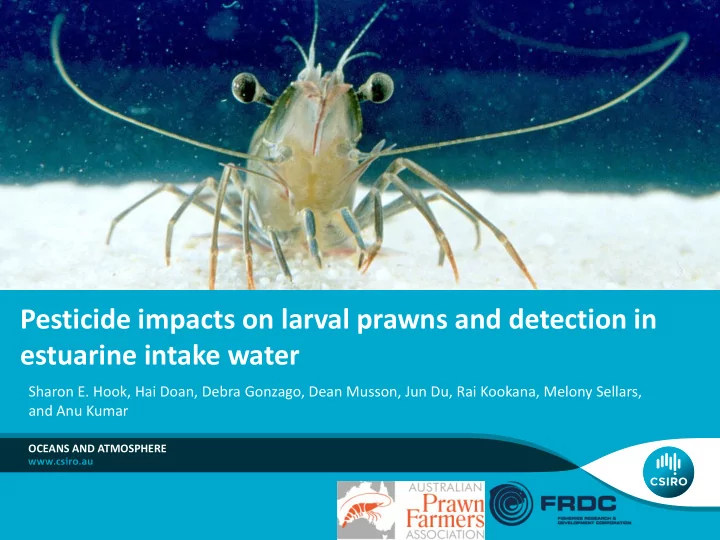
Pesticide impacts on larval prawns and detection in estuarine intake water

OCEANS AND ATMOSPHERE

Sharon E. Hook, Hai Doan, Debra Gonzago, Dean Musson, Jun Du, Rai Kookana, Melony Sellars, and Anu Kumar
slide-2
SLIDE 2

Modern use pesticides| Sharon.Hook@csiro.au 2 |

Organophoshate pesticides

  • malathion, parathion, diazinon, chlorpyrifos, ethion
  • Inhibit acetylcholinesterase
  • Human and environmental health concerns
  • Used in horticulture and agricultural

Pyrethroid pesticides

  • bifenthrin, cypermethrin, esfenvalerate, permethrin
  • Alter nerve repolarization
  • Arthropods are more sensitive
  • Residential -Termites and ant control

Neonicotinoid pesticides

  • clothianidin, imidacloprid, nithiazine, thiacloprid
  • Inhibit nicotinic acetylcholine esterase activity
  • Specific to arthropods
  • Used in sugarcane, horticulture, pest control
slide-3
SLIDE 3

3 |

Toxicity as survival

Imidacloprid concentration ( g/L)

. 1 1 1 1 1 1 1 1

3 |

How toxic are these compounds?

Data from Smit et al., 2015 Human and Ecological Risk Assessment 21:1608-1630

Modern use pesticides| Sharon.Hook@csiro.au

PL15 Penaeus monodon

slide-4
SLIDE 4

4 |

  • R. Turner, DSITI, unpublished data

Modern use pesticides| Sharon.Hook@csiro.au

Townsville

Neonicotinoid: Imidaclorprid concentrations

Line = where PL’s don’t catch prey

slide-5
SLIDE 5

5 |

Objectives:

  • 1. Review the literature around modern use insecticides impacts
  • n non target crustaceans.
  • 2. Determine the sensitivity of your post larval black tiger prawns

to modern - use insecticides

  • 3. Measure the concentrations of insecticides in your farm intake

waters

Modern use pesticides| Sharon.Hook@csiro.au

slide-6
SLIDE 6

6 |

Approach: Toxicity studies

  • Range finder experiment – Prawns were exposed to a “step 10” of pesticide

concentrations

  • Exposed post larval prawns to a range of concentrations of each pesticide
  • Four treatments plus two controls per contaminant
  • Five replicates with 10 PL’s per treatment
  • Animals were fed, and flasks were “bubbled”
  • We measured:
  • Survival over 48 hours
  • Ability to capture live food

Modern use pesticides| Sharon.Hook@csiro.au

slide-7
SLIDE 7

7 |Modern use pesticides| Sharon.Hook@csiro.au

Approach: Feeding Inhibition

  • Prawns were fed every three

hours during the day, but fasted

  • vernight
  • First thing in the morning,

aliquots of 50 artemia were counted out

  • Each flask of post larval prawns

were given an artemia aliquot

  • After two hours, the number of

artemia remaining was counted

slide-8
SLIDE 8

8 |

Sampling locations

Modern use pesticides| Sharon.Hook@csiro.au

Approach: Analytical Chemistry

  • Water samples were collected from

the locations indicated

  • Pesticides were concentrated on

SPE filters

  • Pesticides were eluted from the

filters in methanol

  • Concentrations were determined

via LC/MS

slide-9
SLIDE 9

9 |

Findings: Range finder experiments

Modern use pesticides| Sharon.Hook@csiro.au

Insecticide Dose, µg/L Survival S.E. Control 100 Solvent Control 96.7 5.8 Fipronil 0.1 90 17.3 1 10 100 Bifenthrin 0.001 100 0.01 90 10 0.1 86.7 11.5 1 90 17.3 Imidacloprid 1 93.3 5.8 10 93.3 5.8 100 83.3 28.9 1000 60 17.3

slide-10
SLIDE 10

10 |

Findings: Imidacloprid Toxicity

Modern use pesticides| Sharon.Hook@csiro.au

  • Imidacloprid decreased survival at concentrations greater than 175 μg/L
  • LC50 is 175 μg/L
  • Capture of live prey was decreased at all concentrations tested, lowest is 0.5 μg/L
slide-11
SLIDE 11

11 |

Findings: Fipronil Toxicity

Modern use pesticides| Sharon.Hook@csiro.au

  • Fipronil decreased survival at concentrations tested, the lowest being 0.0625 μg/L
  • LC50 is 0.2 μg/L
  • No sublethal toxicity was measured with fipronil
slide-12
SLIDE 12

12 |

Findings: Bifenthrin Toxicity

Modern use pesticides| Sharon.Hook@csiro.au

  • Bifenthrin decreased survival at concentrations greater than 0.5 μg/L
  • LC50 is 0.36 μg/L
  • Capture of live prey was decreased at all concentrations tested, lowest is 0.125 μg/L
slide-13
SLIDE 13

13 |

Findings: water insecticide concentrations

Modern use pesticides| Sharon.Hook@csiro.au

Insecticides (μg/L) Catchment Farm Date Bifenthrin Chlorpyrifos Fipronil Imidacloprid Clarence, NSW A 20-Mar-17 <0.0025 0.0076 (<0.005- 0.0179) <0.005 <0.0025 Logan, QLD B 22-Sep-16 0.0091 (0.0027- 0.0206*) 0.0247 (0.0063- 0.0430*) 0.028 (<0.005- 0.0738*) 0.0136 (0.0047- 0.0297) Burnett- Mary, QLD C 4-April-17 <0.0025 <0.005 <0.005 0.0146 (0.0115- 0.0173) Mackay, QLD D 13-Dec -17 <0.0025 0.0036 (<0.005- 0.0057) <0.005 0.3450 (0.271- 0.415*) Burdekin, QLD E 19-April-2017 (Cyclone Debbie?) <0.0025 <0.005 <0.005 <0.0025 Wet Tropics F 27-Sept-2016 <0.0025 <0.005 <0.005 0.0028 (0.0027- 0.003) Wet Tropics G 27-Sept-2016 <0.0025 <0.005 <0.005 0.0029 (0.0026- 0.0032)

slide-14
SLIDE 14

14 |

Implications: Insecticide risk

Modern use pesticides| Sharon.Hook@csiro.au

slide-15
SLIDE 15

15 |

Unanswered questions:

  • Bifenthrin and Fipronil bind to sediment? Are they in the ponds? Could

pesticides in the pond sediment impact post larval prawns?

  • These were short exposures – are the prawns more sensitive to long ones?

Is the feeding inhibition reversible? Does it affect survival? What about growth? What is the lowest concentration we see it at?

  • We tested one compound at a time, but the real world is a mixture… What

happens with exposures to mixtures? All of these insecticides target the neurological system of prawns – What happens when they are applied together?

  • Are the concentrations we measured in intake waters typical? Best case

scenario? Worst case scenario?

Modern use pesticides| Sharon.Hook@csiro.au

slide-16
SLIDE 16

16 |

Recommendations: water treatment

Activated charcoal at the intake will remove the insecticides

Developing Low Cost sorbents:

  • Ability to deal with a range of contaminants
  • Nutrients
  • Organics (DOC, Pesticides etc)
  • Pathogens
  • Cost effective

Types of materials include:

  • Biochars
  • Mining waste products - NUA
  • Natural polymers – chitosan
  • Modified clays
  • others

Sharon.Hook@csiro.au

Modern use pesticides| Sharon.Hook@csiro.au

slide-17
SLIDE 17

17 |Modern use pesticides| Sharon.Hook@csiro.au

Take Home Messages:

  • Post larval phase prawns have a sensitivity to modern use

pesticides that is comparable to other crustaceans

  • In some of the water samples, pesticides were measured

at concentrations that would be high enough to pose risk

  • Further study is needed, (1) to better characterise the

concentrations in the environment; (2) to better understand the impacts of these exposures on the

  • rganisms; (3) to develop low cost means of removing the

contaminants for the intake waters

slide-18
SLIDE 18

18 |

Acknowledgments:

  • The farmers who collected water samples
  • Brian Murphy (CSIRO Agriculture & Food)
  • Simon Irvin (CSIRO Agriculture & Food)
  • The staff members at the Bribie Island Research Station
  • Monique Binet (CSIRO Land & Water)
  • Graeme Batley (CSIRO Land & Water)

This project was supported by funding from the Australian Prawn Farmers Association (APFA) and the Fisheries Research and Development Corporation (FRDC) on behalf of the Australian

  • Government. Report is finished and is available.

Modern use pesticides| Sharon.Hook@csiro.au

slide-19
SLIDE 19

Oceans and Atmosphere Sharon Hook Senior Research Scientist t +61 2 9710 6839 e Sharon.Hook@csiro.au Agriculture and Food Melony Sellars Senior Research Scientist t +61 437 025 821 e Melony.Sellars@csiro.au

CSIRO

Thank you

Land and Water Anu Kumar Group Leader t +61-8-8303 8597 e Anupama.Kumar@csiro.au

FRDC Project No 2016-049 IPA APFA