PERSPECTIVES ON VEHICLE-GRID INTEGRATION Dave McCreadie, EV - - PDF document

perspectives on vehicle grid integration
SMART_READER_LITE
LIVE PREVIEW

PERSPECTIVES ON VEHICLE-GRID INTEGRATION Dave McCreadie, EV - - PDF document

PERSPECTIVES ON VEHICLE-GRID INTEGRATION Dave McCreadie, EV Infrastructure and Smart Grid, Sustainability Engineering, Ford Motor Co. Sustainability and Environmental CO 2 Stabilization Targets CO 2 Emissions from Energy Consumption Commercial


slide-1
SLIDE 1

PERSPECTIVES ON VEHICLE-GRID INTEGRATION

Dave McCreadie, EV Infrastructure and Smart Grid, Sustainability Engineering, Ford Motor Co.

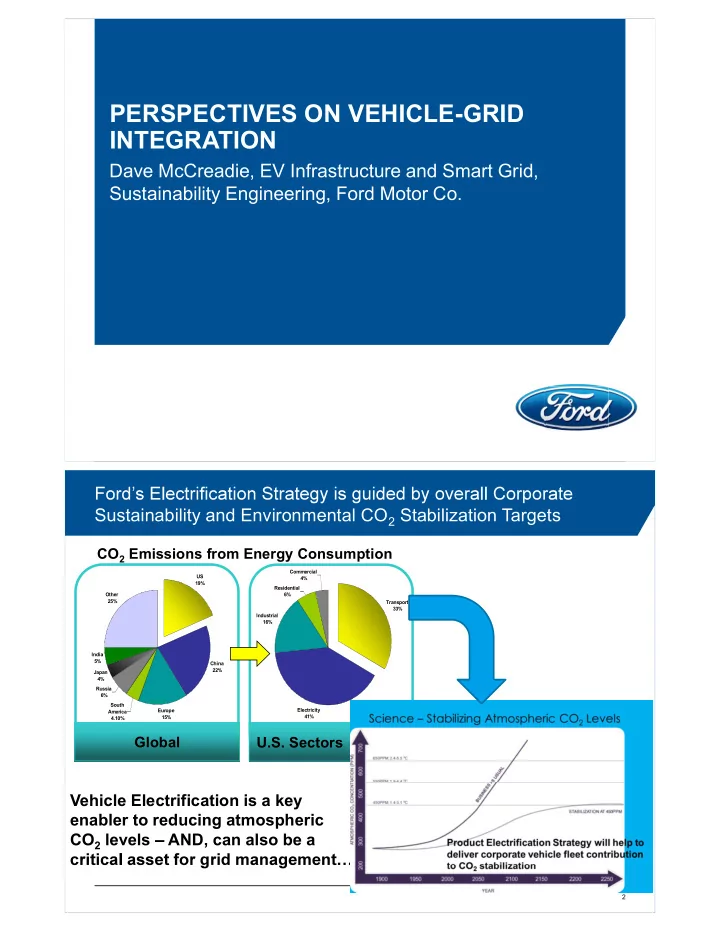
Sustainability and Environmental CO2 Stabilization Targets

2

U.S. Sectors

US 19% China 22% Europe 15% South America 4.10% Russia 6% Japan 4% India 5% Other 25% Transport 33% Electricity 41% Industrial 16% Residential 6% Commercial 4%

CO2 Emissions from Energy Consumption Global

Vehicle Electrification is a key enabler to reducing atmospheric CO2 levels AND, can also be a

slide-2
SLIDE 2

Today- Lower PEV operating costs through Time-of-Use Smart Charging For PEVs today, Time-of-Use rates are the most prevalent and

MyFord Mobile users to take during off-peak hours. Set-it-and-forget-it smart charging. TOU charging has been shown to save as much as 30% or more over charging on flat rates.

But in its essence, the smart grid is about bi-directional Beyond TOU, there are many emerging ways in which PEVs will become part of the smart grid ecosystem, and thereby enable greater economic value for PEV owners.

Smart Grid Creates a Broader Opportunity for Greater Vehicle Electrification

3

Coming Soon- Widespread Vehicle-Grid Integration Aside from pilot demos and limited rollouts thus far, we are quickly approaching a period when VGI will become more prevalent and widely commercialized

Demand Response-- Charging load curtailment to assist with peak reduction Frequency Regulation-- Up and down, fast-responding PEV batteries can be a significant grid resource Renewable Energy Signals-- Set charging times based on % renewables on grid Dynamic Pricing-- Market mechanism to link demand to supply, as Net Load management becomes the critical issue. Vehicle-to-Home-- Power to critical home systems during emergencies/outages can provide significant cost-avoidance (spoiled food, basement flooding, lost work time, etc.)

Smart Grid Creates a Broader Opportunity for Greater Vehicle Electrification

4

slide-3
SLIDE 3

OEM Central Server Facilitating VGI Communications and Helping to Enable Additional Value for PEVs

5

By their nature, PEVs have four main attributes which make them an attractive partner for the electric grid, especially in light of the supply/demand net load challenges for Utilities caused by the increasing influx of renewables.

Operational flexibility (load and generator) Embedded communications which moderate/mitigate their elemental mobility Actuation/control technology to start, stop, throttle charging Low capacity utilization- mostly parked (96% of time), with only 10% of that time necessary for recharging. Very flexible to shift charging to different times of the day to minimize costs and maximize benefits to the grid. [NHTS, EV Project]

These benefits to the grid create value that can be provided back to the PEV owner as revenue to decrease total ownership costs.

The smart grid presents an opportunity to help the OEMs achieve cost-parity with petroleum vehicles -- a key issue for overall PEV adoption PEV adoption rates are a critical issue for OEMs because of ZEV Mandate in the face of difficult PEV economics for OEMs

Vehicle-Grid Integration is a Win-Win Opportunity in the face of Automotive and Utility Industry Challenges

6

slide-4
SLIDE 4

7