Perspectives from Families on Screening, Diagnosis, and Support - - PowerPoint PPT Presentation

perspectives from families on
SMART_READER_LITE
LIVE PREVIEW

Perspectives from Families on Screening, Diagnosis, and Support - - PowerPoint PPT Presentation

Mental Health and Chil ildren: Perspectives Mental Health and Children: from Families on Screening, g, Evaluation and Dia iagnosis Perspectives from Families on Screening, Diagnosis, and Support Lynda Gargan, Ph.D., Executive Director


slide-1
SLIDE 1

Mental Health and Chil ildren: Perspectives from Families on Screening, g, Evaluation and Dia iagnosis

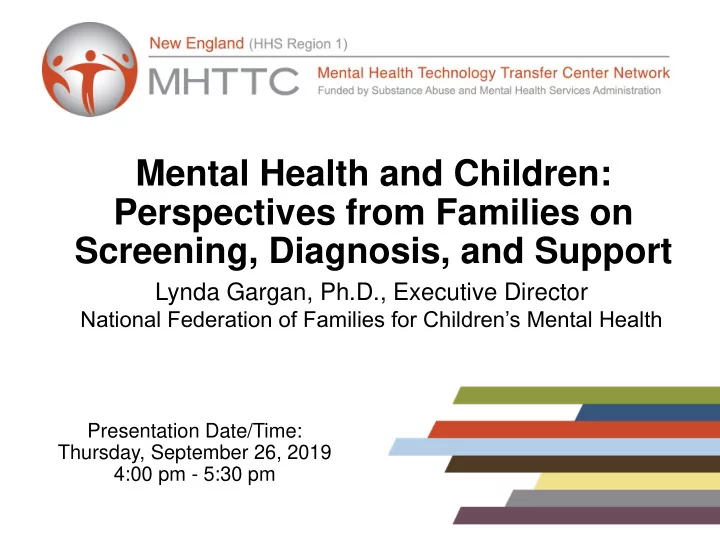
Mental Health and Children: Perspectives from Families on Screening, Diagnosis, and Support

Lynda Gargan, Ph.D., Executive Director

National Federation of Families for Children’s Mental Health

Presentation Date/Time: Thursday, September 26, 2019 4:00 pm - 5:30 pm

slide-2
SLIDE 2

U.S. Department of Education

  • Raising the next

generation is a shared

  • responsibility. When

families, communities and schools work together, students are more successful and the entire community benefits.

  • For schools and districts

across the U.S., family engagement is becoming an integral part of education reform efforts.

slide-3
SLIDE 3

How Is Family Defined?

The concept of family has changed as our culture has evolved. Family units now self-define to reflect their unique characteristics. Youth and young adults may add members to their family unit, based upon their experiences. The “family” must be respected as defined by its members.

slide-4
SLIDE 4

What is Family Engagement?

Family engagement is a collaborative and strengths-based process through which professionals, families, and children build positive and goal-oriented relationships. It is a shared responsibility of families and staff at all levels that requires mutual respect for the roles and strengths each has to offer.

slide-5
SLIDE 5

Engaging families is more than just having them at the table

  • r keeping

them informed.

slide-6
SLIDE 6

Why Does It Matter?

slide-7
SLIDE 7

Why Engage Families?

PROFESSIONALS COME AND GO IN A CHILD’S LIFE. FAMILIES ARE THE ONLY TRUE CONSTANT. FAMILY ENGAGEMENT HELPS TO ESTABLISH SUSTAINABLE PRACTICES AND PROVIDES A SENSE OF STABILITY FOR THE CHILD.

slide-8
SLIDE 8

Strategies for Meaningful Family Engagement

slide-9
SLIDE 9

Screening

  • If screening is suggested, meet with

the parents to discuss their questions

  • r concerns. Use this opportunity to

engage and partner with the family.

  • No matter what the results are, call the

parents to discuss. Ask for input – i.e., “Does this sound right?” “Did we miss something?” “Is there anything you would like to add or redact?”

  • Never place blame or shame on the

student or the parent.

  • Never predict what the results of a full

evaluation might be.

slide-10
SLIDE 10

& El & Elabor aboratio ation

Today’s Presenter Dr. Lynda Gargan C-TLC Project Director Dr. Christine Mason

slide-11
SLIDE 11

Evaluation

  • This can be extremely anxiety

provoking for both the student and family. Even though they may agree that something seems amiss, this process is intrusive and may trigger stress.

  • Meet with the family and student

to explain each step in the process.

  • Always include a family interview

and the results of the interview in an evaluation summary.

  • It’s our job to make this a

positive, supportive process.

slide-12
SLIDE 12

Diagnosis

  • Meet with the family and student to

explain the diagnosis and its implications.

  • Don’t use jargon. Families and students

aren’t clinicians, they need common sense language. Avoid using acronyms.

  • Never underestimate the intelligence of

the family or student. Do not “talk down” to them or tell them what’s best for them.

  • Stop often and encourage the

family/student to ask questions.

  • Ask the family/student if they agree with

the diagnosis. Did we get it right?

  • Remember that the diagnostic process is

not linear and is as much art as science. Family input is critical.

slide-13
SLIDE 13

& El & Elabor aboratio ation

Today’s Presenter Dr. Lynda Gargan C-TLC Project Director Dr. Christine Mason

slide-14
SLIDE 14

Creating a Culture that Encourages Meaningful Family Engagement

  • Make your first contact personal,

introducing you as a partner in their child’s success.

  • Be deliberate in communicating that your

desire is to help and change the narrative.

  • Be mindful that parents are extremely
  • busy. Try not to disrupt their routines.
  • Tip: Avoid contacting families at work

whenever possible.

  • Follow up a phone call with a text or

email that includes your contact information.

slide-15
SLIDE 15

Creating a Physical Environment that Encourages Family Engagement

  • Meet with students and families in a setting that

encourages engagement and that doesn’t separate you from the family.

  • Tip: Get a social worker to design your

meeting space.

  • Smaller spaces encourage relationship building

and intimacy because people are arranged in close proximity.

  • Please don’t bring coffee, etc. into a meeting

unless you offer refreshments to the family/student.

  • Have a pen and paper available for parents to

take notes.

  • Have tissues nearby in case the meeting is

difficult for a family/student.

slide-16
SLIDE 16

Creating a Relational Environment that Encourages Family Engagement

  • Establish relational ground rules (how

they prefer to be addressed).

  • Use titles, i.e., Mr., Ms., etc.: desire for a

more formal relationship.

  • Use first names: desire for a less formal

relationship.

  • Tip: Follow suit in the way that you

address yourself.

  • Establish time limits up front and indicate

that you would like to set a timer or other method to remind everyone when there are only 5 minutes left. Ask the family if they are comfortable with this.

  • Ask the family for their agenda for the

meeting before sharing yours.

slide-17
SLIDE 17

Why Families May Be Hesitant to Engage

FEELING BLAMED OR A LACK OF RESPECT PAST EXPERIENCES WITH SCHOOLS – EITHER WITH OTHER CHILDREN OR WHEN THEY WERE IN SCHOOL FEELINGS OF INTIMIDATION - TEACHERS ARE PERCEIVED AS PROFESSIONALS AND THE EXPERTS FEELING OUTNUMBERED IN MEETINGS FEELINGS OF INCOMPETENCE DUE TO NOT KNOWING THE JARGON, THE INS AND OUTS OF SYSTEM, OR WHAT THEY CAN CONTRIBUTE

slide-18
SLIDE 18

Why Schools May Be Hesitant To Engage?

Past experiences with parents and families Liability concerns It is time intensive Lacking meaningful training on engagement

slide-19
SLIDE 19

Family Engagement Requires Commitment

It requires making a commitment to creating and sustaining an

  • ngoing partnership that

supports family well- being. It honors and supports the parent-child relationships that are central to a child’s healthy development, school readiness, and well-being. It requires acknowledging families and communities as experts on their children.

slide-20
SLIDE 20

This commitment isn’t about getting family “buy in,” it’s about…

Helping families “feel heard” Helping families “feel connected” Ensuring that families have a voice and a “seat at the table” This commitment is a deliberate decision by a system that reflects elements that are important and relevant to families

slide-21
SLIDE 21

Family engagement can be evaluated on a continuum – from families being blamed to being primary decision-makers.

Ask yourself “Where does my work fall on this continuum?”

Families blamed and sidelined Families as primary decision-makers

slide-22
SLIDE 22

In Summary…

Families and schools are extremely important in the lives of our children. School cultures are rapidly evolving, and many requirements are being placed upon the educational community. Families are the most consistent adults in children’s lives. Families have important information to share with schools which may improve the behavioral health of their children. Every educator wants to enhance the lives of their students, but many have not been trained in effective engagement strategies. If we all work in a true partnership, we can improve our children’s behavioral health.

slide-23
SLIDE 23

& El & Elabor aboratio ation

Today’s Presenter Dr. Lynda Gargan C-TLC Project Director Dr. Christine Mason

slide-24
SLIDE 24

Mental Health and Children: Perspectives from Families on Screening, Diagnosis, and Support

slide-25
SLIDE 25

Childhood-Trauma Learning Collaborative (C-TLC) Upcoming Events

Is your school trauma-informed? Are you/your colleagues looking for mental health resources to better support your students? Join the Center for Educational Improvement (CEI) for a series of online events hosted by the New England Mental Health Technology Transfer Center (New England MHTTC). Our complimentary webinar series is designed to strengthen mental health supports that address the needs of children who have experienced/art at risk of experiencing significant trauma.

Next Webinar: November 7 @ 4:00 pm Poverty, Brain Development, and Early Interventions with Kimberly Noble, Ph.D.,

Associate Professor of Neuroscience and Education Teachers College, Columbia University.

slide-26
SLIDE 26

Thank you for attending! Mental Health and Children: Perspectives from Families on Screening, Diagnosis, and Support Questions? Contact Us: Center for Educational Improvement info@edimprovement.org

slide-27
SLIDE 27

Resources

  • https://www.naeyc.org/resources/topics/family-engagement
  • https://www.ed.gov/parent-and-family-engagement
  • http://www.ncsl.org/research/education/family-engagement.aspx
  • http://www.uscrossier.org/ceg/wp-content/uploads/publications/Family-Engagement-in-

Education.pdf

  • https://www.familiesandschools.org/blog/the-importance-of-parent-engagement/
  • https://www.michigan.gov/documents/Parent_Involvement_Part_1_12-16-04_111426_7.pdf
  • https://www.naeyc.org/resources/topics/family-engagement/principles
  • https://oregongearup.org/sites/oregongearup.org/files/grant/meetings/fall2016/authenticfamilyenga

gement.pdf