Permutations and Combinations Rosen, Chapter 5.3 Motivating - - PDF document

permutations and combinations
SMART_READER_LITE
LIVE PREVIEW

Permutations and Combinations Rosen, Chapter 5.3 Motivating - - PDF document

10/17/2016 Permutations and Combinations Rosen, Chapter 5.3 Motivating question In a family of 3, how many ways can we arrange the members of the family in a line for a photograph? 1 10/17/2016 Permutations A permutation of a set of

slide-1
SLIDE 1

10/17/2016 1

Permutations and Combinations

Rosen, Chapter 5.3

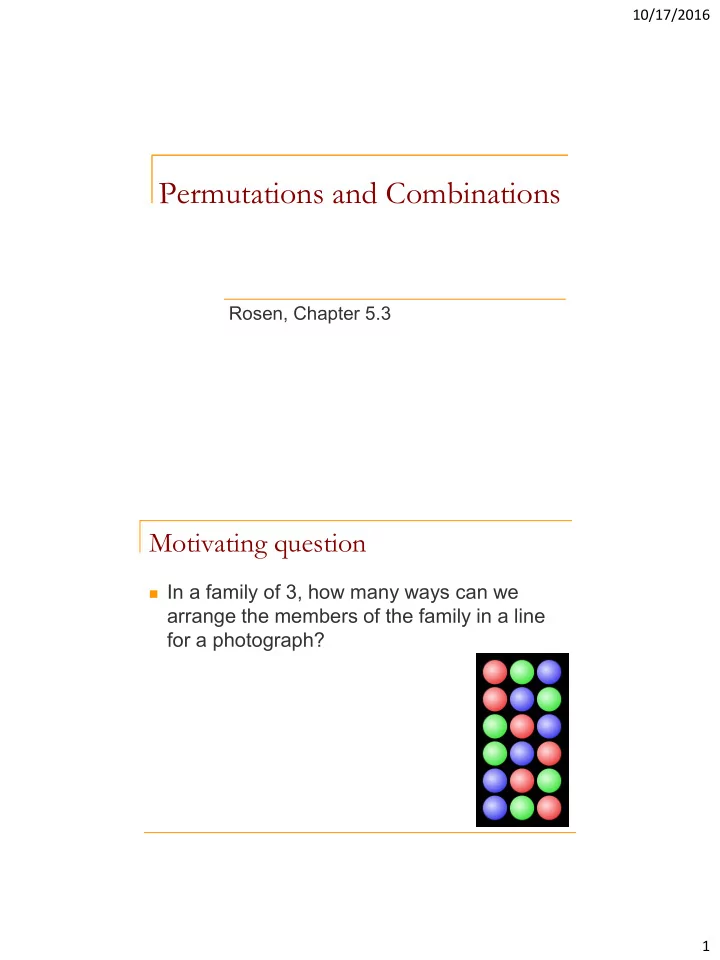
Motivating question

 In a family of 3, how many ways can we

arrange the members of the family in a line for a photograph?

slide-2
SLIDE 2

10/17/2016 2

Permutations

 A permutation of a set of distinct objects is an

  • rdered arrangement of these objects.

 Example: (1, 3, 2, 4) is a permutation of the

numbers 1, 2, 3, 4

 How many permutations of n objects are

there?

How many permutations?

 How many permutations of n objects are

there?

 Using the product rule:

n .(n – 1) . (n – 2) ,…, 2 . 1 = n!

slide-3
SLIDE 3

10/17/2016 3

Anagrams

 Anagram: a word, phrase, or name formed by

rearranging the letters of another. Examples: “cinema” is an anagram of iceman "Tom Marvolo Riddle" = "I am Lord Voldemort”

The anagram server: http://wordsmith.org/anagram/

Example

 How many ways can we arrange 4 students

in a line for a picture?

slide-4
SLIDE 4

10/17/2016 4

Example

 How many ways can we arrange 4 students

in a line for a picture? 4 possibilities for the first position, 3 for the second, 2 for the third, 1 for the fourth. 4*3*2*1 = 24

Example

 How many ways can we select 3 students

from a group of 5 students to stand in line for a picture?

slide-5
SLIDE 5

10/17/2016 5

Example

 How many ways can we select 3 students

from a group of 5 students to stand in line for a picture? 5 possibilities for the first person, 4 possibilities for the second, 3 for the third. 5*4*3 = 60

Definitions

 permutation – a permutation of a set of

distinct objects is an ordered arrangement of these objects.

 r-permutation – a ordered arrangement of r

elements of a set of objects.

slide-6
SLIDE 6

10/17/2016 6

Iclicker Question #1

 You invite 4 people for a dinner party. How

many different ways can they arrive assuming they enter separately?

A) 6 (3!) B) 24 (4!) C) 120 (5!) D) 16 (n2) E) 32 (2n2)

Iclicker Question #1 Answer

 You invite 4 people for a dinner party. How

many different ways can they arrive assuming they enter separately?

A) 6 (3!) B) 24 (4!) C) 120 (5!) D) 16 (n2) E) 32 (2n2)

slide-7
SLIDE 7

10/17/2016 7

Example

 In how many ways can a photographer at a

wedding arrange six people in a row, (including the bride and groom)?

Example

 In how many ways can a photographer at a

wedding arrange six people in a row, (including the bride and groom)?

 6! = 720

slide-8
SLIDE 8

10/17/2016 8

IClicker Question #2

 In how many ways can a photographer at a

wedding arrange six people in a row, including the bride and groom, if the bride must be next to the groom?

A.

6!

B.

5!

C.

2X5!

D.

2X6!

E.

6! – 5!

IClicker Question #2

 In how many ways can a photographer at a

wedding arrange six people in a row, including the bride and groom, if the bride must be next to the groom?

A.

6!

B.

5!

C.

2X5!

D.

2X6!

E.

6! – 5!

slide-9
SLIDE 9

10/17/2016 9

IClicker Question #2 Answer

 In how many ways can a photographer at a

wedding arrange six people in a row, including the bride and groom, if the bride must be next to the groom? Why? The bride and groom become a single unit which can be ordered 2 ways.

IClicker Question #3

 In how many ways can a photographer at a

wedding arrange six people in a row, including the bride and groom, if the bride is not next to the groom?

A.

6!

B.

2X5!

C.

2X6!

D.

6! – 5!

E.

6! – 2*5!

slide-10
SLIDE 10

10/17/2016 10

IClicker Question #3 Answer

 In how many ways can a photographer at a

wedding arrange six people in a row, including the bride and groom, if the bride is not next to the groom?

A.

6!

B.

2X5!

C.

2X6!

D.

6! – 5!

E.

6! – 2*5!

IClicker Question #3 Answer

 In how many ways can a photographer at a

wedding arrange six people in a row, including the bride and groom, if the bride is not next to the groom?

Why?

 6! possible ways for 6  2*5! - possible ways the bride is next to the

groom.

slide-11
SLIDE 11

10/17/2016 11

Example

 In how many ways can a photographer at a

wedding arrange six people in a row, including the bride and groom, if the bride’s mother is positioned somewhere to the left of the groom?

Example

 In how many ways can a photographer at a

wedding arrange six people in a row, including the bride and groom, if the bride’s mother is positioned somewhere to the left of the groom?

 5! + (4 · 4!) + (3 · 4!) + (2 · 4!) + (1 · 4!) =

120 + 96 + 72 + 48 + 24 = 360 possible photo arrangements in which the bride’s mother is to the left of the groom.

slide-12
SLIDE 12

10/17/2016 12

Example

 The first position to fill is the position of the

  • groom. At each position, the bride’s mother

can only occupy 1 of the slots to the left, the

  • ther 4 can be arranged in any manner.

 5! + (4 · 4!) + (3 · 4!) + (2 · 4!) + (1 · 4!) =

120 + 96 + 72 + 48 + 24 = 360 possible photo arrangements in which the bride’s mother is to the left of the groom.

Example

slide-13
SLIDE 13

10/17/2016 13

Iclicker Question #4

 Count the number of ways to arrange n men

and n women in a line so that no two men are next to each other and no two women are next to each other.

  • A. n!
  • B. 2 * n!
  • C. n! * n!
  • D. 2 * n! * n!

Iclicker Question Answer #4

 Count the number of ways to arrange n men

and n women in a line so that no two men are next to each other and no two women are next to each other.

  • A. n!
  • B. 2 * n!
  • C. n! * n!
  • D. 2 * n! * n!
slide-14
SLIDE 14

10/17/2016 14

Why?

 Count the number of ways to arrange n men

and n women in a line so that no two men are next to each other and no two women are next to each other. n! ways of representing men (n!) n! ways of representing women (n! * n!) Can start with either a man or a woman (x2) So 2*n!*n!

The Traveling Salesman Problem (TSP)

TSP: Given a list of cities and their pairwise distances, find a shortest possible tour that visits each city exactly once. Objective: find a permutation a1,…,an of the cities that minimizes where d(i, j) is the distance between cities i and j

An optimal TSP tour through Germany’s 15 largest cities

slide-15
SLIDE 15

10/17/2016 15

Solving TSP

 Go through all permutations of cities, and

evaluate the sum-of-distances, keeping the

  • ptimal tour.

 Need a method for generating all

permutations

 Note: how many solutions to a TSP problem

with n cities?

Generating Permutations

 Let's design a recursive algorithm for

generating all permutations of {0,1,2,…,n-1}.

slide-16
SLIDE 16

10/17/2016 16

Generating Permutations

 Let's design a recursive algorithm for

generating all permutations of {0,1,2,…,n-1}.

 Starting point: decide which element to put first  what needs to be done next?  what is the base case?

Solving TSP

 Is our algorithm for TSP that considers all

permutations of n-1 elements a feasible one for solving TSP problems with hundreds or thousands of cities?

slide-17
SLIDE 17

10/17/2016 17

r-permutations

 An ordered arrangement of r elements of a set:

number of r-permutations of a set with n elements: P(n,r)

 Example: List the 2-permutations of {a,b,c}.

(a,b), (a,c), (b,a), (b,c), (c,a), (c,b) P(3,2) = 3 x 2 = 6

 The number of r-permutations of a set of n elements: then

there are P(n,r) = n(n – 1)… (n – r + 1) (0 ≤ r ≤ n) Can be expressed as: P(n, r) = n! / (n – r)! Note that P(n, 0) = 1.

Iclicker Question #5

 How many ways are there to select a first

prize winner, a second prize winner, and a third prize winner from 100 different people who have entered a contest.

  • A. 100! / 97!
  • B. 100!
  • C. 97!
  • D. 100! – 97!
  • E. 100-99-98
slide-18
SLIDE 18

10/17/2016 18

Iclicker Question #5 Answer

 How many ways are there to select a first

prize winner, a second prize winner, and a third prize winner from 100 different people who have entered a contest.

  • A. 100! / 97!
  • B. 100!
  • C. 97!
  • D. 100! – 97!
  • E. 100-99-98

Iclicker Question #1

 How many permutations of the letters

ABCDEFGH contain the string ABC

  • A. 6!
  • B. 7!
  • C. 8!
  • D. 8!/5!
  • E. 8!/6!
slide-19
SLIDE 19

10/17/2016 19

Iclicker Question #1 Answer

 How many permutations of the letters

ABCDEFGH contain the string ABC

  • A. 6!
  • B. 7!
  • C. 8!
  • D. 8!/5!
  • E. 8!/6!

Iclicker Question #1 Answer

 How many permutations of the letters

ABCDEFGH contain the string ABC Why? For the string ABC to appear, it can be treated as a single entity. That means there are 6 entities ABC, D, E, F, G, H.

slide-20
SLIDE 20

10/17/2016 20

Iclicker Question #2

 Suppose there are 8 runners in a race. The

winner receives a gold medal, the 2nd place finisher a silver medal, 3rd place a bronze, 4th place a wooden medal. How many possible ways are there to award these medals?

  • A. 5!
  • B. 7!
  • C. 8! / 4!
  • D. 8! / 5!
  • E. 8! / 6!

Iclicker Question #2 Answer

 Suppose there are 8 runners in a race. The

winner receives a gold medal, the 2nd place finisher a silver medal, 3rd place a bronze, 4th place a wooden medal. How many possible ways are there to award these medals?

  • A. 5!
  • B. 7!
  • C. 8! / 4! P(8,4) = 8!/(8-4)! = 8 * 7 * 6 * 5
  • D. 8! / 5!
  • E. 8! / 6!
slide-21
SLIDE 21

10/17/2016 21

Combinations

 How many poker hands (five cards) can be

dealt from a deck of 52 cards?

 How is this different than r-permutations?

In an r-permutation we cared about order. In this case we don’t

Combinations

 An r-combination of a set is a subset of size r  The number of r-combinations out of a set

with n elements is denoted as C(n,r) or

 {1,3,4} is a 3-combination of {1,2,3,4}  How many 2-combinations of {a,b,c,d}?

slide-22
SLIDE 22

10/17/2016 22

r-combinations

 How many r-combinations?

Note that C(n, 0) = 1

 C(n,r) satisfies:

 We can see that easily without using the formula

Unordered versus ordered selections

 Two ordered selections are the same if

 the elements chosen are the same;  the elements chosen are in the same order.

 Ordered selections: r-permutations.  Two unordered selections are the same if

 the elements chosen are the same.

(regardless of the order in which the elements are chosen)

 Unordered selections: r-combinations.

44

slide-23
SLIDE 23

10/17/2016 23

Relationship between P(n,r) and C(n,r)

 Suppose we want to compute P(n,r) .  Constructing an r-permutation from a set of n elements

can be thought as a 2-step process: Step 1: Choose a subset of r elements; Step 2: Choose an ordering of the r-element subset.

 Step 1 can be done in C(n,r) different ways.  Step 2 can be done in r! different ways.  Based on the multiplication rule, P(n,r) = C(n,r) ∙ r!  Thus

45

)! ( ! ! ! ) , ( ) , ( r n r n r r n P r n C    

Iclicker Question #3

 How many poker hands (five cards) can be

dealt from a deck of 52 cards?

  • A. 52!
  • B. 52! / 47!
  • C. (52! – 5!) / 47!
  • D. 52! / (5! * 47!)
  • E. (52! – 47!) / 5!
slide-24
SLIDE 24

10/17/2016 24

Iclicker Question #3 Answer

 How many poker hands (five cards) can be

dealt from a deck of 52 cards?

  • A. 52!
  • B. 52! / 47!
  • C. (52! – 5!) / 47!
  • D. 52! / (5! * 47!)
  • E. (52! – 47!) / 5!

Why?

 There are 52! / 47! Permutations so

P(52,5) = 52!__ 47!

 Since order doesn’t matter, there are 5!

solutions that are considered identical. C(52,5) = 52!__ 5! * 47!

slide-25
SLIDE 25

10/17/2016 25

Iclicker Question #4

 How many committees of 3

students can be formed from a group of 5 students?

A.

5! / 2!

B.

5! / (2! * 1!)

C.

5! / (3! * 2!)

D.

6!

Iclicker Question #4 Answer

 How many committees of 3

students can be formed from a group of 5 students?

A.

5! / 2!

B.

5! / (2! * 1!)

C.

5! / (3! * 2!)

D.

6!

slide-26
SLIDE 26

10/17/2016 26

Iclicker Question #5

 The faculty in biology and computer science want to

develop a program in computational biology. A committee of 4 composed of two biologists and two computer scientists is tasked with doing this. How many such committees can be assembled out of 20 CS faculty and 30 biology faculty?

A.

C(50,4)

B.

C(600,4)

C.

C(20,2) + C(30,2)

D.

C(20,2) / C(30,2)

E.

C(20,2) * C(30,2)

Iclicker Question #5 Answer

 The faculty in biology and computer science want to

develop a program in computational biology. A committee of 4 composed of two biologists and two computer scientists is tasked with doing this. How many such committees can be assembled out of 20 CS faculty and 30 biology faculty?

A.

C(50,4)

B.

C(600,4)

C.

C(20,2) + C(30,2)

D.

C(20,2) / C(30,2)

E.

C(20,2) * C(30,2)

slide-27
SLIDE 27

10/17/2016 27

Why?

 There are C(20,2) combinations of CS  There are C(30,2) combinations of Biology  Using the product rule the total combinations

is: C(20,2) * C(30,2)

IClicker Question #6

 A coin is flipped 10 times, producing

either heads or tails. How many possible outcomes are there in total?

  • A. 20
  • B. 210
  • C. 10
  • D. 210/4
  • E. 2
slide-28
SLIDE 28

10/17/2016 28

IClicker Question #6 Answer

 A coin is flipped 10 times, producing

either heads or tails. How many possible outcomes are there in total?

  • A. 20
  • B. 210
  • C. 10
  • D. 210/4
  • E. 2

IClicker Question #7

 A coin is flipped 10 times, producing

either heads or tails. How many possible

  • utcomes contain exactly two heads?
  • A. 28
  • B. 22
  • C. 210/(28 X 22)
  • D. 10!/(2! X 8!)
  • E. 10!/2!
slide-29
SLIDE 29

10/17/2016 29

IClicker Question #7 Answer

 A coin is flipped 10 times, producing

either heads or tails. How many possible

  • utcomes contain exactly two heads?
  • A. 28
  • B. 22
  • C. 210/(28 X 22)
  • D. 10!/(2! X 8!)
  • E. 10!/2!

IClicker Question #8

 A coin is flipped 10 times, producing

either heads or tails. How many possible

  • utcomes contain at most 3 tails?
  • A. 45
  • B. 175
  • C. 176
  • D. 251
  • E. 252
slide-30
SLIDE 30

10/17/2016 30

IClicker Question #8 Answer

 A coin is flipped 10 times, producing

either heads or tails. How many possible

  • utcomes contain at most 3 tails?
  • A. 45
  • B. 175
  • C. 176
  • D. 251
  • E. 252

IClicker Question #8 Answer

 A coin is flipped 10 times, producing

either heads or tails. How many possible

  • utcomes contain at most 3 tails?

 1 way for 0 tails  10 ways for 1 tail  10!/2!*8! = 90/2 = 45 ways for 2 tails  10!/3!*7! = 720/6 = 120 ways for 3 tails

slide-31
SLIDE 31

10/17/2016 31

IClicker Question #9

 A coin is flipped 10 times, producing

either heads or tails. How many possible outcomes contain the same number of heads and tails?

  • A. 210 / 2
  • B. 10! / (5! X 5!)
  • C. 10! / 5!
  • D. 10 / 5

IClicker Question #9 Answer

 A coin is flipped 10 times, producing

either heads or tails. How many possible outcomes contain the same number of heads and tails?

  • A. 210 / 2
  • B. 10! / (5! X 5!)
  • C. 10! / 5!
  • D. 10 / 5
slide-32
SLIDE 32

10/17/2016 32

Spock’s Dilemma

 While commanding the Enterprise, Spock has

10 possible planets. He needs you to write a program that allows him to know how many possible combinations there are if he can

  • nly visit 4 of the planets. He has become

fascinated with recursion and wants you to solve it recursively.

 How can we do this?

Computing C(n, k) recursively

 consider the nth object

C(n,k) = C(n-1,k-1) + C(n-1,k) pick n or don't

slide-33
SLIDE 33

10/17/2016 33

C(n, k): base case

 C(k, k) = 1

Why?

 C(n, 0) = 1

Why?

Computing C(n, k) recursively

C(n,k) = C(n-1,k-1) + C(n-1,k) pick n

  • r don't

C(k,k) = 1 C(n,0) = 1 we can easily code this as a recursive method!

 This is an example of a recurrence relation, which is a

recursive mathematical expression

slide-34
SLIDE 34

10/17/2016 34

Some Advice about Counting

 Apply the multiplication rule if

 The elements to be counted can be obtained through

a multistep selection process.

 Each step is performed in a fixed number of ways

regardless of how preceding steps were performed.

 Apply the addition rule if

 The set of elements to be counted can be broken up

into disjoint subsets

 Apply the inclusion/exclusion rule if

 It is simple to over-count and then to subtract

duplicates

67

Some more advice about Counting

 Make sure that

1) every element is counted; 2) no element is counted more than once. (avoid double counting)

 When using the addition rule:

1) every outcome should be in some subset; 2) the subsets should be disjoint; if they are not, subtract the overlaps

68