
Slide 1 / 102
This material is made freely available at www.njctl.org and is intended for the non-commercial use of students and teachers. These materials may not be used for any commercial purpose without the written permission of the owners. NJCTL maintains its website for the convenience of teachers who wish to make their work available to other teachers, participate in a virtual professional learning community, and/or provide access to course materials to parents, students and others.
Click to go to website: www.njctl.org New Jersey Center for Teaching and Learning Progressive Science Initiative
Slide 2 / 102
www.njctl.org
AP Chemistry
Periodic Trends
Slide 3 / 102
Recall that the periodic law states that the physical and chemical properties of the elements tend to recur in a systematic way when arranged by increasing atomic number.
The Periodic Law Slide 4 / 102
Over the course of this unit, we will use our knowledge of the atom to explain the periodic trends we see regarding the following properties: PROPERTY DEFINITION
Ionic Charge charge of common ion formed by that element Atomic/Ionic Radii Distance from the nucleus to outermost electron Density Ratio of Mass/Volume Ionization Energy Energy required to remove valence electron Metallic Character Disposition to have metallic characteristics - ie. conduct electricity Electronegativity Measure of attraction for electrons when the atom is sharing electrons in a molecule.
The Periodic Law
Slide 5 / 102
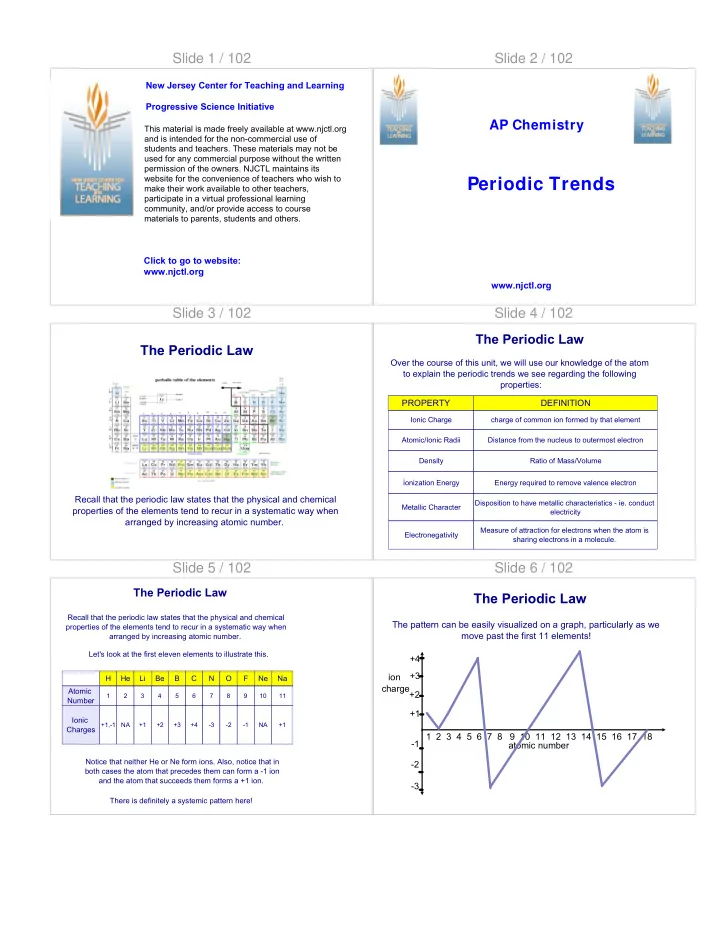
Recall that the periodic law states that the physical and chemical properties of the elements tend to recur in a systematic way when arranged by increasing atomic number. Let's look at the first eleven elements to illustrate this. H He Li Be B C N O F Ne Na Atomic Number
1 2 3 4 5 6 7 8 9 10 11
Ionic Charges
+1,-1 NA +1 +2 +3 +4
- 3
- 2
- 1
NA +1
Notice that neither He or Ne form ions. Also, notice that in both cases the atom that precedes them can form a -1 ion and the atom that succeeds them forms a +1 ion. There is definitely a systemic pattern here!
The Periodic Law
Slide 6 / 102
The pattern can be easily visualized on a graph, particularly as we move past the first 11 elements! ion charge +1 +2 +3
- 1
- 2
- 3