SLIDE 1
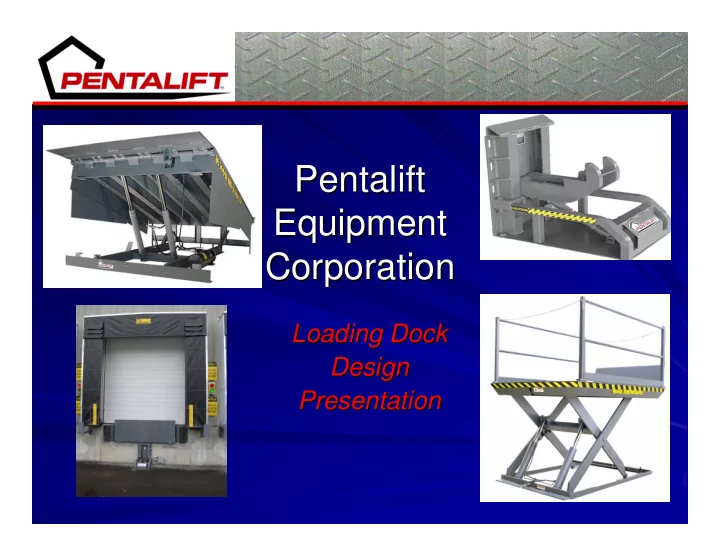
Pentalift Pentalift Equipment Equipment Corporation Corporation
Loading Dock Loading Dock Design Design Presentation Presentation
SLIDE 2
History
Established in 1983 by Arne Pedersen. Pentalift consists of two Divisions, Loading Dock Division and Lift Table Division. Loading Dock Division manufactures a complete line of Loading Dock Equipment, Vehicle Restraints, Dock Seals and Dock Shelters. Lift Table Division focuses on Custom Designed Lifting Equipment. 25+ Years Industry Experience.
SLIDE 3 Specifications
Pentalift is proud to be listed as an approved supplier on MasterSpec. Pentalift is incorporating product specifications which can be downloaded from the Pentalift Website. Our Dock Design Guide contains important factors for Architects to consider in
dock design.
SLIDE 4
Factors Affecting Dock Design Factors Affecting Dock Design
1.Loading Dock Safety 1.Loading Dock Safety Issues. Issues. 2.Type of Facility. 2.Type of Facility. 3.Trailer Design. 3.Trailer Design. 4.Dock Equipment Type. 4.Dock Equipment Type. 5.Building Design/Apron. 5.Building Design/Apron.
SLIDE 5 Dock Safety Issues Dock Safety Issues
Potential Accidents at the Potential Accidents at the loading Dock. loading Dock.
– – Void in the Floor. Void in the Floor. – – Unscheduled Trailer Departure. Unscheduled Trailer Departure. – – Trailer Creep. Trailer Creep. – – Trailer Landing Gear Collapse. Trailer Landing Gear Collapse. – – Trailer Tip Over. Trailer Tip Over. – – Forklift Roll Off. Forklift Roll Off. – – Stump Stump-
Out.
Factor # 1Dock Safety
SLIDE 6
Factor # 1Dock Safety
SLIDE 7 Other Facility Factors Other Facility Factors
Facility Type, Truck Fleet and Loading style will Facility Type, Truck Fleet and Loading style will affect: affect:
1. 1.
Door Size. Door Size.
2. 2.
Dock Height. Dock Height.
3. 3.
Dock Leveler Size. Dock Leveler Size.
4. 4.
Dock Leveler Capacity. Dock Leveler Capacity.
5. 5.
Dock Leveler Lip Length. Dock Leveler Lip Length.
6. 6.
Bumper Projection. Bumper Projection.
7. 7.
Style of Dock Seal or Dock Shelter. Style of Dock Seal or Dock Shelter.
8. 8.
Style of Vehicle Restraint required. Style of Vehicle Restraint required.
Factor # 2 Type of Facility
SLIDE 8
Trailer Design Affects Dock Design Trailer Design Affects Dock Design
Trailer Bed Heights. Trailer Bed Heights. Rear Impact Guards. Rear Impact Guards. Air Ride Suspension. Air Ride Suspension. Trailer Inside Width. Trailer Inside Width. Trailer Inside Height. Trailer Inside Height. Trailer Tailgates. Trailer Tailgates.
Factor # 3 Trailer Design
SLIDE 9
Trailer Bed Heights Trailer Bed Heights
Type of Trucks/Trailers: Type of Trucks/Trailers: Reefer (refrigerated). Reefer (refrigerated). Semi Trailers. Semi Trailers. Lowboys. Lowboys. Air Ride suspension. Air Ride suspension. Step Trailers. Step Trailers.
Factor # 3 Trailer Design
SLIDE 10
Factor # 3 Trailer Design Goal is to create a Dock Height and Door Size that will match up to the trailers that will be used.
SLIDE 11
Rear Impact Guards Rear Impact Guards (R.I.G.) (R.I.G.)
– – Maximum 22 Maximum 22” ” (560mm) (560mm) from Grade to R.I.G. from Grade to R.I.G. – – Many R.I.G. Many R.I.G.’ ’s can get as s can get as low as 10 low as 10” ” depending on depending on approach slope and approach slope and suspension (Air Ride). suspension (Air Ride). – – Ensure Axle is placed at Ensure Axle is placed at farthest rear position. farthest rear position. – – Maximum 12 Maximum 12” ” (305mm) (305mm) from rear of trailer to from rear of trailer to R.I.G. R.I.G. – – 4 4” ” x 4 x 4” ” horizontal member horizontal member is now standard. is now standard.
Factor # 3 Trailer Design
SLIDE 12
Air Ride Suspensions Air Ride Suspensions
Creates a more cushioned ride that helps Creates a more cushioned ride that helps protect product. protect product. At the Loading Dock the suspension can cause At the Loading Dock the suspension can cause problems for dock levelers, vehicle restraints, problems for dock levelers, vehicle restraints, dock seals and bumpers. dock seals and bumpers. This trailer movement can cause the trailer to This trailer movement can cause the trailer to creep forward away from the dock, causing the creep forward away from the dock, causing the Dock Leveler lip to lose penetration into the Dock Leveler lip to lose penetration into the bed of the truck and a potential safety issue. bed of the truck and a potential safety issue. Factor # 3 Trailer Design
SLIDE 13 Trailer Height and Width Trailer Height and Width
Inside width on new style Trailers can be Inside width on new style Trailers can be as much as 101 as much as 101” ” (8 (8’ ’-
5” ”) and allows for a ) and allows for a 40 40” ” pallet and 48 pallet and 48” ” pallet to fit side by side. pallet to fit side by side. Inside Height of up to Inside Height of up to 114 114” ” allows for double allows for double stacked loads to max stacked loads to max
- ut Trailer volume.
- ut Trailer volume.
Factor # 3 Trailer Design
- 101” Inside width trailer not shown
SLIDE 14 Recommended Door Size Recommended Door Size
With trailers becoming wider the With trailers becoming wider the recommendation is to consider using 9 recommendation is to consider using 9’ ’W W
’W x 10 W x 10’ ’H Dock Doors. H Dock Doors. This will give full access to the trailer for This will give full access to the trailer for possible full width and full height possible full width and full height loading/unloading. loading/unloading. Door size should match truck size and Door size should match truck size and load style. load style.
Factor # 3 Trailer Design
SLIDE 15
Dock Leveler Width Dock Leveler Width
Full Width End Loading Full Width End Loading
– – Drop off zone Drop off zone
space created between side of space created between side of deck and side of truck/trailer deck and side of truck/trailer giving the potential for material giving the potential for material handling equipment to drop handling equipment to drop through. through. Note: It is not recommended to Note: It is not recommended to taper the lips on 7 taper the lips on 7’ ’ wide Dock wide Dock Levelers. Levelers.
Factor # 3 Trailer Design
SLIDE 16
Recommended Dock Leveler Width Recommended Dock Leveler Width
Wider Trailers allow the possibility of Wider Trailers allow the possibility of wider loads and use 2 x 48 wider loads and use 2 x 48” ” W pallets. W pallets. Also a 7 Also a 7’ ’W Dock Leveler will assist with W Dock Leveler will assist with full width access for the forklift over a full width access for the forklift over a standard 6 standard 6’ ’ wide Dock Leveler. wide Dock Leveler.
Factor # 3 Trailer Design
SLIDE 17
Determining Dock Leveler Deck Length Determining Dock Leveler Deck Length
Type of Material Handling Equipment can Type of Material Handling Equipment can affect Dock Leveler length. affect Dock Leveler length. Slope requirements. Slope requirements. Maximum Maximum Ideal Ideal
– – Pallet Truck Pallet Truck 7% 7% 3.5% 3.5% – – Electric Forklift Electric Forklift 10% 10% 5.0% 5.0% – – Gas Forklift Gas Forklift 15% 15% 7.5% 7.5% Factor # 3 Trailer Design
SLIDE 18
Recommended Dock Leveler Length Recommended Dock Leveler Length
The wider variety of trailer styles seen at The wider variety of trailer styles seen at the dock, the longer the Dock Leveler has the dock, the longer the Dock Leveler has to be to maintain smooth transition to the to be to maintain smooth transition to the trailers and to maintain the float range with trailers and to maintain the float range with air ride suspensions. air ride suspensions. Standard lengths of 6 Standard lengths of 6’ ’ to 8 to 8’ ’ Long may not Long may not be enough. be enough. Consider 10 Consider 10’ ’ Long or more if needed. Long or more if needed.
Factor # 3 Trailer Design
SLIDE 19
Types Of Dock Equipment Types Of Dock Equipment
Hydraulic Dock Levelers. Hydraulic Dock Levelers. Mechanical Dock Levelers. Mechanical Dock Levelers. Edge of Dock Levelers. Edge of Dock Levelers. Automatic Vehicle Restraints. Automatic Vehicle Restraints. Mechanical Vehicle Restraints. Mechanical Vehicle Restraints. Automatic and Manual and Wheel Automatic and Manual and Wheel Chocks. Chocks. Dock Seals & Shelters. Dock Seals & Shelters. Dock Bumpers & Lights. Dock Bumpers & Lights. Factor # 4 Dock Equipment Type
SLIDE 20
Edge of Dock
Available in both Mechanical and Hydraulic models. Lower cost alternative to the pit style Dock Leveler. Suitable for lesser capacities and facilities with less frequent use. Suited for servicing minimal deviation in above and below level ranges. Excellent upgrade to aluminum plates.
SLIDE 21 Features: Features: Upward Bias Spring Systems. Upward Bias Spring Systems. Mechanical Fallsafe. Mechanical Fallsafe.
– – Legs prevent deck from Legs prevent deck from descending below dock descending below dock level under a fallsafe level under a fallsafe situation. situation.
Fallsafe Fallsafe -
where there is a load on the deck of the Dock load on the deck of the Dock Leveler and the truck/trailer Leveler and the truck/trailer supporting the lip of the Dock supporting the lip of the Dock Leveler pulls away allowing Leveler pulls away allowing deck to descend to lowest deck to descend to lowest position. position.
Mechanical Dock Levelers Mechanical Dock Levelers
Factor # 4 Dock Equipment Type
LEGS WILL STOP THE FREE FALL THESE LEGS CAN CAUSE STUMP-OUT
SLIDE 22 Air Ride Trailer Effects Air Ride Trailer Effects
- n Mechanical Dock Levelers
- n Mechanical Dock Levelers
Mechanical Dock Levelers equipped with Mechanical Dock Levelers equipped with Fallsafe legs can complicate loading operations Fallsafe legs can complicate loading operations since they can prematurely engage and stop the since they can prematurely engage and stop the downward movement of the Dock Leveler deck downward movement of the Dock Leveler deck until the legs are manually disengaged. until the legs are manually disengaged. This causes the issue commonly referred to as This causes the issue commonly referred to as “ “Stump Stump-
Out” ”. Stump . Stump-
Out can damage the Dock Leveler and increase the potential for injuries to Leveler and increase the potential for injuries to the dock worker. the dock worker. Stump Stump-
- Out is eliminated by specifying Hydraulic
Out is eliminated by specifying Hydraulic Dock Levelers. Dock Levelers. Factor # 3 Trailer Design
SLIDE 23 Fallsafe Legs can Cause Stump Fallsafe Legs can Cause Stump-
Out:
– – The truck/trailer lowers The truck/trailer lowers when being loaded/unloaded when being loaded/unloaded allowing the mechanical allowing the mechanical fallsafe legs to engage. fallsafe legs to engage. – – Then only the lip of the Dock Then only the lip of the Dock Leveler will float with the truck/trailer Leveler will float with the truck/trailer after the deck stops descending. after the deck stops descending. – – This creates an obstacle preventing the This creates an obstacle preventing the material handling equipment from material handling equipment from leaving the truck/trailer (STUMP leaving the truck/trailer (STUMP-
OUT).
Issues with Mechanical Dock Levelers Issues with Mechanical Dock Levelers
Factor # 4 Dock Equipment Type
SLIDE 24 Features: Features: Why use a Hydraulic Dock Why use a Hydraulic Dock Leveler? Leveler?
– – A Hydraulic Dock Leveler requires A Hydraulic Dock Leveler requires less maintenance than a Mechanical less maintenance than a Mechanical Dock Leveler, to keep operating Dock Leveler, to keep operating efficiently. efficiently. – – Auto Return to Dock feature helps to Auto Return to Dock feature helps to eliminate void in the floor potential. eliminate void in the floor potential. – – Uses Hydraulic vertical Float to Uses Hydraulic vertical Float to maintain smooth transition and maintain smooth transition and contact with trailer bed at all times contact with trailer bed at all times eliminating Stump eliminating Stump-
Out. – – Industry Proven Velocity Fuse Industry Proven Velocity Fuse system stops Dock Leveler within 3 system stops Dock Leveler within 3” ” in a free fall situation. in a free fall situation.
Hydraulic Dock Levelers Hydraulic Dock Levelers
Factor # 4 Dock Equipment Type
Hydraulic Dock Levelers create a more safe and ergonomic dock environment
SLIDE 25 Vertical Storing Dock Leveler Vertical Storing Dock Leveler
Vertical Storing Dock Leveler Vertical Storing Dock Leveler uses a fully hydraulic system uses a fully hydraulic system to lower/raise deck and to lower/raise deck and extend lip. extend lip. Control Panel operation Control Panel operation allowing interlocking to other allowing interlocking to other electrical equipment. electrical equipment. Used in facilities where Used in facilities where cleanliness or temperature cleanliness or temperature conditions must be conditions must be maintained. maintained. Factor # 4 Dock Equipment Type
USED IN AREAS WHERE ENERGY EFFICIENCY IS REQUIRED
SLIDE 26 Recommendation Recommendation – – GO HYDRAULIC! GO HYDRAULIC!
Why use a Hydraulic Dock Leveler? Why use a Hydraulic Dock Leveler?
– – Less Maintenance. Less Maintenance. – – Increases Safety Factor at the dock area. Increases Safety Factor at the dock area. – – Ability to be interlocked to Door, Vehicle Ability to be interlocked to Door, Vehicle Restraint and / Restraint and / or Dock Shelter.
– – Eliminates Eliminates “ “Stump Stump-
Out” ” from occurring. from occurring. – – Greater operating Range. Greater operating Range. – – Floats 12 Floats 12” ” above and 12 above and 12” ” below dock to below dock to maintain Lip contact with Trailer. maintain Lip contact with Trailer. Factor # 4 Dock Equipment Type
SLIDE 27
Capacity
What is Static Capacity? The amount of evenly distributed static weight that a Dock Leveler can support in the stored position. What is Dynamic Capacity? The total rolling load that a Dock Leveler can safely support while the lip is resting on the truck/trailer bed. Industry Standards are rated using Static Capacity.
SLIDE 28
Capacity
Determine Static Capacity Determine Impact Factor (I) What is the Impact Factor?
– Multiplier used to compensate for the forces applied by a moving load. – For normal applications, Pentalift uses a minimum impact factor of 2.5 for its standard series of Dock Levelers and a 2.0 for its Ultima series Dock Levelers.
SLIDE 29 Capacity
Sample Calculation
WHE=Weight of material handling equipment (plus any attachments) WL=Weight of the load I= Impact force WHE = 10,000 lb WL = 5,000 lb I = 2.5 Static Capacity = (10,000 lb + 5,000 lb) x 2.5 = 15,000 lb x 2.5 = 37,500 lbs Or 40,000 lbs
Capacity is rounded up to the next standard capacity.
SLIDE 30 Pit Design Pit Design
Advantages Advantages
- Installed after the floor
Installed after the floor is poured. is poured.
Easily removed for replacement. replacement.
Disadvantages Disadvantages
Pit formed in advance
Separate curb angle required. required.
Extra installation with welding in place. welding in place.
- Factor # 4 Dock Equipment Type
SLIDE 31 Pour Pour-
In-
Place Design
Advantages Advantages
Requires concrete pad for installation. for installation.
Concrete pours around Dock Leveler once Dock Leveler once leveled and secured. leveled and secured.
Disadvantages Disadvantages
Must be set up before pouring concrete. pouring concrete.
Harder to replace after installed. installed.
- Factor # 4 Dock Equipment Type
SLIDE 32 Advantages of Pour-In- Place Dock Levelers for new construction or renovation. Cost savings:
No forming of pits by contractor. Dock Leveler comes installed in Pour in Place unit. No curb angles.
– Pits are always square allowing leveler to perform better. – Controls the quality of the installation.
Pour-In-Place
SLIDE 33 Pit Design Pit Design
Advantages Advantages
Provides concrete floor beside Dock Leveler. beside Dock Leveler.
- Flat plate option welds to
Flat plate option welds to embedded channel. embedded channel.
Disadvantages Disadvantages
Pit formed in advance
Separate curb angle required. required.
Channel required when concrete poured. concrete poured.
- Factor # 4 Dock Equipment Type
SLIDE 34 Pit Design Pit Design
Advantages Advantages
- Step in floor requiring no
Step in floor requiring no preformed pit. preformed pit.
Easy cleaning pit floor
- Flat plate option welds to
Flat plate option welds to embedded channel. embedded channel.
Disadvantages Disadvantages
Channel required when concrete poured. concrete poured.
Open area beside Dock Leveler. Leveler.
Stand required to mount controls. controls.
- Factor # 4 Dock Equipment Type
SLIDE 35
Why Wheel Chocks Don Why Wheel Chocks Don’ ’t Work t Work
Truck has enough force to Truck has enough force to easily pull over rubber easily pull over rubber chocks. chocks. Ice, snow and rain can Ice, snow and rain can affect its grip. affect its grip. Has to be manually placed Has to be manually placed creating a possible human creating a possible human error situation. error situation. They are easily lost and or They are easily lost and or damaged. damaged. Factor # 1Dock Safety
SLIDE 36
Features and Benefits: Features and Benefits: Creates a safe working Creates a safe working environment at the dock. environment at the dock. Locks onto Trailer R.I.G. Locks onto Trailer R.I.G. Prevents trailer from early Prevents trailer from early departure. departure. Easy operation from Easy operation from Control Panel inside Control Panel inside building. building. Effective communication Effective communication with truck driver via outside with truck driver via outside lights. lights.
Hydraulic Vehicle Restraint Hydraulic Vehicle Restraint
Factor # 4 Dock Equipment Type
SLIDE 37 Low Profile Vehicle Restraint Low Profile Vehicle Restraint
Same Features and Benefits Same Features and Benefits as HFR restraint Plus: as HFR restraint Plus: 8 8-
3/4” ” low profile stored low profile stored height to lock to lower height to lock to lower R.I.G. trailers. R.I.G. trailers. Perfect option for certain Perfect option for certain decline approaches. decline approaches.
Factor # 4 Dock Equipment Type
SLIDE 38
Under Dock Leveler Vehicle Under Dock Leveler Vehicle Restraint Restraint
Features and Benefits: Features and Benefits: Stored under Hydraulic Stored under Hydraulic Dock Leveler creates a Dock Leveler creates a unobstructed dock unobstructed dock approach. approach. Has 40,000lb of Has 40,000lb of restraining force. restraining force. Ideal option at New Ideal option at New Construction phase. Construction phase. Factor # 4 Dock Equipment Type
SLIDE 39
Trailer Creep/Early Departure Alarm. Trailer Creep/Early Departure Alarm.
– – When a truck/trailer tries to drive away while the When a truck/trailer tries to drive away while the Ultrahook is engaged on the R.I.G., an audible Ultrahook is engaged on the R.I.G., an audible alarm will sound and the interior red light will flash to alarm will sound and the interior red light will flash to inform the operator of this situation. inform the operator of this situation.
Under Dock Leveler. Under Dock Leveler.
– – Restraint stores completely under the Dock Leveler Restraint stores completely under the Dock Leveler to protect it from the weather and any damage from to protect it from the weather and any damage from equipment being used at the grade level. equipment being used at the grade level.
Under Dock Leveler Vehicle Under Dock Leveler Vehicle Restraint Restraint
Factor # 4 Dock Equipment Type
SLIDE 40
Dock Seals/Shelters Dock Seals/Shelters
Generally Dock Seals offer a Generally Dock Seals offer a tighter environmental Seal. tighter environmental Seal. Truck Shelters allow for a Truck Shelters allow for a wider variety of Trailers at wider variety of Trailers at the Dock and Larger Doors the Dock and Larger Doors for End Loading. for End Loading. Application will determine Application will determine Dock Seal or Dock Shelter Dock Seal or Dock Shelter type that best fits. type that best fits.
Factor # 4 Dock Equipment Type
SLIDE 41 Dock Bumpers Dock Bumpers
Molded Rubber Molded Rubber – – Basic style of bumper Basic style of bumper
– – Can easily wear due to air ride suspensions. Can easily wear due to air ride suspensions.
Laminated Laminated – – Provide good wear protection against air Provide good wear protection against air ride trailers. ride trailers. Steel Faced Steel Faced -
- Provides the best protection against air
Provides the best protection against air ride wear issues. ride wear issues. Trucks can generate up to 300,000 lb of force at the Trucks can generate up to 300,000 lb of force at the dock. dock. Air Ride Suspensions increase the wear on a bumper. Air Ride Suspensions increase the wear on a bumper. Longer Bumpers are recommended to protect the wall Longer Bumpers are recommended to protect the wall from Air Ride trailers that can move vertically 6 from Air Ride trailers that can move vertically 6” ” to 8 to 8” ”. . Bumper length will depend on dock height and trailer Bumper length will depend on dock height and trailer height. height.
Factor # 4 Dock Equipment Type
SLIDE 42
Elevating Dock Lifts
Available in pit-mounted and low-profile. Available in 3 sided pit design for greater flexibility at the loading dock. Suitable for applications where a traditional loading dock does not exist. Vertical travel of 59” allows for a wide range of truck bed heights.
SLIDE 43
Pentalift Surface Mounted Design
Surface Mounted
– LPE685
SLIDE 44
Equipment Recommendations Equipment Recommendations
Specify: Specify: Hydraulic Dock Levelers. Hydraulic Dock Levelers. Vehicle Restraints. Vehicle Restraints. Interlocking of Dock Equipment and Interlocking of Dock Equipment and Overhead Door. Overhead Door. Laminated or Steel faced Bumpers. Laminated or Steel faced Bumpers. Factor # 4 Dock Equipment Type
SLIDE 45 Facility Style Affects Dock Design Facility Style Affects Dock Design
Application Affects Design: Application Affects Design: Refrigerated Warehouses Refrigerated Warehouses
– – Cold temperature/Freezer Cold temperature/Freezer -
Clean operation. – – May Require Vertical Storing Dock Levelers. May Require Vertical Storing Dock Levelers.
Trucking Terminals Trucking Terminals
– – Fast paced Fast paced -
Cross Docking – – Shunting Shunting – – May use Mechanical or Hydraulic Dock May use Mechanical or Hydraulic Dock Levelers. Levelers.
Distribution/Manufacturing Centers Distribution/Manufacturing Centers
– – System integration System integration -
Just in time delivery – – Type of Loading/shipping will affect size of Type of Loading/shipping will affect size of Dock Levelers needed. Dock Levelers needed.
Factor # 2 Type of Facility
SLIDE 46
Building Design Building Design
Dock Approach/Grade. Dock Approach/Grade. Apron Spacing. Apron Spacing. Door Spacing. Door Spacing. Dock Height. Dock Height.
Factor # 5 Building Design
SLIDE 47 Dock Approach Grade Dock Approach Grade
Most dock approaches Most dock approaches are either Level or Decline. are either Level or Decline. Decline: Project bumper Decline: Project bumper thickness 1 thickness 1” ” for every 1% of for every 1% of decline beyond the 4 decline beyond the 4” ” thick thick bumpers required for a level bumpers required for a level approach. approach. e.g. 4% decline = 8 e.g. 4% decline = 8” ” total bumper total bumper projection. projection. This 8 This 8” ” can include a cantilever can include a cantilever
- r haunch of 4
- r haunch of 4”
” and Bumpers at and Bumpers at 4 4” ” to = 8 to = 8” ”. . Dock Seals or Dock Shelters will Dock Seals or Dock Shelters will have to be tapered to match. have to be tapered to match.
Factor # 5 Building Design
SLIDE 48
Apron Spacing Apron Spacing
To give trucks enough room to maneuver To give trucks enough room to maneuver freely in and out of the dock. freely in and out of the dock. Recommendation is to provide twice the Recommendation is to provide twice the length of longest trailer plus a 10 length of longest trailer plus a 10’ ’ safety safety factor. factor. E.g. 70 E.g. 70’ ’ Trailer and Trailer and Cab x 2 = 140 Cab x 2 = 140’ ’+10 +10’ ’ = 150 = 150’ ’ apron spacing apron spacing
Factor # 5 Building Design
SLIDE 49 Door Spacing Door Spacing
Recommendation is to Design Doors with 12 Recommendation is to Design Doors with 12’ ’ centers. centers. This allows for trucks with an overall width of This allows for trucks with an overall width of 10 10’ ’ including side mirrors to easily maneuver in including side mirrors to easily maneuver in and out of the dock. and out of the dock. Narrower spacing is possible when room is Narrower spacing is possible when room is
- limited. In this case consider using Dock Seals
- limited. In this case consider using Dock Seals
- r Dock Shelters with common members or
- r Dock Shelters with common members or
saw tooth docks to maximize available space. saw tooth docks to maximize available space. Factor # 5 Building Design
SLIDE 50
Dock Height Dock Height
Most common Dock Most common Dock Height is 48 Height is 48” ” to 52 to 52” ”. . Goal is to match the Goal is to match the dock height to the dock height to the trailers that will be seen at the dock. trailers that will be seen at the dock. Its ideal is have a slight incline into the Its ideal is have a slight incline into the trailer for loading and unloading. trailer for loading and unloading.
Factor # 5 Building Design
SLIDE 51 Final Recommendations Final Recommendations
Safety Safety
- Specify Vehicle Restraints and
Specify Vehicle Restraints and Interlock to Dock Leveler and/or OHD. Interlock to Dock Leveler and/or OHD. Equipment Equipment
- Spec Hydraulic Dock Levelers.
Spec Hydraulic Dock Levelers. Dock Height Dock Height
- Match to Trailer Bed Heights.
Match to Trailer Bed Heights. Door Size Door Size
- Match to Trailer Width (est. 9
Match to Trailer Width (est. 9’ ’W x 10 W x 10’ ’H). H). Dock Leveler Size Dock Leveler Size -
Spec 7’ ’ Wide for End Loading. Wide for End Loading.
Spec 8’ ’ long to 10 long to 10’ ’ long for smooth long for smooth Transition into Trailer. Transition into Trailer. Capacity Capacity
- Match to MGL and Forklifts Used.
Match to MGL and Forklifts Used. Bumpers Bumpers
- Spec Laminated or Steel Faced.
Spec Laminated or Steel Faced. Door Spacing Door Spacing
Spec 12’ ’ Centers Where Possible. Centers Where Possible. Apron Spacing Apron Spacing
- Spec 2x Overall Truck length + 10
Spec 2x Overall Truck length + 10’ ’. .
Final Recommendations
SLIDE 52 Please Contact Pentalift Sales Representative For Additional Information.