Penrose: From Mathematical Notation to Beautiful Diagrams Jonathan - - PowerPoint PPT Presentation

penrose from mathematical notation to beautiful diagrams
SMART_READER_LITE
LIVE PREVIEW

Penrose: From Mathematical Notation to Beautiful Diagrams Jonathan - - PowerPoint PPT Presentation

Penrose: From Mathematical Notation to Beautiful Diagrams Jonathan Aldrich, Carnegie Mellon University Joint work with Katherine Ye, Wode Ni, Max Krieger, Dor Maayan, Jenna Wise, Yumeng Du, Lily Shellhammer, Joshua Sunshine, and Keenan


slide-1
SLIDE 1

Penrose: From Mathematical Notation to Beautiful Diagrams

Jonathan Aldrich, Carnegie Mellon University Joint work with Katherine Ye, Wode Ni, Max Krieger, Dor Ma’ayan, Jenna Wise, Yumeng Du, Lily Shellhammer, Joshua Sunshine, and Keenan Crane

1

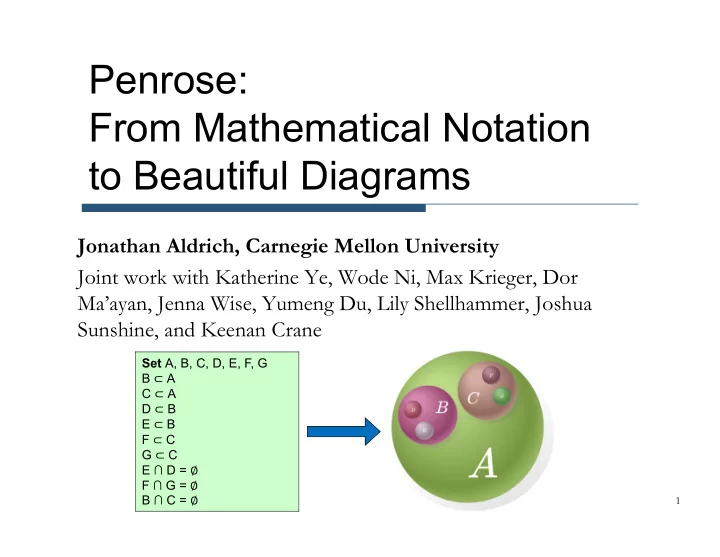
Set A, B, C, D, E, F, G B ⊂ A C ⊂ A D ⊂ B E ⊂ B F ⊂ C G ⊂ C E ∩ D = ∅ F ∩ G = ∅ B ∩ C = ∅

slide-2
SLIDE 2

Diagrams are useful, but too rare

  • Diagrams are useful…
  • Diagrams help in solving math problems [Larkin&Simon]
  • High-impact papers have many figures [Lee et al.]
  • But rare: just 39% of arXiv math papers contain diagrams
  • And even those contain only 1 figure for every 10 pages

“People have very powerful facilities for taking in information visually... On the other hand, they do not have a good built-in facility for turning an internal spatial understanding back into a two- dimensional image. [So] mathematicians usually have fewer and poorer figures in their papers and books than in their heads.”

  • Fields medalist William Thurston

2

slide-3
SLIDE 3

The Penrose Vision

3

You write this: Or, if you prefer, this: Penrose generates this:

slide-4
SLIDE 4

Penrose in Action

  • Linear algebra – simple intro
  • Linear algebra – sugar and direct manipulation
  • SIGGRAPH teaser video

4

slide-5
SLIDE 5

Can we create a LaTeX for Diagrams?

LaTeX

  • Describe document content

(.tex) separate from layout

  • Extensible formatting styles

(.sty)

  • Extensible with new document

structuring concepts (macros)

  • Optimizes (mostly textual)

layout of documents Penrose

  • Describe mathematical content

(Substance) separate from visual representation

  • Extensible rendering (Style)
  • Extensible with new math

domains (Domain)

  • Optimizes (graphical) layout of

diagrams

5

slide-6
SLIDE 6

Existing tools are inadequate

  • Graphing calculators (e.g. Wolfram Alpha)
  • Visualize concrete data or functions
  • Don’t understand, can’t visualize mathematical abstractions
  • Drawing tools (e.g. Adobe Illustrator, TikZ)
  • Require laborious specification of low-level details
  • Don’t understand semantics
  • Domain-specific visualizations (e.g. Group Explorer)
  • Work well for a particular domain, but are not extensible

6

slide-7
SLIDE 7

The Penrose Architecture and Users

7

slide-8
SLIDE 8

Anatomy of a Substance Program

8

Object U of type VectorSpace Syntactic sugar for AddV(u3, u4) Declares that u5 is equal to AddV(u3, u4) Syntactic sugar declares variables and relationships In(ui, U) for each ui

slide-9
SLIDE 9

The Domain Language

type Vector type VectorSpace predicate In: Vector * VectorSpace V function addV: Vector * Vector -> Vector notation "v1 + v2" ~ "addV(v1, v2)" notation "Vector a ∈ U" ~ "Vector a; In(a, U)"

9

Declares type VectorSpace. Constructors may eventually have arguments. Declares a predicate and its type Declares an operator and its type Declares syntactic sugar

slide-10
SLIDE 10

Substance and Domain Design Features

  • Separate, reusable domain extensions
  • New types, predicates, operators
  • New domain-specific notation
  • Similar to Coq notation extension
  • Generic, typed object model
  • Check that substance programs are well-formed
  • Match on types in style programs

10

slide-11
SLIDE 11

The Style Language

11

Match once per Vector; call it v For each v there must be at least one U And In(v, U) must hold

slide-12
SLIDE 12

The Style Language

12

For each match create an Arrow graphical

  • bject. Attach it to the shape field of v.

Set a feature of v.shape The runtime can optimize other features encourage contributes to objective

  • function. ensure is a constraint.

Refines a shape created earlier Creates more shapes for vectors when there is predicate relating them to other vectors Creates more shapes for vectors when there is predicate relating them to other vectors

slide-13
SLIDE 13

Substance, Style, and Output

13

4 4 3

slide-14
SLIDE 14

Style Design Characteristics

  • Extensible and reusable
  • Many styles per domain
  • Use different styles with the same substance program
  • Typical end-users need not understand style programs
  • But expert users can edit them or write new ones if they want to
  • Provides a visual semantics for substance programs
  • Pattern matches over logical objects, generates graphical objects
  • Generates objectives and constraints for later optimization
  • Later matches can refine the semantics provided by earlier ones

14

slide-15
SLIDE 15

Optimization

  • Basically hill-climbing to solve constraints and maximize
  • bjectives
  • All Penrose functions are end-to-end differentiable
  • Can take the derivative and modify the input(s) in the direction(s)

that improve the composite objective function

  • Can run multiple times

 multiple diagrams

15

slide-16
SLIDE 16

Mathematics Underlying the Constraints

16

slide-17
SLIDE 17

How do these relationships look if we assume that two parallel lines never meet?

Euclidean Geometry

slide-18
SLIDE 18

drawn in euclidean geometry (assuming parallel postulate)

Euclidean Geometry

slide-19
SLIDE 19

What if the parallel postulate doesn’t hold? How would we visualize these relationships on, say, a sphere?

Non-Euclidean Geometry

slide-20
SLIDE 20

(different samples of the same Substance program, not a rotated sphere of the same diagram) here’s the style program

Non-Euclidean Geometry

slide-21
SLIDE 21

(different samples of the same Substance program)

Non-Euclidean Geometry

slide-22
SLIDE 22

More Penrose Demonstrations

  • Set theory
  • tree style
  • Venn style
  • Real analysis
  • parallel axis style
  • perpendicular axis style
  • Any live requests?
  • Set theory
  • Linear algebra
  • Real analysis

22

slide-23
SLIDE 23

Penrose: customizable visual semantics for concept- level expressions in an extensible set of domains

23

slide-24
SLIDE 24

More examples

24