Pediatrics & We are family! This program is dedicated to my - - PDF document

pediatrics amp
SMART_READER_LITE
LIVE PREVIEW

Pediatrics & We are family! This program is dedicated to my - - PDF document

10/10/2019 The story of courageous Jackson. Little wonder & typically developing, Jackson Leyden, with his dad John, prepping for baby brother! Courageous Jackson with mom, Lisa. On the journey with epilepsy. Pediatrics & We are


slide-1
SLIDE 1

10/10/2019 1

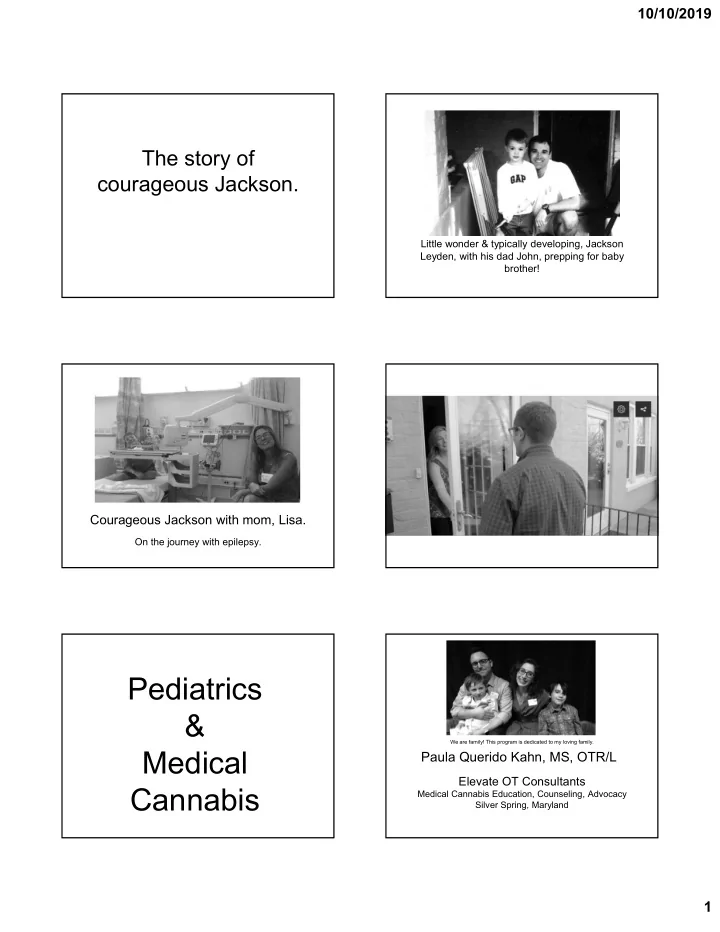
The story of courageous Jackson.

Little wonder & typically developing, Jackson Leyden, with his dad John, prepping for baby brother!

Courageous Jackson with mom, Lisa.

On the journey with epilepsy.

Pediatrics & Medical Cannabis

Paula Querido Kahn, MS, OTR/L

Elevate OT Consultants

Medical Cannabis Education, Counseling, Advocacy Silver Spring, Maryland

We are family! This program is dedicated to my loving family.

slide-2
SLIDE 2

10/10/2019 2

Meet my family.

Disclosure: My husband, Rabbi James Kahn, works on the national level for Liberty Cannabis, which has humble beginnings here in the DMV.

In today’s presentation: We will learn about medical cannabis history, chemistry, pharmaceuticals, effects, clinical implications, how to gain access in our state. We will learn about the relationship between development, academic learning and medical cannabis in pediatrics. We will address OT and PTs role in working with pediatric clients using medical cannabis.

What do families seek from our services?

slide-3
SLIDE 3

10/10/2019 3

In my experience working as an OT in rehabilitation and then with medical cannabis patients of all ages in Washington DC… Clean, professional, warm, welcoming, accessible environment Dependable, high quality services and relationships over time Adaptive equipment for individual needs A listening ear Respect and care Language, atmosphere, and action that are free of judgement

What is Stigma?

“A mark of shame or discredit: Stain”

According to Merriam-Webster.com.

How might stigma affect the lives of families choosing to use medical cannabis with their children?

When do families turn to medical cannabis?

slide-4
SLIDE 4

10/10/2019 4

When other known pathways have been exhausted. When the risks of pharmaceutical or surgical intervention are too high. When the risks of not doing anything are too high. When they learn of the benefits and limited side- effects.

How do we best combat stigma?

Educate

  • urselves.

Educate

  • thers.

Use compassionate language and action.

What is Medical Cannabis?

slide-5
SLIDE 5

10/10/2019 5

➢Cannabis is a genus of flowering plants that includes

  • riginally three different

species, Cannabis sativa, Cannabis indica and Cannabis

  • ruderalis. NOW, with the advent
  • f the medical cannabis

industry, HYBRIDS are the preferred choice in MEDICINAL formulations.

Cannabis is One of Nature’s Most Versatile Plants

COMPILED FROM JEFFREY FRIEDLAND'S BOOK, MARIJUANA: THE WORLD’S MOST UNDERSTOOD PLANT.

History of cannabis use for medicinal purposes

26

15th Century BC: Cannabis written about in medical texts:

  • Rh-Ya, the Chinese pharmacopeia
  • Ebers Papyrus , an Egyptian medical text

Chinese Emperor Shen Nung, “the father of Chinese medicine,” is credited with discovering cannabis’ healing properties – lived around 2700 B.C. 1000 BC: Documented use in India as an anesthetic, to lower fevers, to aid sleep, and to cure dysentery 700 BC: Documented medicinal use in Persia 200 BC: Documented use in Ancient Greece for inflammation and eye treatments

COMPILED FROM JEFFREY FRIEDLAND'S BOOK, MARIJUANA: THE WORLD’S MOST UNDERSTOOD PLANT. 27

18th Century: Dr. William O’Shaughnessy wrote The Memoranda on India Materia Medical, the first English text on Indian medicinal plants O’Shaugnessy created a cannabis extract that reduced the spastic symptoms of tetanus and rabies, the pain of rheumatoid arthritis, and infant convulsions 1850: “Cannabis Indica” is listed in the Pharmacopeia of the US as a treatment for pain, alcoholism, opiate addition, and more. It started to be added to medicinal products Cannabis became an ingredient in “patent medicine,” along with secret ingredients like cocaine and opium 1889: an article in The Lancet described the use of cannabis to treat opium and choral hydrate withdraw symptoms

History of cannabis use for medicinal purposes

  • Medicinal preparations of cannabis became available in US pharmacies in the

1850s.

  • Cannabis was a part of the American pharmacopeia until 1942.

Cannabis in Western Medicine

MARIJUANA LAW IN THE U.S.

COMPILED FROM JEFFREY FRIDLAN’DS BOOK, MARIJUANA: THE WORLD’S MOST UNDERSTOOD PLANT.

The movement to ban cannabis in the United States

30

Cannabis is removed for the U.S. Pharmacopeia

1942

Roosevelt issues executive order allowing for hemp to be grown for the production of military necessities – lasts until the end of WW II

1942

Narcotics Control Act classifies cannabis as a narcotic

1956

The Controlled Substances Act classifies cannabis as a Schedule 1 narcotic

1970

slide-6
SLIDE 6

10/10/2019 6

The Species Problem in Cannabis

by Ernest Small (published in1978)

  • Found it impossible to scientifically tell the difference between cannabis and

hemp

  • Despite this, he chose a distinction factor – it is the distinguishing factor that

legal frameworks are built upon today regulating hemp and cannabis:

  • 1. Cannabis plants with a THC level of more than 0.3 % = cannabis
  • 2. Cannabis plants with a THC level of less than 0.3 % = hemp

This is what continues to cause the confusion between hemp and cannabis today.

What is the Endocannabinoid System?

Russo, E.B. 2008. Cannabinoids in management of difficult to control pain. Therapeutics & Clinical Risk Management 4(1):245-259.

Cannabinoids: 3 Varieties

➢THC was discovered by Dr. Raphael

Mechoulam in Israel

➢Until the discovery and isolation of

Delta-9 tetrahyrdrocannabinol, scientists did not understand what caused the psychoactive effect in Cannabis.

➢Since then, multiple components

including THC, CBD, CBC, CBG, not to mention terpines and flavonoids have been identified within the cannabis plant.

THC Discovered in 1964

Raphael Mechoulam - Father of Cannabinoid Research http://www.beyondthc.com/wp-content/uploads/2012/07/eCBSystemLee.pdf Delta-9 Tetrahydrocannabinol

➢In a study published in 1990, researchers

were able to clone a CB1 brain receptor, after much hypothesizing that there must be receptors in the brain for cannabinoids.

➢Since then, research has expanded to

include cloning CB2 receptors, understanding complex interaction of cannabinoids with our CNS, immune system and organs.

➢Dr. Kano and his colleagues in Tokyo

reported in 2009 about the influence of endocannbinoids on synaptic transmission.

Cannabinoid receptors in brain discovered in 1990.

Kano M1, Ohno-Shosaku T, Hashimotodani Y, Uchigashima M, Watanabe M. Endocannabinoid-mediated control of synaptic transmission. Physiol Rev. 2009 Jan;89(1):309-80.

Delta-9 Tetrahydrocannabinol

slide-7
SLIDE 7

10/10/2019 7

How Cannabis Interacts with Our Bodies Methods of Ingestion:

By mouth via eating, ie. oil, butter, capsules, dummies, sprays, alcohol/oil based tinctures. By mouth via sublingual use of sprays or tinctures. By inhaling via smoking or vaporizing into lungs. By applying via topicals to skin. By suppository via rectal insertion.

What is Cannabidiol

  • r

CBD?

From ProjectCBD.org

slide-8
SLIDE 8

10/10/2019 8

Some other important cannabinoids:

  • Cannabinol (CBN): mildly psychoactive, may decrease eye

pressure and seizure occurrence.

  • Cannabichromene (CBC): may provide pain relief, has

sedative effects.

  • Cannabigerol (CBG) may have sedative effects and

antimicrobial properties, may decrease eye pressure.

  • Tetrahydrocannabivarin (THCV) showing promise for Type-2

diabetes and related metabolic disorders.

Cannabinoid based Pharmaceuticals

From National Center for Complementary and Integrative Health

slide-9
SLIDE 9

10/10/2019 9

Visit PROJECT CBD

www.projectcbd.org/how-to/cbd-drug- interactions for EDUCATIONAL PRIMER ON CANNABINOID-DRUG INTERACTIONS

Effects of Cannabinoids

for any age. Cannabis acts as an adaptogen in the

  • body. At too low dose, no effect, too high

dose opposite effect, just right dose leads to therapeutic effects.

Excerpt from ProjectCBD.org

slide-10
SLIDE 10

10/10/2019 10

From National Center for Complementary and Integrative Health

Information gathered from article by Zerrin Atakan: Cannabis, a complex plant: different compounds and different effects on individuals. Ther Adv Psychopharmacol. 2012 Dec; 2(6): 241–254.

Effect THC CBD References

Receptor/nonreceptor effects

CB1

++ ± Rhee et al. [1997]; Iwamura et al. [2001]; Hayakawa et al. [2008]

CB2

+ ± Rhee et al. [1997]; Showalter et al. [1996]

Anti inflammatory

+ + Juknat et al. [2011]

Immunomodulatory

+ + Costa et al. [2007] CNS effects

Anticonvulsant

+ ++ Wallace et al. [2001]

Muscle relaxant

++ + Lakhan and Rowland [2009]

Anxiolytic

± ++ Zuardi and Guimaraes [1997]; Crippa et al. [2009]

Psychotropic

++ − Russo [2001]; D’Souza et al. [2004]; Borgwardt et al. [2008]

Antipsychotic

− ++ Zuardi et al. [1995]; Moreira and Guimaraes [2005]

Short-term memory problems

+ − Hayakawa et al. [2008]; Morgan et al. [2010]

Distortion of perception of time

++ − Karniol and Carlini [1973]; Anderson et al. [2010]

Neuroprotective antioxidant

+ ++ Juknat et al. [2011]

Antiemetic

++ ++ Parker et al. [2011]

Sedation

+ − Nicholson et al. [2004]; Russo et al. [2007] Information gathered from article by Zerrin Atakan: Cannabis, a complex plant: different compounds and different effects on individuals. Ther Adv Psychopharmacol. 2012 Dec; 2(6): 241–254.

Effect THC CBD References

Cardiovascular effects

Bradycardia

− + Benowitz and Jones [1981]

Tachycardia

+ − Gorelick and Heishman [2006]

Hypertension

+ − Batkai et al. [2004]

Hypotension

− + Gorelick and Heishman [2006]

Appetite/GI/metabolic Appetite

+ − Pertwee [2009]

GI motility (slowed)

++ + Di Marzo and Piscitelli [2011]

Metabolic/diabetes

+ − Di Marzo et al. [2011] Anticarcinogenesis

Glioma (apoptosis)

+ + Torres et al. [2011]

Lung cancer

+ ++ Athanasiou et al. [2007]; Ramer et al. [2012] Ophthalmological

Intraocular pressure (reduced)

++ + Green [1998]

Effects of Cannabinoids
slide-11
SLIDE 11

10/10/2019 11

How Cannabinoids Effect Our Bodies

Terpenes: Scents & Therapeutic Effects

Breakdown: Maryland Patient Diagnoses

From National Center for Complementary and Integrative Health

slide-12
SLIDE 12

10/10/2019 12

Adolescent Use of Medical Cannabis

Medical Cannabinoids in Children and Adolescents: A Systematic Review

Shane Shucheng Wong, Timothy E. Wilens

Pediatrics

November 2017, VOLUME 140 / ISSUE 5

Maternal Prenatal Use

  • f Cannabis
slide-13
SLIDE 13

10/10/2019 13

Visit www.acog.org for more information and extensive research reference list.

What is the role of

  • ccupational therapists &

physical therapists in addressing medical cannabis treatment in our practice settings?

We work with: Early intervention Students Families Communities And other client groups

slide-14
SLIDE 14

10/10/2019 14

Occupational Therapy and Physical Therapy Services: Focus on improving reported symptoms (OT: in order to foster independent engagement in life’s occupations; PT: in order to promote the ability to move, reduce pain, restore function, and prevent disability.) Respond to questions about medical cannabis in our state. Some patients may be using it already. OTs frequently educate about medication benefits and drawbacks, and integrating medications into daily routines. OTs and PTs should monitor and document effects, physical, cognitive, emotional and communicate this with families and

  • ther involved professionals as needed for best care of the

individual child. Occupational Therapy and Physical Therapy Services:

What is the relationship between academic learning & pediatric medical cannabis use?

What is the relationship between development & pediatric use of medical cannabis?

In my experience with minors enrolled in DC’s medical cannabis program:

Medical cannabis use that is monitored by parents and healthcare practitioners and purchased from licensed dispensaries, can lead to improvements in academic learning, from early childhood through high school and into college. In speaking with a college-aged minor himself, using medical cannabis has made all the difference in anxiety levels and focus as he pursues his higher education.

slide-15
SLIDE 15

10/10/2019 15

Christopher T. Campbell, PharmD, Marjorie Shaw Phillips, MS, and Kalen Manasco, PharmD, J Pediatr Pharmacol Ther. 2017 May-Jun; 22(3): 176–185.

Families report increased social engagement, eye contact, academic improvements with pediatric use of cannabis as medicine. You may advise to family to administer medicine before treatment, like we might suggest for other pain relieving medications. Work with your interdisciplinary team to support the child and family. Low and slow with dosage.

In speaking with parents of minors who use medical cannabis, they report…

slide-16
SLIDE 16

10/10/2019 16

How do we best combat stigma?

Educate yourself. Educate

  • thers.

Use compassionate language.

  • Study the research.

Conduct research! Participate in the emerging industry. Bring awareness to colleagues, families in your practice settings. Knowledge: decreases stigma. Understand: the political landscape regarding medical cannabis. It can be very challenging for families making choices about children’s lives. Children change so dosage changes! Help families go with the flow of life. Do what you always do! Be great communicators and professionals!

Clinical Practice Considerations and Implications

slide-17
SLIDE 17

10/10/2019 17

Benefits of Legalization & Regulation of Cannabis as Medicine

  • Standardized dosage and labeling.
  • Batch identification.
  • Quality controls and assurances.
  • Safe ingredients, i.e. no pesticides or other

harmful additives.

  • No synthetics.
  • Farm to table: Local businesses, local jobs, and

local fresh produce. Helps the consumer to be on the right side of the law. Improved education, research & public policy. Decreased STIGMA

Benefits of Legalization & Regulation of Cannabis as Medicine Recent and upcoming studies of pediatric patients: Epilepsy Behavioral Conditions Perinatal Brain Injury Neuroblastoma Chemotherapy and Oncology

slide-18
SLIDE 18

10/10/2019 18

From National Center for Complementary and Integrative Health

Why educate

  • urselves about

medical cannabis in Maryland now?

What is the Maryland Medical Cannabis Commission (MMCC)? What is the Maryland Medical Cannabis Commission (MMCC)?

IMPORTANT Maryland allows patients to obtain medical cannabis for ANY medical condition which is severe and for which other medical treatments have been ineffective

Children (under 18) can participate, but must have a caregiver assigned Currently, only MD residents can participate Insurance does not cover medical cannabis certification

  • r products

Mailing cannabis is illegal...patients w. limited mobility should designate a caregiver Takes 2-5 weeks to become certified, but Hospice patients will be processed immediately Patients are limited to two ounces of flower or its equivalent on a rotating 30-day basis

Cannabis in Maryland

slide-19
SLIDE 19

10/10/2019 19

*Requires basic computer skills, like uploading a pic of your photo ID and using an email account

STEP 1: Create a patient account with MMCC at mmcc.maryland.gov STEP 3: Visit a MMCC registered provider (List available at medchi.org/medcan) STEP 2: (wait 2 – 4 weeks) Receive 16-digit patient ID # by mail STEP 4: Visit any MD dispensary w/ patient ID # and ID card

Getting Certified

Caregiver Registration

  • Register Online at www.mmcc.Maryland.gov
  • Upload contact information (email) and recent photo
  • Patient designate caregivers during registration process
  • Two (2) maximum caregivers per patient
  • Five (5) maximum patients per caregiver
  • Caregivers must be 21 years or older

Certifying Providers Registration

  • Be a licensed provider in good standing with the State of

Maryland

  • Providers include Maryland Physicians, Nurse Practitioner,

Certified Nurse Mid-Wives, Podiatrists and Dentists

  • Register online at www.mmcc.Maryland.gov
  • Renew registration every two (2) years
  • Specify conditions/diseases that you plan to treat
  • Online course is now available for for MD certifying providers

and other medical professionals interested in learning about the clinical uses of cannabis. For more info, visit themedicalcannabisinstitute.org

Jackson’s Courage!

Jackson is 16 now. He still has seizures. His shoulder has sustained

  • injuries. Now the family lives in Colorado, and inspires us all to keep

hiking our mountains each day.

Jackson’s Courage!

Jackson is 16 now. He still has seizures. Currently, he is on a break from his cannabis medicine and is on Keppra and Dilantin. A surgical committee is reviewing his case to see if he is a candidate for surgery. Mom says he probably is not a candidate. He will soon get off the Dilantin and go back to a whole spectrum CBD cannabis oil, instead of the pharmaceutical grade cannabis option that had stopped working.

slide-20
SLIDE 20

10/10/2019 20

Jackson’s Courage! Jackson’s Courage! Jackson’s Courage! Canna Moms Unite!

On the front line, fighting for the rights of families around the country.

Knowledge is Power. Knowledge reduces stigma. Educate yourselves. Listen to families. Educate families. Educate other professionals. Provide access to local resources. Support the child and family the way you always would. Keep doing the incredible work you do!!!

Questions?

Contact:

Elevate OT Consultants

Paula Querido Kahn, MS, OTR/L 301.244.9228 paula@elevateotc.com www.elevateotc.com

Thank you!