pediatric audiology Report of EFAS Working Group on School Age - - PowerPoint PPT Presentation

pediatric audiology
SMART_READER_LITE
LIVE PREVIEW

pediatric audiology Report of EFAS Working Group on School Age - - PowerPoint PPT Presentation

School age hearing screening and pediatric audiology Report of EFAS Working Group on School Age Hearing Screening Jan Wouters, Leuven, BE Hearing loss in children and the development of on-line non- speech hearing screening for school-age


slide-1
SLIDE 1

1

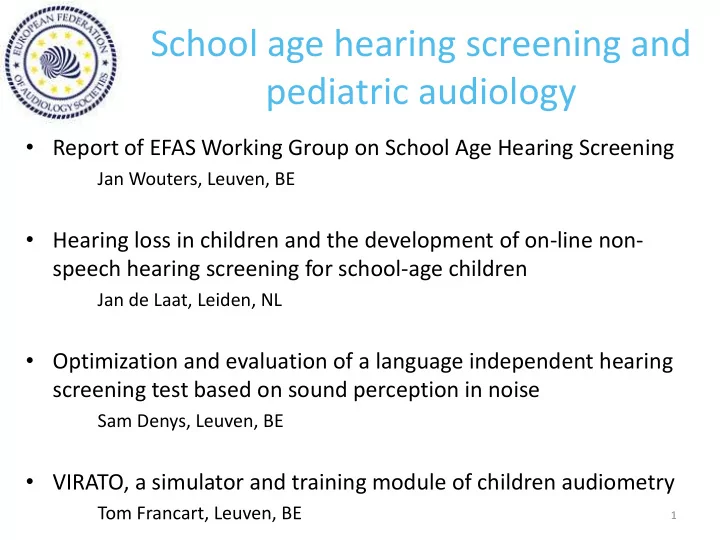
  • Report of EFAS Working Group on School Age Hearing Screening

Jan Wouters, Leuven, BE

  • Hearing loss in children and the development of on-line non-

speech hearing screening for school-age children

Jan de Laat, Leiden, NL

  • Optimization and evaluation of a language independent hearing

screening test based on sound perception in noise

Sam Denys, Leuven, BE

  • VIRATO, a simulator and training module of children audiometry

Tom Francart, Leuven, BE

School age hearing screening and pediatric audiology

slide-2
SLIDE 2

2

  • Report of EFAS Working Group on School Age Hearing Screening

Jan Wouters, Leuven, BE

  • Hearing loss in children and the development of on-line non-

speech hearing screening for school-age children

Jan de Laat, Leiden, NL

  • Optimization and evaluation of a language independent hearing

screening test based on sound perception in noise

Sam Denys, Leuven, BE

  • VIRATO, a simulator and training module of children audiometry

Tom Francart, Leuven, BE

School age hearing screening and pediatric audiology

slide-3
SLIDE 3

3

  • Aim
  • focus in pilot project on the investigation of

– more efficient methodology for hearing screening (Q1) – Incidence of hearing impairment at post-neonatal age until 18 year (Q2)

  • pilot project may be a stimulant for large study

across-Europe and application for an EU-project

EFAS Working Group SHS

slide-4
SLIDE 4

4

  • 31 May 2017: WHA (executive committee of WHO)

resolution about actions to prevent and treat hearing loss, and intensify hearing screening in babies, children and adults.

http://apps.who.int/gb/ebwha/pdf_files/EB139/B139_5-en.pdf http://www.who.int/mediacentre/news/releases/2017/vector-control-ncds-cancer/en/

  • 22 years since the last strong resolution and action

plan about hearing loss!

EFAS Working Group SHS

slide-5
SLIDE 5

5

  • Q1: Methodology
  • The Sound Ear Check: a new screening methodology for SHS
  • language independent, based on ecologically relevant sounds
  • developed and optimized by partners Netherlands-Leuven
  • with child friendly pictures
  • will be administered in combination with the locally used SHS

screening methodology in a few 1000 children (by each contributing partner), possibly at different ages, at least at school- entry (5 or 6 year old)

  • The Sound Ear Check will provide an across-partner and across-

language reference measure.

EFAS Working Group SHS

slide-6
SLIDE 6

6

  • Q2: Evidence/Incidence
  • Investigation of evidence for necessity of SHS
  • inventory of the already available information
  • pilot studies in some countries on a regional or county scale, based
  • n typically a few 1000 children (by each contributing partner) with

records tracked from NHS (Neonatal Hearing Screening) to SHS

  • whatever the used screening methodology is for SHS
  • the comparison of SHS data with NHS databases will be made to

extract information about incidence

  • Important info for health policy making

EFAS Working Group SHS

slide-7
SLIDE 7

7

  • Action plan 2017 (1/2)
  • Organize, prepare and start pilot project with application of Sound

Ear Check together with school age hearing screening as applied in

  • wn country (Q1) and, if applicable, compare with the NHS data for

all screened children (Q2).

  • pilot project will be covered with own resources of the partners
  • Partners Leuven and Netherlands developed and implemented the

test on tablet, ready for use at the time of the EFAS congress

  • A number of measurement sets (with Sound Ear Check only, or plus

Digit Triplet Test in own language) will be provided for partners

EFAS Working Group SHS

slide-8
SLIDE 8

8

  • Action plan 2017 (2/2)
  • At the Interlaken EFAS-congress a 1 hour meeting to discuss
  • A meeting of EFAS WG SHS and project partners will be organized

in Leuven in the late summer 2017 to:

  • deliver the measurement sets of calibrated headphone plus tablet

with software installed, manual, training and supplementary info,

  • make test protocol with aspects: power calculations, how to deal

with conductive hearing loss, test-retest reliability, distribution of thresholds, precise test procedures

  • make agreements about use of material, a price per set will be

requested for rent. Each partner is owner of the own data, and will (only) have the transcription of child vs identification key of the

  • wn data, the layer above is completely anonymized.

EFAS Working Group SHS

slide-9
SLIDE 9

9

  • Questions
  • Who is interested and will be able in concrete terms to collaborate

in the pilot project? jan.wouters@med.kuleuven.be

  • Partners in the project:
  • Finland:

(Q1)Q2 Tytti Willberg

  • Israel

Q1(Q2) Limor Lavie

  • Turkey

Q1Q2 Gonca Sennaroglu

  • Romania:

Q1(Q2) Madalina Georgescu

  • Norway

Q1(Q2) Vinay Swarnalatha Nagaraj

  • Ireland:

Q1&Q2 Theresa Pitt

  • Netherlands:

Q1 Wouter Dreschler, Jan de Laat

  • Belgium:

Q1&Q2 KU Leuven team

EFAS Working Group SHS

slide-10
SLIDE 10

10

  • Report of EFAS Working Group on School Age Hearing Screening

Jan Wouters, Leuven, BE

  • Hearing loss in children and the development of on-line non-

speech hearing screening for school-age children

Jan de Laat, Leiden, NL

  • Optimization and evaluation of a language independent hearing

screening test based on sound perception in noise

Sam Denys, Leuven, BE

  • VIRATO, a simulator and training module of children audiometry

Tom Francart, Leuven, BE

School age hearing screening and pediatric audiology