
SLIDE 1
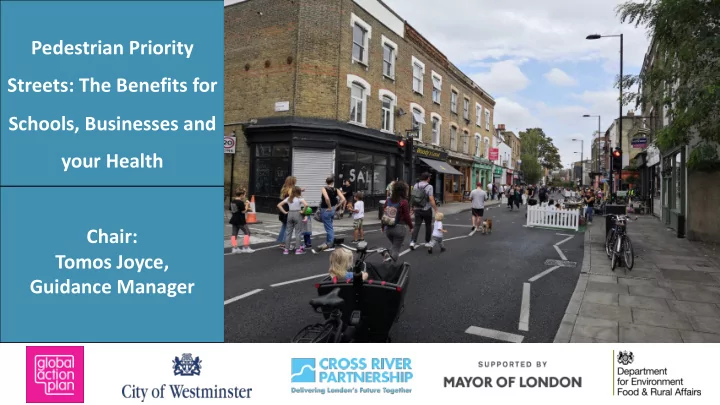
Pedestrian Priority Streets: The Benefits for Schools, Businesses - - PowerPoint PPT Presentation
Pedestrian Priority Streets: The Benefits for Schools, Businesses and your Health Chair: Tomos Joyce, Guidance Manager Todays Speakers Ross Phillips Tomos Joyce Martyn Lowder Sarah Rye Susannah Wilks Anusha Rajamani Rachael Aldridge
Rachael Aldridge Project Officer Cross River Partnership
Webinar Tech Lead
Tomos Joyce Guidance Manager Cross River Partnership
Chair
Susannah Wilks Director Cross River Partnership
Speaker
Ross Phillips Project Officer Cross River Partnership
Speaker
Martyn Lowder Change Manager Global Action Plan
Speaker
Anusha Rajamani Project Officer Cross River Partnership
Chat Moderator
Sarah Rye Head of Public Realm and Security City of Westminster
Speaker
| 2 |
TITLE | DATE
| 2 |
Create great places, sharing best practice whilst ensuring all businesses are supported to grow sustainably Working with engaged people connecting stakeholders to successfully collaborate and deliver Deliver innovative projects for partners encouraging businesses to shift from incremental to permanent change, whilst inspiring others to do more at pace
Working towards sustainable businesses, and improving air quality.
TITLE | DATE
| 2 |
1 - 2m
1. Give your car a day off – Walk, cycle or take public transport to work or school 2. Use quieter streets when you’re on a bike or on foot to avoid polluted main roads. 3. Work from home more often – challenge your workplace to make this easier for you If driving is essential: 4. Go electric – There are lots of ways you can travel electric. Hire an electric car, taxi or test drive an electric vehicle today. 5. Don't idle – If you drive, turn off your engine when your vehicle is stationary, and it is safe to do so.
Avoid burning at home 6. Avoid using wood burning stoves and open fires - if it is essential, only burn dry, well-seasoned or ‘Ready-to-Burn’ labelled wood, or smokeless fuel. 7. Avoid burning household and garden waste – take it to the tip instead. Wise up 8. Learn more about air pollution - visit and share the CleanAirHub.org.uk with everything you need to know about air pollution in one place. 9. Support local change – talk to your local Councillors and MP about air pollution in your area and ask what you can do to support the local plan.
to tackle air pollution and help inspire others at @CleanAirDayUK #cleanairday.
WESTMINSTER CITY COUNCIL PUBLIC REALM COVID-19 RESPONSE
MAYOR OF MILAN HEAD OF C40 TASK GROUP
SHORT TERM
a matter of days
MEDIUM TERM
weeks
LONG TERM
months
BERLIN, GERMANY BARCELONA, SPAIN PARIS, FRANCE CROYDON & LEWISHAM CAMDEN TOWN, LB CAMDEN LB HACKNEY
Trialling new strategic cycle routes New infrastructure addressing public health, active travel, biodiversity and social amenity Mayor’s pledge to deliver a ‘15 minute city’to encourage more self-sufficient communities Planters installed to cut out rat running and increase pedestrian space at key locations Plans to fast-track delivery of Low Emission Neighbourhood Plans for further permanent introductions of school streets
AND A SERIES OF PRIORITY AREAS WERE IDENTIFIED FOR WESTMINSTER...
TRANSPORT HUBS KEY WALKING ROUTES HIGH STREETS & TOWN CENTRES
CARS AND PARKING DOMINATESCHOOLS OPEN SPACES AND PARKS COMMERCIAL AREAS
Allowing the cautious re-opening of key areas of the economy Safeguarding social distancing in traditionally congested areas and introducing alternative methods of travel Ensuring local centres are capable of meeting all local socio-economic needs Ensuring role as a critical local resource can continue safely and cater to demand
Responding to the need for increased Space and healthier surrounding
Ensuring confidence on narrow streets
THIS LED TO A TWO PHASED APPROACH BEING ADOPTED...
PHASE ONE
MOVEMENT STRATEGY
PHASE TWO
HOSPITALITY SCHEMES Provision of increased space for social distancing to ensure people can safely use Westminster’s Streets. Measures support pedestrians and cyclists making necessary journeys in the short term or a return to “normal life” in the medium and long term. Proposals focused on key pedestrian and cycle routes in areas of high demand. As the hospitality industry prepared to re-open, WCC took additional measures to enable outdoor dining. This covered changes to highways, licensing and amenities in the areas that host clusters of hospitality businesses. Measures supported businesses that need to operate in a modified way to meet government guidance.
PHASE ONE MOVEMENT STRATEGY
PHASE TWO HOSPITALITY SCHEMES
PHASE TWO HOSPITALITY SCHEMES
PHASE TWO HOSPITALITY SCHEMES
Three different typologies have been proposed for streets that are part of Westminster Council’s hospitality schemes. Extension of outdoor seating areas In focused areas extending the hours
within the carriageway areas Temporary footway widening works - Type 1 Outdoor dining against building frontages, with widened footways allowing social distancing between diners and pedestrians Temporary footway widening works - Type 2 Outdoor dining in new areas of widened footway, with the footway retained for pedestrians Timed closures to vehicles Supporting dining against building frontages - with pedestrians in the temporarily closed carriageway
PHASE TWO HOSPITALITY SCHEMES
ENGAGEMENT... Due to the pandemic and urgent nature of these works, typical engagement avenues were not always available to us. Despite this WCC have worked to promote the project across its varied comms platforms and have used various opportunities to promote the scheme and how stakeholders can be involved or comment. Members, Ward Cllrs and senior officers have carried out site visits, hosted virtual discussions, appeared on local radio shows and attended smaller virtual meetings held by business resident groups. A dedicated mailbox has also been established. Residents, BIDs, neighbourhood forums, amenity societies representatives of cycling, taxis, coaches and similar groups have all been involved in the development of these proposals.
‘AS A BUSINESS IN SOHO THE SCHEME HAS GIVEN US A LIFE LINE’
SOHO ARTS CLUB
‘IT HAS BREATHED LIFE INTO THE AREA AND INTO THE ECONOMY AND RE-DEFINED WHAT IS POSSIBLE WHEN A GROUP OF INDEPENDENT BUISNESSES, WITH A LITTLE HELP AND GUIDANCE, CAN ACHIEVE’
SANCTUM SOHO
‘IT HAS SAVED A LOT OF JOBS AND GIVEN PEOPLE AN OPPORTUNITY TO EARN A LIVING AGAIN. I HAD PEOPLE ON FURLOUGH THAT WE’VE CALLED BACK BECAUSE THE TRADING IS GOING WELL. THESE PEOPLE ARE NOW EARNING FULL SALARY BECAUSE OF IT AND HAVING A BETTER LIFE’
BALANS SOHO SOCIETY
| 2 |
“We need to urgently reconsider use of street space to provide safe and appealing spaces to walk and cycle as an alternative to car use ..”
London Streetspace Plan (May 2020)
Over 9,000 Londoners die prematurely each year as a result of air pollution £3.7 billion is the cost of air pollution to London’s economy
| 2 |
The Healthy Streets Approach is a global policy framework that “puts people and their health at the centre of decisions about how we design, manage and use public spaces ”. It aims to make streets healthy, safe and welcoming for everyone by prioritising people and their needs.
Parklets Green Infrastructure Cycle / walking infrastructure
School/ Play Streets Low Traffic Neighbourhoods
Car Free Events Cycle training Journey Planning
streets, bordered by main or “distributor” roads, where “through” motor vehicle traffic is discouraged or removed.
activity
cycling, particularly for COVID-19
Guide to Low Traffic Neighbourhoods
e.g. Brackenbury Village, and producing guidance on low-traffic initiatives e.g. parklets
Some Considerations Size and location Accessibility Transport and travel connectivity Active travel infrastructure
motorised traffic at school drop-off and pick-up times.
times
September.
play and school streets
for Professionals” is a brilliant guide.
perspective as a school or parent, “Mums for Lungs” resources include:
A free service to help with the implementation of School Streets For more information on how to use the service please contact: Fiona Coull HSE Project Manager fionacoull@crossriverpartnership.org Ross Phillips Project Officer rossphillips@crossriverpartnership.org
with a further 9 proposed.
Credit: Southwark Council
in 16 different London ‘villages’, where both air pollution and population density levels are high.
through:
last mile deliveries to businesses
streets.
and vastly improved air quality.
interact, spend money, relax and take in green space, and for children to play, learn and travel safely.
school streets and low traffic neighbourhoods in your area.
Tomos Joyce Guidance Manager Cross River Partnership tomosjoyce@crossriverpartnership.org Susannah Wilks Director Cross River Partnership susannahwilks@crossriverpartnership.org Ross Phillips Project Officer Cross River Partnership rossphillips@crossriverpartnership.org
www.crossriverpartnership.org @CrossRiverPship
linkedin.com/company/cross-river-partnership/
www.crossriverpartnership.org/newsletter Search ‘Cross River Partnership’ in YouTube
Martyn Lowder Change Manager Global Action Plan martyn.lowder@globalactionplan.org.uk Sarah Rye Head of Public Realm and Security City of Westminster srye@westminster.gov.uk