
SLIDE 1
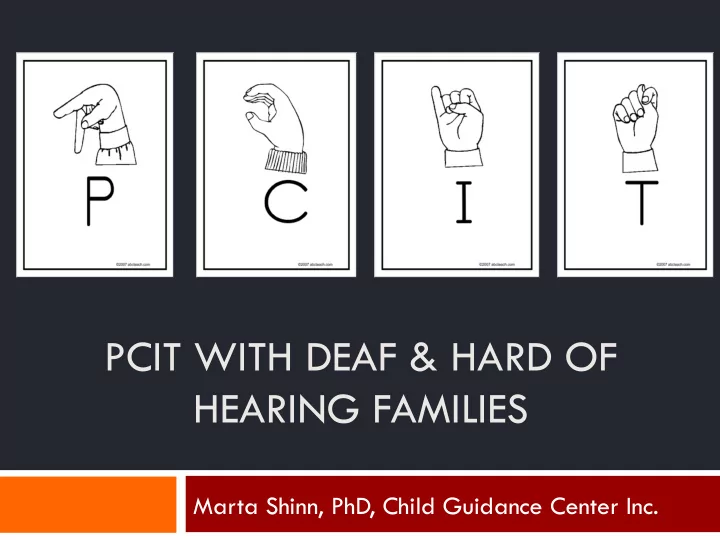
PCIT WITH DEAF & HARD OF HEARING FAMILIES Marta Shinn, PhD, - - PowerPoint PPT Presentation
PCIT WITH DEAF & HARD OF HEARING FAMILIES Marta Shinn, PhD, Child Guidance Center Inc. Why Treat the Hearing Impaired? Tips for Working with Interpreters Do not have a relative interpret. Select a certified ASL interpreter (by
¨ Do not have a relative interpret. ¨ Select a certified ASL interpreter (by NAD or RID). ¨ Discuss your role as clinician and their role as a
¨ Discuss confidentiality. ¨ Discuss room setup. ¨ Check in and out.
¨ VIDEO
¨ Assess their willingness to “work” to learn PCIT. ¨ Teach them about PCIT - previewing all materials
q Determine Exact English Signs for PCIT.
¨ VIDEO
¨ Interpreter is a facilitator of rapport and a cultural
¨ Therapist is not in the room and the interpreter
¨ Interpreter experiences interaction and has resulting
¨ Do not have a relative interpret.
¨ Sit the child and parent across from each other. ¨ Position the interpreter slightly behind the child. ¨ Place the earpiece on the interpreter. ¨ Look while the interpreter is voicing so you know
¨ VIDEO DEMONSTRATION OF THE SKILL
¨ Select any rules prior to session with the parent and
¨ Modify the active ignore to include modeling and
¨ VIDEO DEMONSTRATION OF THE SKILL
¨ VIDEO DEMONSTRATION OF THE SKILL
¨ VIDEO
¨ Reflections are about physically “mirroring” signs. ¨ Timing of reflections & imitation can be challenging.
¨ VIDEO DEMONSTRATION OF THE SKILL
¨ VIDEO DEMONSTRATION OF THE SKILL
¨ VIDEO DEMONSTRATION OF THE SKILL
¨ VIDEO DEMONSTRATION OF THE SKILL
¨ Have the interpreter pre-read handouts and
¨ Have interpreter sit/stand next to TV screen while
¨ Practice, practice, practice PDI skills using “Mr.
¨ Have the parent stand up and sign in front of the
¨ VIDEO DEMONSTRATION OF THE SKILL
¨ VIDEO DEMONSTRATION OF THE SKILL
¨ VIDEO DEMONSTRATION OF THE SKILL
¨ Transitional warnings are vital because DHH
¨ Modeling is a visual teaching tool! Teach cleanup by
¨ Seal the the session with nurture. Have the parent
¨ VIDEO DEMONSTRATION OF THE SKILL
¨ VIDEO DEMONSTRATION OF THE SKILL
¨ VIDEO DEMONSTRATION OF THE SKILL
You may access an electronic version of this publication at:
http://pcit.ucdavis.edu/wp-content/uploads/2012/08/Clinical-Case-Studies-2013- Shinn-1534650113500065.pdf Contact the author: mshinn@cgcinc.org