PATIENT ENGAGEMENT Learning Session LEARNING AND ACTION 2 - - PDF document

patient engagement
SMART_READER_LITE
LIVE PREVIEW

PATIENT ENGAGEMENT Learning Session LEARNING AND ACTION 2 - - PDF document

4/13/2015 PATIENT ENGAGEMENT Learning Session LEARNING AND ACTION 2 NETWORK RACHELLE DUBOSE CARUTHERS, LMSW OUTREACH COORDINATOR RCARUTHERS@NW14.ESRD.NET 469-916-3800 OFFICE WELCOME AND INTRODUCTIONS Network 14 Staff 126 Dialysis


slide-1
SLIDE 1

4/13/2015 1

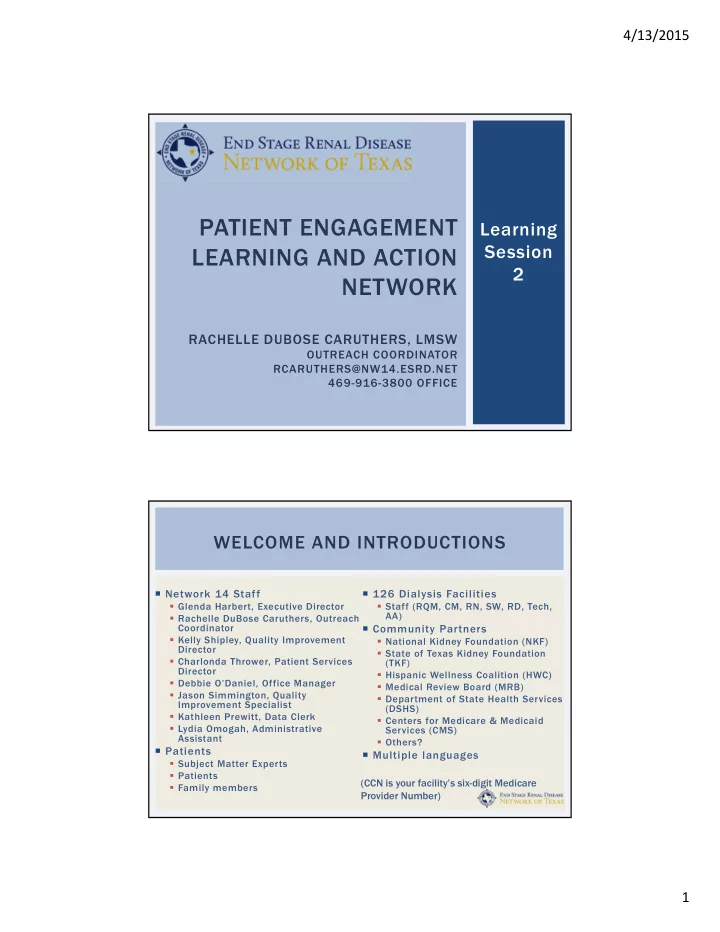
Learning Session 2

PATIENT ENGAGEMENT LEARNING AND ACTION NETWORK

RACHELLE DUBOSE CARUTHERS, LMSW

OUTREACH COORDINATOR RCARUTHERS@NW14.ESRD.NET 469-916-3800 OFFICE

 Network 14 Staff

  • Glenda Harbert, Executive Director
  • Rachelle DuBose Caruthers, Outreach

Coordinator

  • Kelly Shipley, Quality Improvement

Director

  • Charlonda Thrower, Patient Services

Director

  • Debbie O’Daniel, Office Manager
  • Jason Simmington, Quality

Improvement Specialist

  • Kathleen Prewitt, Data Clerk
  • Lydia Omogah, Administrative

Assistant

 Patients

  • Subject Matter Experts
  • Patients
  • Family members

 126 Dialysis Facilities

  • Staff (RQM, CM, RN, SW, RD, Tech,

AA)

 Community Partners

  • National Kidney Foundation (NKF)
  • State of Texas Kidney Foundation

(TKF)

  • Hispanic Wellness Coalition (HWC)
  • Medical Review Board (MRB)
  • Department of State Health Services

(DSHS)

  • Centers for Medicare & Medicaid

Services (CMS)

  • Others?

 Multiple languages

WELCOME AND INTRODUCTIONS

(CCN is your facility’s six-digit Medicare Provider Number)

slide-2
SLIDE 2

4/13/2015 2

Review PE LAN activities and goals Discuss Learning Session 1 feedback QIA Train the Trainer: FPR Handbook and Tools All Teach, All Learn

  • Campaign 1: Fluid (Diet) patient workbook

materials

  • Campaign 2: Missed Treatments workbook

materials

Collect Baseline Next steps

OBJECTIVES

11:30 am – 12:15 pm – Lunch 12:15 – 12:45 pm – Overview of PE LAN 12:45 – 2:15 pm – QIA: FPR Toolkit 2:15 – 2:30 pm – Break 2:30 – 3:30 pm – Patient Education Campaign 3:30 – 3:45 pm – Baseline Data Collection 3:45 – 4:00 pm – Wrap-up and Next Steps

AGENDA

slide-3
SLIDE 3

4/13/2015 3

NETWORK 14 MISSION STATEMENT We support equitable patient‐ and family‐centered quality dialysis and kidney transplant health care through the provision of patient services, education, quality improvement, and information management.

https://youtu.be/zUnEzRijSBk An organized effort of sharing learning by a network of organizations or teams to:

  • Adapt known BEST PRACTICES for a specific

health priority or issue,

  • Achieve significant results in a short period of

time,

  • Scale up BEST PRACTICES to other
  • rganizations via a planned SPREAD strategy.

All Teach, All Learn environment

WHAT IS A LEARNING AND ACTION NETWORK (LAN)?

slide-4
SLIDE 4

4/13/2015 4

LEARNING AND ACTION NETWORKS

Requirements

  • Patient Subject Matter Experts (SMEs)
  • At least 4 meetings
  • Monthly reporting

Topics

  • Patient-driven

Activities

  • Quality improvement activity (QIA)
  • 5% relative improvement over baseline
  • Two patient education campaigns
  • 10% relative improvement over baseline

2015 PE LAN

slide-5
SLIDE 5

4/13/2015 5

Quality improvement activity (QIA)

  • Activity: Recruit and train Facility Patient

Representatives (FPRs)

  • Target: 5% relative improvement over baseline
  • Measures
  • QIA: The number of

number of FPR applications FPR applications collected at the facility during the prior month

  • QIA: The number of FPRs

number of FPRs during the prior month that have received one or more hours of training using the FPR Toolkit

2015 PE LAN: QIA

 QIA: Recruit and Train FPRs

  • Process Measure (NOT CUMULATIVE)
  • Numerator: The number of FPR applications collected at the facility in the

prior month

  • Denominator: The total number of patients in the facility in the prior

month

  • Outcome Measure
  • Numerator: The number of FPRs that have received one or more hours of

training with the FPR Toolkit in the prior month (CUMULATIVE # of FPRs)

  • Denominator: The total number of patients in the facility in the prior

month

 Example: In April, you report that have 0 trained FPRs in the prior month.

QIA MEASURES

Mar Mar Apr pr Ma May Jun un Jul Jul Aug ug Sep Sep 1 2 1 2 3 # of trained FPRs

slide-6
SLIDE 6

4/13/2015 6

Patient Education Campaign 1: Diet

  • Activity: Patients complete activities in a fluid

management workbook to learn about diet

  • Target: 10% relative improvement over

baseline

  • Measure
  • The number of patients that complete one or more

module(s) in the patient workbook during the current month

  • “Complete” is defined as finishing two or more

activities in a module.

2015 PE LAN: CAMPAIGN 1

Tracking: The number of patients that complete one or more module(s) during the current month Reporting example: In June, you report that 3 patients completed modules during the current month

Patient Patient Mod

  • dule 1

ule 1 Mod

  • dule 2

ule 2 Mod

  • dule 3

ule 3 Mod

  • dule 4

ule 4 Anna A. June June June July Bob B. June June July Cathy C. July August David D. June June July July

CAMPAIGN 1 MEASURES

Mar Mar Apr pr Ma May Jun un Jul Jul Aug ug Sep Sep 3 4 1

slide-7
SLIDE 7

4/13/2015 7

Patient Education Campaign 2: Missed Treatments

  • Activity: Patients complete activities in a

workbook to learn about the impact of missing treatments

  • Target: 10% relative improvement over baseline
  • Measures
  • The number of

number of une unexcuse cused d missed treatme missed treatments ts in the prior month

  • The number of

number of schedule scheduled treatme d treatments ts in the prior month

2015 PE LAN: CAMPAIGN 2

1. 1. Nam Name of pe

  • f person that will complete the survey EVERY MONTH

2. 2. Job Job ti title of person completing this survey EVERY MONTH 3. 3. Email a l address dress of person completing this survey EVERY MONTH 4. 4. Facility C cility CCN (6-digit Medicate Provider Number) 5. 5. Phone n e number er to reach the person completing this survey 6. QIA: The numb mber o er of FPR a R appli plications ations collected at the facility during the prior month 7. QIA: The num number of FP

  • f FPRs during the prior month that have received
  • ne or more hours of training using the FPR Toolkit

8. Patient Education Campaign 1: Diet (Fluid Management) - The num number of pa

  • f patients that complete one or more module(s) in the

patient workbook during the current month (“Complete” is defined as finishing two or more activities in a module.) 9. Patient Education Campaign 2: Missed Treatments - The num number of

  • f

unexcuse cused m d missed ssed t trea eatme tments ts in the prior month

  • 10. Patient Education Campaign 2: Missed Treatments - The num

number of

  • f

sched hedule led t d treatm eatments ents in the prior month

  • 11. The total

tal number of

  • f pa

pati tien ents ts in the facility in the prior month

PE LAN BASELINE MEASURES:

ONE PER FACILITY

slide-8
SLIDE 8

4/13/2015 8

Option 1

 Baseline: April

  • 1. QIA: May-Jun
  • 2. Campaign 1: Jun-Jul
  • 3. Campaign 2: Jul-Aug

 Deadline: Aug 30

Option 2

 Baseline: April  May-Aug

  • 1. QIA
  • 2. Campaign 1
  • 3. Campaign 2

 Deadline: Aug 30

PROJECT TIMELINE PROJECT TIMELINE

2015 PE LAN Activity Mar Apr May Jun Jul Aug Sep

  • I. Learning Session 1 Webinars
  • II. Learning Session 2 Meetings

*Data Collection: Baseline via LS2 Meetings

  • A. QIA: Recruit and Train FPRs
  • III. Learning Session 3 Webinars
  • B. Campaign 1: Patient Workbook on Fluid Management
  • IV. Learning Session 4 Webinars
  • C. Campaign 2: Patient Workbook on Missing Treatments
  • V. Learning Session 5 Webinars

*Data Collection: Monthly via Survey Monkey

slide-9
SLIDE 9

4/13/2015 9

 Activity Goal: All facilities have one or more trained FPRs for MWF and TTS (two or more total FPRs) 1. Recruit 2 or more FPRs by:

  • Posting job description
  • Recruiting appropriate candidates
  • Collecting FPR applications
  • 2. Train 2 or more FPRs for a minimum of one hour each during

May and June by:

  • Reviewing the complete FPR Handbook with patient
  • Completing the FPR Orientation Checklist
  • Collecting signed FPR Agreements
  • Updating CROWNWeb with FPR information

2015 PE LAN QIA

FPR FPR Handbook + Handbook + Tools =

  • ols = Toolkit
  • olkit
  • 2: NEW

2: NEW Commonly Used Terms (acronyms and definitions)

  • 3: NEW

3: NEW (TOOL) Orientation Checklist

  • 4: Overview (reduced from 5 pages)
  • 5: What is a FPR/what do they do?
  • 6: Grievance Process
  • 7: Confidentiality and Medical Information
  • 8: Patient Advisory Committee
  • 9: Patient Engagement Learning and Action Network
  • 10-11: (TOOL) Role Description
  • 12: (TOOL) Application
  • 13: (TOOL) Staff Referral
  • 14: NE

NEW (TOOL) Agreement

  • 15: Network Contact Information

FPR TOOLKIT

slide-10
SLIDE 10

4/13/2015 10

Focus: Fluid Management Intervention: Patient workbook Format: Four modules with 3 – 5 activities in each module Project Implementation and Support: FPRs/Techs Facility-specific Recognition Program CAMPAIGN 1: DIET

 Intro: Set SMART goals for fluid

  • Definitions
  • Goal worksheet
  • Kidney coloring pages

 Module 1: How Much Fluid Can I Have?

  • Fluid tracker worksheet
  • What is EDW
  • High fluid foods
  • Ways to decrease thirst

 Module 2: How Much Salt is Okay to Eat?

  • Low and high salt foods
  • Eating out
  • Cooking ideas

 Module 3: How Can I Still Enjoy Foods I Love? (Portion Control)

  • Examples of portion sizes
  • Puzzle/crossword

 Module 4: How Do I to Manage Diabetes When I Have Kidney Disease?

PATIENT FLUID MANAGEMENT WORKBOOK

slide-11
SLIDE 11

4/13/2015 11

Tracking Recognition Program Ideas

  • When patients complete a module:
  • Poster that patients sign
  • Balloons
  • Stickers/sticker chart

Patient Patient Mod

  • dule 1

ule 1 Mod

  • dule 2

ule 2 Mod

  • dule 3

ule 3 Mod

  • dule 4

ule 4 Anna A. June June June July Bob B. June June July Cathy C. July August David D. June June July July

CAMPAIGN 1 RECOGNITION

 Intro: Set SMART goals for fluid

  • Definitions
  • Goal worksheet

 Module 1: How Much Fluid Can I Have?

  • Fluid tracker worksheet
  • What is EDW
  • High fluid foods
  • Ways to decrease thirst

 Module 2: How Much Salt is Okay to Eat?

  • Low and high salt foods
  • Eating out
  • Cooking ideas

 Module 3: How Can I Still Enjoy Foods I Love? (Portion Control)

  • Examples of portion sizes
  • Puzzle/crossword

 Module 4: How Do I to Manage Diabetes When I Have Kidney Disease?

CAMPAIGN 2: DIET WORKBOOK

slide-12
SLIDE 12

4/13/2015 12

 Focus: Missed Treatments  Intervention: Patient workbook  Format: Two to four modules with 3 – 5 activities in each module  Modules:

  • 1. A
  • 2. B
  • 3. C
  • 4. D

 Numerator: The number of unexcused missed treatments in the prior month  Denominator: The number of scheduled treatments in the prior month

CAMPAIGN 2: MISSED TREATMENTS Learning Session 2

  • April 2 – Lubbock
  • April 9 – San Antonio
  • April 23 – Dallas
  • April 30 – Houston

NEXT STEPS

2015 PE LAN Activity Mar Apr May Jun Jul Aug Sep

  • I. Learning Session 1 Webinars
  • II. Learning Session 2 Meetings

*Data Collection: Baseline via LS2 Meetings

  • A. QIA: Recruit and Train FPRs
  • III. Learning Session 3 Webinars
  • B. Campaign 1: Patient Workbook on Fluid Management
  • IV. Learning Session 4 Webinars
  • C. Campaign 2: Patient Workbook on Missing Treatments
  • V. Learning Session 5 Webinars

*Data Collection: Monthly via Survey Monkey

slide-13
SLIDE 13

4/13/2015 13

Review PE LAN activities and goals Discuss Learning Session 1 feedback QIA Train the Trainer: FPR Handbook and Tools All Teach, All Learn

  • Campaign 1: Fluid (Diet) patient workbook

materials

  • Campaign 2: Missed Treatments workbook

materials

Collect Baseline Next steps

OBJECTIVES Learning Session 2

PATIENT ENGAGEMENT LEARNING AND ACTION NETWORK

RACHELLE DUBOSE CARUTHERS, LMSW

OUTREACH COORDINATOR RCARUTHERS@NW14.ESRD.NET 469-916-3800 OFFICE