Patient Centered Medical Home primary care that facilitates - - PDF document

patient centered medical home
SMART_READER_LITE
LIVE PREVIEW

Patient Centered Medical Home primary care that facilitates - - PDF document

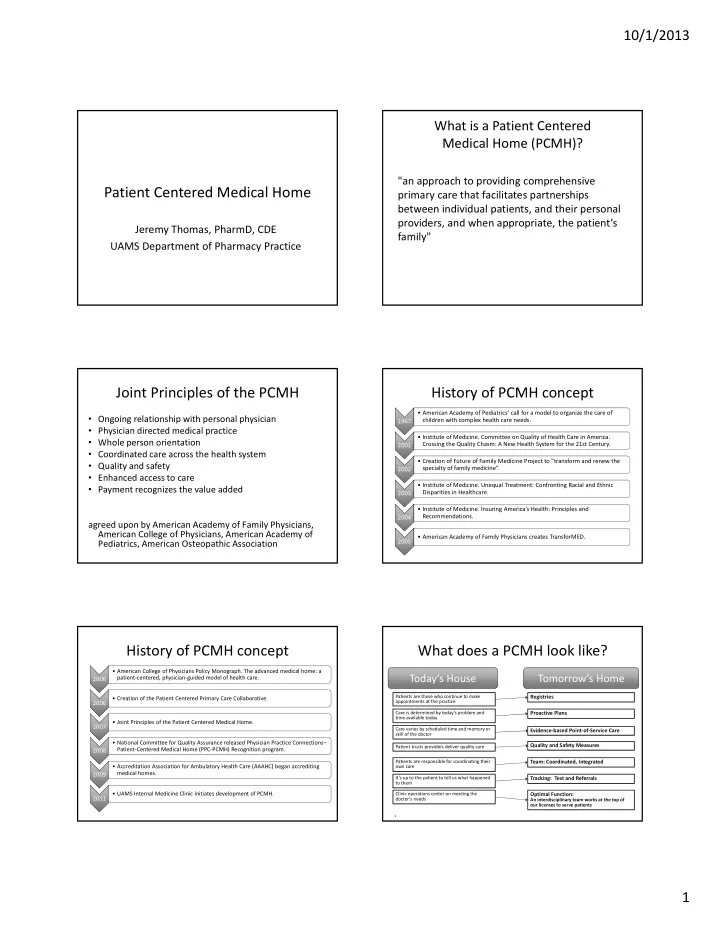
10/1/2013 What is a Patient Centered Medical Home (PCMH)? "an approach to providing comprehensive Patient Centered Medical Home primary care that facilitates partnerships between individual patients, and their personal providers, and when


slide-1
SLIDE 1

10/1/2013 1

Patient Centered Medical Home

Jeremy Thomas, PharmD, CDE UAMS Department of Pharmacy Practice

What is a Patient Centered Medical Home (PCMH)?

"an approach to providing comprehensive primary care that facilitates partnerships between individual patients, and their personal providers, and when appropriate, the patient’s family"

Joint Principles of the PCMH

  • Ongoing relationship with personal physician
  • Physician directed medical practice
  • Whole person orientation
  • Coordinated care across the health system
  • Quality and safety
  • Enhanced access to care
  • Payment recognizes the value added

agreed upon by American Academy of Family Physicians, American College of Physicians, American Academy of Pediatrics, American Osteopathic Association

History of PCMH concept

1967 1967

  • American Academy of Pediatrics’ call for a model to organize the care of

children with complex health care needs. 2001 2001

  • Institute of Medicine. Committee on Quality of Health Care in America.

Crossing the Quality Chasm: A New Health System for the 21st Century. 2002 2002

  • Creation of Future of Family Medicine Project to "transform and renew the

specialty of family medicine”. 2003 2003

  • Institute of Medicine. Unequal Treatment: Confronting Racial and Ethnic

Disparities in Healthcare. 2004 2004

  • Institute of Medicine. Insuring America’s Health: Principles and

Recommendations. 2005 2005

  • American Academy of Family Physicians creates TransforMED.

History of PCMH concept

2006 2006

  • American College of Physicians Policy Monograph. The advanced medical home: a

patient‐centered, physician‐guided model of health care. 2006 2006

  • Creation of the Patient Centered Primary Care Collaborative.

2007 2007

  • Joint Principles of the Patient Centered Medical Home.

2008 2008

  • National Committee for Quality Assurance released Physician Practice Connections–

Patient‐Centered Medical Home (PPC‐PCMH) Recognition program. 2009 2009

  • Accreditation Association for Ambulatory Health Care (AAAHC) began accrediting

medical homes. 2011 2011 • UAMS Internal Medicine Clinic initiates development of PCMH.

6

Clinic operations center on meeting the doctor’s needs

Optimal Function:

An interdisciplinary team works at the top of

  • ur licenses to serve patients

Patients are responsible for coordinating their

  • wn care

Team: Coordinated, Integrated

Patient trusts providers deliver quality care

Quality and Safety Measures

Care varies by scheduled time and memory or skill of the doctor

Evidence‐based Point‐of‐Service Care

Care is determined by today’s problem and time available today

Proactive Plans

It’s up to the patient to tell us what happened to them

Tracking: Test and Referrals Registries

Patients are those who continue to make appointments at the practice

What does a PCMH look like?

Tomorrow’s Home Today’s House

slide-2
SLIDE 2

10/1/2013 2

Great Outcomes

Practice Organization Quality Measures

Patient Centeredness

Patient Experience Heath Information Technology

Building Blocks of a PCMH

Health Information Technology

Patient Centeredness Business & Clinical Process Automation Connectivity & Communication Evidence‐Based Medicine Support Clinical Data Analysis & Representation

  • Intra‐office team

coordination

  • Results, referrals and

procedures tracking

  • Schedule and resource

management

  • All patient, all condition

registry

  • Quality measurement

collection and analysis

  • Reporting to third

parties

  • E‐prescribing
  • Clinical messaging

with patients

  • Health information

exchange

  • Evidence‐based

template for documentation

  • Access to online

medical information

  • Clinical decision

support

  • Lab testing
  • Prescriptions
  • Registries

Practice Organization

Personnel Management Clinical Systems

  • Every team member

understands the important role they play in delivering efficient care and is empowered to make suggestions for improvement

  • Lab testing
  • Prescriptions
  • Patient Registries

Financial Management

  • All staff are aware of the

most effective ways to deliver care

  • National policies support the

investment of resources into primary care practices that are effective and efficient Patient Experience

Patient Centeredness

Health Information Technology Quality Measures

Patient Centeredness Performance Measurement Culture of Improvement Reliable Systems

  • Quality measures should

be based in clinical evidence

  • Patient satisfaction

surveys

  • Staff education
  • Team meetings
  • Ensure quality

improvement initiatives are not punitive

  • Develop reliable systems

to collect information

  • Check list and reminders
  • Evidence‐based decision

support tool

Practice Organization Health Information Technology Patient Experience Quality Measures

Patient Centeredness Personalized Care Convenient Access Care Coordination

  • Same‐day appointments
  • After‐hours access

coverage

  • Online patient services
  • Reminders
  • Non‐physician care

management

  • Shared decision‐making
  • Self‐management support
  • Referral management
  • Patent engagement and

education

  • Prevention screening and

services

Practice Organization Health Information Technology Family Medicine Foundation

Great Outcomes

  • Good for patients

– Patients enjoy better health. – Patients share in health care decisions.

  • Good for physicians

– Physicians focus on delivering excellent medical care.

  • Good for practices

– Team works effectively together. – Resources support the delivery of excellent patient care.

  • Good for payors and employers

– Ensures quality and efficiency. – Avoids unnecessary costs.

Patient Experience Health Information Technology

Great Outcomes

Practice Organization Quality Measures

Patient Centeredness

Patient Experience Heath Information Technology

slide-3
SLIDE 3

10/1/2013 3

Outcomes of PCMH Interventions

  • 29% reduction in ER visits and 11% reduction in

ambulatory sensitive care admission Group Health Cooperative of Puget Sound Community Care of North Carolina

  • 93% of asthmatics received appropriate maintenance

medications

  • 40% decrease in hospitalizations for asthma and 16% lower ER

visit rate

Health Partners Medical Group MN

  • 350% reduction in appointment waiting time

The Outcomes of Implementing Patient‐Centered Medical Home Interventions: A Review of the Evidence on Quality, Access and Costs from Recent Prospective Evaluation Studies, August 2009. www.pcpcc.net

Outcomes of PCMH Interventions

Geisinger Health System

  • Statistically significant improvements in quality of

preventive (74.0% improvement), coronary artery disease (22.0%) and diabetes care (34.5%) for PCMH pilot practice sites Genesee Health Plan

  • 72% of the uninsured adults in Genesee County

now identify a primary care practice as their medical home

The Outcomes of Implementing Patient‐Centered Medical Home Interventions: A Review of the Evidence on Quality, Access and Costs from Recent Prospective Evaluation Studies, August 2009. www.pcpcc.net

Outcomes of PCMH Interventions

  • 39% Decrease in emergency room admissions
  • 24% Decrease in hospital admissions
  • Net reduction cost of $640 per patient and $1,650 among

high risk patients

Intermountain Healthcare Medical Group Management Plus Blue Cross Blue Shield of NC‐ Palmetto Primary Care Physicians

  • 12.4% decrease in ER visits
  • 10% decrease in hospital admissions
  • Total medical and pharmacy costs were 6.5% lower

The Outcomes of Implementing Patient‐Centered Medical Home Interventions: A Review of the Evidence on Quality, Access and Costs from Recent Prospective Evaluation Studies, August 2009. www.pcpcc.net

PHARMACIST INVOLVEMENT

The Patient Centered Medical Home

NCQA PCMH 2011 Standards

  • Enhance Access and Continuity
  • Identify and Manage Patient Populations
  • Plan and Manage Care
  • Provide Self‐Care Support and Community

Resources

  • Track and Coordinate Care
  • Measure and Improve Performance

Identify and Manage Patient Populations Standard 2, Element B

Practice uses a searchable electronic system to record the following data:

  • Allergies, including medication allergies and

adverse reactions, for more than 80% of patients

  • List of prescription medications with the date
  • f updates for more than 80% of patients
slide-4
SLIDE 4

10/1/2013 4

Practices uses patient data and evidence‐based guidelines to generate lists and remind patients about needed services:

  • At least three different preventive care

services

  • At least three different chronic care services
  • Patients not recently seen by the practice
  • Specific medications

Identify and Manage Patient Populations Standard 2, Element D Medication Management Standard 3, Element D

The practice manages medications in the following ways

  • Reviews and reconciles medications with patients for

more than 50% of care transitions

  • Provides information about new prescriptions to more

than 80 % of patients

  • Assesses patient understanding of medications for more

than 50% of patients with date of assessment

  • Assesses patient response to medications and barriers

to adherence for more than 50% of patients with date

  • f assessment
  • Documents over‐the‐counter medications, herbal

therapies and supplements for more than 50% of patients, with the date of updates

Electronic Prescribing Standard 3, Element E

Practice uses e‐prescribing system with the following capabilities:

  • Generates and transmits at least 40% of

prescriptions to pharmacies

  • Generates at least 75% of eligible prescriptions
  • Integrates with patient medical records
  • Performs patient‐specific checks for drug‐drug and

drug‐ allergy interactions

  • Alerts prescribers to generic alternatives
  • Alerts prescribers to formulary status

Self‐Management Support Standard 4, Element A

The practice conducts activities to support patients/families in self‐ management:

  • Provides educational resources or refers at least 50% of patients

to educational resources to assist in self‐management

  • Uses an EHR to identify patient‐specific education resources and

provide them to more than 10 percent of patients, if appropriate

  • Develops and documents self‐management plans and goals in

collaboration with at least 50% of patients

  • Documents self‐management abilities for at least 50% of patients
  • Provides self‐management tools to record self‐care results for at

least 50%of patients

  • Counsels at least 50% of patients to adopt healthy behaviors

Why involve pharmacist is PMCH?

  • 3.5 billion prescriptions written annually in US
  • 4 of 5 patients leave MD office with Rx
  • Rx’s are involved in 80% of all treatments
  • Most commonly identified drug problems

– patient requires additional therapy – dosages need to be titrated to achieve benefit

  • WHO estimates adherence rate of 50% for

chronic medications

Academy of Managed Care Pharmacy American Association of Colleges of Pharmacy American College of Clinical Pharmacy American Pharmacists Association American Society of Consultant Pharmacists American Society of Health-System Pharmacists College of Psychiatric and Neurologic Pharmacists National Association of Chain Drug Stores National Community Pharmacists Association

slide-5
SLIDE 5

10/1/2013 5

PRINCIPLES FOR INCLUSION OF PHARMACISTS’ CLINICAL SERVICES IN THE PATIENT‐CENTERED PRIMARY CARE MEDICAL HOME

Available at http://www.accp.com/docs/positions/misc/IntegrationPharmacistClinical ServicesPCMHModel3‐09.pdf

Principles for Pharmacist Incorporation into PCMH Framework

  • Access to pharmacists’ clinical services
  • Patient‐focused collaborative care
  • Flexibility in medical home design
  • Development of outcome measures
  • Access to relevant patient information
  • Effective health information technology
  • Aligned payment policies

PATIENT‐CENTERED PRIMARY CARE COLLABORATIVE (PCPCC)

Integrating Comprehensive Medication Management to Optimize Patient Outcomes

PCPCC Comprehensive Medication Management

  • medication management service needs to be

delivered directly to a specific patient

  • assessment of the specific patient’s medication‐

related needs

  • care plan is developed to resolve the problems
  • service is expected to add unique value to the

care of the patient

  • work of pharmacists and medication therapy

practitioners needs to be coordinated with

  • ther team members in the PCMH

COMPREHENSIVE MEDICATION MANAGEMENT SERVICES

Patient‐Centered Primary Care Collaborative (PCPCC)

Assessment of the Patient’s Medication‐ Related Needs

  • all current Rx, OTC, Supplements, vitamins,

meds from friends and family, etc.

– current systems don’t capture everything

  • uncovering patient’s medication experience
  • complete medication history
  • medications are linked to indicated condition
  • goal is to determine if outcomes are achieved

through medication use

slide-6
SLIDE 6

10/1/2013 6

Identification of the Patient’s Medication‐related Problems

  • Each Medication is assessed for

– Appropriateness – Effectiveness – Safety – Adherence

Development of a Care Plan

  • Intervene to solve medication‐related problems
  • Establish individualized therapy goals
  • Design personalized education and interventions
  • Establish measureable outcome parameters
  • Determine appropriate follow‐up time frames

PCPCC Comprehensive Medication Management: Patient Identification

  • Not meeting the intended therapy goal
  • Experiencing adverse effects
  • Difficulty understanding/following regimen
  • In need of preventive therapy
  • Frequently readmitted to the hospital

PCPCC Comprehensive Medication Management: Payment and Coverage

  • monthly care coordination payment
  • visit‐based fee‐for‐service component
  • performance‐based component

COMPREHENSIVE PRIMARY CARE INITIATIVE

Opportunities in Arkansas

Comprehensive Primary Care Initiative

slide-7
SLIDE 7

10/1/2013 7

CPC Opportunities

  • selected primary care practices who are

committed to improving the patient experience through

– increased access and continuity – planned care for chronic conditions and preventative care – patient and caregiver engagement – coordination of care across the medical neighborhood – risk‐stratified care management

  • receive enhanced payments based on a per

member per month formula.

CPC Sites in Arkansas CPC vs PCMH

  • CPC initiative aligns with the PCMH model:

– include a personal physician – physician directed medical practice – whole‐person orientation – coordinated care – access – continuity of care – population and disease management through electronic health records and patient registries – quality – safety

Summary

  • The PCMH has the potential to improve the

care of patients

  • Appropriate medication management is vital

component of providing comprehensive care

  • Pharmacist have the capacity and ability to

provide medication therapy management

References and Resources

  • PCMH and Pharmacists

– http://iforumrx.org/node/126 – http://www.pcpcc.org/resources

  • Comprehensive Primary Care Initiative

– http://innovation.cms.gov/initiatives/Comprehens ive‐Primary‐Care‐Initiative/index.html – http://www.aafp.org/practice‐ management/pcmh/initiatives/cpci.html

Questions: jltomas2@uams.edu