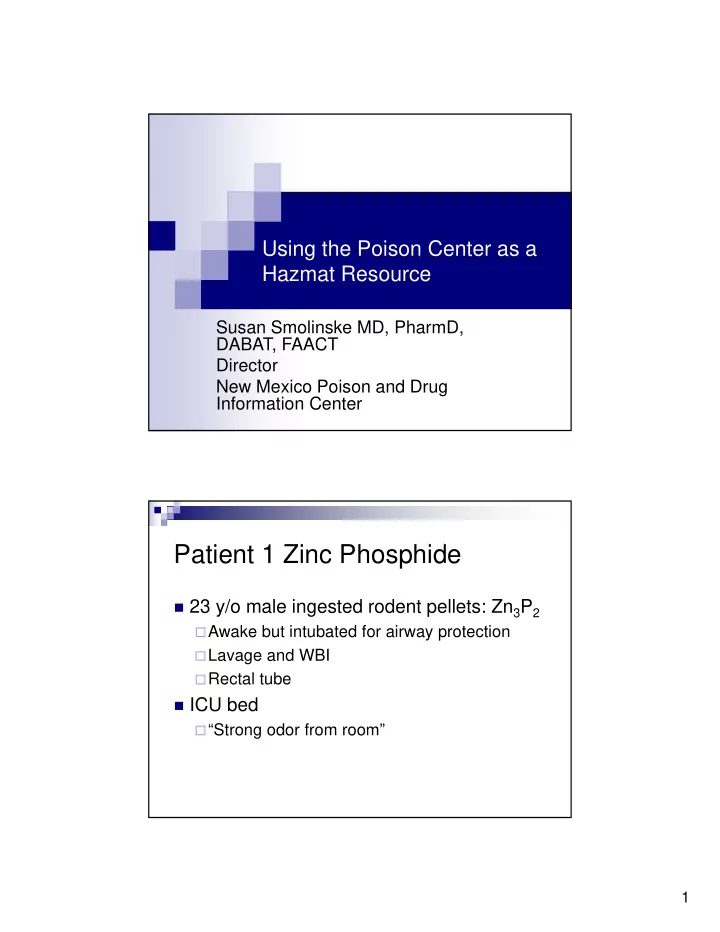
Patient 1 Zinc Phosphide 23 y/o male ingested rodent pellets: Zn 3 P - - PDF document

patient 1 zinc phosphide
SMART_READER_LITE
LIVE PREVIEW

Patient 1 Zinc Phosphide 23 y/o male ingested rodent pellets: Zn 3 P - - PDF document

Using the Poison Center as a Hazmat Resource Susan Smolinske MD, PharmD, DABAT, FAACT Director New Mexico Poison and Drug Information Center Patient 1 Zinc Phosphide 23 y/o male ingested rodent pellets: Zn 3 P 2 Awake but intubated


slide-1
SLIDE 1

1

Using the Poison Center as a Hazmat Resource

Susan Smolinske MD, PharmD, DABAT, FAACT Director New Mexico Poison and Drug Information Center

Patient 1 Zinc Phosphide

 23 y/o male ingested rodent pellets: Zn3P2

Awake but intubated for airway protection Lavage and WBI Rectal tube

 ICU bed

“Strong odor from room”

slide-2
SLIDE 2

2

Patient 1

 Negative pressure

room

 Phosphine monitoring

commenced

 SCBA and Level 2

HazMat

 Level > STEL

 Staff refused to enter

 Patient self-extubated  Sensor positioned at

patients anus

 Repositioned to staff

breathing space

 Safe levels  Patient reintubated

 Levels rapidly dropped

 Patient recovered

Patient 2 Zinc Phosphide

 28-year-old man presented after ingestion

  • f an unknown amount of Zn3P2

 On arrival stable with no reported odor  Intubated for airway protection  Lavage returned 200 mL of white stuff, WBI  Rectal tube inserted, waste double-bagged  Admitted to ICU rather than isolation room

slide-3
SLIDE 3

3

Patient 2

 At 18 hours staff report strong odor in room  SCBA and Ph3 sensors brought in by Hazmat

team

 One sensor had level above STEL  ICU evacuated  Patient moved to negative pressure room  Patient had transient anemia and pulmonary

  • complications. No staff illnesses

Patient 3 Zinc Phosphide

 36-year-old man presented to ED 2 hours after ingesting

750 grams of 60% AlP pellets

 Intubated, profused gray, green material came up

esophagus clogging suction tube

 Material had garlic odor, causing pulmonary and ocular

irritation to staff

 Patient moved outdoors, resuscitated 1 hour and died  PPE was gloves, gowns, N-95 masks, higher levels not

available

slide-4
SLIDE 4

4

Patient 3

 Hazmat called initially by canceled by IC

when he mistakenly thought it was phosgene and not phosphine

 Hazmat reactivated, National Guard called  High phosphine levels detected 11 days

later

Patient 3

 Ventilator and ultrasound left outside in

rain with monitors, gurney, pumps due to monitoring inability

 Two providers hospitalized for respiratory

distress

 ED not usable for 2 days  OMI consulted with poison center

regarding autopsy and burial precautions

slide-5
SLIDE 5

5

Patient 4 Cyanide

 31 year old man

suicide with KCN

 Resuscitated at the

scene

 Transported to local

hospital

 Intubated  Supportive care  antidote

Portable negative pressure room

slide-6
SLIDE 6

6

Patient 4

 Poison center advised antidote while en

route to hospital (hydroxocobalamin)

 Hospital personnel start calling poison

center concerned about contamination

 Hospital put ambulances on divert but

accepting walk-ins with “informed consent” about potential toxic fumes

Patient 4

 Hazmat was in the area doing a massive

preparedness exercise and did testing fairly quickly with negative results

 Patient died and concern raised about autopsy;

ME was given PPE

 The poison center was never given the IC name

and only communicated with hospital staff

 Hazmat removed remaining packets of KCN

from patient’s home

slide-7
SLIDE 7

7

Patient 5 Mercury

 Patient called 911 reporting mercury poisoning  Paramedics called Poison Center to ask about

mercury poisoning

 2 paramedics + 1 firefighter arrive on scene.  Patient admitted to ED for bloody diarrhea.

Patient reported “working with metals, maybe mercury 3 days ago.”

slide-8
SLIDE 8

8

Accidental Mercury Poisoning

 Patient brought contaminated grease pan with

him, which was doubled bagged at ED as well as clothes. Both bags sent to Safety Risk Services.

  • DOH received call from UNM about case.
  • Told patient had been cooking a powdered ore

in home oven with mercury to obtain gold

Photo of Ore

slide-9
SLIDE 9

9

Health Effects: Elemental Mercury

 Symptoms may develop within a few hours  Chills, metallic taste, mouth sores, swollen

gums, nausea, vomiting, abdominal pain, diarrhea, headache, weakness, confusion, shortness of breath, cough, chest tightness, bronchitis, pneumonia and kidney damage

ED Visit by ATSDR

 Tests of patient on revealed:

 Blood Mercury of 576 ug/L Urine Mercury of 1827 ug/L Notifiable Condition Level: Blood Mercury: >3 ug/L Urine Mercury: >5 ug/L

 Patient started on oral chelation with

succimer

slide-10
SLIDE 10

10

Ambulance

 DOH urged paramedics and firefighters to be

tested for mercury

 Ambulance used to transport patient temporarily

‘retired’ until ambulance could be tested

 Jerome analyzer rented and ambulance was

found ‘negative’ for mercury

 Results for paramedics and firefighter were not

received until one month after the tests were run All results below notifiable condition level.

Mercury Levels in House

 Patient’s house (a rental) was cordoned off after

informing home owner

 DOH paid for an environmental consulting

company to monitor house outside and inside

 Patient discharged on same day, under

supervision of physician

 EPA uses ATSDR mercury action levels:

  • <= 1 ug/m3: Level acceptable for occupancy of any

structure after a spill

  • < 10 ug/m3: Level acceptable for objects (air around)
slide-11
SLIDE 11

11

Mercury Levels in House

 In the kitchen, levels were 420 ug/m3  Other areas lower (23 ug/m3 by

washer/dryer)

 Homeowner then wanted to know what

DOH could do about the house

 Patient wanted his things out of house  NMED was contacted but they could not

use emergency funds

EPA National Response Network

 DOH discovered the EPA has a National

Response Network and a Mercury Team

 Team mobilized to residence.  EPA contractors conducted mercury monitoring

in the ambulance and ER

 They tested the grease pan and clothes

(bagged) and both were hot (about 50 ug/m3) for mercury.

 Also tested the ER chair where patient sat

(clothes had not been removed before transport). The chair was below 10 ug/m3

slide-12
SLIDE 12

12

EPA National Response Network

 Ambulance tested and the biohazard bag was >

10 ug/m3.

 No New Mexico protocol for clearing ambulance  EPA suggested action level of 3 ug/m3 for “an

  • ccupational or commercial setting where

mercury is not usually handled.”

 Once bag removed, air in ambulance below 3

ug/m3

 DOH + EMS Bureau then cleared (via letter) the

ambulance to resume service

slide-13
SLIDE 13

13

EPA National Response Network

 EPA Team conducted air monitoring for mercury

vapors with a Lumex Mercury Analyzer— capable of detecting nanogram/m3 levels of Hg mercury vapor

EPA National Response Network

 Just inside doorway, levels were 15 ug/m3  In order to reduce mercury levels, house

was actively vented

 Heaters inside home set up with copious

blowers/fans to push vapors out of windows.

 Vented air monitored to ensure

permissible exposure levels weren’t exceeded

slide-14
SLIDE 14

14

Complications

 Homeowner was given choice: EPA can

clean up or she could pay to do it herself

 She had house cleaned up but did not

coordinate with EPA

 Homeowner-hired environmental

company: reported 0.00 ug/m3 mercury in the house

 BUT, used Jerome meter and detection

limit is 1 ug/m3

Patient 6 Mercury: Day 1

 2 children playing with vial, broke in bed, estimate 1 tsp

spilled

 Recommendations:

 Clean up per MI guidelines  Shower and change clothes (resulted in drain being

contaminated)

 Stat blood mercury  Provided DOH phone number

slide-15
SLIDE 15

15

Follow up on Day 1

 Caller states still beads visible in planks of

wood floor; she was going to vacuum

 Recommended against vacuum  Keep door closed and stay out of room

until plan for cleanup

slide-16
SLIDE 16

16

Follow up on day 4

 Detailed self clean-up advice given

Contact insurance Remove carpeting Take remaining Hg to hazmat site (gave

address)

Follow up on day 5

 Lab results on two less exposed children

return

Both 8 mcg/L (nl < 10) Normals are based on adult occupational

exposures

NHANES data shows 95% of children have

levels < 1)

The fact that index child’s level not back likely

indicates it is hig

slide-17
SLIDE 17

17

Follow up day 5 continued

Asked for seafood history; if negative

evacuate home, call contractor

Mother states no seafood; additional history is

that home has no AC, temperatures are 75 degrees or higher

Home evacuated; went to grandmother’s on

same property

On hold with Tricore 15 minutes or more lab

tech did not return to phone

Day 6

 MD calls with mercury level of 67 mcg/L  Chelation recommended directly to MD from consultant

 Began to initiate process to obtain succimer

 Family calls and still seeing beads in flooring after

extensive cleanup effort (ignored recommendation to call consultant)

 History obtained that child has baseline developmental

disorders (spatial anxiety, abnormal sensory processing)

 Child goes to ED to get Rx and resident says admission

needed

slide-18
SLIDE 18

18

Day 7

EPA notified and agreed to send a team

NRC notified (required to get EPA involved)

DOH notified Toxicology met EPA at patient’s home

Bedroom level exceeded limit of Lumex (> 50,000)

Required self-contained breathing protection

Clean-up efforts included

Mercury binding solution

Mercury vacuum

Heat and vent cycles

Entire room drywall and insulation removed

Two washing machines disposed (tried wash cycle with binding solution)

Wood flooring deemed the cause of remaining vapors

Sealed floor with polyurethane (ineffective)

Sealed floor with DuraPoxy (certified barrier)

Declared clear after 17 days of cleaning

EPA START team

slide-19
SLIDE 19

19

Day 8

 Child gets first dose of succimer in ED  She is sent home with 5 days worth of

medication (all we had)

Pharmacist recommended child swallow

capsules

We recommend putting in yogurt, applesauce

  • r pudding

Subsequent mercury level is 12 mcg/L before

chelation

Lessons learned Mercury

 Involve LEPC, NRC, DOH early if > 1 thermometer  Get complete history (medical conditions, seafood consumption)  Have family evacuate as soon as discovered  Remove clothes and shoes then wipe with washcloth before

showering

 Be more questioning about “pending labs”  Wash hair with Selsun Blue or equivalent  Use Selsun blue on dogs (not cats)  Put all clothes, shoes and washcloths in sealed bags  Figure out a better way to get succimer to patients

slide-20
SLIDE 20

20

What can we learn from these cases?

 Call the poison center early  When in doubt, remove patient’s clothes before transport to

prevent contamination in ER

 We can activate Chempack and hazmat  Identify an Incident Commander  Double NG tube  Lavage and WBI closed circuit  Alert Hazmat early to obtain monitoring equipment  Alert Hazmat early to obtain proper PPE  Negative pressure room  Limit patient movement to other areas  Consult poison center regarding fatal hazmat cases

slide-21
SLIDE 21

21

New Mexico Poison Center

 Cost analysis

 PCCs save $13.00 for every $1.00 spent on PCC

support

 It only takes 10 calls to prevent one unnecessary

hospitalization

 We can reduce LOS (average 3 days)

 We can reduce ICU overutilization  We can reduce resource allocation  We can reduce hospital admission costs

The pharmacist role for Hazmat

 Include poison center in emergency plans  Call us for antidote questions

Dose Administration Facilitate procurement of antidotes

 Connect us with the incident commander  Call in all patients “exposed” so that

surveillance can occur

slide-22
SLIDE 22

22

NPDS

 National Poison Database System

Used by all poison centers Cases uploaded every 8 minutes Can identify clusters of poisonings Used by CDC for toxicosurveillance

Poison Center Chempack policy

 During a potential public health emergency or

incident, where CHEMPACK contents might be required, the New Mexico Poison & Drug Information Center will assist the Department of Health by 1) determining whether the CHEMPACK antidotes may be useful given all known facts regarding the incident at the time NMPDIC is contacted 2) rendering a decision to use or not use the CHEMPACK 3) estimating antidote dosing units that will be needed.

slide-23
SLIDE 23

23

How to ask for help

 The on-scene Incident Commander, Emergency

Response Officer, or hospital representative will contact the NMPDIC via 505-272-0064 and will request assistance in determining whether CHEMPACK should be used for a potential chemical/nerve agent incident.

All known information will be communicated to any Poison Information Specialist

 The Poison Information Specialist will contact

the NMDOH on-call Epidemiologist Service, who will render a decision about usefulness of the CHEMPACK and will approve its deployment. List of chemical agents that create potential hospital hazmat patients

 Mercury  Organophosphates/nerve gases  Aluminum phosphide  Zinc phosphide  ATSDR “Managing hazardous materials

incidents: a planning guide for the management of contaminated patients: http://www.atsdr.cdc.gov/MHMI/mhmi_v1_ 2_3.pdf.

slide-24
SLIDE 24

24

Many Ways to Contact NMPDIC

 Emergency

 1-800-222-1222

 Cell phone issues

 505-272-2222  ssmolinske@salud.unm.e

du

 http://nmpoisoncenter.unm

.edu/

 Like us on Facebook!

Webpoisoncontrol.org