Path to effective electroweak operators - - PowerPoint PPT Presentation

path to effective electroweak operators
SMART_READER_LITE
LIVE PREVIEW

Path to effective electroweak operators - - PowerPoint PPT Presentation


slide-1
SLIDE 1

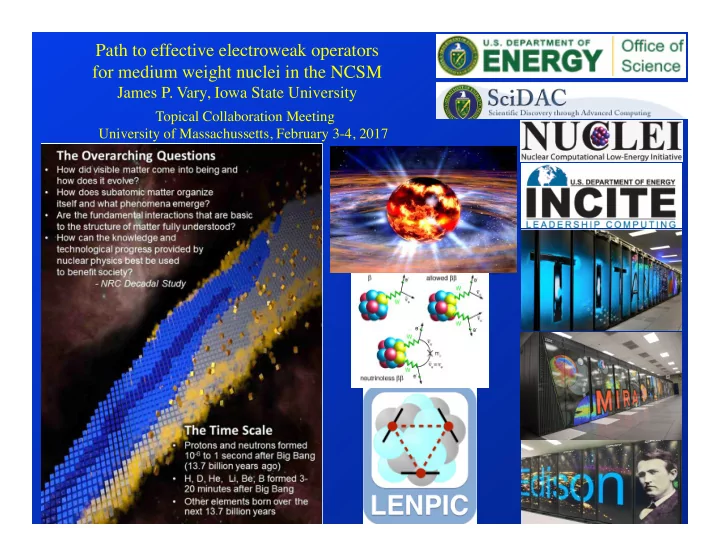
Path to effective electroweak operators for medium weight nuclei in the NCSM

James P. Vary, Iowa State University

Topical Collaboration Meeting University of Massachussetts, February 3-4, 2017

Nuclear Double Beta-Decay Figure

Neutrinos and Fundamental Symmetries

slide-2
SLIDE 2

1. Light nuclei and “single” OLS renormalization (NCSM) 2. Lesson from Gamow-Teller transitions: 12C and 14C => 3NFs! 3. “Single” OLS on sample electroweak operators 4. “Double” OLS pathway to medium mass nuclei 5. Updates on LENPIC progress – new Chiral EFT operators

Outline

slide-3
SLIDE 3

ab initio No Core Shell Model “NCSM”

No Core Full Config NCFC NCSM- Reson’g Grp Method & NCSM- Contin’m SU(3)- NCSM Basis Light Front Quant’zn HORSE Scat’g phase shifts

Structure Reactions

Effective Field Theory

  • ext’l field

Monte Carlo NCSM Importance Truncated NCSM NCSM with Core

Extensions of the ab initio NCSM

Gamow- NCSM & Density Matrix Renormaliz’n Group Complex- Scaled NCSM Tetraneutron

slide-4
SLIDE 4

No-Core Configuration Interaction calculations

Barrett, Navrátil, Vary, Ab initio no-core shell model, PPNP69, 131 (2013)

Given a Hamiltonian operator

ˆ H =

  • i<j

(⃗ pi − ⃗ pj)2 2 m A +

  • i<j

Vij +

  • i<j<k

Vijk + . . .

solve the eigenvalue problem for wavefunction of A nucleons

ˆ H Ψ(r1, . . . , rA) = λ Ψ(r1, . . . , rA)

Expand wavefunction in basis states |Ψ⟩ = ai|Φi⟩ Diagonalize Hamiltonian matrix Hij = ⟨Φj| ˆ

H|Φi⟩

No-Core CI: all A nucleons are treated the same Complete basis −

→ exact result

In practice truncate basis study behavior of observables as function of truncation

Progress in Ab Initio Techniques in Nuclear Physics, Feb. 2015, TRIUMF , Vancouver – p. 2/50

Expand eigenstates in basis states

slide-5
SLIDE 5

Basis expansion Ψ(r1, . . . , rA) = aiΦi(r1, . . . , rA)

Many-Body basis states Φi(r1, . . . , rA) Slater Determinants Single-Particle basis states φik(rk) quantum numbers n, l, s, j, mj Radial wavefunctions: Harmonic Oscillator, Wood–Saxon, Coulomb–Sturmian, Berggren (for resonant states)

M-scheme: Many-Body basis states eigenstates of ˆ Jz ˆ Jz|Φi⟩ = M|Φi⟩ =

A

  • k=1

mik|Φi⟩ Nmax truncation: Many-Body basis states satisfy

A

  • k=1
  • 2 nik + lik
  • ≤ N0 + Nmax

Alternatives: Full Configuration Interaction (single-particle basis truncation) Importance Truncation

Roth, PRC79, 064324 (2009)

No-Core Monte-Carlo Shell Model

Abe et al, PRC86, 054301 (2012)

SU(3) Truncation

Dytrych et al, PRL111, 252501 (2013)

Progress in Ab Initio Techniques in Nuclear Physics, Feb. 2015, TRIUMF , Vancouver – p. 3/50

Woods-Saxon, Coulomb-Sturmian, Complex Scaled HO, Berggren,. . . Harmonic Oscillator (HO),

Nmax runs from zero to computational limit. (Nmax , ) fix HO basis

φα r

k

( ) with α = (n,l,s, j,m j)

2n +l

( )α ≤ N0 + Nmax

α occ.

slide-6
SLIDE 6

Nuclear interaction

Nuclear potential not well-known, though in principle calculable from QCD

ˆ H = ˆ Trel +

  • i<j

Vij +

  • i<j<k

Vijk + . . .

In practice, alphabet of realistic potentials Argonne potentials: AV8′, AV18 plus Urbana 3NF (UIX) plus Illinois 3NF (IL7) Bonn potentials Chiral NN interactions plus chiral 3NF , ideally to the same order . . . JISP16 . . .

Progress in Ab Initio Techniques in Nuclear Physics, Feb. 2015, TRIUMF , Vancouver – p. 5/50

Major development during the past 5-10 years: High-precision ab initio calculations now used to “discover” the correct strong NN+NNN interaction

slide-7
SLIDE 7

Controlling the center-of-mass (cm) motion in order to preserve Galilean invariance Add a Lagrange multiplier term acting on the cm alone so as not to interfere with the internal motion dynamics

H = Heff Nmax,!!

( )+"Hcm

Hcm = P2 2M A + 1 2 M A!2R2 " "10 suffices

Low-lying “physical” spectrum Approx. copy of low-lying spectrum

!!"

Along with the Nmax truncation in the HO basis, the Lagrange multiplier term guarantees that all low-lying solutions have eigenfunctions that factorize into a 0s HO wavefunction for the cm times a translationaly invariant wavefunction.

Heff Nmax,Ω

( )≡ P[Trel +V a Nmax,Ω ( )]P

slide-8
SLIDE 8

Nuclei represent strongly interacting, self-bound, open systems with multiple scales – a computationally hard problem whose solution has potential impacts on other fields Question: What controls convergence/uncertainties of observables? Answer: Characteristic infrared (IR) and ultraviolet (UV) scales of the operators. Operators in a plane-wave basis: IR: λ = lowest momentum scale - can be zero (e.g. Trel, r2, B(Eλ), . . . ) UV: Λ = highest momentum scale - can be infinity (e.g. Trel, hard-core VNN) Operators in a harmonic-oscillator basis with Nmax = Max[2n + l] truncation:

λ ≈ !Ω Nmax Λ ≈ !Ω Nmax

What are examples of the other physically relevant scales in nuclear physics? Interaction scales (total binding, Fermi momentum, SRCs, one-pion exchange, . . . ) Leading dissociation scale (halos, nucleon removal energy, . . .) Collective motion, clustering scales (Q, B(E2), giant modes, . . . )

IR: UV:

slide-9
SLIDE 9

Guidelines for many-body calculations to guarantee preserved predictive power:

  • 1. Select basis regulators:

all relevant IR scale limits except Trel all relevant UV scale limits except Trel

  • 2. Since Trel has simple IR and UV asymptotics, extrapolation is feasible

for observables where Trel dominates J-matrix for scattering – takes both IR and UV limits of HO basis IR extrapolation tools developed over past ~5 years To follow guideline #1, the OLS method provides the advantage of transforming all operators to act only within the scale fixed by the basis regulators. The cost: induced many-body operators need to be assessed. The benefit: extrapolation may be avoided

λ ≤ Λ≥

slide-10
SLIDE 10

H

PHeffP PHeffQ = 0 QHeffP = 0 QHeffQ

P Q P Q Nmax

With H defining the OLS transforma?on, same picture applies to other Hermi?an operators

slide-11
SLIDE 11

Outline of the OLS process

UHU † =U[T +V]U † = Hd Heff =UOLSHUOLS

= PHeffP = P[T +Veff]P U P = PUP ! U P = P ! U PP = U P U P†U P Heff = ! U P†Hd ! U P = ! U P†UHU † ! U P = P[T +Veff]P Oeff = ! U P†UOU † ! U P = P[Oeff]P UOLS = ! U P†U

slide-12
SLIDE 12

NCSM with OLS renormalization in harmonic oscillator basis Chiral NN (EM500) + Chiral 3N (Epelbaum, et al.) Note: EW observables evaluated with naïve bare operators in this paper.

slide-13
SLIDE 13

12C B(M1;0+0->1+1)

0.5 1 1.5 2 2.5 3 3.5 4 2 4 6 Nma B(M1;0+0->1+1) 15 Expt. 15 N3LO 16 N3LO

Nmax

ν-12C cross section and the 0+ 0 -> 1+ 1 Gamow-Teller transition

A.C.Hayes, P. Navratil, J.P. Vary, PRL 91, 012502 (2003); nucl-th/0305072 First successful description

  • f the GT data required 3NF.

Both CDBonn + TM’ or AV8’ + TM’ => large enhancement N3LO+3NF (OLS) results from:

  • P. Navartil, V.G. Gueorguiev,

J.P. Vary, W.E. Ormand and

  • A. Nogga, PRL 99, 042501 (2007).

N3LO + 3NF(N2LO) N3LO only

Exp

JISP16 Non-local NN interaction from inverse scattering (JISP16) also successful Nmax = 6, 8 results with SRG on N3LO+3NF (N2LO); P. Maris, et al, PRC 90, 014314 (2014) [ ] NN only (SRG/OLS) NN + 3N (SRG)

OLS (OLS) (OLS)

slide-14
SLIDE 14

Origin of the anomalously long life-time of 14C

  • 0.03
  • 0.02
  • 0.01

0.01 0.02 0.03 GT matrix element

no 3NF forces with 3NF forces (cD= -0.2) with 3NF forces (cD= -2.0)

s p sd pf sdg pfh sdgi pfhj sdgik pfhjl

shell

  • 0.1

0.1 0.2 0.3 0.2924

near-complete cancellations between dominant contributions within p-shell very sensitive to details

Maris, Vary, Navratil, Ormand, Nam, Dean, PRL106, 202502 (2011)

INT workshop on double beta decay, Aug. 2013, Seattle, WA – p. 32/35

Note contributions from higher shells

slide-15
SLIDE 15

Comparison GT transitions in A = 14

  • 0.03
  • 0.02
  • 0.01

0.01 0.02 0.03 GT matrix element no 3NF forces with 3NF forces (CD=-0.2) with 3NF forces (CD=-2.0) s p sd pf sdg pfh sdgi pfhj sdgik pfhjl

shell

  • 0.1

0.1 0.2 0.3 0.2924

  • 0.03
  • 0.02
  • 0.01

0.01 0.02 0.03 GT matrix element no 3NF forces with 3NF forces (CD=-0.2) with 3NF forces (CD=-2.0) s p sd pf sdg pfh sdgi pfhj sdgik pfhjl

shell

0.4 0.8 0.836 0.842 0.803

Chiral 3-body interactions leads to suppression of GT transition for

14C(0+, 0) state, but not for 14C∗(0+, 2) state

INT workshop on double beta decay, Aug. 2013, Seattle, WA – p. 33/35

Left panel: P. Maris, et al., Phys. Rev. Lett. 106, 202502 (2011). Right panel: P. Maris, Journal of Physics: Conference Series 402, 012031 (2012)

slide-16
SLIDE 16

Consider two nucleons as a model problem with V = Chiral N3LO (EM) solved in the harmonic oscillator basis with ħΩ = 10, 15 and 20 MeV with an added harmonic oscillator quasipotential (OLS) Hamiltonian Electroweak observables: Root mean square radius R Magnetic dipole operator M1 Electric dipole operator E1 Electric quadrupole moment Q Electric quadrupole transition E2 Gamow-Teller GT Neutrinoless double-beta decay M(0ν) Dimension of the “full space” for all results depicted here: Max (Nmax) = 120 (JISP16) = 200 (Chiral N3LO)

H = T +Uosc(!Ωbasis)+V

slide-17
SLIDE 17

Ground state energy of the Deuteron = |E(Nmax) – E(exact)|/|E(exact)| Few results with JISP16 to illustrate long-range

  • perators
slide-18
SLIDE 18

= |BM1(Nmax) – BM1(exact)|/|BM1(exact)|

slide-19
SLIDE 19

= |rms(Nmax) – rms(exact)|/rms(exact)

slide-20
SLIDE 20

893]=

  • (MeV) B(GT)

5 0.335579 10 0.348252 15 0.352959 20 0.356046 OLS

5 10 15 20 25 30NMax + 1 0.34 0.35 0.36 0.37 B(GT)

Truncation vs. OLS for B(GT) 1S0->3S1 -decay

896]=

  • (MeV)

B(GT) 5 0.335579 10 0.348252 15 0.352959 20 0.356046 OLS

5 10 15 20 25 30NMax + 1 0.02 0.04 0.06 0.08 0.10 0.12 Fractional Difference

Truncation vs. OLS for B(GT) 1S0->3S1 -decay

= |BGT(Nmax) – BGT(exact)|/|BGT(exact)|

slide-21
SLIDE 21

Examine the lowest 4 eigenstates of H in 1S0 channel and compare convergence with Nmax truncation of bare H (Chiral N3LO) with OLS renormalized result plotted as fractional differences from the exact result.

  • 383]=
  • State

MeV s0 13.856 s1 47.887 s2 79.919 s3 111.61 OLS

5 10 15 20 25 30 NMax 0.00 0.05 0.10 0.15

  • Fract. Diff.
  • Trun. vs. OLS of Energy using N3LO =15 1s0->1s0

by

(* *)

635]=

  • State

MeV s0 6.7021 s1 24.382 s2 41.281 s3 57.924 OLS

5 10 15 20 25 30 NMax 0.00 0.05 0.10 0.15 0.20 0.25 0.30

  • Fract. Diff.
  • Trun. vs. OLS of Energy using N3LO =8 1s0->1s0
  • =
  • >

by

slide-22
SLIDE 22

435]=

  • State

MeV s0 8.6392 s1 30.952 s2 52.149 s3 73.012 OLS

5 10 15 20 25 30 NMax 0.00 0.05 0.10 0.15 0.20 0.25

  • Fract. Diff.
  • Trun. vs. OLS of Energy using N3LO =10 1s0->1s0
  • =
  • >

by

  • 383]=
  • State

MeV s0 13.856 s1 47.887 s2 79.919 s3 111.61 OLS

5 10 15 20 25 30 NMax 0.00 0.05 0.10 0.15

  • Fract. Diff.
  • Trun. vs. OLS of Energy using N3LO =15 1s0->1s0

by

Examine the lowest 4 eigenstates of H in 1S0 channel and compare convergence with Nmax truncation of bare H (Chiral N3LO) with OLS renormalized result plotted as fractional differences from the exact result.

slide-23
SLIDE 23

Consider a 2-body contribution within EFT to 0ν2β-decay at LO n n π- π- e- e- p p

  • G. Prézeau, M. Ramsey-Musolf and P. Vogel, Phys. Rev. D 68, 034016 (2003)

Note: Additional operators being adopted – stay tuned

, x = mπ ! r

Preliminary

slide-24
SLIDE 24

Preliminary Preliminary

(* *)

635]=

  • State

MeV s0 6.7021 s1 24.382 s2 41.281 s3 57.924 OLS

5 10 15 20 25 30 NMax 0.00 0.05 0.10 0.15 0.20 0.25 0.30

  • Fract. Diff.
  • Trun. vs. OLS of Energy using N3LO =8 1s0->1s0
  • =
  • >

by

727]=

  • State

M(2) s0 1.0435 s1 0.56158 s2 0.45059 s3 0.39366 OLS

5 10 15 20 25 30 NMax

  • 0.4
  • 0.2

0.0 0.2 0.4

  • Fract. Diff.
  • Trun. vs. OLS of total 2-decay using N3LO =8 1s0->1s0
  • =
  • >

by

slide-25
SLIDE 25

435]=

  • State

MeV s0 8.6392 s1 30.952 s2 52.149 s3 73.012 OLS

5 10 15 20 25 30 NMax 0.00 0.05 0.10 0.15 0.20 0.25

  • Fract. Diff.
  • Trun. vs. OLS of Energy using N3LO =10 1s0->1s0
  • =
  • >

by

Preliminary Preliminary

slide-26
SLIDE 26

Preliminary Preliminary

slide-27
SLIDE 27

Plans: Expand treatment to wider range of EW operators within Chiral EFT Implement in finite nuclei: Input OLS’d operators as TBMEs in single-particle representation Evaluate/save TB density matrices (static and transition) and use to evaluate OLS’d observables and compare with results from bare observables Extend to 3-body H with OLS at 3-body level Now consider the path to medium weight nuclei

slide-28
SLIDE 28

!"#$!% &'()% !"#$*%+%,% *"#$!%% %%+%,% *"#$*%

H

P Q P Q Nmax

P’H’effP’

N’max= 0

Double OLS reduc?on of the basis to a “conven?onal” shell model valence space Dikmen, Lisetskiy, BarreJ, Maris, Shirokov, Vary, PRC 91, 064301 (2015); arXiv 1502:00700

slide-29
SLIDE 29

A = 48 neutrinoless double beta-decay Method: Double OLS transforma?on to obtain Veff for fp or fpg model space Input: Chiral NN + 3N interac?on NCSM: A = 40 , 41 and 42 Nmax = 2 (test case) and 4 (ul?mate goal) for first OLS transforma?on #Eigen Converge 60 eigenvalues/eigenvectors for A = 42 for 195 mx els M-scheme matrix dimensions for Nmax = 4 Dimension NNZ(NN-only) NNZ(NN+NNN) 40Ca 29,606,819 42Ca/42Ti 970,634,363 42 Sc 1,211,160,184 54 x 1012 48Ca ~220 billion (currently out of reach for full NCSM) Test run: 48Ca (Nmax=2) D=214 x 106 with chiral NN+3N: 2000 Lanczos itera?ons on Titan (2.4 secs/itera?on on 4000 cores) produced 120 converged states (June 2014)

slide-30
SLIDE 30

2+ 0+ 4+ 3+ 1+ 5+ 2+ 0+ 2+ 3H+L 3- 3,4,5 @5-D 4H-L H1L- 3- chiral experiment CD-Bonn+3 3 4 5 6 E HMeVL 48Ca Excitations 5 + 4 + 6 + 3 + 7 + 2 + 3 + 1+ 5 + 4 + 2 + 0 + 7 + 1+ 4 + 2 + 4 + 3 + 6 + 3 + chiral experim ent CD-Bonn +3 0.0 0.5 1.0 1.5 2.0 2.5 3.0 E H MeVL 48Sc Excitations

Chiral NN+3N (SRG0800, Nmax= 2) H.D. PoJer, et al, in prepara?on HO basis = 14 MeV CD-Bonn + 3 (OLS, Nmax= 0,1) J.P. Vary, et al, J. Phys. G36, 085103(2009) HO basis = 10.5 MeV

NCSM calcula?ons for A=48 PRELIMINARY

slide-31
SLIDE 31

Low Energy Nuclear Physics International Collaboration

  • E. Epelbaum, H. Krebs
  • A. Nogga

P . Maris, J. Vary

  • J. Golak, R. Skibinski,
  • K. Tolponicki, H. Witala
  • S. Binder, A. Calci, K. Hebeler,
  • J. Langhammer, R. Roth
  • R. Furnstahl
  • H. Kamada

Calculation of three-body forces at N3LO

Goal Calculate matrix elements of 3NF in a partial- wave decomposed form which is suitable for different few- and many-body frameworks Challenge Due to the large number of matrix elements, the calculation is extremely expensive. Strategy Develop an efficient code which allows to treat arbitrary local 3N interactions. (Krebs and Hebeler)

slide-32
SLIDE 32

Initial LENPIC Collaboration results: Chiral NN results for 6Li by Chiral order Orange: Chiral order uncertainties; Blue/Green: Many-body method uncertainties

  • S. Binder, et al, Phys. Rev. C93, 044002 (2016); arXiv:1505.07218
slide-33
SLIDE 33

Collaborators at Iowa State University and NUCLEI Team members Robert Basili Weijie Du Matthew Lockner Pieter Maris Soham Pal Hugh Potter Shiplu Sarker

slide-34
SLIDE 34

1. Light nuclei and “single” OLS renormalization (NCSM) 2. Lesson from Gamow-Teller transitions: 12C and 14C => 3NFs! 3. “Single” OLS on sample electroweak operators 4. “Double” OLS pathway to medium mass nuclei 5. Updates on LENPIC progress – new Chiral EFT operators

Outline Conclusions

OLS succeeds in renormalizing the IR and UV scales in these initial applications to electroweak operators. Major additional efforts needed to develop and apply these methods: effective Hamiltonians, effective electroweak operators, many-body methods, . . . .