Patent Troll Terminology -Patent assertion entity (PAE) - - PDF document

patent troll terminology
SMART_READER_LITE
LIVE PREVIEW

Patent Troll Terminology -Patent assertion entity (PAE) - - PDF document

4/16/2015 The Misinterpretation of eBay v. MercExchange and Why: An Analysis of the Case History, Precedent, and Parties Forthcoming, Chapman L. Rev. Professor Ryan T. Holte Southern Illinois University School of Law rholte@law.siu.edu


slide-1
SLIDE 1

4/16/2015 1

Professor Ryan T. Holte Southern Illinois University School of Law rholte@law.siu.edu Presentation: 17 April 2015 SIU Alumni CLE, Taft Law, Chicago, IL

1

The Misinterpretation of eBay v. MercExchange and Why: An Analysis of the Case History, Precedent, and Parties Forthcoming, Chapman L. Rev.

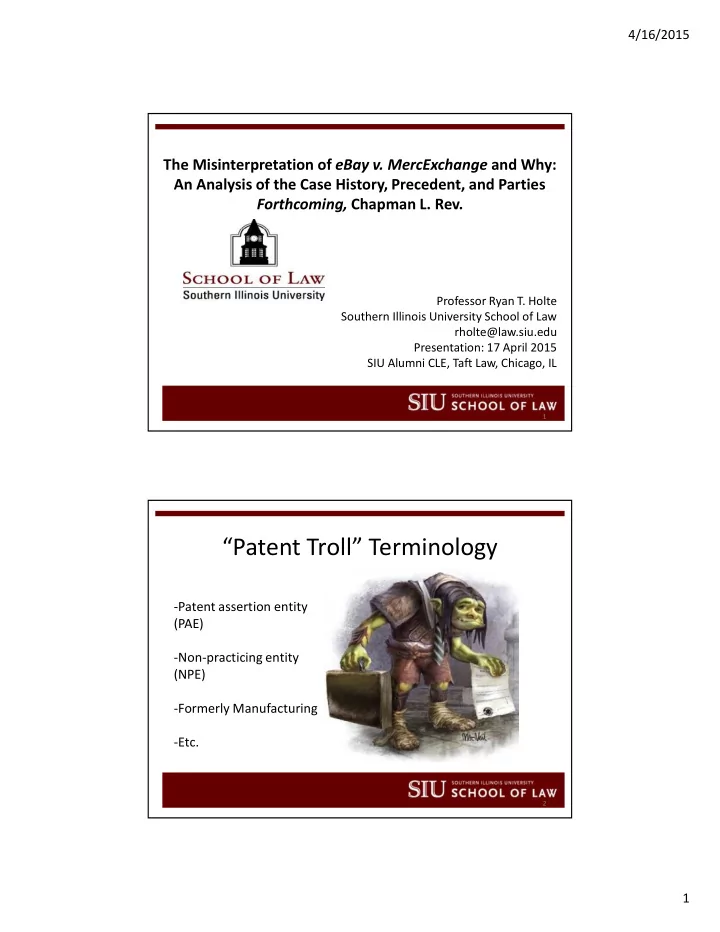
“Patent Troll” Terminology

2

  • Patent assertion entity

(PAE)

  • Non-practicing entity

(NPE)

  • Formerly Manufacturing
  • Etc.
slide-2
SLIDE 2

4/16/2015 2

3

Patent Trolls or Great Inventors: Case Studies of Patent Assertion Entities

59 ST. LOUIS. U. L.J. 1 (2014) (Published March 2014)

The Parties & Dispute

4

slide-3
SLIDE 3

4/16/2015 3

The Injunction

  • Five week jury trial
  • Jury finds MercExchange’s two patents valid and

eBay a willful infringer

  • Both parties cite four equitable factors within

their injunction briefing

  • District Court cited factors and denied injunction

5

Why Denial? (J. Friedman’s opinion)

  • Back to the patent troll issue
  • MercExchange willing to license its patents
  • MercExchange “exists solely to license . . . and

not develop or commercialize”

  • Conclusion: Departed with longstanding tradition
  • f validity + infringement = injunction

6

slide-4
SLIDE 4

4/16/2015 4

Federal Circuit Reversal

  • Short opinion; J. Bryson discussed the injunction

issues for 1pg

  • Did not cite four-factor test
  • Found numerous errors with district court’s

injunction analysis.

  • improper concern over business method patents
  • Re. licensing: “leverage in licensing is a natural

consequence of the right to exclude”

7

Supreme Court

  • 31 amicus briefs
  • SG files and argues on behalf of MercExchange
  • Justice Thomas authors unanimous opinion
  • Reverses Fed Cir for not applying the four-factor test;

courts must apply the test

  • Reverses district court for “classifying” MercExchange

for not practicing the patent

  • Affirmed Continental case—”nonuse is no efficient

reason for withholding [an] injunction”

8

slide-5
SLIDE 5

4/16/2015 5

Two Concurrences

  • Justice Roberts—majority holding rests on

traditional notions of equity; tradition teaches that courts have granted injunctions for willful patent infringement

  • Justice Kennedy—Supports Roberts’ concurrence;

cautions against new types of cases, firms who “use patents to primarily obtain licensing fees”

  • Cites a single 2003 online FTC report regarding non-

practicing entities in the computer hardware industry

9

06-08: Back to the Dist. Ct.

  • J. Friedman orders additional discovery
  • eBay argues design around; patent found

invalid at USPTO during reexam (later reversed)

  • OA: focus on Kennedy’s concurrence and

MercExchange being a “troll”

  • Op: J. Friedman denies injunction
  • Discussion of MercExchange false license; inventor

email; inventor background

  • Cites to Kennedy

10

slide-6
SLIDE 6

4/16/2015 6

Settlement

  • Second appeal to Fed. Cir. after denial of

injunction

  • Fully briefed; Fed. Cir. orders mediation with

settlement authority participants

  • Settlement in Feb. 2008 before Fed. Cir. OA
  • eBay buys all MercExchange patents
  • eBay continues to prosecute patents; 6 issued

11

Important Case Study Facts to Emphasize

12

  • eBay’s PR campaign
  • after Fed. Cir. appeal
  • after Sup. Ct. opinion
  • Supreme Court opinion confused in the press
  • Majority affirms Continental
  • Kennedy—historical basis; cites to 1 FTC report
  • Case did not end at Sup Ct
  • Different than press’ review
slide-7
SLIDE 7

4/16/2015 7

Data Regarding Case Interpretation

13

  • Post-eBay injunction denial at 78% for NPEs
  • < 5% before eBay
  • 217 total injunction decisions since eBay
  • 27% deny injunctions across all parties

[data from Chris Seaman]

  • 24 Fed. Cir. appeals w/full eBay analysis since 2006
  • If injunction granted—73% affirmed
  • If injunction denied—78% likely to remand
  • Forthcoming Fed. Cir. empirical study with Seaman

What the case has become

14

  • Many courts citing Kennedy as law for injunctions
  • Many early injunction-denial opinions citing

Kennedy forward cited

  • Note: Only 1 Federal Circuit cite to Kennedy’s

concurrence since eBay

  • J. Friedman assigned 40 patent cases while on

bench—all anti-patent

  • Many cites to Friedman’s second injunction denial

as useful precedent in the application of eBay

  • Public media perception is that eBay won, no more

injunctions for NPEs

slide-8
SLIDE 8

4/16/2015 8

Corrections on eBay’s “precedent” & why

15

  • eBay does not stand for injunctions being

unavailable to PAEs—the true holding has been lost

  • District courts are overusing Kennedy’s

concurrence

  • But… Fed. Cir. has generally the same results for

injunctions before and after eBay

Corrections on eBay’s “precedent” & why

16

  • Large notorious public companies are dangerous

as litigants for useful legal precedent

  • Many complicated issues, increased press, and a

potentially biased Judge complicate the case’s value

  • Evidence of a larger PR and amicus effort to reduce

patent injunctions in favor of certain business models

  • eBay would have likely lost second Fed. Cir.

appeal

  • Would have potentially upset precedent of case
slide-9
SLIDE 9

4/16/2015 9

Contact

  • Prof. Ryan T. Holte

Southern Illinois University School of Law rholte@law.siu.edu Article available on SSRN

17