
SLIDE 1
Pat Hanrahan Computer Science Department Stanford University - - PDF document
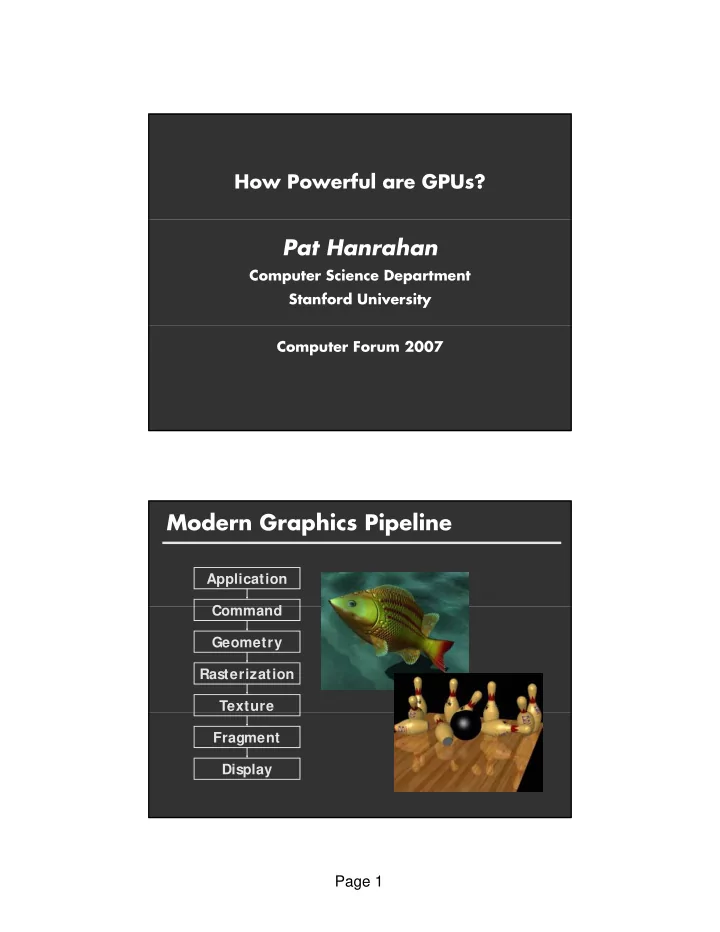
How Powerful are GPUs? Pat Hanrahan Computer Science Department Stanford University Computer Forum 2007 Modern Graphics Pipeline Application C Command d Geometry Rasterization Texture Fragment Display Page 1 A Pitch from 5 Years Ago
Pat Hanrahan, circa 2002-2005
Gap between GPU and CPU stablelized
DX10 mandates unified graphics pipeline GPGPU – many algorithms implemented
CPU – fast sequential processor GPU – fast data parallel processor Hybrid CPU/GPU
80 nm process ~700 million transistors 64 4-wide unified shaders ~700 Mhz clock 512-bit GDDR memory GDDR3 @ 900Mh 115 GB/ GDDR3 @ 900Mhz = 115 GB/s GDDR4 @ 1100Mhz = 140 GB/s 230 Watt
R300 not R600
90 nm TSMC process 681million transistors 480 mm^2 128 scalar processors 1.3 Ghz clock rate 384 bit GDDR 384-bit GDDR memory GDDR3 @ 900Mhz = 86.4 GB/s 130 Watts
R t i ti Input Assembler Host
SP SP
L1
TF
Thread Processor Vertex Thread Rasterization Geometry Thread Pixel Thread Input Assembler
SP SP
L1
TF SP SP
L1
TF SP SP
L1
TF SP SP
L1
TF SP SP
L1
TF SP SP
L1
TF SP SP
L1
TF
L2 FB L2 FB L2 FB L2 FB L2 FB L2 FB
64K 32-bit 32 4-32-bit
64K insts 32 4-32-bit
8 4-32-bit
# c[0-3] = modelview projection (composite) matrix # c[4-7] = modelview inverse transpose # c[32] = eye-space light direction # c[33] = constant eye-space half-angle vector # c[35].x = pre-multiplied diffuse light color & diffuse mat. # c[35].y = pre-multiplied ambient light color & diffuse mat. # c[36] = specular color; c[38].x = specular power
DP4 o[HPOS].x, c[0], v[OPOS]; # Transform position. DP4 o[HPOS].y, c[1], v[OPOS]; DP4 o[HPOS].z, c[2], v[OPOS]; DP4 o[HPOS].w, c[3], v[OPOS]; DP3 R0.x, c[4], v[NRML]; # Transform normal. DP3 R0.y, c[5], v[NRML]; DP3 R0 z c[6] v[NRML]; DP3 R0.z, c[6], v[NRML]; DP3 R1.x, c[32], R0; # R1.x = L DOT N' DP3 R1.y, c[33], R0; # R1.y = H DOT N' MOV R1.w, c[38].x; # R1.w = specular power LIT R2, R1; # Compute lighting MAD R3, c[35].x, R2.y, c[35].y; # diffuse + ambient MAD o[COL0].xyz, c[36], R2.z, R3; # + specular END
Thread Execution Manager Input Assembler Host Thread Execution Manager
Parallel Data Cache Parallel Data Cache Parallel Data Cache Parallel Data Cache Parallel Data Cache Parallel Data Cache Parallel Data Cache Parallel Data Cache SIMD Core SIMD Core SIMD Core SIMD Core SIMD Core SIMD core SIMD core SIMD Core
Global Memory Load/store
8 functional units
P ll l D t C h
SIMD 16/32 “warp” 8-10 stage pipeline Thread scheduler 128-512 threads/core 16 KB shared memory
Parallel Data Cache
frag4 frag3 frag2 frag1 instr1 instr2 instr3
frag4 frag3 frag2 frag1 Run until stall at texture fetch
(multiple instructions)
MAD instruction
http://graphics.stanford.edu/projects/gpubench/
ATI X1900XTX NVIDIA 7900GTX
http://graphics.stanford.edu/projects/gpubench/
NVIDIA 7900GTX NVIDIA 8800GTX
SAXPY
X1900 (DX9):
6 GFlops
X1900 (CTM):
6 GFlops
X1900 (CTM):
6 GFlops
8800GTX (DX9):
12 GFlops SGEMV
X1900 (DX9):
4 GFlops
X1900 (CTM):
6 GFlops
8800GTX (DX9):
14 GFlops SGEMM
X1900 (DX9):
30 GFlops
X1900 (CTM):
120 GFlops
8800GTX (DX9):
105 Gflops
3 Ghz Core 2
40 Gflops
NVIDIA’s Cg Microsoft’s HLSL OpenGL Shading Language RapidMind Sh [McCool et al. 2004] RapidMind Sh [McCool et al. 2004]
Threads: pthreads, Occam, UPC, … Message passing: MPI
APL, SETL, S, Fortran90, … C* (lisp*), NESL, …
StreaMIT, StreamC/KernelC MS Accelerator, CUDA, DPVM, PeakStream
Multidimensional arrays (stencils) Graphs and meshes (topology)
Application: map Reductions: scan, reduce (fold) Communication: send, sort, gather, scatter Communication: send, sort, gather, scatter Filter (|O|<|I|) and generate (|O|>|I|)
Brook for GPUs: Stream computing on graphics hardware,
Gravitational acceleration Gravitational accel. + jerk
Implicit solvent models Implicit solvent models Lennard-Jones Coulomb
*TFLOPs is actual flops from software cores, not peak values
Nforce4 SLI Dual core Opteron 2x ATI X1900XTX Linux
Not actual machine
“Data parallel multi-threaded machine”
Processor of the future likely to be a CPU/GPU Small number of traditional CPU cores Large number of GPU cores Large number of GPU cores
Incredible opportunity for architectural
Incredible opportunity for reinventing parallel