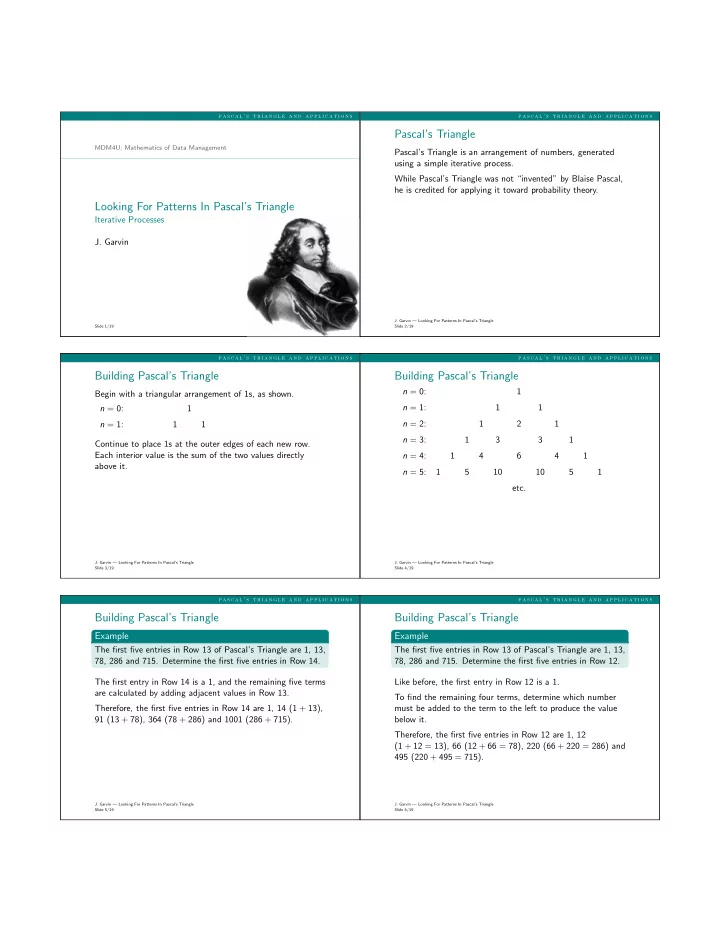
Pascals Triangle MDM4U: Mathematics of Data Management Pascals - - PDF document

pascal s triangle
SMART_READER_LITE
LIVE PREVIEW

Pascals Triangle MDM4U: Mathematics of Data Management Pascals - - PDF document

p a s c a l s t r i a n g l e a n d a p p l i c a t i o n s p a s c a l s t r i a n g l e a n d a p p l i c a t i o n s Pascals Triangle MDM4U: Mathematics of Data Management Pascals Triangle is an arrangement of numbers, generated


slide-1
SLIDE 1

p a s c a l ’ s t r i a n g l e a n d a p p l i c a t i o n s

MDM4U: Mathematics of Data Management

Looking For Patterns In Pascal’s Triangle

Iterative Processes

  • J. Garvin

Slide 1/19

p a s c a l ’ s t r i a n g l e a n d a p p l i c a t i o n s

Pascal’s Triangle

Pascal’s Triangle is an arrangement of numbers, generated using a simple iterative process. While Pascal’s Triangle was not “invented” by Blaise Pascal, he is credited for applying it toward probability theory.

  • J. Garvin — Looking For Patterns In Pascal’s Triangle

Slide 2/19

p a s c a l ’ s t r i a n g l e a n d a p p l i c a t i o n s

Building Pascal’s Triangle

Begin with a triangular arrangement of 1s, as shown. n = 0: 1 n = 1: 1 1 Continue to place 1s at the outer edges of each new row. Each interior value is the sum of the two values directly above it.

  • J. Garvin — Looking For Patterns In Pascal’s Triangle

Slide 3/19

p a s c a l ’ s t r i a n g l e a n d a p p l i c a t i o n s

Building Pascal’s Triangle

n = 0: 1 n = 1: 1 1 n = 2: 1 2 1 n = 3: 1 3 3 1 n = 4: 1 4 6 4 1 n = 5: 1 5 10 10 5 1 etc.

  • J. Garvin — Looking For Patterns In Pascal’s Triangle

Slide 4/19

p a s c a l ’ s t r i a n g l e a n d a p p l i c a t i o n s

Building Pascal’s Triangle

Example

The first five entries in Row 13 of Pascal’s Triangle are 1, 13, 78, 286 and 715. Determine the first five entries in Row 14. The first entry in Row 14 is a 1, and the remaining five terms are calculated by adding adjacent values in Row 13. Therefore, the first five entries in Row 14 are 1, 14 (1 + 13), 91 (13 + 78), 364 (78 + 286) and 1001 (286 + 715).

  • J. Garvin — Looking For Patterns In Pascal’s Triangle

Slide 5/19

p a s c a l ’ s t r i a n g l e a n d a p p l i c a t i o n s

Building Pascal’s Triangle

Example

The first five entries in Row 13 of Pascal’s Triangle are 1, 13, 78, 286 and 715. Determine the first five entries in Row 12. Like before, the first entry in Row 12 is a 1. To find the remaining four terms, determine which number must be added to the term to the left to produce the value below it. Therefore, the first five entries in Row 12 are 1, 12 (1 + 12 = 13), 66 (12 + 66 = 78), 220 (66 + 220 = 286) and 495 (220 + 495 = 715).

  • J. Garvin — Looking For Patterns In Pascal’s Triangle

Slide 6/19

slide-2
SLIDE 2

p a s c a l ’ s t r i a n g l e a n d a p p l i c a t i o n s

Notation

The first row in Pascal’s Triangle is Row 0. This means that the nth row has n + 1 entries. Each column is read diagonally downwards, from right to left. The first column is Column 0. A entry’s position may be denoted tn,r, indicating the rth term in the nth row. For example, t4,1 = 4 and t5,3 = 10, as shown on the previous slide.

  • J. Garvin — Looking For Patterns In Pascal’s Triangle

Slide 7/19

p a s c a l ’ s t r i a n g l e a n d a p p l i c a t i o n s

Notation

n = 0: t0,0 n = 1: t1,0 t1,1 n = 2: t2,0 t2,1 t2,2 n = 3: t3,0 t3,1 t3,2 t3,3 n = 4: t4,0 t4,1 t4,2 t4,3 t4,4 etc.

  • J. Garvin — Looking For Patterns In Pascal’s Triangle

Slide 8/19

p a s c a l ’ s t r i a n g l e a n d a p p l i c a t i o n s

Notation

Terms in Pascal’s Triangle

For any term in Pascal’s Triangle, such that n ≥ 1 and r ≥ 1, then tn,r = tn−1,r−1 + tn−1,r. Since each term is generated by adding the two terms above it, a term in the nth row must use the two values in the (n − 1)th row. Since columns read diagonally down and left, when two terms are added together, the rightmost term must be in the same column as the sum. Thus, a term in the rth column is generated from terms in the rth and (r − 1)th columns.

  • J. Garvin — Looking For Patterns In Pascal’s Triangle

Slide 9/19

p a s c a l ’ s t r i a n g l e a n d a p p l i c a t i o n s

Notation

Example

Express t16,7 as the sum of two terms in Pascal’s Triangle. Since n = 16 and r = 7, t16,7 = t16−1,7−1 + t16−1,7 = t15,6 + t15,7.

  • J. Garvin — Looking For Patterns In Pascal’s Triangle

Slide 10/19

p a s c a l ’ s t r i a n g l e a n d a p p l i c a t i o n s

Notation

Example

Express t20,8 as the difference of two terms in Pascal’s Triangle. If tn,r = tn−1,r−1 + tn−1,r, then tn−1,r−1 = tn,r − tn−1,r. Let n − 1 = 20 and r − 1 = 8. Then t20,8 = t21,9 − t20,9.

  • J. Garvin — Looking For Patterns In Pascal’s Triangle

Slide 11/19

p a s c a l ’ s t r i a n g l e a n d a p p l i c a t i o n s

Patterns in Pascal’s Triangle

There are many patterns in Pascal’s Triangle – so many, in fact, that entire books have been written about various patterns within. For each of the first four rows in Pascal’s Triangle, determine the sum of the values in that row. In the first row, there is only a 1, so the sum is 1. In the second row, 1 + 1 = 2. In the third row, 1 + 2 + 1 = 4. In the fourth row, 1 + 3 + 3 + 1 = 8. In general, the sum of the nth row of Pascal’s Triangle is 2n.

  • J. Garvin — Looking For Patterns In Pascal’s Triangle

Slide 12/19

slide-3
SLIDE 3

p a s c a l ’ s t r i a n g l e a n d a p p l i c a t i o n s

Patterns in Pascal’s Triangle

Example

Which row of Pascal’s Triangle has a row sum of 4 096? Divide 4 096 by 2 and make note of the number of times this can occur. Since 212 = 4 096, row 12 has a row sum of 4 096. (A better method is to use logarithms, but those are outside the scope of this course.)

  • J. Garvin — Looking For Patterns In Pascal’s Triangle

Slide 13/19

p a s c a l ’ s t r i a n g l e a n d a p p l i c a t i o n s

Patterns in Pascal’s Triangle

Imagine boxes stacked in triangular piles, where each row contains one less box than the one immediately below it. Here are the first three piles.

  • J. Garvin — Looking For Patterns In Pascal’s Triangle

Slide 14/19

p a s c a l ’ s t r i a n g l e a n d a p p l i c a t i o n s

Patterns in Pascal’s Triangle

The first three piles have one, three and six boxes

  • respectively. How many boxes are in the fourth pile, and

where are these numbers in Pascal’s Triangle? The fourth pile will contain the six boxes from the third pile, plus four more in the lower row. Thus, there are ten boxes in the fourth pile.

  • J. Garvin — Looking For Patterns In Pascal’s Triangle

Slide 15/19

p a s c a l ’ s t r i a n g l e a n d a p p l i c a t i o n s

Patterns in Pascal’s Triangle

These are known as the triangular numbers, and are located in column 2. n = 0: 1 n = 1: 1 1 n = 2: 1 2 1 n = 3: 1 3 3 1 n = 4: 1 4 6 4 1 n = 5: 1 5 10 10 5 1 etc.

  • J. Garvin — Looking For Patterns In Pascal’s Triangle

Slide 16/19

p a s c a l ’ s t r i a n g l e a n d a p p l i c a t i o n s

Patterns in Pascal’s Triangle

Another interesting pattern in Pascal’s Triangle is often called “hockey stick” pattern. Beginning at the first entry in any column, sum the numbers downward and left to some arbitrary point, then move down and right one entry. What do you notice? The entry is the sum of the numbers.

  • J. Garvin — Looking For Patterns In Pascal’s Triangle

Slide 17/19

p a s c a l ’ s t r i a n g l e a n d a p p l i c a t i o n s

Patterns in Pascal’s Triangle

n = 0: 1 n = 1: 1 1 n = 2: 1 2 1 n = 3: 1 3 3 1 n = 4: 1 4 6 4 1 n = 5: 1 5 10 10 5 1 etc. The sum of the values in column 1 from t1,1 to t4,1 is 1 + 2 + 3 + 4 = 10.

  • J. Garvin — Looking For Patterns In Pascal’s Triangle

Slide 18/19

slide-4
SLIDE 4

p a s c a l ’ s t r i a n g l e a n d a p p l i c a t i o n s

Questions?

  • J. Garvin — Looking For Patterns In Pascal’s Triangle

Slide 19/19