
SLIDE 1
Partnership Working: Creating the Possible A Parent / Carer’s Perspective Lisa Watchorn
(Circles Network, 2001)
Lisa Watchorn In Control 07/12/2016
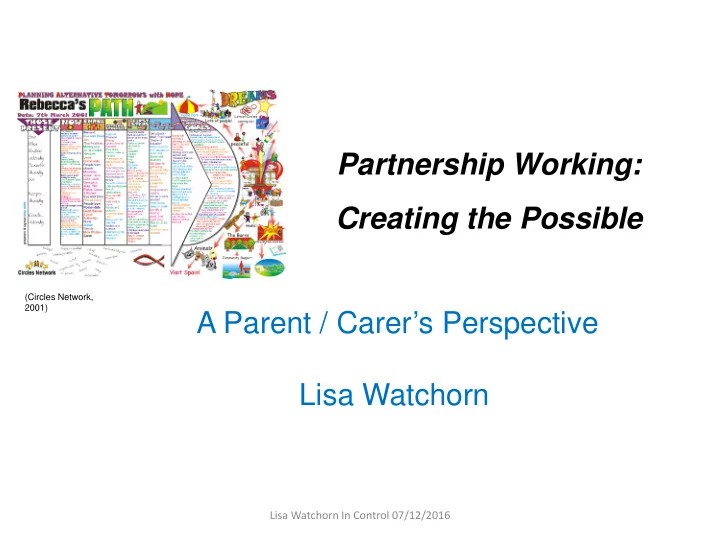
Partnership Working: Creating the Possible (Circles Network, 2001) - - PowerPoint PPT Presentation
Partnership Working: Creating the Possible (Circles Network, 2001) A Parent / Carers Perspective Lisa Watchorn Lisa Watchorn In Control 07/12/2016 Who am I? Why am I here today? Lisa Watchorn In Control 07/12/2016 How could we start to
(Circles Network, 2001)
Lisa Watchorn In Control 07/12/2016
Lisa Watchorn In Control 07/12/2016
Lisa Watchorn In Control 07/12/2016
The label: High functioning autism ADHD / Impulse Control Disorder Significant sensory impairment Severe challenging behaviour The person: Bright and funny Walked at 10 months, could read by age 3 Head Boy at Primary School and swam for the local swimming club Brilliant at technology and building / fixing just about anything!
Lisa Watchorn In Control 07/12/2016
J’s educational journey to age 17…….
in June of Year 7
complex and challenging behaviours at Easter of Year 9
J returned home in June 2014 with high ambitions but no support and no educational provision
Lisa Watchorn In Control 07/12/2016
The label: Tourette Syndrome ADHD Dyscalculia Mild Learning Difficulties Behavioural, Emotional and Social Difficulties The person: Bright and funny Great hand / eye coordination, good at sports Could ride a bike at 2 ½ Has corporate sponsorship as a skater Excellent drummer and guitarist Was a School Prefect Loves to be outside!
Lisa Watchorn In Control 07/12/2016
T’s educational journey to age 17…….
moved onto School Action Plus
and became suicidal
support of Local Authority, Forest School and CAMNET
dropped down a year to Year 9 and remained there very happily for rest of his education
T reached the end of Year 11 in 2015 with clear career ambitions but no
Lisa Watchorn In Control 07/12/2016
The boys were now young men, well into transition. Our focus was on how we could flex the education and social care system so they could explore what real inclusion could look like beyond school… “Young people in transition who become valued community members in pursuit of a dream, build more than a world for themselves, they also build a new world of possibilities for others.”
(Mount & O’Brien, 2002) How could we give their unique gifts a chance to grow, and help them create possibilities and learn through trial and error in order to move into an adult world where they could be genuinely included and valued?
Lisa Watchorn In Control 07/12/2016
Young people and parents of children who have EHC plans have the right to request a Personal Budget, which may contain elements of education, social care and health funding…..including:
manage services themselves
and commissions the support specified in the EHC plan (these are sometimes called notional budgets)
managed by an individual or organisation on behalf of the child’s parent or the young person
(SEND Code of Practice 2014: 48)
Lisa Watchorn In Control 07/12/2016
How we used the new legislation and Code of Practice for J:
community organisation which was willing to work with us as a partner
to agree a protocol and process in an area unfamiliar to us all, and J was moved onto an EHCP
work experience, independent learning and setting up and running his own micro- enterprise, and used short breaks money towards driving lessons
psychologist who shares our vales to work 1:1 with J for an hour a week
In the space of 18 months, J obtained Level 3 Diplomas in ICT and Business Entrepreneurship and Enterprise, and set up his own small gardening and IT micro business with TalentMatch Humber support and funding. He made new friends, went to a Fake Festival with them and began volunteering at the local autism youth club as a mentor.
Lisa Watchorn In Control 07/12/2016
How we used the new legislation and Code of Practice for T:
not feel ready to move on from his school and wanted to move into the 6th Form with his friends, but did not want to follow an exclusively academic programme
bespoke 6th Form programme that would help him to achieve his aspirations. This included AS Level Art, re-doing maths and English GCSEs but doing away with his learning support assistant and instead having 1:1 lessons with the subject teachers, building in additional pastoral support to work on emotional resilience and working with the local golf club to create a work experience placement for two days per week in green-keeping and estate management
T left school on the Friday at the end of the Summer term, and was successful in interview for his dream job as an apprentice in grounds maintenance, parks and open spaces the following Monday…
Lisa Watchorn In Control 07/12/2016
J now at 19:
Has an Advanced Level Apprenticeship in IT, working across two really inclusive primary schools. He loves his job and advises staff and mentors youngsters on the Spectrum Has a small group of good friends, and a good social life Has passed his driving test and has his
Receives no paid support at all except for his ongoing sessions with his psychologist
Lisa Watchorn In Control 07/12/2016
T now at 18….
Has been working for four months and loves his job He has recently finished with his girlfriend of two years, and is enjoying the single life! Is learning to drive Has become a keen off road biker and has saved up and bought his own motorbike Still skates and is now sponsored by two companies Has a great group of friends who share his love of the outdoors and high adrenaline sports
Lisa Watchorn In Control 07/12/2016
With thanks to James Carville & Bill Clinton 1982
High cost placement
Individualised programme
Ongoing psychology input
Mainstream / AP
Independent mainstream with support Nil Ongoing
Lisa Watchorn In Control 07/12/2016
Lisa Watchorn In Control 07/12/2016
J’s Strengths and Talents
Very determined and hardworking Honest Practically minded Creative Good sense of humour Polite and professional Kind & thoughtful Willing to push himself and give things a go Loyal W hat is I m portant to J
expected of me and what your rules and boundaries are – I won’t always ‘get’ this unless you tell me
honest with me. I don’t like people who play mind games or expect me to guess the subtext
confusion does not make me calm, even though I can be messy
instructions and direction – I learn best by ‘doing’
to have a laugh and joke
me as the adult I am
pretty much anything
my space personally and professionally
even if I don’t always succeed
fixing computers and building networks etc
even my hamster is called Chewbacca!
How Best to Support J
use of language. I won’t read your body language or facial expressions very well and can sometimes appear rude. Please just tell me directly if I have misjudged something
what you want me to do – I tend to work best if you show me rather than just tell me
verbally, so sometimes need to write things down
flexible and work hard but I can be easily distracted and start obsessing about
please tell me to stop – you need to be direct with me
need to be clear what your priority is and what order you want things doing in
clarification – some things are not always clear to me
and my sensory differences get worse. Please let me take a short break if I need it – I won’t take advantage!
the rest will then speak for itself
valued/ appreciated with regular feedback – you need to tell me, I won’t just know…
They are a sign I am a bit nervous / anxious
very ‘hyper’ and I lose focus. Nudge me to not eat that extra chocolate bar!
J’s s One P e Pag age P e Profile
(Sanderson, 2007) Lisa Watchorn In Control 07/12/2016
W hat w e like and adm ire about T
Strong-w illed Honest Tries hard Good sense of hum our Friendly/ easy going w ith people Approachable Good at sport Kind & caring Genuine concern about others Loyal
W hat is I m portant to T
me and what your rules and boundaries are
I love the countryside, fishing, shooting, golf, skateboarding, drumming, playing guitar and most sports
welcoming people, not unpleasant or negative people
confusion does not make me calm
instructions and direction – I learn best by ‘doing’
have a laugh and joke
everything and reminders / help to write this down
space personally and professionally
making a difference
if I don’t always succeed How Best to Support T
day and ensure I have understood any instructions
me as part of the team…
– don’t give me too much coffee or coca cola or I lose focus completely. Energy drinks are my deadly enemy!
flexible and work hard but I can be easily
please give me a gentle nudge
clarification – some things are not always clear
expect me to guess – this also helps me plan my work
grumpy – please help me to think through the things that are worrying me but don’t pander to my bad mood!
what you want me to do – I tend to work best if you show me rather than just tell me
things safely but do get worse if I am stressed or anxious
..the rest will then speak for itself
valued/ appreciated with regular feedback
T’ T’s O One e Pag age P Profile
(Sanderson, 2007) Lisa Watchorn In Control 07/12/2016
Lisa Watchorn In Control 07/12/2016
Assertiveness skills and empowerment – speaking up for ourselves effectively, presenting at meetings, communication and listening skills, learning to work in partnership Knowledge and awareness raising – exposure to what is possible and how it has been achieved elsewhere…..Partners in Policymaking and In Control! Issue-specific training – look at creating self-sustaining options. Pay carers to train
children Advice, advocacy and brokerage – someone independent to go to when things are tough Formal and informal support networks – families supporting families through friendship, mentoring, and a listening ear
Lisa Watchorn In Control 07/12/2016
Lisa Watchorn In Control 07/12/2016
Martin Luther King
Lisa Watchorn In Control 07/12/2016
With thanks to J and T for sharing their stories
Lisa Watchorn In Control 07/12/2016
Children and Families Act (2014). London: HMSO. Available online at: http://www.legislation.gov.uk/ukpga/2014/6/contents/enacted (Accessed 01/11/2016). Circles Network (2001) Planning Alterative Tomorrows with Hope [Online]. Available at: http://www.circlesnetwork.org.uk/index.asp?slevel=0z217&parent_id=217 (Accessed 01/11/2016). Department for Education (2014) Funding for children and young people with SEND Consultation Document. London: HMSO. Available online at: https://www.gov.uk/government/consultations/funding-for-children-and-young-people-with-send (Accessed 01/11/2016). Ea, P. (2016) The People Vs The School System [Online]. Available at: https://www.youtube.com/watch?v=dqTTojTija8 (Accessed 01/11/2016). Education Funding Agency (2015) Guidance Funding rates and formula. London: HMSO. Available online at: https://www.gov.uk/government/publications/funding-rates-and-formula (Accessed 01/11/2016). Mount, B. & O’Brien, C. (2002) Building New Worlds. New York: Capacity Works. Special Educational Needs and Disabilities Code of Practice: 0 to 25 Years (2014). London: HMSO. Available online at: https://www.gov.uk/government/publications/send-code-of-practice-0-to-25 (Accessed 01/11/2016). Sanderson, H. ( 2007) One Page Profiles [Online]. Available at: http://www.helensandersonassociates.co.uk/person- centred-practice/one-page-profiles/ (Accessed 01/11/2012)
Lisa Watchorn In Control 07/12/2016