SLIDE 1 Parsimony
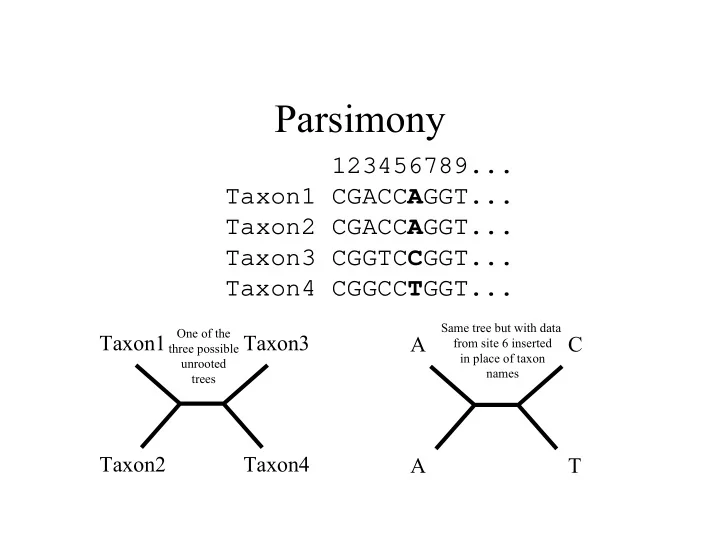
123456789... Taxon1 CGACCAGGT... Taxon2 CGACCAGGT... Taxon3 CGGTCCGGT... Taxon4 CGGCCTGGT...
Taxon1 Taxon3 Taxon2 Taxon4 A C A T
Same tree but with data from site 6 inserted in place of taxon names One of the three possible unrooted trees
SLIDE 2
"Standard" Parsimony
SLIDE 3 Important things to note about that last slide:
- Two (2) steps was the minimum
– no way to explain the observed data with just 1 evolutionary change
- More than one way to assign ancestral
character states to get 2 steps
–
- ne interior node must have A but the other interior
node can have anything except G
- Enumerating all possible combinations of
ancestral states is not the most efficient way to determine the number of steps
– more on this later
SLIDE 4
Parsimony Steps
123456789... Taxon1 CGACCAGGT... Taxon2 CGACCAGGT... Taxon3 CGGTCCGGT... Taxon4 CGGCCTGGT... Steps 001102000...
Taxon1 Taxon3 Taxon2 Taxon4 Tree 1's length for first 9 sites = 4 Let's call this tree 1: (1,2,(3,4))
SLIDE 5
Parsimony Steps
123456789... Taxon1 CGACCAGGT... Taxon2 CGACCAGGT... Taxon3 CGGTCCGGT... Taxon4 CGGCCTGGT... Steps 002102000...
Taxon1 Taxon2 Taxon3 Taxon4 Tree 2's length for first 9 sites = 5 Tree 2: (1,3,(2,4))
SLIDE 6
Parsimony Steps
123456789... Taxon1 CGACCAGGT... Taxon2 CGACCAGGT... Taxon3 CGGTCCGGT... Taxon4 CGGCCTGGT... Steps 002102000...
Taxon1 Taxon2 Taxon4 Taxon3 Tree 3's length for first 9 sites = 5 Tree 3: (1,4,(2,3))
SLIDE 7 Parsimony (using only 9 sites)
Taxon1 Taxon3 Taxon2 Taxon4 Taxon1 Taxon3 Taxon2 Taxon4 Taxon1 Taxon3 Taxon2 Taxon4
4 steps 5 steps 5 steps most parsimonious
This is the simplest explanation of the data for the first 9 sites according to the parsimony criterion. Choosing one of the other two trees requires additional (ad hoc) justification.
SLIDE 8 Wagner vs. Fitch Parsimony
Wagner
1 2 3
Fitch
2 1 3
Note: this is just one possible character state tree
(distinction exists only in case of multistate characters)
This "tree" says that all changes between 0 and 2, 0 and 3, or 2 and 3 must go through state 1 (and thus require 2 steps) In Fitch Parsimony, a change between any two states is possible, and all changes count just 1 step
(ordered characters) (unordered characters)
SLIDE 9 Transversion Parsimony
- Transitions (A↔G, C↔T) more common
than transversions (all other changes)
- Transitions saturate faster than
transversions, thus transversions are sometimes more reliable for reconstructing history
- Transversion parsimony is extreme,
ignoring all transitions, counts 1 step for each transversion
SLIDE 10 Saturation
C→A A→G A→G
C G A A A G
Transversions rarer, should trust them more Transitions common,
parallelism (shown here), convergence,
Saturation refers to the loss of historical information due to the effect of "multiple hits"
SLIDE 11 Implementing Transversion Parsimony
– R means purine (A or G) – Y means pyrimidine (C or T)
- Replace nucleotides with either R or Y
– only transversions will be detectable
- Note: Nexus data file format allows you to
do this substitution virtually
– no need to actually modify your data
SLIDE 12
Transversion Parsimony
SLIDE 13
Step Matrices
A C G T A 1 1 1 C 1 1 1 G 1 1 1 T 1 1 1
From To Step matrix for Fitch parsimony
SLIDE 14
A C G T A 5 1 5 C 5 5 1 G 1 5 5 T 5 1 5
Step Matrices
From To This step matrix implements something like transversion parsimony, but less severe It counts 5 for each transversion
SLIDE 15
A C G T A 5 1 5 C 5 5 1 G 1 5 5 T 5 1 5
Step Matrices
From To This step matrix implements something like transversion parsimony, but less severe And counts 1 step for each transition
SLIDE 16
Generalized Parsimony
SLIDE 17 Important points
- Do not compare scores across parsimony variants
– A tree with a transversion parsimony score of 25 is not necessarily better than a tree with a Fitch parsimony score of 31
- Parsimony does not provide any guidance for
selecting weights for step matrices
– parsimony cannot tell us that the transition:transversion weight ratio 1:5 is better than 1:1
SLIDE 18 Other variants
– characters are assumed irreversible – ancestral state assumed known – forces use of rooted trees
– derived state can arise only once, but as many reversals as needed are allowed – popular for modeling restriction sites (which are lost more easily than they are gained)
- Unweighted parsimony, equal-weighted parsimony
– usually means Fitch parsimony (what I call standard parsimony)
SLIDE 19 Counting steps with a minimum of effort
T C C A A G {A,G} {A,C} {A} {A,C} {A,C,T}
(+1 step) (+1 step) (+1 step) (+1 step)
4 steps total
SLIDE 20 What is "weighted" parsimony?
- Some changes weighted more than others
– i.e. generalized parsimony
- Some sites weighted more than other sites
– weighting may be determined a priori – weighting may be dynamic (i.e. a function of the number of changes reconstructed)
When someone says they are using weighted parsimony, this can mean more than one thing: