A quick review The parsimony principle: Find the tree that requires - - PowerPoint PPT Presentation

a quick review
SMART_READER_LITE
LIVE PREVIEW

A quick review The parsimony principle: Find the tree that requires - - PowerPoint PPT Presentation

A quick review The parsimony principle: Find the tree that requires the fewest evolutionary changes! A fundamentally different method: Search rather than reconstruct Parsimony algorithm 1. Construct all possible trees 2. For


slide-1
SLIDE 1
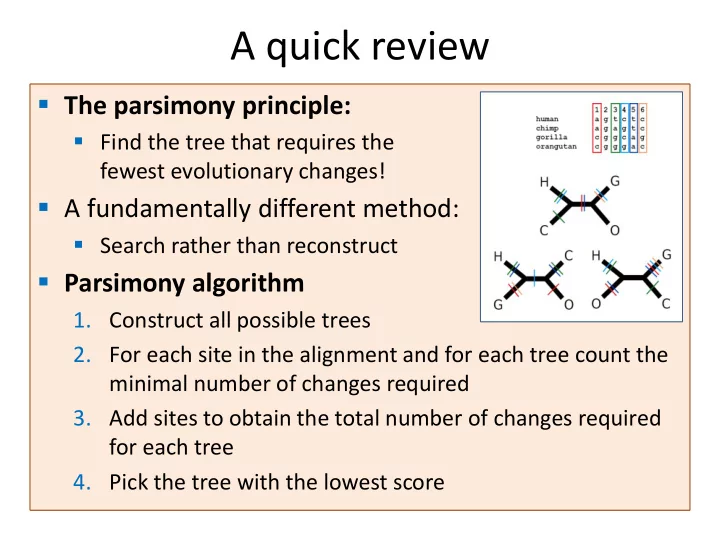
  • The parsimony principle:
  • Find the tree that requires the

fewest evolutionary changes!

  • A fundamentally different method:
  • Search rather than reconstruct
  • Parsimony algorithm
  • 1. Construct all possible trees
  • 2. For each site in the alignment and for each tree count the

minimal number of changes required

  • 3. Add sites to obtain the total number of changes required

for each tree

  • 4. Pick the tree with the lowest score

A quick review

slide-2
SLIDE 2
  • Small vs. large parsimony
  • Fitch’s algorithm:
  • 1. Bottom-up phase: Determine the set of possible states
  • 2. Top-down phase: Pick a state for each internal node
  • Searching the tree space:
  • Exhaustive search, branch and bound
  • Hill climbing with Nearest-Neighbor Interchange
  • Branch confidence and bootstrap support

A quick review – cont’

slide-3
SLIDE 3

Clustering

Some slides adapted from Jacques van Helden

Genome 373 Genomic Informatics Elhanan Borenstein

slide-4
SLIDE 4
  • The goal of gene clustering process is to partition the

genes into distinct sets such that genes that are assigned to the same cluster are “similar”, while genes assigned to different clusters are “non- similar”.

The clustering problem

gene y gene x

slide-5
SLIDE 5

Many different data types, same structure

slide-6
SLIDE 6

Why clustering

slide-7
SLIDE 7
  • Clustering genes or conditions is a basic tool for the

analysis of expression profiles, and can be useful for many purposes, including:

  • Inferring functions of unknown genes

(assuming a similar expression pattern implies a similar function).

  • Identifying disease profiles

(tissues with similar pathology should yield similar expression profiles).

  • Deciphering regulatory mechanisms: co-expression of genes

may imply co-regulation.

  • Reducing dimensionality.

Why clustering

slide-8
SLIDE 8

Different views of clustering …

slide-9
SLIDE 9

Different views of clustering …

slide-10
SLIDE 10

Different views of clustering …

slide-11
SLIDE 11

Different views of clustering …

slide-12
SLIDE 12

Different views of clustering …

slide-13
SLIDE 13

Different views of clustering …

slide-14
SLIDE 14
  • An important step in many clustering methods is the

selection of a distance measure (metric), defining the distance between 2 data points (e.g., 2 genes)

Measuring similarity/distance

“Point” 1 “Point” 2 : [0.1 0.0 0.6 1.0 2.1 0.4 0.2] : [0.2 1.0 0.8 0.4 1.4 0.5 0.3]

Genes are points in the multi-dimensional space Rn

(where n denotes the number of conditions)

slide-15
SLIDE 15
  • So … how do we measure the distance between two

point in a multi-dimensional space?

Measuring similarity/distance

B A

slide-16
SLIDE 16
  • So … how do we measure the distance between two

point in a multi-dimensional space?

  • Common distance functions:
  • The Euclidean distance

(a.k.a “distance as the crow flies” or distance).

  • The Manhattan distance

(a.k.a taxicab distance)

  • The maximum norm

(a.k.a infinity distance)

  • The Hamming distance

(number of substitutions required to change one point into another).

Measuring similarity/distance

p-norm 2-norm 1-norm infinity-norm

slide-17
SLIDE 17
  • Another approach is to use the correlation between

two data points as a distance metric.

  • Pearson Correlation
  • Spearman Correlation
  • Absolute Value of Correlation

Correlation as distance

slide-18
SLIDE 18
  • The metric of choice has a marked impact on the shape
  • f the resulting clusters:
  • Some elements may be close to one another in one metric

and far from one anther in a different metric.

  • Consider, for example, the point (x=1,y=1) and the
  • rigin.
  • What’s their distance using the 2-norm (Euclidean distance )?
  • What’s their distance using the 1-norm (a.k.a. taxicab/

Manhattan norm)?

  • What’s their distance using the infinity-norm?

Metric matters!

slide-19
SLIDE 19
  • A good clustering solution should have two features:

1. High homogeneity: homogeneity measures the similarity between genes assigned to the same cluster. 2. High separation: separation measures the distance/dis- similarity between clusters. (If two clusters have similar expression patterns, then they should probably be merged into one cluster).

The clustering problem

slide-20
SLIDE 20
  • “Unsupervised learning” problem
  • No single solution is necessarily the true/correct!
  • There is usually a tradeoff between homogeneity and

separation:

  • More clusters  increased homogeneity but decreased separation
  • Less clusters  Increased separation but reduced homogeneity
  • Method matters; metric matters; definitions matter;
  • There are many formulations of the clustering problem;

most of them are NP-hard (why?).

  • In most cases, heuristic methods or approximations are

used.

The “philosophy” of clustering

slide-21
SLIDE 21
  • Many algorithms:
  • Hierarchical clustering
  • k-means
  • self-organizing maps (SOM)
  • Knn
  • PCC
  • CAST
  • CLICK
  • The results (i.e., obtained clusters) can vary drastically

depending on:

  • Clustering method
  • Parameters specific to each clustering method (e.g. number
  • f centers for the k-mean method, agglomeration rule for

hierarchical clustering, etc.)

One problem, numerous solutions

slide-22
SLIDE 22

Hierarchical clustering

slide-23
SLIDE 23
  • An agglomerative clustering method
  • Takes as input a distance matrix
  • Progressively regroups the closest objects/groups
  • The result is a tree - intermediate nodes represent clusters
  • Branch lengths represent distances between clusters

Hierarchical clustering

  • bject 2
  • bject 4
  • bject 1
  • bject 3
  • bject 5

c1 c2 c3 c4

leaf nodes branch node root

Tree representation

  • bject 1
  • bject 2
  • bject 3
  • bject 4
  • bject 5
  • bject 1

0.00 4.00 6.00 3.50 1.00

  • bject 2

4.00 0.00 6.00 2.00 4.50

  • bject 3

6.00 6.00 0.00 5.50 6.50

  • bject 4

3.50 2.00 5.50 0.00 4.00

  • bject 5

1.00 4.50 6.50 4.00 0.00

Distance matrix

slide-24
SLIDE 24

mmm… Déjà vu anyone?

slide-25
SLIDE 25
  • 1. Assign each object to a separate cluster.
  • 2. Find the pair of clusters with the shortest distance,

and regroup them into a single cluster.

  • 3. Repeat 2 until there is a single cluster.

Hierarchical clustering algorithm

slide-26
SLIDE 26
  • 1. Assign each object to a separate cluster.
  • 2. Find the pair of clusters with the shortest distance,

and regroup them into a single cluster.

  • 3. Repeat 2 until there is a single cluster.

Hierarchical clustering algorithm

slide-27
SLIDE 27

Hierarchical clustering

  • One needs to define a (dis)similarity metric between

two groups. There are several possibilities

  • Average linkage: the average distance between objects from

groups A and B

  • Single linkage: the distance between the closest objects

from groups A and B

  • Complete linkage: the distance between the most distant
  • bjects from groups A and B
  • 1. Assign each object to a separate cluster.
  • 2. Find the pair of clusters with the shortest distance,

and regroup them into a single cluster.

  • 3. Repeat 2 until there is a single cluster.
slide-28
SLIDE 28

Impact of the agglomeration rule

 These four trees were built from the same distance matrix,

using 4 different agglomeration rules.

Note: these trees were computed from a matrix

  • f random numbers.

The impression of structure is thus a complete artifact.

Single-linkage typically creates nesting clusters Complete linkage create more balanced trees.

slide-29
SLIDE 29

Hierarchical clustering result

29

Five clusters

slide-30
SLIDE 30

Clustering in both dimensions

  • We can cluster genes, conditions (samples), or both.
slide-31
SLIDE 31