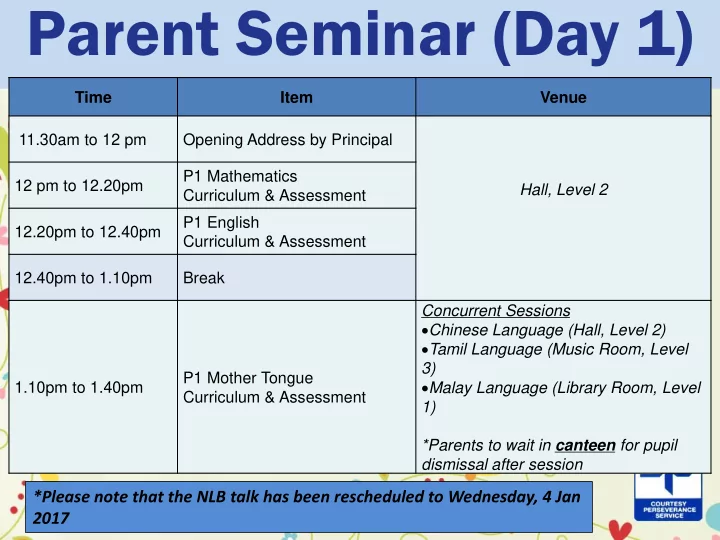
SLIDE 1 Parent Seminar (Day 1)
Time Item Venue 11.30am to 12 pm Opening Address by Principal Hall, Level 2 12 pm to 12.20pm P1 Mathematics Curriculum & Assessment 12.20pm to 12.40pm P1 English Curriculum & Assessment 12.40pm to 1.10pm Break 1.10pm to 1.40pm P1 Mother Tongue Curriculum & Assessment Concurrent Sessions Chinese Language (Hall, Level 2) Tamil Language (Music Room, Level 3) Malay Language (Library Room, Level 1) *Parents to wait in canteen for pupil dismissal after session
*Please note that the NLB talk has been rescheduled to Wednesday, 4 Jan 2017
SLIDE 2 Welcome to the Cedar Family!
P1 Parents’ Seminar 3 January 2017
SLIDE 3 Outline
- School Directions
- The 6-year Journey
- Tips for Parents
- Week 1 matters
SLIDE 4 School Directions
Vision Mission Values
SLIDE 5
Our Vision
Every Cedarian a lifelong learner, a person of character
SLIDE 6 Our Vision
The school aspires to groom every Cedarian into individuals with robust character, rooted in
- values. Every Cedarian also
understands that learning never
- stops. Each of them loves
learning and will pursue continuous learning throughout his/her life.
SLIDE 7
Our Mission
Nurturing Enthusiastic Learners and Responsible Citizens
SLIDE 8 Our Mission
Our school mission shows our commitment and focus to develop Cedarians into individuals who take
- wnership of their learning
and participate actively in lessons.
SLIDE 9
Our Values
Courtesy Care Enthusiasm Determination Adaptability Responsibility
SLIDE 10 Our Mission
They are also nurtured to become members of society who pay it forward by displaying care and respect for self, others and the environment and who make sound decisions, with others in mind.
SLIDE 11 School Directions
Our Strategic Foci Our Student Outcomes
SLIDE 12
- Striving for Academic Excellence for Lifelong
Learners
- Developing Cedarians of Character
- Pursuing Staff Excellence to build capacity and
competency in Teaching, Administrative Efficiency and Customer Service
Our Strategic Foci
SLIDE 13
- Effective Communicator
- Creative Thinker
- Active Contributor
- Upstanding Leader
With an additional focus on Talent Management
Our Student Outcomes
SLIDE 14 PSLE Matters Student Outcomes:
Effective Communicator Creative Thinker
Our Strategic Focus on Academic Matters
SLIDE 15 Academic Matters
- Focus on acquiring and mastering the
fundamentals in EL, Math, Science and Mother Tongue
up communication skills in speaking and presentation
- Developing the capacity to think creatively,
for the purposes of problem-solving
SLIDE 16 Changes to the PSLE in 2021
~ a Summary
Academic Matters
SLIDE 17 NEW SYSTEM
- There will be 8 Achievement Levels (ALs)
with AL1 being the best.
- A student’s AL for each subject will reflect
his level of achievement, rather than how he has performed relative to his peers.
STUDENTS WITH SIMILAR SCORES IN EACH SUBJECT WILL BE GROUPED INTO ACHIEVEMENT LEVELS
*PA *PASS SS GR GRADE E IS S AL7 OR OR BETTE ETTER
17
PE PER SU SUBJE JECT
AL 1 (BEST) AL 2 AL 3 AL 4 AL 5 AL 6 AL 7 AL 8
SLIDE 18 NEW SYSTEM
18
- This offers a good balance.
- It reduces fine differentiation between
students while still giving parents and educators a gauge of a student’s progress at the end of primary school.
- Students can then be matched to suitable
academic programmes in secondary schools.
WHY 8 ACHIEVEMENT LEVELS?
18
PE PER SU SUBJE JECT
AL 1 (BEST) AL 2 AL 3 AL 4 AL 5 AL 6 AL 7 AL 8
*PASS PASS GRADE IS E IS AL7 OR OR BETTE ETTER
SLIDE 19 NEW SYSTEM
assessments, we will provide reference raw mark ranges for each AL.
- These are based on learning
- bjectives of the curriculum.
CON ONSIDER SIDERATI TION ON
meaningful differentiation
REFERENCE RAW MARK RANGES
AL RAW MARK RANGE 1 ≥ 90 2 85 – 89 3 80 – 84 4 75 – 79 5 65 – 74 6 45 – 64 7 20 – 44 8 < 20
19
SLIDE 20 NEW SYSTEM
- The PSLE Score replaces the
T-score Aggregate.
- The PSLE Score ranges from
4 to 32, with 4 being the best.
Aggregate, students are less finely differentiated.
4 SUBJECT ALs WILL BE ADDED TO FORM THE PSLE SCORE
ENGLISH MOTHER TONGUE MATHEMATICS SCIENCE AL3 AL2 AL1 AL2
PSLE SCORE: : 8
20
SLIDE 21 NEW SYSTEM
- Students will continue to be
placed in the appropriate Secondary School courses – Express, Normal (Academic), Normal (Technical) or
STUDENTS WILL BE STREAMED BY THEIR PSLE SCORE
STREAMING CRITERIA COURSE NEW NEW (PSLE (PSLE SCORE) SCORE) EXPRESS
4 – 20
EXPRESS / N(A)
21 – 22
N(A)
23 – 24
N(A) / N(T)
25
N(T)
≥ 26
21
SLIDE 22 i
IN SUMMARY
WHAT REMAINS WHAT CHANGES
- The T-scores Aggregate will be replaced
by the PSLE Score, to reduce the fine differentiation of our students at a young age based on exam scores.
- Students will be assessed based on their own
achievement, instead of comparing them to their peers.
tested, and scores are awarded to guide students’ choices for the next stage of their education journey
continually updated. This is not related to the PSLE scoring and Sec 1 posting changes.
22
SLIDE 23 More Updates on the impact of PSLE results
& how the AL system will be implemented in later years
SLIDE 24 OUR HOPES FOR OUR CHILDREN
LOOKING BEYOND ACADEMIC RESULTS
SLIDE 25 25
- PSLE Scores replace T-score Aggregates,
reducing fine differentiation.
- Achievement Levels will reflect student’s
level of achievement, regardless of how his peers have done.
REDUCE OVER-EMPHASIS ON ACADEMIC RESULTS
IN SUMMARY
SLIDE 26
- Develop different aspects of
their character.
- Know that there are different
kinds of talents, academic and non-academic.
- Know that grades are just
a part of their story.
- Understand that there are
many paths to a fulfilling life.
WE WANT OUR CHILDREN TO:
26
SLIDE 27 Student Outcomes:
Effective Communicator Creative Thinker
Our Strategic Focus on Academic Matters
SLIDE 28 Effective Communicator
Oracy Competitions
Internal External
Primary 4 & 5
Debate
Primary 3 & 4
Speech & Drama Public Speaking
Primary 1
Show & Tell
SLIDE 29 Creative Thinker
Special Post-PSLE programme
P6 Pay It Forward Initiative
For the Talented – Competitions
Sony Creative Science Awards & Other Innovation Competitions
For the Selected
Future Innovators’ Programme
For the Masses
Our In-house Creative and Inventive Thinking Curriculum
SLIDE 30 Student Outcomes:
- Active Contributor
- Upstanding Leader
Our Strategic Focus on Character Formation
SLIDE 31 Character Formation
- Supporting the school’s Values In Action
(VIA) Programme :
- Based on our school values
- Includes
care
the environment through daily cleaning
SLIDE 32
Active Contributor
Values in Action Programme Student Suggestion Scheme Contributing to School Initiatives
SLIDE 33 Upstanding Leader
For the Talented
School Leadership
For the Selected
Team leadership
For the Masses
Class Leadership
SLIDE 34 Talent Management Our Special Focus
SLIDE 35
SLIDE 36
The 6-year Journey
SLIDE 37 6-year Journey
Beyond P1…
- HCL offered earlier to the children at P2
- Major re-arrangement of classes at the end of
P2: class size can grow to 40 per class at P3
- P3 Gifted Screening Test
- P5 and P6: offering of Foundation Subjects to
those who fare very badly in and offering of HMT to those who can cope
- Direct School Admission (DSA) opportunities: for
pupils with talents in CCA/Math/Sci
SLIDE 38
Tips for Parents
Student Well-being Academic Success
SLIDE 39 Student Well-Being
- Safety and Security
- Home-school Communication
- Personal Belongings
- Other Common Issues
SLIDE 40
Safety and Security
To build up your child’s independence and self confidence, parents are not allowed to come to school during curriculum time. We need your understanding and cooperation on this matter.
SLIDE 41 When Your Child Is Sick
- Please provide us with an MC promptly if
your child is away from school because of illness
- Do not send your child to school when he
/ she is ill e.g. common flu, fever, Hand Foot & Mouth Disease, Chicken Pox, contagious flu strains, etc. even if he / she is sitting for a formal assessment
Safety and Security
SLIDE 42 Safety and Security
- If your child is unwell in the middle of the
school day and you are not able to pick him/her up yourself, please ensure that:
- 1. You provide a letter identifying the
person who is picking him/her up and authorising him/her to do so
- 2. The person taking your child home is at
least 21 years of age, not e.g. an elder secondary school/Junior College sibling
- 3. The person picking him/her up is to
report to the Office first and sign an early departure form
SLIDE 43 Please provide us a copy of:
- Medical records if your child is suffering
from an ailment that we should take note Please take note that we are not allowed to administer medication to your child although we can supervise your child taking his/her medication
- Legal documents from Courts of Law
where relevant
Home-School Communication
SLIDE 44 Home-School Communication
Please check your child’s handbook daily for messages from your child’s teachers and acknowledge by signing in the handbook after you have read the message and followed up with the necessary action.
You will also be kept updated on upcoming events through quarterly newsletters and other
- notices. It’s a good practice to check your child’s
bag daily for such letters.
SLIDE 45
- Parent-Teacher Appointments
Please make appointments with the teacher you would like to meet up with to avoid being disappointed (appointments can only take place in the afternoon). Please leave your contact number with the Office and your child’s teacher will contact you as soon as
- possible. Please refrain from calling after 6pm and
- n weekends.
Email is preferred.
Home-School Communication
SLIDE 46 Personal Belongings
Provide him/her with story books: he/she should always have one in his/her bag good to buy both English and Mother Tongue story books to broaden his/her vocabulary Ensure that he/she has tissue paper, an extra pair of shorts in his/her bag but do check that he/she is not bringing unnecessary books, etc. to school: we would like the pupils to carry their bags themselves
SLIDE 47 If he/she is not used to handling money, please provide him/her snacks for recess time Please ensure that he/she is wearing his/her name tag given previously on Orientation Day for the first 2 weeks of school Trolley bags as school bags are neither ‘stair-friendly” nor healthy. If possible, purchase for him/her a haversack
Personal Belongings
SLIDE 48 Refrain from giving your child too much money for recess or allowing him/her to bring expensive items to school Pupils are not allowed to bring toys, trading cards, electronic games, etc Due to dietary differences, we do not encourage the celebration of birthdays in school Handphone can only be used after school and is their own responsibility
Personal Belongings
SLIDE 49
- Rough play
- Name-calling and teasing
- Queue-jumping
- Fascination with the bookshop
- Exchange of items in school
- Taking things without permission
- Disorderly behaviour in the school bus
Some Common Issues
SLIDE 50
- Allowing the school to look into
the matter rather than taking matters into your own hands
- Do not confront another child
should there be a disagreement between your child and his/her class/school mate.
and not reacting too quickly
Some Common Issues
SLIDE 51 Primary School
A Period of Great Discovery and Formation of Habits and Attitudes to:
- studies
- people
- school rules and
regulations & the school environment
SLIDE 52 Academic Success
- Attendance
- Homework and Assessments
- Support from Home
- Sending the right message
- Parent-child Bonding
SLIDE 53 Attendance
- Ensuring that your child attends school
every day to the best of his/her ability – long absences from school are not encouraged as they affect the learning process for the child
take your child’s absence from school very seriously
SLIDE 54 Homework & Assessments
when present, may be a continuation of work started in class
- Ensuring that the homework is done by
your child so that we can follow up
up with the teacher’s recommendations beyond signing your child’s worksheet or file
a balanced perspective to assessments
SLIDE 55 Support from Home
- Where possible, helping to coach your
child in practical skills e.g.:
- Addition, subtraction and
multiplication (when the time comes)
- Telling time
- Counting money
- Spelling
- Reading
SLIDE 56
- Role model habits like reading and good speech
patterns
- Teach him/her to be independent toilet-trained,
packing his / her bag, dressing himself / herself, showing you letters given to him / her by the school, etc.
- Please refer to the website @
https://www.schoolbag.sg
Support from Home
SLIDE 57
- Hence consistent parental attention is
important from P1 – P6
- Consistent attention does not mean
constant intervention as your child needs to learn from his/her mistakes and to be independent
Sending the right message
SLIDE 58
- Consistent attention means that you
have signalled your interest in his/her progress
- Have a good understanding of his/her
strengths and weaknesses and you are able to set him or her achievable stretch targets right through his educational journey
Sending the right message
SLIDE 59 Take an active interest in your child’s
- progress. He/she needs a proper time table at
home as he/she does in school to complete his/her work Take an active interest in him/her as a whole person: not only his/her studies but also what he/she enjoys, who his/her friends are, etc. Your child needs your attention right through his school life but the type of attention you give needs to change with his/her age
Parent-Child Bonding
SLIDE 60 MOE Website for Parents
https://www.schoolbag.sg/
SLIDE 61
Week 1 Matters
SLIDE 62 Week 1 Matters
- Please ensure that your child is also instructed on
your transport arrangements for him/her at dismissal time
– Allow your child to go through the processes before taking them back home.
- For transport issues, please raise them directly to
bus operator
- You will receive a letter from your child’s Form
Teacher informing you of some general school matters today. (e.g. Travel Declaration forms)
SLIDE 63
- Reporting time on Thursday, 5 Jan 2017 and Friday, 6
Jan 2017 is by 7.35am in the admin classroom.
– Should your child reach after that, please do inform him/her to go straight to the School Hall.
- Parents are not allowed to go into the school
compound.
- As there is a Temperature Taking exercise on 5
January, your child will be issued a thermometer (one-off provision) for him/her to take home on 5 January.
– Please take note that it is for his/her PERSONAL use and NOT to be shared.
Week 1 Matters
SLIDE 64
- Classroom and House allocation
– You will receive a letter from your child’s Form Teacher informing you of his/her allocated class and house. – Please note that should your child/ward has an elder sibling in the school, his/her house will be the same as his/her sibling. – You may now buy your child’s house t-shirts and shorts from:
- Venue: School Bookshop
- Day: Monday to Friday
- Time: 11am to 3pm
Week 1 Matters
SLIDE 65 P1 Parents’ Seminar on 3 and 4 Jan 2017
– EL Department – Math Department – MT Department
- Dismissal of P1 pupils from the School Hall.
(Parents are to wait in the canteen).
SLIDE 66 P1 Parents’ Seminar on 3 & 4 Jan 2017
– School Health Services – Health Promoting School Canteen – Programme for Active Learning (PAL) – Character and Citizenship Education – ICT matters
- Please take note that school proper
commences on 5 Jan for your child
SLIDE 67 The Way Forward
- We truly appreciate your making time to join us
these 2 days. It indicates your desire to invest in a fruitful relationship with the school to support your child’s growth and progress.
- We are open to feedback and want to work with
you to unlock the potential in your child.
SLIDE 68 The Way Forward
- Keep the communication channels open.
- Give feedback directly to teachers and the school.
- Be assured that we will not compromise learning.
- Give the school the authority to care and
discipline.
- Be patient with us too, because education is often
a slow and long process.
SLIDE 69
The Way Forward
WE ARE ON THE SAME TEAM!
SLIDE 70
Primary 1 Mathematics Curriculum and Assessment Briefing
Mdm Anita (Senior Teacher – Math)
SLIDE 71
Primary 1 Mathematics 2017
SLIDE 72 Cedar Primary School
Different types of learning in school
- Frontal teaching
- Use of mini whiteboard
- Use of learning aids
- Written work
- Performance task
SLIDE 73 Topics Covered in Primary One Term 1
- Numbers to 10
- Addition & Subtraction within 10
- Numbers showing position
Term 2
- Numbers to 20
- Addition & Subtraction within 20
- Length
- 2D shapes & patterns
SLIDE 74 Term 3
- Numbers to 40
- Addition & Subtraction up to
40
Term 4
SLIDE 75 Forms of Informal and Formal Assessment Worksheets / Workbook exercises Guided Journal writing Performance Tasks (non-weighted) Mini Tests (weighted)
More information will be given to parents later.
SLIDE 76 Cover Page for Workbook Chapter Exercises
SLIDE 77 Hands-on activities
SLIDE 78 Hands-on activities
SLIDE 79 Cedar Primary School
SLIDE 80 MOM, I HAVE A QUESTION ABOUT MY MATH HOMEWOR K
OKAY..WE HAVE SOME SHARP PENCILS, SCRATCH PAPER,GOOD LIGHT, SUPPORTIVE CHAIRS.
SO WHAT’S YOUR QUESTION? WHY DO I HAVE TO DO MY HOMEWORK ?
SLIDE 81
SLIDE 82 Mathematics learning can take place anywhere. Family members can help make learning fun and meaningful for the child.
SLIDE 83 Shapes and Patterns
SLIDE 84 Blocks
Reading Numbers
SLIDE 85 Skip Counting (Count in twos)
SLIDE 86 In the car park Identify the digits on the vehicle plates Counting Addition
SLIDE 87
Time shown in different ways
SLIDE 88 Prices of items in shops - Money
SLIDE 89
Coins and Notes used in Singapore
SLIDE 90
SLIDE 91
SLIDE 92
Primary 1 English Curriculum and Assessment Briefing
Ms Marianne Ha (Head of Department – English)
SLIDE 93 P1 English Language (EL) Curriculum & Assessment Briefing 3 January 2017
SLIDE 94 Presentation Outline
P1 English Curriculum Holistic Assessment for English
SLIDE 95 P1 ENGLISH CURRICULUM
STELLAR
Reading & Writing Speaking & Listening
Explicit Language Teaching
Grammar Reading Comprehension Composition writing
SLIDE 96 Strategies for English Language Learning and Reading (STELLAR)
STELLAR Vision Children who love reading and have a strong foundation in the English Language STELLAR Learning
- Teaching and learning of English using
more speaking and listening activities
- Children learn reading and writing using
rich and interesting books, with discussions led by the teacher
SLIDE 97
SLIDE 98
STELLAR Lessons
SLIDE 99 Why the use of books in STELLAR?
- pen up the world for children
- help children think and wonder
- increase children’s vocabulary and
knowledge about the world around them
- provide good examples for reading and
writing
SLIDE 100 Other Highlights for P1 English
Show & Tell Learning Journeys, i.e. Singapore Zoo Engaging pupils using ICT, i.e. Moo-O School-wide Reading Programme
- IREAD, NLB mass borrowing sessions
Learning Fest Learning Carnival
SLIDE 101 2017 P1 English Assessment Weighting
Term 1 (0%) Term 2 (20%) Term 3 (30%) Term 4 (50%)
____________________ Total for the year: 100%
* No Semestral Assessments at P1
SLIDE 102 2017 P1 Holistic Assessment
Term 1 Term 2 Term 3 Term 4
(Words 1-50)
(sentence construction)
(short passage)
- Comprehension
- Sight Words
(Word 51-100)
- Show & Tell
- Reading Aloud
(longer passage)
Paper Booklet A
Composition
(with helping words)
Composition
Paper Booklet B
Irregular Verbs
Conversation
0% 20% 30% 50%
SLIDE 103 Focus in Term 1:
- Setting of Routines & Procedures
- Getting to know your child
e.g. Diagnostic assessments
Building a Good Foundation
SLIDE 104 Baseline Standards at P1
What your child should master by the end of P1:
Reading
Words
passage fluently
SLIDE 105 Baseline Standards at P1
What your child should master by the end of P1:
Writing
- Write a short composition based on
given pictures
Good penmanship
SLIDE 106 What you and your child can do
Go through and test your child the Sight
Words
Encourage your child to read
- e.g. read to and with your child
- e.g. bring your child to the library
- e.g. have lots of reading material at home
- e.g. let your child read books on their special interests
- e.g. talk about the book (characters, favourite parts, etc)
SLIDE 107 What you and your child can do
Learn the Spelling words for each test;
remediate the words that your child is unable to spell
Correct your child’s penmanship Check that your child completes his/her
given assignments on time; stress independence
Monitor your child’s HA progress
SLIDE 108 School Support for P1 English
Learning Support
Programme (EL)
Reading Support
Programme
kidsRead (partnership
with NLB)
Remedials (starting in
Term 2)
SLIDE 109 Additional Online EL Resources
STrategies for English Language Learning
And Reading (STELLAR) website http://www.stellarliteracy.sg/
Starfall
http://www.starfall.com/
National Library Board
http://eresources.nlb.gov.sg/index.aspx
SLIDE 110
STELLAR Website
SLIDE 111
STELLAR Website
SLIDE 112
STELLAR Website
SLIDE 113
Starfall (Early reading) Website
SLIDE 114 Additional Online EL Resources
National Library Board http://eresources.nlb.gov.sg/index.aspx
SLIDE 115 Let’s start off right in developing
competent and confident English language users!
SLIDE 116 Primary 1 Mother Tongue Curriculum and Assessment Briefing
Concurrent Sessions Chinese Language (Hall, Level 2) Tamil Language (Music Room, Level 3) Malay Language (Library Room, Level 1) *Parents to wait in canteen for pupil dismissal after session