Paragraph 6 System and Compulsory License for Access to Medicines - - PowerPoint PPT Presentation

paragraph 6 system and compulsory license for access to
SMART_READER_LITE
LIVE PREVIEW

Paragraph 6 System and Compulsory License for Access to Medicines - - PowerPoint PPT Presentation

Paragraph 6 System and Compulsory License for Access to Medicines HU Yuanqiong Senior Legal and Policy Advisor Access Campaign, Mdecins Sans Frontires yuanqiong.hu@geneva.msf.org South Centre, TRIPS Council side event, Geneva,


slide-1
SLIDE 1

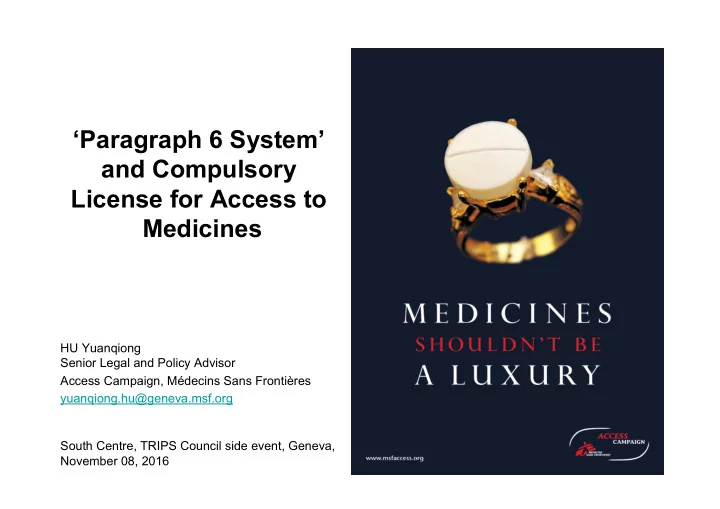
‘Paragraph 6 System’ and Compulsory License for Access to Medicines

HU Yuanqiong Senior Legal and Policy Advisor Access Campaign, Médecins Sans Frontières yuanqiong.hu@geneva.msf.org South Centre, TRIPS Council side event, Geneva, November 08, 2016

slide-2
SLIDE 2

Médecins Sans Frontières (MSF), founded in 1971

  • international, independent, medical humanitarian organization
  • delivers emergency aid to people affected by armed conflict, epidemics, natural

disasters and exclusion from healthcare in nearly 70 countries.

MSF and Access to Medicines

Nobel Peace Prize Lecture 1999

  • Dr. James Orbinski

Médecins Sans Frontières International President

“Today, a growing injustice confronts us. …… Life saving essential medicines are either

  • too expensive,
  • are not available because they are not seen

as financially viable,

  • r because there is virtually no new

research and development for priority tropical diseases. This market failure is our next challenge. The challenge however, is not ours alone. It is also for governments, international government institutions, the pharmaceutical industry and other NGOs to confront this injustice. What we as a civil society movement demand is change, not charity. ”
slide-3
SLIDE 3

Challenges to Access to Medicines

Availability Suitability Affordability

Affordability as a continued battle -- https://www.youtube.com/watch?v=3Ug3LbVRuhw

Strict patentability criteria Compulsory license Parallel import Anti-competition

Main TRIPS flexibilities

slide-4
SLIDE 4

Generic Compe,,on as a Catalyst for Price Reduc,on

Source: MSF Untangling the Web of An7retroviral Price Reduc7ons, 15th Edi7on, July 2012

slide-5
SLIDE 5

Today: Still Unaffordable

Source: MSF Untangling the Web

  • f an7retroviral Price Reduc7ons,

18th Edi7on, July 2016

  • HIV: the price of a third-

line regimen is more than 17 times higher than the recommended first-line

  • post-TRIPS + FTA era

sees slower pace of forming generic competition at global level

slide-6
SLIDE 6

Dilemmas with Subsidies, Procurement and Price Discrepancies

  • Manufacture cost of HPV is only

$0.45-0.59 per dose (Chaevia Clendinen et. al.,

Manufacture Cost of HPV Vaccines for Developing Countries, Vaccine, October 2016 )

  • Duopoly continues as lacking of

competition

  • Subsidized price benefit will be lost

when country gets categorised

  • therwise
  • Role of patents in retain monopoly?

– e.g. GSK patents on 2-dose regimen, age groups application, compositing new serotypes with existing technologies…

Source: The Right Shot – Bringing Down Barriers to Affordable and Adaptive Vaccines, MSF, January 2015, http://www.msfaccess.org/sites/default/files/MSF_assets/Vaccines/Docs/ VAC_report_ProductCardHPV_ENG_2014.pdf

slide-7
SLIDE 7

Use of August 30 Decision System: MSF’s Experience

  • Paragraph 6 of the Doha

declaration, November 14, 2001

“We recognize that WTO Members with insufficient or no manufacturing capacities in the pharmaceutical sector could face difficulties in making effective use of compulsory licensing under the TRIPS

  • Agreement. We instruct the

Council for TRIPS to find an expeditious solution to this problem……”

  • WTO General Council

Decision, August 30, 2003

– Notification based mechanism to implement Para 6 – Both countries issue compulsory license (if patented in both) – Anti-diversion requirement – So far only one test case between Canada and Rwanda in 13 years

slide-8
SLIDE 8

Testing Canada’s Bill C9 - The Jean Chrétien pledge to Africa

  • Canada being the first country enacted national

law to implement August 30 decision (2004

  • MSF in need of Fix-dose-combination of ARV for

HIV/AIDS treatment --- AZT/3TC/NVP

  • MSF joined legislative consultation and

approached generic producers in Canada to use the new law for exportation

slide-9
SLIDE 9

Timeline of the story

  • Oct 2003 –Jan 2004, legislative consultations on Bill C9

– Issues of right of first refusal by patent holders, list of eligible countries removed; open for non-government procurement – List of eligible medicines remained

  • May 2004, Bill C9 passed
  • August 2004, MSF proposed 5 ARVs to be considered in using the law
  • February 2005, Apotex agreed to produce AZT/3TC/NVP
  • April 2005, Apotext trial batch out for testing
  • May 2005, Bill C9 entered into force
  • June 2005, MSF proposed to amend the Bill and eligible medicines list
  • September 2005, AZT/3TC/NVP added to the list and Apotext applied for

regulatory approval in Canada

slide-10
SLIDE 10

Cont.

  • November 2005, Apotex started negotiation with respective patent holders of

AZT/3TC/NVP (GSK, BI); MSF started convincing potential importing countries

  • Same period, India produced generic AZT/3TC/NVP applied for WHO Pre-

qualification

  • June 2006, Hetero got WHO PQ approval; MSF started procurement for its

projects; shortly, Aurobindo got WHO PQ on the same product

  • July-October 2007, Canada and Rwanda notified WTO using August 30

decision

  • Canada/Rwanda remains the only case when August 30 decision is used
  • Has August 30 decision fulfilled the mandates set forth by Doha declaration?
  • Is this an effective and expeditious mechanism?
slide-11
SLIDE 11

Intersection with Trade Agreements and IP Rules

Pre- TRIPS Post- TRIPS

1995 Agreement on Trade Related Intellectual Property Rights (TRIPS), WTO Patent on pharmaceutical products Minimum 20 years protection General criteria for patenting Compulsory license incl. gov. use Exceptions and limitations Data protection Parallel Import/ Voluntary License

  • Non binding
  • Diversified
  • Binding
  • Unified/flexible

TRIPS-plus provisions in free trade agreements (FTA)

Patent term extension Broad patentability Narrow exceptions and limitations Limits compulsory license Data exclusivity Investor protection/ ISDS Patent linkage

Border enforcement- goods in transit Judicial enforcement- expanding scope

  • f liabilities
slide-12
SLIDE 12

What has changed in the past decade?

  • Use of compulsory license for importation and production remains
  • n medicines
  • Excessive political pressures remain by industrial and governments,

for instance:

  • Abbott announced withdrew of new drug registration in

Thailand after a CL issued, 2007

  • Pharma association campaign in weakening patent law

reform in South Africa which is intending to strengthen the CL mechanism, 2014

  • Use of CL conceived as ‘bad’ for trade, in lieu India on US

Special 301 priority watch list after CL issued on medicines

slide-13
SLIDE 13

Cont.

  • Practices of countries continue in

light of Doha declaration since 2001 34 instances of compulsory licence 51 instances of government use 32 instances of LDC exception use

Source: Ellen t’Horn, Private Patents and Public Health: Changing Intellectual Property Rules for Access to Medicines, 2016, available at: http://accesstomedicines.org/wp-content/uploads/private-patents-and-public-health.pdf

slide-14
SLIDE 14

United Nations’ Secretary General High Level Panel Report

  • n Access to Medicines
  • Commitment and respect Doha declaration
  • Curtail evergreening by adapting and applying rigorous

definitions of invention and patentability

  • Effectuate quick, fair, predictable and implementable

compulsory licenses on medicines

  • Revise Para 6 decision to enable swift and expedient

export of medicines under compulsory license and consider a waiver and permanent revision of TRIPS to enable above

  • Report pressures undermine the use of TRIPS flexibilities

during Trade Policy Review

  • Exclude public health harmful provisions in bilateral and

regional trade and investment treaties with a public health impact assessment Recommendations [2.6.1 (a)-(e)] on TRIPS flexibilities and TRIPS-plus provisions

UN HLP on access to medicines report: http://www.unsgaccessmeds.org/final-report/ (September 2016)

slide-15
SLIDE 15
  • Thank you!

http://www.msfaccess.org