Paper Contribution Best-First Belief State Enumeration Increased - - PDF document

paper contribution
SMART_READER_LITE
LIVE PREVIEW

Paper Contribution Best-First Belief State Enumeration Increased - - PDF document

DX-05 MSL Entry Decent & Landing Sequence Diagnosis as Approximate Belief State Enumeration for Probabilistic Concurrent Constraint Automata DX-05 Oliver B. Martin Michel D. Ingham Brian C. Williams michel.ingham@jpl.nasa.gov Jet


slide-1
SLIDE 1

1

June 2, 2005

DX-05

Diagnosis as Approximate Belief State Enumeration for Probabilistic Concurrent Constraint Automata

Oliver B. Martin Brian C. Williams

{omartin, williams}@mit.edu Massachusetts Institute of Technology

Michel D. Ingham

michel.ingham@jpl.nasa.gov Jet Propulsion Laboratory

June 2, 2005

DX-05

MSL Entry Decent & Landing Sequence

June 2, 2005

DX-05

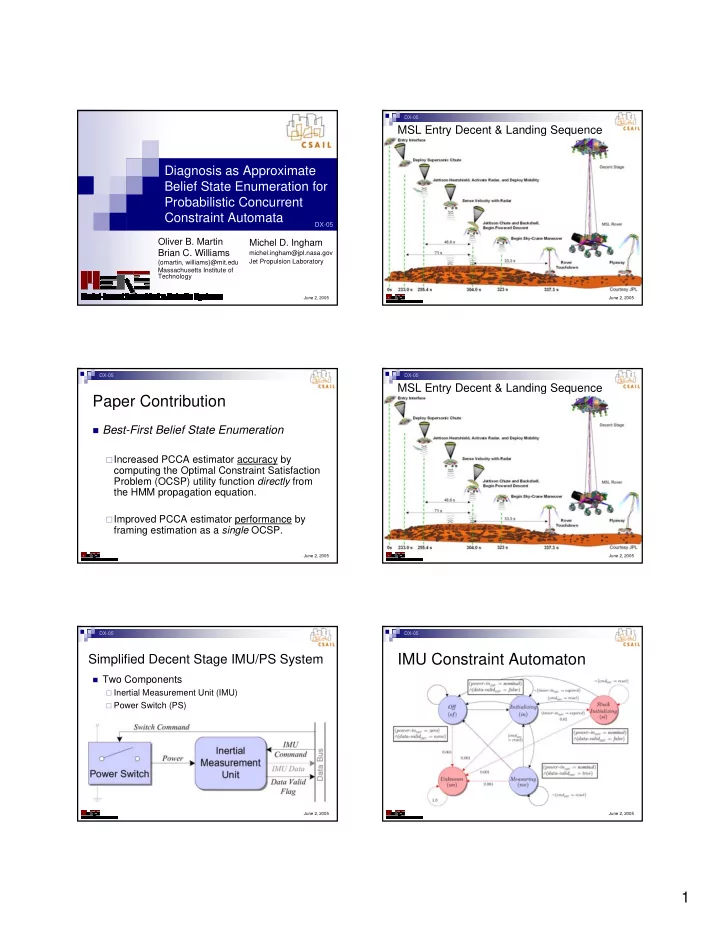
Paper Contribution

Best-First Belief State Enumeration

Increased PCCA estimator accuracy by

computing the Optimal Constraint Satisfaction Problem (OCSP) utility function directly from the HMM propagation equation.

Improved PCCA estimator performance by

framing estimation as a single OCSP.

June 2, 2005

DX-05

MSL Entry Decent & Landing Sequence

June 2, 2005

DX-05

Simplified Decent Stage IMU/PS System

Two Components

Inertial Measurement Unit (IMU) Power Switch (PS)

June 2, 2005

DX-05

IMU Constraint Automaton

slide-2
SLIDE 2

2

June 2, 2005

DX-05

PS Constraint Automaton

June 2, 2005

DX-05

Estimation of PCCA

Belief State Evolution visualized with a Trellis Diagram Compute the belief state for each estimation cycle

0.7 0.2 0.1

Complete history knowledge is

captured in a single belief state by exploiting the Markov property

Belief states are computed using

the HMM belief state update equations

June 2, 2005

DX-05

HMM Belief State Update Equations

Propagation Equation Update Equation

t t+1 June 2, 2005

DX-05

June 2, 2005

DX-05

Approximations to PCCA Estimation

1.

The belief state can be accurately approximated by maintain the k most likely estimates

2.

The probability of each state can be accurately approximated by the most likely trajectory to that state

3.

The observation probability can be reduced to 1.0 for observations consistent with the state, and 0.0 for

  • bservations inconsistent with the state

t+1 1.0 or 0.0 June 2, 2005

DX-05

Belief State Representation

Best-First Belief State

Enumeration (BFBSE)

Best-First Trajectory

Enumeration (BFTE)

slide-3
SLIDE 3

3

June 2, 2005

DX-05

Simple IMU/PS Scenario

Best-First Belief State

Enumeration (BFBSE)

Best-First Trajectory

Enumeration (BFTE)

June 2, 2005

DX-05

PCCA Estimation as an OCSP

For PCCA Estimation:

x is the set of reachable target modes C(y) requires that the observations, modal

constraints, and interconnections must be consistent

f(x) is the estimate probability for state x

June 2, 2005

DX-05

PS Automaton

June 2, 2005

DX-05

Conflict-directed A* heuristic

HMM propagation equation: Split into admissible heuristic for partial assignments:

June 2, 2005

DX-05

Accuracy Results

EO-1 Model (12 components) 30 estimation cycles (nominal operations)

June 2, 2005

DX-05

Complexity Analysis

Best-First Belief State

Enumeration (BFBSE)

n·k arithmetic computations 1 OCSP

Best-First Trajectory

Enumeration (BFTE)

n arithmetic computation k OCSPs

Recall A* best case: n·b, worst case: bn

slide-4
SLIDE 4

4

June 2, 2005

DX-05

Performance Results

Heap Memory Usage

June 2, 2005

DX-05

Performance Results

Run-time (1.7 GHz Pentium M, 512MB RAM)

June 2, 2005

DX-05

Current Work

Extend BFBSE to use both HMM belief

state update equations

Use observation probabilities within the conflict-

directed search to avoid unlikely candidates

Done efficiently using a conditional probability table (Published in S.M. Thesis and i-SAIRAS ’05)

June 2, 2005

DX-05

Backup Slides

June 2, 2005

DX-05

Simple Two Switch Scenario

Sw1=on Sw2=on Sw1=bkn Sw2=bkn Sw1=on Sw2=on Sw1=on Sw2=bkn 0.7 0.3 0.343 0.063 0.147 0.147 (0.7)(0.7) (0.7)(0.3) (1)(1)

Most likely trajectories (k=2)

Very reactive Gross lower-bound Extraneous computation

Multiple OCSP instances Estimates generated and thrown away

Sw1=bkn Sw2=bkn 0.3 Sw1=bkn Sw2=on Sw1=bkn Sw2=bkn (0.3)(0.7) (0.3)(0.3)

1 bknt 0.3 0.7

  • nt

bknt+1

  • nt+1

Switch

June 2, 2005

DX-05

Approximate Belief State Enumeration (k=2)

Sw1=on Sw2=on Sw1=bkn Sw2=bkn Sw1=on Sw2=on Sw1=on Sw2=bkn Sw1=bkn Sw2=on Sw1=bkn Sw2=bkn 0.7 0.3 0.343 0.363 0.147 0.147 (0.7)(0.7) (0.7)(0.3) (0.3)(0.3) (0.3)(0.7) (1)(1)

Complete probability

Assuming approximate belief

state is the true belief state

Tighter lower bound

Single OCSP

Best-first order using A* Unfortunately, Not MPI

1 bknt 0.3 0.7

  • nt

bknt+1

  • nt+1

Switch

slide-5
SLIDE 5

5

June 2, 2005

DX-05

Belief State Update

Complete probability distribution is calculated using the

Hidden Markov Model Belief State Update equations

A Priori Probability:

Solved as single OCSP

A* Cost Function:

( )

1 0, 0, 1 0, 0, 1

P( | , ) P( | , ) P( | , )

t t t t k i i

t t t t t t t t t j k k k k i x s s

s

  • x

v x v s

  • b

m m m

+ < > < > + < > <

  • >

Î Î

æ ö ÷ ç ÷ ¢ = = = ç ÷ ç ÷ ÷ ç è ø

å Õ

Sw1=on Sw2=on Sw1=bkn Sw2=bkn Sw1=bkn Sw2=bkn 0.7 0.3 0.363 (0.3)(0.3) (1)(1)

( ) ( )

1 1 0, 0, 1 ( )

( ) P( | , ) max P( | , ) P( | , )

t t t t h h g h i

t t t t t t t t t g g g g h h h h i v x x n x n s

f n x v x v x v x v s

  • b

m m m

+ + < > <

  • >

¢Î Î Ï Î

æ ö ÷ ç ÷ ¢ ¢ ç = = = × = = × ÷ ç ÷ ç ÷ è ø

å Õ Õ

D
g(n) h(n)

June 2, 2005

DX-05

Three Switch Enumeration Example

1 bknt 0.3 0.7

  • nt

bknt+1

  • nt+1

Switch

Sw1=on Sw2=bkn Sw3=on 0.7 0.3 0.343 0.147 0.21 0.153 (0.7) (0.7)(1)(0.7)

Assume

No commands No observations

Enumeration scheme same as most

likely trajectories

Expand tree by adding mode assignments Only difference is the cost function

0.147 Sw1=bkn Sw2=on Sw3=bkn Sw1=on Sw2=bkn Sw3=on Sw1=bkn Sw2=on Sw3=bkn Sw1=bkn Sw2=bkn Sw3=bkn Sw1=bkn Sw2=bkn Sw3=on Sw1=on Sw2=bkn Sw3=bkn (0.3) (0.3)(1)(0.3) (1) (1)(0.7)(1) (0.3) (0.3)(1)(0.7) (0.7) (0.7)(1)(0.3) (1) (1)(0.3)(1)

June 2, 2005

DX-05

Why max in f(n)?

1 bknt 0.3 0.7

  • nt

bknt+1

  • nt+1

Switch

Sw1=on Sw2=bkn Sw3=on 0.7 0.3 Sw1=bkn Sw2=on Sw3=bkn Initial Approximate Belief State and Transition Probabilities A* Cost Function

{ }

0.357 {Sw1 = bkn} ? {Sw1 = on}

f(Sw1= f(Sw1=bkn bkn) = ) = (0.3) (0.3)( ? )( ? )·0.7 + (1.0) (1.0)( ? )( ? )·0.3 = 0.51

  • Which mode assignment next?
  • Sw2=bkn?

f(Sw1= f(Sw1=bkn bkn) = ) = (0.3) (0.3)(1.0)( ? )·0.7 + (1.0) (1.0)(0.3)( ? )·0.3 = 0.3

  • Or Sw2=on?

f(Sw1= f(Sw1=bkn bkn) = ) = (0.3) (0.3)(0.0)( ? )·0.7 + (1.0) (1.0)(0.7)( ? )·0.3 = 0.21 f(Sw1= f(Sw1=bkn bkn) = ) = (0.3) (0.3)(1.0)(0.3)·0.7 + (1.0) (1.0)(0.3)(1.0)·0.3 = 0.153 Best Best f(n f(n) )? ? Combinatorial Problem

{Sw1 = bkn}: 0.51 {Sw2 = bkn}: 0.3 {Sw2 = on}: 0.21 {Sw3 = bkn} 0.153 {Sw3 = on} 0.147 {Sw3 = bkn} 0.21 {Sw3 = on} 0.0

( ) ( )

1 1 0, 0, 1 ( )

( ) P( | , ) max P( | , ) P( | , )

t t t t h h g h i

t t t t t t t t t g g g g h h h h i v x x n x n s

f n x v x v x v x v s

  • b

m m m

+ + < > <

  • >

¢Î Î Ï Î

æ ö ÷ ç ÷ ¢ ¢ ç = = = × = = × ÷ ç ÷ ç ÷ è ø

å Õ Õ

D

June 2, 2005

DX-05

Guaranteed Admissible

1 bknt 0.3 0.7

  • nt

bknt+1

  • nt+1

Switch

Sw1=on Sw2=bkn Sw3=on 0.7 0.3 Sw1=bkn Sw2=on Sw3=bkn Initial Approximate Belief State and Transition Probabilities A* Cost Function

{ }

0.357 {Sw1 = bkn} ? {Sw1 = on}

f(Sw1= f(Sw1=bkn bkn) = ) = (0.3) (0.3)( ? )( ? )·0.7 + (1.0) (1.0)( ? )( ? )·0.3 = 0.51

  • Maximize each term regardless of

mode assignment to sw2

f(Sw1= f(Sw1=bkn bkn) = ) = (0.3) (0.3)(1.0)( ? )·0.7 + (1.0) (1.0)(0.7)( ? )·0.3 = 0.42 f(Sw1= f(Sw1=bkn bkn) = ) = (0.3) (0.3)(1.0)(0.7)·0.7 + (1.0) (1.0)(0.7)(1.0)·0.3 = 0.357 Best Best f(n f(n) )? ? Combinatorial Problem

{Sw1 = bkn}: 0.51 {Sw2 = bkn}: 0.3 {Sw2 = on}: 0.21 {Sw3 = bkn} 0.153 {Sw3 = on} 0.147 {Sw3 = bkn} 0.21 {Sw3 = on} 0.0

( ) ( )

1 1 0, 0, 1 ( )

( ) P( | , ) max P( | , ) P( | , )

t t t t h h g h i

t t t t t t t t t g g g g h h h h i v x x n x n s

f n x v x v x v x v s

  • b

m m m

+ + < > <

  • >

¢Î Î Ï Î

æ ö ÷ ç ÷ ¢ ¢ ç = = = × = = × ÷ ç ÷ ç ÷ è ø

å Õ Õ

D

June 2, 2005

DX-05

Tree Expansion

1 bknt 0.3 0.7

  • nt

bknt+1

  • nt+1

Switch

Sw1=on Sw2=bkn Sw3=on 0.7 0.3 Sw1=bkn Sw2=on Sw3=bkn Initial Approximate Belief State and Transition Probabilities A* Cost Function

{ }

0.357 {Sw1 = bkn} 0.343 {Sw1 = on}

f(Sw1=on) = f(Sw1=on) = (0.7) (0.7)(1.0)(0.7)·0.7 + (0.0) (0.0)(0.7)(1.0)·0.3 = 0.343

  • Due to no MPI, all children of each node must be placed
  • n the queue before deciding which node to expand next
  • Node is in the queue

Node is in the queue

  • Node was

Node was dequeued dequeued and expanded and expanded

( ) ( )

1 1 0, 0, 1 ( )

( ) P( | , ) max P( | , ) P( | , )

t t t t h h g h i

t t t t t t t t t g g g g h h h h i v x x n x n s

f n x v x v x v x v s

  • b

m m m

+ + < > <

  • >

¢Î Î Ï Î

æ ö ÷ ç ÷ ¢ ¢ ç = = = × = = × ÷ ç ÷ ç ÷ è ø

å Õ Õ

D

June 2, 2005

DX-05

Tree Expansion

1 bknt 0.3 0.7

  • nt

bknt+1

  • nt+1

Switch

Sw1=on Sw2=bkn Sw3=on 0.7 0.3 Sw1=bkn Sw2=on Sw3=bkn Initial Approximate Belief State and Transition Probabilities A* Cost Function

{ }

0.357 {Sw1 = bkn} 0.343 {Sw1 = on}

f(Sw1= f(Sw1=bkn bkn, Sw2= , Sw2=bkn bkn) = ) = (0.3) (0.3)(1.0)(0.7)·0.7 + (1.0) (1.0)(0.3)(1.0)·0.3 = 0.237

  • Sw1=bkn has the best cost

so it is dequeued and its children are expanded

0.237 {Sw1 = bkn, Sw2=bkn} 0.21 {Sw1 = bkn, Sw2=on}

f(Sw1= f(Sw1=bkn bkn, Sw2=on) = , Sw2=on) = (0.3) (0.3)(0.0)(0.7)·0.7 + (1.0) (1.0)(0.7)(1.0)·0.3 = 0.21

( ) ( )

1 1 0, 0, 1 ( )

( ) P( | , ) max P( | , ) P( | , )

t t t t h h g h i

t t t t t t t t t g g g g h h h h i v x x n x n s

f n x v x v x v x v s

  • b

m m m

+ + < > <

  • >

¢Î Î Ï Î

æ ö ÷ ç ÷ ¢ ¢ ç = = = × = = × ÷ ç ÷ ç ÷ è ø

å Õ Õ

D

slide-6
SLIDE 6

6

June 2, 2005

DX-05

Tree Expansion

1 bknt 0.3 0.7

  • nt

bknt+1

  • nt+1

Switch

Sw1=on Sw2=bkn Sw3=on 0.7 0.3 Sw1=bkn Sw2=on Sw3=bkn Initial Approximate Belief State and Transition Probabilities A* Cost Function

{ }

0.357 {Sw1 = bkn} 0.343 {Sw1 = on}

f(Sw1=on, Sw2= f(Sw1=on, Sw2=bkn bkn) = ) = (0.7) (0.7)(1.0)(0.7)·0.7 + (0.0) (0.0)(0.3)(1.0)·0.3 = 0.343

  • Sw1=on is now the next

best and is dequeued and expanded

0.237 {Sw1 = bkn, Sw2=bkn} 0.21 {Sw1 = bkn, Sw2=on}

f(Sw1=on, Sw2=on) = f(Sw1=on, Sw2=on) = (0.7) (0.7)(0.0)(0.7)·0.7 + (0.0) (0.0)(0.3)(1.0)·0.3 = 0.0

0.343 {Sw1 = on, Sw2=bkn} 0.0 {Sw1 = on, Sw2=on}

( ) ( )

1 1 0, 0, 1 ( )

( ) P( | , ) max P( | , ) P( | , )

t t t t h h g h i

t t t t t t t t t g g g g h h h h i v x x n x n s

f n x v x v x v x v s

  • b

m m m

+ + < > <

  • >

¢Î Î Ï Î

æ ö ÷ ç ÷ ¢ ¢ ç = = = × = = × ÷ ç ÷ ç ÷ è ø

å Õ Õ

D

June 2, 2005

DX-05

Tree Expansion

1 bknt 0.3 0.7

  • nt

bknt+1

  • nt+1

Switch

Sw1=on Sw2=bkn Sw3=on 0.7 0.3 Sw1=bkn Sw2=on Sw3=bkn Initial Approximate Belief State and Transition Probabilities A* Cost Function

{ }

0.357 {Sw1 = bkn} 0.343 {Sw1 = on}

  • {Sw1=on, Sw2=bkn} is now

the next best

0.237 {Sw1 = bkn, Sw2=bkn} 0.21 {Sw1 = bkn, Sw2=on} 0.343 {Sw1 = on, Sw2=bkn} 0.0 {Sw1 = on, Sw2=on} 0.147 {Sw1 = on, Sw2=bkn, Sw3=bkn} 0.343 {Sw1 = on, Sw2=bkn, Sw3=on}

( ) ( )

1 1 0, 0, 1 ( )

( ) P( | , ) max P( | , ) P( | , )

t t t t h h g h i

t t t t t t t t t g g g g h h h h i v x x n x n s

f n x v x v x v x v s

  • b

m m m

+ + < > <

  • >

¢Î Î Ï Î

æ ö ÷ ç ÷ ¢ ¢ ç = = = × = = × ÷ ç ÷ ç ÷ è ø

å Õ Õ

D

June 2, 2005

DX-05

Tree Expansion

1 bknt 0.3 0.7

  • nt

bknt+1

  • nt+1

Switch

Sw1=on Sw2=bkn Sw3=on 0.7 0.3 Sw1=bkn Sw2=on Sw3=bkn Initial Approximate Belief State and Transition Probabilities A* Cost Function

{ }

0.357 {Sw1 = bkn} 0.343 {Sw1 = on}

  • {Sw1=on, Sw2=bkn, Sw3=on}

is the best estimate!

0.237 {Sw1 = bkn, Sw2=bkn} 0.21 {Sw1 = bkn, Sw2=on} 0.343 {Sw1 = on, Sw2=bkn} 0.0 {Sw1 = on, Sw2=on} 0.147 {Sw1 = on, Sw2=bkn, Sw3=bkn} 0.343 {Sw1 = on, Sw2=bkn, Sw3=on}

  • Continue expanding to get more

estimates in best-first order

( ) ( )

1 1 0, 0, 1 ( )

( ) P( | , ) max P( | , ) P( | , )

t t t t h h g h i

t t t t t t t t t g g g g h h h h i v x x n x n s

f n x v x v x v x v s

  • b

m m m

+ + < > <

  • >

¢Î Î Ï Î

æ ö ÷ ç ÷ ¢ ¢ ç = = = × = = × ÷ ç ÷ ç ÷ è ø

å Õ Õ

D

June 2, 2005

DX-05

Three Switch Enumeration Example

1 bknt 0.3 0.7

  • nt

bknt+1

  • nt+1

Switch

Sw1=on Sw2=bkn Sw3=on 0.7 0.3 0.343 0.147 0.21 0.153 (0.7) (0.7)(1)(0.7)

Assume

No commands No observations

Enumeration scheme same as most

likely trajectories

Expand tree by adding mode assignments Only difference is the cost function

0.147 Sw1=bkn Sw2=on Sw3=bkn Sw1=on Sw2=bkn Sw3=on Sw1=bkn Sw2=on Sw3=bkn Sw1=bkn Sw2=bkn Sw3=bkn Sw1=bkn Sw2=bkn Sw3=on Sw1=on Sw2=bkn Sw3=bkn (0.3) (0.3)(1)(0.3) (1) (1)(0.7)(1) (0.3) (0.3)(1)(0.7) (0.7) (0.7)(1)(0.3) (1) (1)(0.3)(1)

June 2, 2005

DX-05

Summary

Approximate belief state enumeration successfully

framed as an OCSP with an admissible heuristic for A*

Still only considers a priori probability

Performance Impact

Uses same OCSP scheme as the most likely trajectories

algorithm

Changed only by using a different cost function Conflicts can still be used to prune branches A* is worse case exponential in the depth of the tree but the tree

depth will not change

Only one OCSP solver necessary

No redundant conflicts to be generated No extraneous estimates generated and thrown out

MPI no longer holds

Queue will contain a larger number of implicants