PAH related to congenital Consultant/speaker for Actelion, Pfizer - - PowerPoint PPT Presentation

pah related to congenital
SMART_READER_LITE
LIVE PREVIEW

PAH related to congenital Consultant/speaker for Actelion, Pfizer - - PowerPoint PPT Presentation

21/04/2018 Disclaimers Unrestricted educational grants from Actelion, GSK, Pfizer PAH related to congenital Consultant/speaker for Actelion, Pfizer heart disease in the adult RBH: unrestricted research grants from Actelion Kostas


slide-1
SLIDE 1

21/04/2018

PAH related to congenital heart disease in the adult

Kostas Dimopoulos MD MSc PhD FESC Adult Congenital Heart Centre & Centre for Pulmonary Hypertension Royal Brompton Hospital & Imperial College London London, UK

Disclaimers

  • Unrestricted educational grants from Actelion, GSK,

Pfizer

  • Consultant/speaker for Actelion, Pfizer
  • RBH: unrestricted research grants from Actelion

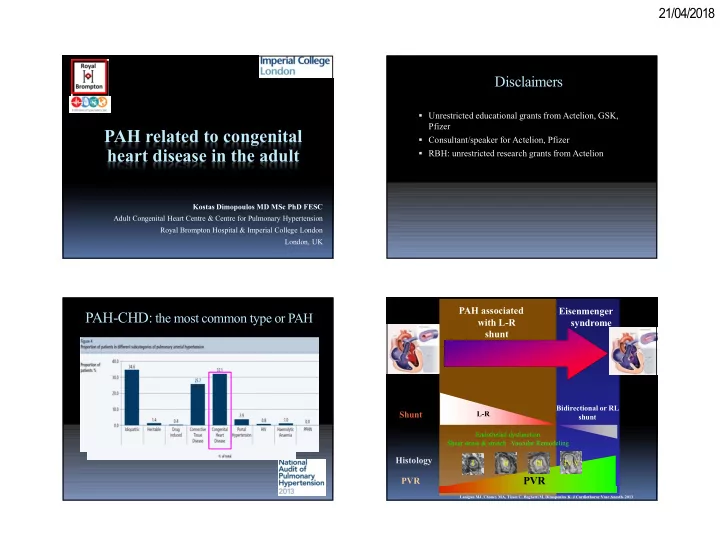
PAH-CHD: the most common type or PAH

R-L

Shunt Histology PVR

I

Shear stress & stretch Vascular Remodeling

Bidirectional or RL shunt

PAH associated with L-R shunt Eisenmenger syndrome

Endothelial dysfunction

L-R IV-V II III

PVR

Lanigan MJ, Chaney MA, Tissot C, Beghetti M, Dimopoulos K. J Cardiothorac Vasc Anesth. 2013

slide-2
SLIDE 2

21/04/2018 Clinical classification of PAH-CHD

Four different classes of PAH-CHD …plus a few more!

  • 1. Eisenmenger
  • 2. L-R shunt
  • 3. Small defect
  • 4. Repaired

+

  • 1. Segmental PH
  • 2. Fontan

Scoliosis ↑ ↑ Perioperative risk Exercise intolerance Arrhythmias Thrombosis Heart failure Bleeding Organ failure Hyperviscosity ↑ ↑ Pregnancy risk

Disability ↓ QoL Sudden death Hepatic dysfunction Renal failure Hyponatremia TIA/CVA Syncope Gout Cholelithiasis Endocarditis

Kempny A et al. Eur Heart J 2011

cooking

Kempny A et al. Eur Heart J 2011;eurheartj.ehr461

cooking

slide-3
SLIDE 3

21/04/2018

General management principles

  • Avoid dehydration, extreme isometric exercise
  • Avoid high altitude (cyanosis)
  • Air travel is safe in cyanotic pts: mobiliseBroberg et al Heart 2006
  • Special anaesthetic management
  • Avoid pregnancy: Contraception
  • Good dental/skin hygiene
  • Endocarditis/ cerebral abscess
  • Treat iron deficiency, especially when Hb less than expected
  • Remain active within abilities, avoid strenuous isometric exercise

The haematologic effect of cyanosis

Prevalence of iron deficiency and relation to saturations

Oxygen saturation (%)

Diller, Dimopoulos et al. EHJ 2010

Prevalence of iron deficiency:

  • 20-37% of patients with cyanotic CHD
  • Easily overlooked as standard laboratory methods (Hb, MCV) do not apply

Why do cyanotic patients need a higher hemoglobin

Pulmonary blood flow

Erythrocytosis maintains adequate oxygen delivery to peripheral tissues

Secondary erythrocytosis

Diller et al, CITY 2010

Erythrocytosis: higher blood viscosity but also higher exercise capacity

Broberg et al. JACC 2006 Exercise capacity Blood viscosity

Eisenmenger syndrome

slide-4
SLIDE 4

21/04/2018

Iron supplementation in cyanotic ACHD:

Exercise capacity and QoL

Tay E, et al. IJC 2010

Anticoagulation?

  • No evidence for or against
  • Increase risk of bleeding but also thrombosis
  • Anticoagulate if:

1.

Previous confirmed embolic events

2.

AF

3.

Significant congestive heart failure

4.

In situ PA thrombosis

  • Aspirin: No evidence

CXRs Over 10 years

Transplantation? Stenting? Operation?

Haemodynamic collapse

slide-5
SLIDE 5

21/04/2018

Mortality risk of pregnancy in PAH related to CHD

Bedard, Dimopoulos, Gatzoulis, EHJ 2009 30 17 36 28 56 33 10 20 30 40 50 60 1997-2007 1978-1996 % iPAH CHD-PAH

  • PH

p=0.047

  • Maternal mortality risk

30%

  • Baby growth retardation

risk 80%: premature

  • Risk of spontaneous

abortions

  • Also interruption of

pregnancy carries significant risks

Timing of death Cause of death

Week 12 Circulatory collapse Week 23 Severe RV failure Week 28 Severe RV failure 12 h post Severe RV failure 1 day post Acute RV failure, intraperitoneal bleeding 1 day post PE, RV failure 2 days post Cardiac arrest 3 days post PE 5 days post Endocarditis, PE, RV failure 6 days post PE, RV failure 7 days post Severe RV failure 7 days post Severe RV failure, PH crisis 14 days post Severe RV failure 21 days post PH crisis, RV failure, heavy vaginal bleeding 21 days post PE, RV failure 24 days post Severe RV failure 90 days post Circulatory collapse

Bedard, Dimopoulos, Gatzoulis, EHJ 2009 Pre- partum

Post-partum

Obstetrician Cardiologist

Anaesthetist

Cardiac & Obs Transplan tation & VAD Neonatal team

Imaging Midwives Cardiology ward PHT team

Cardiac theatre

Nurse specialist

Fetal medicine

ITU & HDU staff

Haematology

+Psychology

Arrhythmia in PAH-CHD

Drakopoulou M et al. Under rev, Heart

Arrhythmia, used as a time-varying covariate in the Cox model, was a strong predictor of death

HR 3.41, 95%CI: 2.10-5.53, p<0.0001

slide-6
SLIDE 6

21/04/2018 The remarkable right ventricle of Eisenmenger syndrome

  • Eisenmenger
  • iPAH

However, not all CHD-PAH have preserved RV function

  • Pretricuspid defects
  • Complex defect

Even within same anatomy: 2 cases of Eisenmenger PDA The true survival of Eisenmenger patients

slide-7
SLIDE 7

21/04/2018

Echocardiographic Composite score

Composite score

  • TAPSE<15mm
  • Systole/diastole time on TR ≥1.5
  • RA area ≥25cm2
  • RA area/LA area ratio ≥1.5

Example of composite score

S S D

Systole/Diastole duration RA area RA/LA area TAPSE

S S D

Composite score

  • TAPSE<15mm
  • Systole/diastole time on TR

≥1.5

  • RA area ≥25cm2
  • RA area/LA area ratio ≥1.5

6MWD, Albumin and BNP in Eisenmenger syndrome

1098 patients (median age 34∙4years, range 16∙1-84∙4years, 65∙1% female, 31∙9% with Down syndrome)

slide-8
SLIDE 8

21/04/2018

Kempny et al, Circulation 2017

The MUSES collaboration

Parameter Unit HR P-value Age 10years 1·35 1·14 - 1·61 <0·001 Pre-tricuspid shunt

  • 1·97

1·12 - 3·46 0·019 Oxygen saturation at rest 10% 0·61 0·46 - 0·82 <0·001 Six minute walking distance 100m 0·67 0·54 - 0·82 <0·001 Presence of pericardial effusion

  • 2·35

1·33 - 4·13 0·003 95% CI

The MUSES collaboration

Data from Kempny et al, Circulation 2017

BREATHE-5: Reduced PVR and increased 6-MWD

  • 400
  • 300
  • 200
  • 100

100 200 300

Placebo (n = 17) Bosentan (n = 36)

PVR (dyn·s·cm-5)

Change from baseline

  • 40
  • 30
  • 20
  • 10

10 20 30 40 50 60

Placebo (n = 17) Bosentan (n = 37)

6-MWD (m)

Change from baseline

Galiè N, et al. Circulation 2006; 114:48-54.

TE = -472 dyn·s·cm-5, p = 0.038 TE = 53.1 m, p = 0.008

Long-term effect of PAH-advanced therapies in Eisenmenger patients

*The graph depicts average change compared to baseline, with 10%, 25%, 75% and 90% percentiles derived from bootstrap analysis. P-values refer to repeated measure ANOVA results

Diller GP, et al. Int J Cardiol 2012.

slide-9
SLIDE 9

21/04/2018

PAH advanced therapies are associated with an improved outcome in Eisenmenger patients

A retrospective, single-centre study in 229 patients with ES

Dimopoulos K, Inuzuka R, et al. Circulation 2010; 121:20-5.

Cumulative mortality (%)

5 10 15 20 25 30 35 40 45 1 2 3 4 5 6 7

No advanced therapies Advanced therapies

p=0.015

time (years) HR 0.16, 95% CI: 0.04-0.71

MAESTRO study: macitentan in ES

  • The primary endpoint evaluating change in 6MWD was not met.
  • NT-proBNP improved
  • PVRi in the haemodynamic substudy favoured macitentan.
  • Macitentan was well tolerated in this patient population.

What about other types of PAH-CHD? Case of PAH-CHD

  • 27 year old lady
  • Born in 1990 in Asia
  • Cardiac Diagnoses: Perimembranous VSD, PFO
  • Presented at RBH at the age of 12 years
slide-10
SLIDE 10

21/04/2018

Age 12 years VSD, PFO

  • K. Dimopoulos, S.J. Wort, M.A. Gatzoulis, European Heart Journal (2014) 35, 691–700

★ Air

NO

Qp/Qs = 3 Qpi 8 L/min/m2 mPAP 44 mmHg

PVRi dropped from 6.5 to 4.8 WU x m2

★ NO

AIR

Qp/Qs = 2 QPi 6 L/min/m2 mPAP 44 mmHg PVRi 6.5 WU x m2

VSD closure (13 years)

14mm Amplatzer perimembranous VSD occluder The RV pressure post-deployment 48/8 mmHg

Cardiac catheterization (15 years)

  • K. Dimopoulos, S.J. Wort, M.A. Gatzoulis, European Heart Journal (2014) 35, 691–700

Qp/Qs = 1 Qp 3.2 L/min/m2 PVRi 13.4 WU x m2 PVRi increased from 6.5 (12y) to 13.4 (15y) WU x m2

★ ★ Air ★ NO

2002

2005 Air NO

Admission at 23 weeks of pregnancy (November 2016)

  • Haemoptysis related to an upper respiratory infection
  • Increasing SOB
  • Presyncope on effort
  • AICU for advanced monitoring
  • IV epoprostenol* and escalation of therapy by 1-

2ng/kg/min according to tolerance

  • Required respiratory support with CPAP and high flow O2
slide-11
SLIDE 11

21/04/2018

Cardiac catheter 3 months post partum

  • K. Dimopoulos, S.J. Wort, M.A. Gatzoulis, European Heart Journal (2014) 35, 691–700

Qp/Qs 0.67, PVR 16 WU, PVRi 26 TRIPLE THERAPY CONTRACEPTION TRANSPLANTATION

★ ★ Air ★ NO

2002

2005 Air NO

★ ★

DO NOT close defects in established pulmonary vascular disease

Repaired defects

Other types of PAH-CHD

Segmental PH: ToF Complex Pulmonary Atresia PH with a systemic RV: Mustard TGA

Example of segmental PH

Complex pulmonary atresia

  • Complex pulmonary atresia
  • Large PDA to upper LPA
  • Small MAPCA to mid L lung
  • MAPCA to R lung
  • PH in left upper lung/R lung?
  • How do you calculate PVR?
  • PAH therapies?

Accepted JAHA 2018

slide-12
SLIDE 12

21/04/2018

The importance of a low PVR in Fontan patients

Normal haemodynamics With a normal PVR, the RV allows for a normal CO at rest and a significant increase in CO during exercise

RA RV PA LA

LV

Ao RA

TP gradient

PVR N RAP N

LV preload

N

The importance of a low PVR in Fontan patients

RA RV PA LA

LV

Ao RA

TP gradient

RA PA LA

LV

Ao RA

TP gradient

PVR “N” RAP ↑↑↑

LV preload

↓↓

No RV With a high normal PVR, the absence of an RV results in very high RA pressure, very low CO at rest and no increase in CO during efforts Optimal Fontan haemodynamics The PVR is low normal, there is a mild- moderate increase in RA pressure, low- normal CO at rest and CO increases during efforts (less than normal)

PVR ↓ RAP ↑

LV preload

↓/N

PVR mLAP mPAP PVR TPG PBF   

  • 75 adolescents and adults
  • Randomized 1:1 to 14 weeks of

treatment with bosentan or placebo.

  • 69 patients (92%) completed

the study.

  • Peak oxygen consumption

Bosentan: increased 2.0 mL/kg/min (from 28.7 to 30.7)

Placebo: increased 0.6 mL/kg/min (from 28.4 to 29.0) (P=0.02).

  • Nine bosentan-treated patients

improved 1 functional class, whereas none improved in the placebo group (P=0.0085).

Bosentan

  • Action 1: identify patients with PAH-CHD lost to follow-up and

those followed in non-specialist centres

  • Action 2: screen all congenital heart disease patients thoroughly for

the presence of pulmonary arterial hypertension

  • Action 3: educate cardiologists and pulmonary hypertension

physicians on the distinct features of Eisenmenger syndrome

  • Action 4: standardize treatment, avoid pitfalls, and challenge old

myths in Eisenmenger syndrome

  • Action 5: do not close defects in Eisenmenger syndrome or other

PAH-CHD with established pulmonary vascular disease: ‘I can close it’ does not mean ‘I should close it’

slide-13
SLIDE 13

21/04/2018

  • Action 6: use PAH therapies to improve exercise capacity, quality
  • f life, and prognosis in Eisenmenger syndrome
  • Action 7: be inclusive of other types of PAH-CHD, beyond

Eisenmenger syndrome

  • Action 8: explore the concept of a ‘permissive’ trait genotype in

patients with large ASDs who develop out-of-proportion pulmonary arterial hypertension and Eisenmenger syndrome

  • Action 9: promote clinical research and collaboration between

specialist centres on areas of controversy and lack of evidence

  • Action 10: support care of pulmonary arterial hypertension related

to congenital heart disease patients in the developing world

Thank you!

slide-14
SLIDE 14

21/04/2018

In patients with shunts: Qp, NOT “CO”

Vascular Resistance

Definitions

Qp mLAP mPAP Qp TPG PVR   

Qs mRAP mAoP SVR  

PVR can be normal with a high TPG: L-R shunts

PVR can be high with a normal mPAP, when PBF is low: Fontan

PWP, LVEDP

  • r (best) direct

LA pressure

BSA PVR PVRI  